Copper Pipe Size Chart 2026 – Type K, L, M Dimensions
Copper Pipe Size Chart
Type K, L, M Dimensions
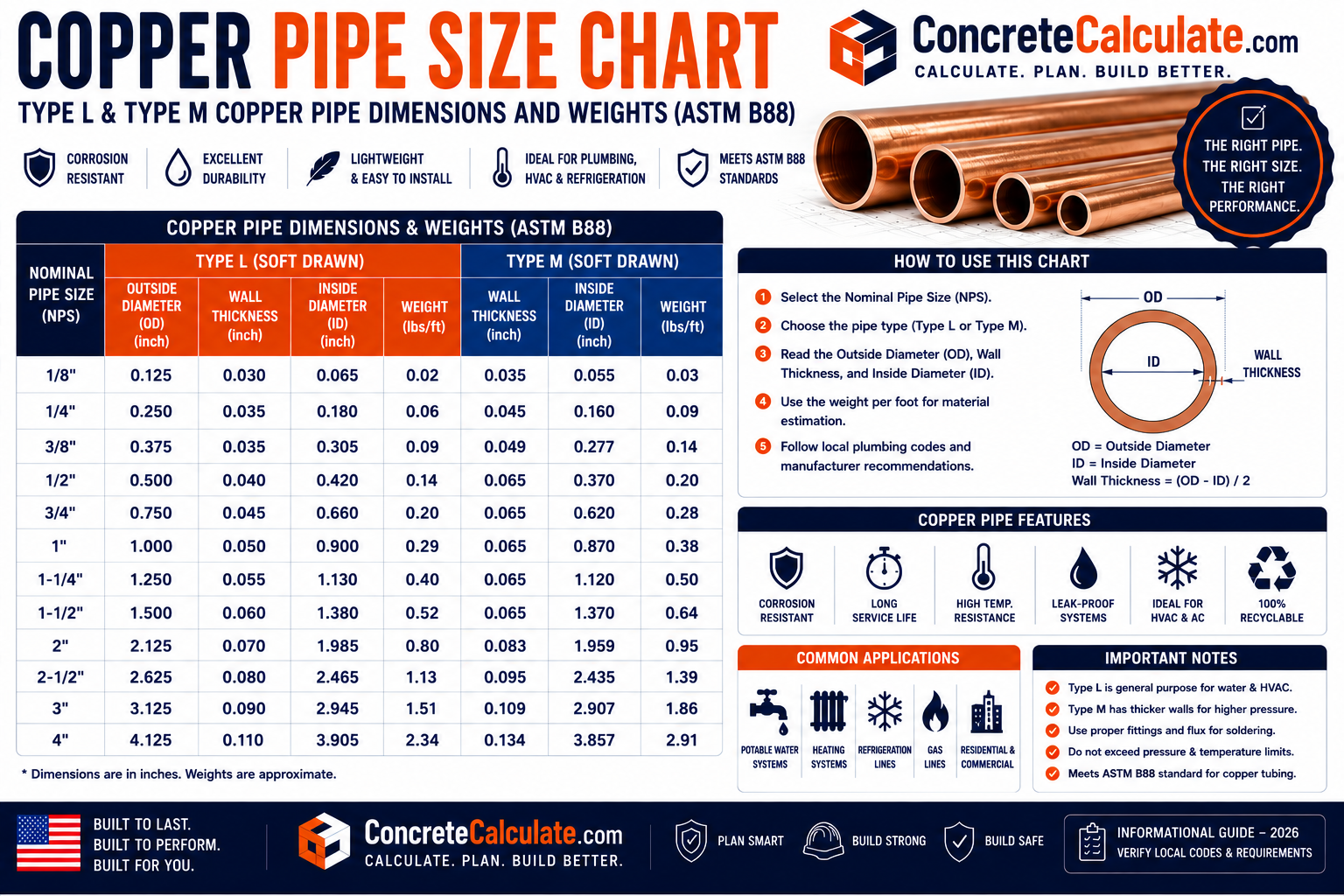
Nominal copper tube size is not its actual outside diameter. 1/2 inch nominal copper tube measures 0.625 inches OD, with different ID depending on Type K, L, or M.
 Reviewed by Muhammad Ramzan Babar, PhD Researcher & Calculator Developer · View Profile
Nominal 1/2 inch copper water tube has an actual outside diameter of 0.625 inches (5/8 inch), not 0.500 inches. This same OD applies whether the tube is Type K, L, or M; only wall thickness and inside diameter change between types.
⭐⭐⭐ Copper Pipe Size Chart: Quick Reference
Dimensions per ASTM B88, the governing standard for seamless copper water tube.
| Nominal Size | Actual OD | Type K Wall | Type K ID | Type L Wall | Type L ID | Type M Wall | Type M ID |
|---|---|---|---|---|---|---|---|
| 1/4″ | 0.375″ | 0.035″ | 0.305″ | 0.030″ | 0.315″ | — | — |
| 3/8″ | 0.500″ | 0.049″ | 0.402″ | 0.035″ | 0.430″ | 0.025″ | 0.450″ |
| 1/2″ | 0.625″ | 0.049″ | 0.527″ | 0.040″ | 0.545″ | 0.028″ | 0.569″ |
| 5/8″ | 0.750″ | 0.049″ | 0.652″ | 0.042″ | 0.666″ | — | — |
| 3/4″ | 0.875″ | 0.065″ | 0.745″ | 0.045″ | 0.785″ | 0.032″ | 0.811″ |
| 1″ | 1.125″ | 0.065″ | 0.995″ | 0.050″ | 1.025″ | 0.035″ | 1.055″ |
| 1-1/4″ | 1.375″ | 0.065″ | 1.245″ | 0.055″ | 1.265″ | 0.042″ | 1.291″ |
| 1-1/2″ | 1.625″ | 0.072″ | 1.481″ | 0.060″ | 1.505″ | 0.049″ | 1.527″ |
| 2″ | 2.125″ | 0.083″ | 1.959″ | 0.070″ | 1.985″ | 0.058″ | 2.009″ |
| 2-1/2″ | 2.625″ | 0.095″ | 2.435″ | 0.080″ | 2.465″ | 0.065″ | 2.495″ |
| 3″ | 3.125″ | 0.109″ | 2.907″ | 0.090″ | 2.945″ | 0.072″ | 2.981″ |
| 4″ | 4.125″ | 0.134″ | 3.857″ | 0.110″ | 3.905″ | 0.095″ | 3.935″ |
ASTM B88 covers dimensions, weights, and tolerances for nominal or standard copper water tube sizes across Types K, L, and M. All values shown reflect the standardized dimensional relationships defined in that specification.
⭐⭐⭐ Copper Pipe vs Copper Tube
These terms are often used interchangeably but refer to genuinely different standardized products.
Copper tube (ASTM B88)
The standard terminology for the K, L, M plumbing products covered throughout this page, used in water supply, HVAC, heating, and many industrial applications.
Copper pipe (ASTM B42)
A separate standardized product, seamless copper pipe with its own dimensional system distinct from copper tube; less commonly encountered in typical residential plumbing than Type K, L, or M tube.
Beyond B88 water tube and B42 pipe, ASTM also covers B306 for copper drainage tube (DWV) and B819 for medical gas system tube, each a distinct product with its own dimensions. Confirm which specification actually governs the product in question.
⭐⭐⭐ Copper Tube Nominal Size vs Actual Outside Diameter
This is the core confusion this chart exists to resolve.
| Nominal Size | Actual OD (in) |
|---|---|
| 1/4″ | 0.375 |
| 3/8″ | 0.500 |
| 1/2″ | 0.625 |
| 5/8″ | 0.750 |
| 3/4″ | 0.875 |
| 1″ | 1.125 |
| 1-1/4″ | 1.375 |
| 1-1/2″ | 1.625 |
| 2″ | 2.125 |
| 2-1/2″ | 2.625 |
| 3″ | 3.125 |
| 4″ | 4.125 |
| 5″ | 5.125 |
| 6″ | 6.125 |
For most common sizes, nominal copper tube size is approximately 1/8 inch less than actual outside diameter: 1/2 inch nominal is 5/8 inch actual, 3/4 inch nominal is 7/8 inch actual, and 1 inch nominal is 1-1/8 inch actual. This is a legacy of how copper water tube was originally standardized, and is a completely different convention from steel or PVC nominal pipe sizing.
⭐⭐⭐ Copper Tube Type K, L and M Explained
These are wall thickness designations, not schedules, and should never be called “Schedule K” or similar.
Type K
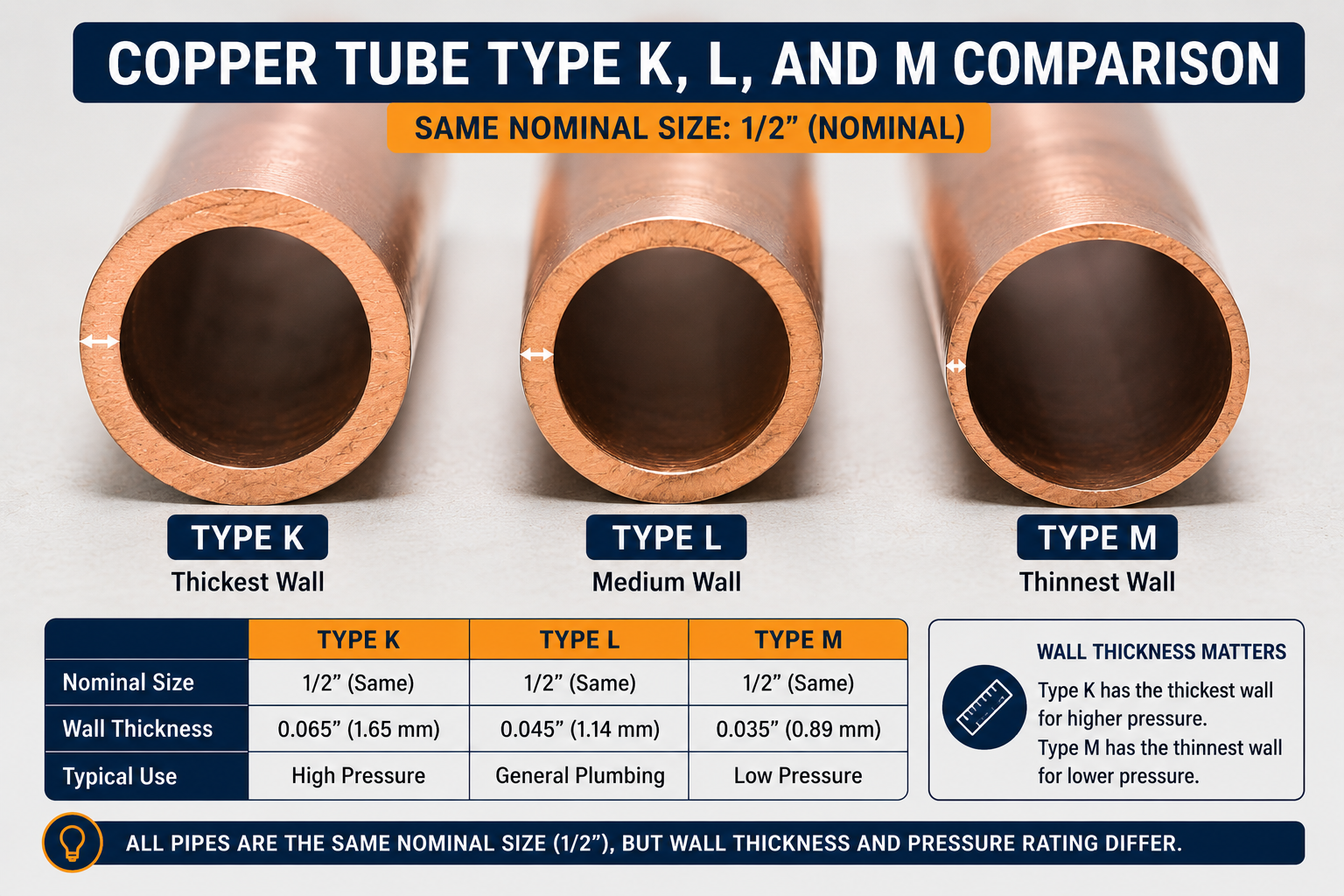
The thickest wall among the three common types at any given nominal size, resulting in the smallest inside diameter and highest weight per foot.
Type L
An intermediate wall thickness, commonly the most widely used type for general residential and commercial plumbing.
Type M
The thinnest wall of the three, resulting in the largest inside diameter and lowest weight per foot at the same nominal size.
At 1/2 inch nominal size (0.625 inch OD): Type K wall is 0.049 inches, Type L wall is 0.040 inches, and Type M wall is 0.028 inches, showing the clear progression from thickest to thinnest.
⭐⭐⭐ Type K Copper Pipe Size Chart
The thickest wall type, often specified for underground water service, fire protection, and heavy-duty applications.
| Nominal Size | OD (in) | Wall (in) | ID (in) | Weight (lb/ft) |
|---|---|---|---|---|
| 1/4″ | 0.375 | 0.035 | 0.305 | 0.145 |
| 3/8″ | 0.500 | 0.049 | 0.402 | 0.269 |
| 1/2″ | 0.625 | 0.049 | 0.527 | 0.344 |
| 3/4″ | 0.875 | 0.065 | 0.745 | 0.641 |
| 1″ | 1.125 | 0.065 | 0.995 | 0.839 |
| 1-1/4″ | 1.375 | 0.065 | 1.245 | 1.036 |
| 1-1/2″ | 1.625 | 0.072 | 1.481 | 1.362 |
| 2″ | 2.125 | 0.083 | 1.959 | 2.063 |
| 3″ | 3.125 | 0.109 | 2.907 | 4.000 |
| 4″ | 4.125 | 0.134 | 3.857 | 6.510 |
⭐⭐⭐ Type L Copper Pipe Size Chart
The most commonly used type for general residential and commercial plumbing.
| Nominal Size | OD (in) | Wall (in) | ID (in) | Weight (lb/ft) |
|---|---|---|---|---|
| 1/4″ | 0.375 | 0.030 | 0.315 | 0.126 |
| 3/8″ | 0.500 | 0.035 | 0.430 | 0.198 |
| 1/2″ | 0.625 | 0.040 | 0.545 | 0.285 |
| 3/4″ | 0.875 | 0.045 | 0.785 | 0.455 |
| 1″ | 1.125 | 0.050 | 1.025 | 0.655 |
| 1-1/4″ | 1.375 | 0.055 | 1.265 | 0.884 |
| 1-1/2″ | 1.625 | 0.060 | 1.505 | 1.140 |
| 2″ | 2.125 | 0.070 | 1.985 | 1.750 |
| 3″ | 3.125 | 0.090 | 2.945 | 3.330 |
| 4″ | 4.125 | 0.110 | 3.905 | 5.380 |
⭐⭐⭐ Type M Copper Pipe Size Chart
The thinnest wall of the three common water tube types, commonly used for lighter-duty interior plumbing.
| Nominal Size | OD (in) | Wall (in) | ID (in) | Weight (lb/ft) |
|---|---|---|---|---|
| 3/8″ | 0.500 | 0.025 | 0.450 | 0.145 |
| 1/2″ | 0.625 | 0.028 | 0.569 | 0.204 |
| 3/4″ | 0.875 | 0.032 | 0.811 | 0.328 |
| 1″ | 1.125 | 0.035 | 1.055 | 0.465 |
| 1-1/4″ | 1.375 | 0.042 | 1.291 | 0.682 |
| 1-1/2″ | 1.625 | 0.049 | 1.527 | 0.940 |
| 2″ | 2.125 | 0.058 | 2.009 | 1.460 |
| 3″ | 3.125 | 0.072 | 2.981 | 2.680 |
| 4″ | 4.125 | 0.095 | 3.935 | 4.660 |
⭐⭐⭐ Type K vs Type L vs Type M
Application, pressure, temperature, code, and installation conditions determine the appropriate type; none is universally “better.”
| Feature | Type K | Type L | Type M |
|---|---|---|---|
| Relative wall | Thickest | Medium | Thinnest |
| ID for same nominal size | Smallest | Medium | Largest |
| Material usage | Higher | Medium | Lower |
| Typical application | Heavy duty, underground service, fire protection | General plumbing, most common type | Lighter duty interior applications |
| Standard | ASTM B88 | ASTM B88 | ASTM B88 |
ASTM B88 notes that the appropriate tube type depends on internal and external fluid pressure, installation and service conditions, and local requirements. Do not select a type based on assumption; verify against actual project conditions and applicable code.
Type K vs Type L
At 1/2 inch, K has a 0.049 in wall versus L’s 0.040 in wall, meaning K carries roughly 22 percent more wall material and a smaller ID.
Type L vs Type M
At 1/2 inch, L has a 0.040 in wall versus M’s 0.028 in wall, a meaningful difference in both material and ID.
⭐⭐⭐ Copper Pipe Size by Nominal Diameter
Quick individual reference for the most commonly searched copper tube sizes.
1/4 inch copper
OD 0.375 in. K: 0.035 in wall, 0.305 in ID. L: 0.030 in wall, 0.315 in ID. Type M not standardized at this size.
3/8 inch copper
OD 0.500 in. K: 0.049 in wall, 0.402 in ID. L: 0.035 in wall, 0.430 in ID. M: 0.025 in wall, 0.450 in ID.
1/2 inch copper ⭐⭐⭐
OD 0.625 in (5/8 inch actual). K: 0.049 in wall, 0.527 in ID. L: 0.040 in wall, 0.545 in ID. M: 0.028 in wall, 0.569 in ID. The most common residential plumbing size.
3/4 inch copper
OD 0.875 in (7/8 inch actual). K: 0.065 in wall, 0.745 in ID. L: 0.045 in wall, 0.785 in ID. M: 0.032 in wall, 0.811 in ID.
1 inch copper
OD 1.125 in (1-1/8 inch actual). K: 0.065 in wall, 0.995 in ID. L: 0.050 in wall, 1.025 in ID. M: 0.035 in wall, 1.055 in ID.
1-1/4 and 1-1/2 inch copper
1-1/4 in: OD 1.375 in, K/L/M walls of 0.065/0.055/0.042 in. 1-1/2 in: OD 1.625 in, K/L/M walls of 0.072/0.060/0.049 in.
2 inch copper ⭐⭐⭐
OD 2.125 in. K: 0.083 in wall, 1.959 in ID. L: 0.070 in wall, 1.985 in ID. M: 0.058 in wall, 2.009 in ID.
3 and 4 inch copper
3 in: OD 3.125 in, K/L/M walls of 0.109/0.090/0.072 in. 4 in: OD 4.125 in, K/L/M walls of 0.134/0.110/0.095 in.
⭐⭐⭐ Copper Tube Size in Inches and mm
A unit conversion; the nominal U.S. size designation remains unchanged.
| Nominal Size | OD (in) | OD (mm) |
|---|---|---|
| 1/4″ | 0.375 | 9.525 |
| 3/8″ | 0.500 | 12.700 |
| 1/2″ | 0.625 | 15.875 |
| 5/8″ | 0.750 | 19.050 |
| 3/4″ | 0.875 | 22.225 |
| 1″ | 1.125 | 28.575 |
| 1-1/4″ | 1.375 | 34.925 |
| 1-1/2″ | 1.625 | 41.275 |
| 2″ | 2.125 | 53.975 |
| 2-1/2″ | 2.625 | 66.675 |
| 3″ | 3.125 | 79.375 |
| 4″ | 4.125 | 104.775 |
⭐⭐⭐ Soft vs Hard Copper Tube Temper
Temper affects flexibility, installation method, and how the tube is supplied.
| Feature | Soft / Annealed | Hard / Drawn |
|---|---|---|
| Flexibility | Higher | Lower |
| Bending | Easier, can be bent by hand or with a bending tool | More limited, typically requires fittings for direction changes |
| Typical supply form | Coils | Straight lengths |
| Joining | Depends on the specific fitting/system used | Depends on the specific fitting/system used |
ASTM B88 distinguishes drawn (hard) and annealed (soft) tube, and notes that suitable joining methods can depend on temper. Drawn K and L tube can be suitable for certain compression fittings, while soft tube is often preferred where bending around obstacles is needed.
⭐⭐⭐ Copper Tube Markings & Identification
Printed markings and color coding are the most reliable identification methods.
| Marking Element | Example | Meaning |
|---|---|---|
| Manufacturer | Company name/logo | Identifies producer for specification lookup |
| Copper designation | Cu / UNS C12200 | Copper alloy designation |
| Type | TYPE L | Wall thickness designation (K, L, or M) |
| Size | 1/2 IN | Nominal size |
| Standard | ASTM B88 | Governing product specification |
| Color stripe (common convention) | Green (K), blue (L), red (M) | Widely used but not universally guaranteed color convention |
While green, blue, and red stripes commonly correspond to Type K, L, and M respectively in the U.S. market, color coding is a common industry convention, not a guaranteed universal identifier. Always confirm with the printed text marking or measured dimensions rather than color alone.
Equipment for Your Project
Affiliate disclosure: As an Amazon Associate, ConcreteCalculate earns from qualifying purchases. We may also earn a commission from other affiliate links at no additional cost to you.
⭐⭐⭐ Copper Fittings & Joining Methods
Fitting selection and compatibility depend on tube size, type, and temper together.
Sweat (soldered/brazed) fittings
The traditional copper joining method, referencing ASME B16.18 and B16.22 for solder-joint and brazed fitting dimensions. ASTM B88 references these fitting standards for compatible copper plumbing fittings.
Compression fittings
Suited to certain drawn K and L tube applications, per ASTM B88’s guidance; verify manufacturer compatibility for the specific tube type and temper.
Flared connections
Common for soft copper tube in refrigeration and some gas applications, kept as a distinct joining method from sweat and compression.
Press-connect fittings
A modern mechanical joining method; always use manufacturer-approved tube and fitting combinations rather than assuming universal compatibility across brands.
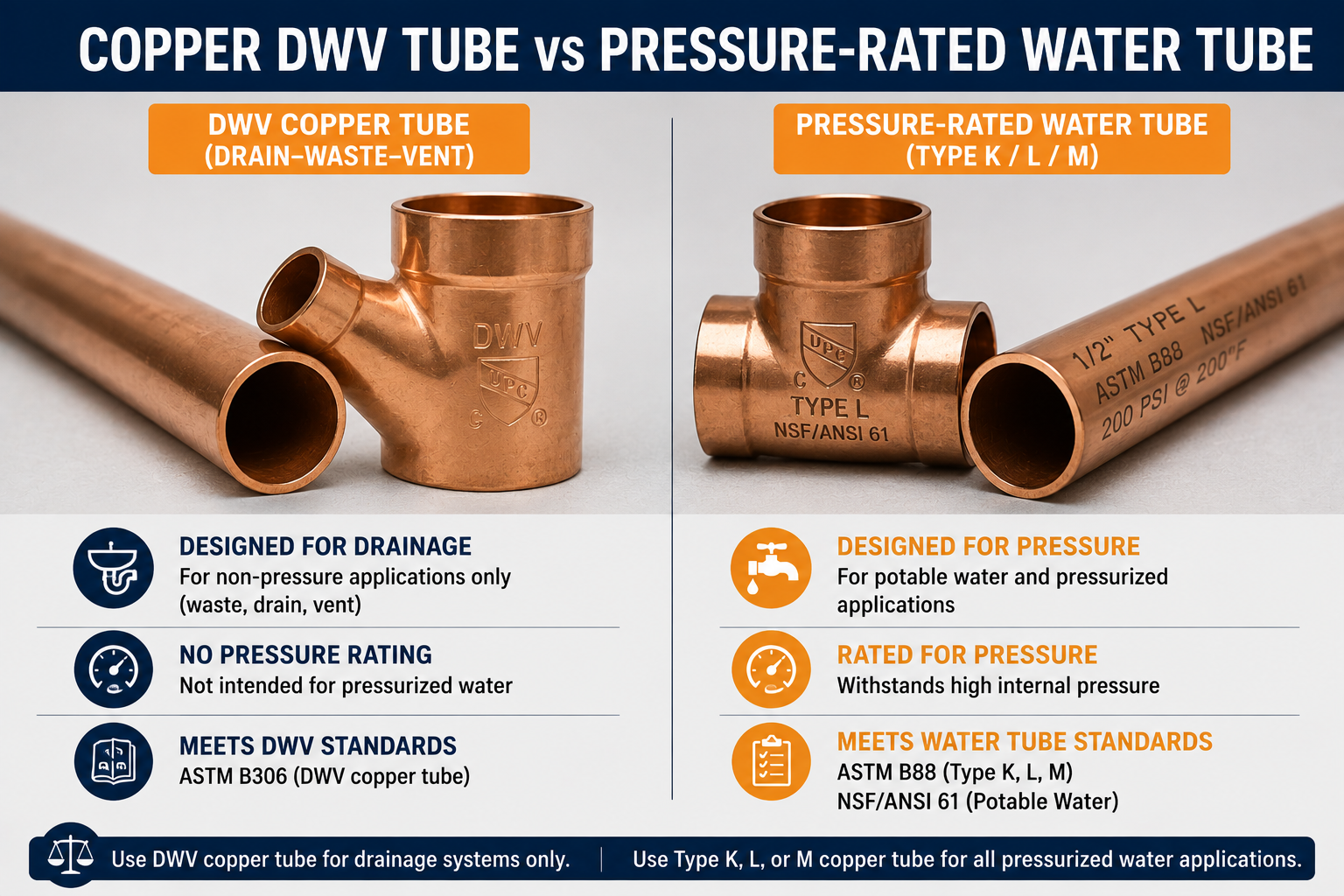
⭐⭐⭐ Copper DWV vs Water Tube
Drainage tube and water tube are governed by separate standards and are not interchangeable.
| Feature | Water Tube (K/L/M) | DWV Tube |
|---|---|---|
| Governing standard | ASTM B88 | ASTM B306 |
| Application | Pressurized water supply and similar service | Drain, waste, and vent (gravity, non-pressure) |
| Wall thickness | Type-specific per B88 | Thinner, DWV-specific wall per B306 |
| Interchangeable? | No | No |
ASTM B306 covers seamless copper drainage tube as a distinct product from ASTM B88 water tube. DWV tube is not rated for pressurized water supply service and should never be substituted into a pressure application.
⭐⭐⭐ Copper ACR / Refrigeration Tube
Refrigeration tubing is a separate product line from ASTM B88 water tube, not simply a relabeled version of it.
ACR tube characteristics
Air conditioning and refrigeration (ACR) tube is typically sized by actual outside diameter directly, cleaned and capped for refrigerant service, and supplied in specific tempers and coil formats suited to refrigeration installation.
Why it is kept separate
ACR tube dimensions, cleanliness requirements, and applicable product standards differ from water tube; using the K/L/M water tube table for an ACR application is not appropriate. Confirm the correct ACR-specific product data before specifying refrigerant line sets.
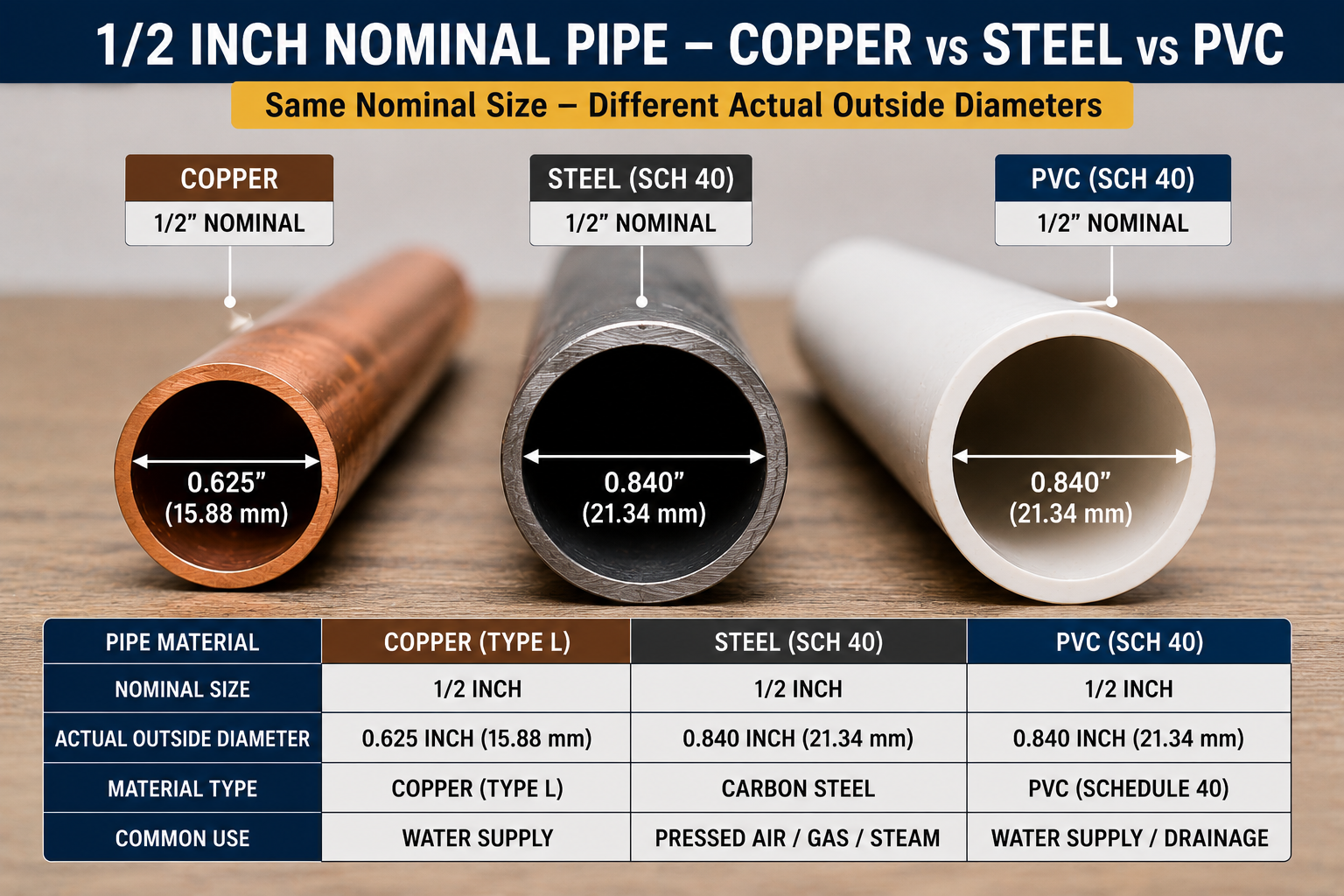
⭐⭐⭐ Copper vs Steel vs PVC Pipe Sizing
Users frequently and incorrectly assume that “1/2 inch” means the same thing across all pipe materials.
| Material | 1/2 Inch Nominal Actual OD | Sizing System |
|---|---|---|
| Copper tube | 0.625 in | ASTM B88 copper tube convention |
| Steel pipe (NPS) | 0.840 in | ASME B36.10 nominal pipe size (NPS) |
| PVC pipe | 0.840 in | ASTM D1785, matches steel NPS convention |
A 1/2 inch nominal copper tube (0.625 in OD) is smaller than a 1/2 inch nominal steel or PVC pipe (0.840 in OD), because copper tube uses an entirely different nominal sizing convention than the NPS system used for steel and PVC. Never assume fittings, adapters, or dimensions transfer directly between these materials at the same nominal label. See the PVC Pipe Size Chart and Pipe Wall Thickness Chart for the NPS-based systems.
Copper Type K/L/M is a wall-thickness designation system, conceptually similar in purpose to Schedule 40/80 for steel, but the two are not the same system and their designations should never be mixed or substituted.
⭐⭐⭐ Copper Pipe Standards
Multiple ASTM standards cover different copper tube and pipe products.
| Standard | Covers |
|---|---|
| ASTM B88 | Seamless copper water tube, Types K, L and M |
| ASTM B88M | Metric companion specification to B88 |
| ASTM B306 | Copper drainage tube (DWV) |
| ASTM B42 | Seamless copper pipe, standard sizes |
| ASTM B819 | Copper tube for medical gas systems, defining K and L wall schedules for that application |
ASTM B88 references ASME B16.18 and B16.22 for soldered and brazed copper plumbing fittings, connecting the tube dimensional standard to the applicable fitting dimensional standards.
⭐⭐⭐ Copper Pipe Pressure & Flow
Pressure capability and flow depend on more than nominal size alone.
Working (operating) pressure and burst pressure are distinct concepts. Burst pressure represents a failure condition and should never be treated as an acceptable operating value; published copper tube references distinguish drawn and annealed tube burst pressures at room temperature specifically because they differ from safe operating limits.
Pressure rating factors
ASTM B88 identifies internal and external fluid pressure, installation and service conditions, and local requirements as factors in selecting tube type; pressure capability is not determined by nominal size alone.
Flow area
Cross-sectional flow area A = πD²/4 using actual ID. Type K, L, and M of the same nominal size have different IDs and therefore different flow areas.
| 1/2 Inch Copper | ID (in) | Flow Area (in²) |
|---|---|---|
| Type K | 0.527 | 0.218 |
| Type L | 0.545 | 0.233 |
| Type M | 0.569 | 0.254 |
See the Pipe Pressure Rating Chart for the broader material-specific pressure rating framework.
⭐⭐⭐ Choosing Between Type K, L and M
Follow a decision process rather than defaulting to one type by habit.
Determine whether the application is water supply, heating, refrigeration, or another use.
Establish the actual operating conditions the tube must withstand.
Underground burial, exposed interior runs, and other conditions affect the appropriate type and temper.
Local plumbing codes may specify minimum type requirements for certain applications.
Choose K, L, or M based on the combined requirements above.
Confirm compatible fittings for the chosen type and temper.
Residential plumbing
Type L is commonly used for general water supply branch and main lines, though local code and specific project requirements should confirm the selection.
Underground service
Type K is often specified for underground water service lines due to its thicker wall, subject to local code requirements.
⭐⭐⭐ Copper Pipe Size Visual Guide
Original diagrams explaining copper anatomy, Type K/L/M comparison, and nominal size versus actual OD.
⭐⭐⭐ Copper Pipe Size Worked Examples
These examples demonstrate identification and calculation.
1. Identify 1/2 Inch Copper Tube
2. Calculate Type L ID
3. Compare K/L/M
4. Convert OD to mm
5. Determine Tube Type
⭐⭐⭐ Common Copper Pipe Size Mistakes
Most copper sizing errors trace back to one of these misunderstandings.
❌ Assuming 1/2 inch copper has a 1/2 inch OD
Actual OD is 0.625 inches (5/8 inch), not 0.500 inches.
❌ Confusing nominal size with actual OD
This gap applies across every common copper tube size.
❌ Confusing copper tube with copper pipe
Water tube (B88) and pipe (B42) are different standardized products.
❌ Mixing K/L/M with Schedule 40/80
Different systems for different materials; never interchange the terminology.
❌ Mixing water tube with DWV
B88 water tube and B306 DWV tube are not interchangeable.
❌ Mixing ACR and water tube
Refrigeration tube uses its own product line, dimensions, and cleanliness requirements.
❌ Assuming K, L and M have the same ID
ID varies meaningfully between types at the same nominal size.
❌ Ignoring temper
Soft and hard tube have different installation and joining considerations.
❌ Choosing type based only on appearance or color
Color coding is a common convention, not a guaranteed universal identifier.
❌ Assuming burst pressure equals working pressure
Burst pressure is a failure condition, never an acceptable operating value.
❌ Assuming all fittings are interchangeable
Confirm manufacturer compatibility for the specific tube type, temper, and fitting system.
❌ Using the wrong standard
Confirm whether B88, B42, B306, or B819 actually governs the product in question.
Frequently Asked Questions
📄 Download Copper Pipe Size Chart PDF
This PDF is a genuine field reference. Use the print button to create a print-ready or downloadable version.
Cite or Embed This Chart
Copy the page-wide citation to reference the complete Copper Pipe Size Chart.