Ready Mix vs Site Mix Concrete: Which Should You Use?
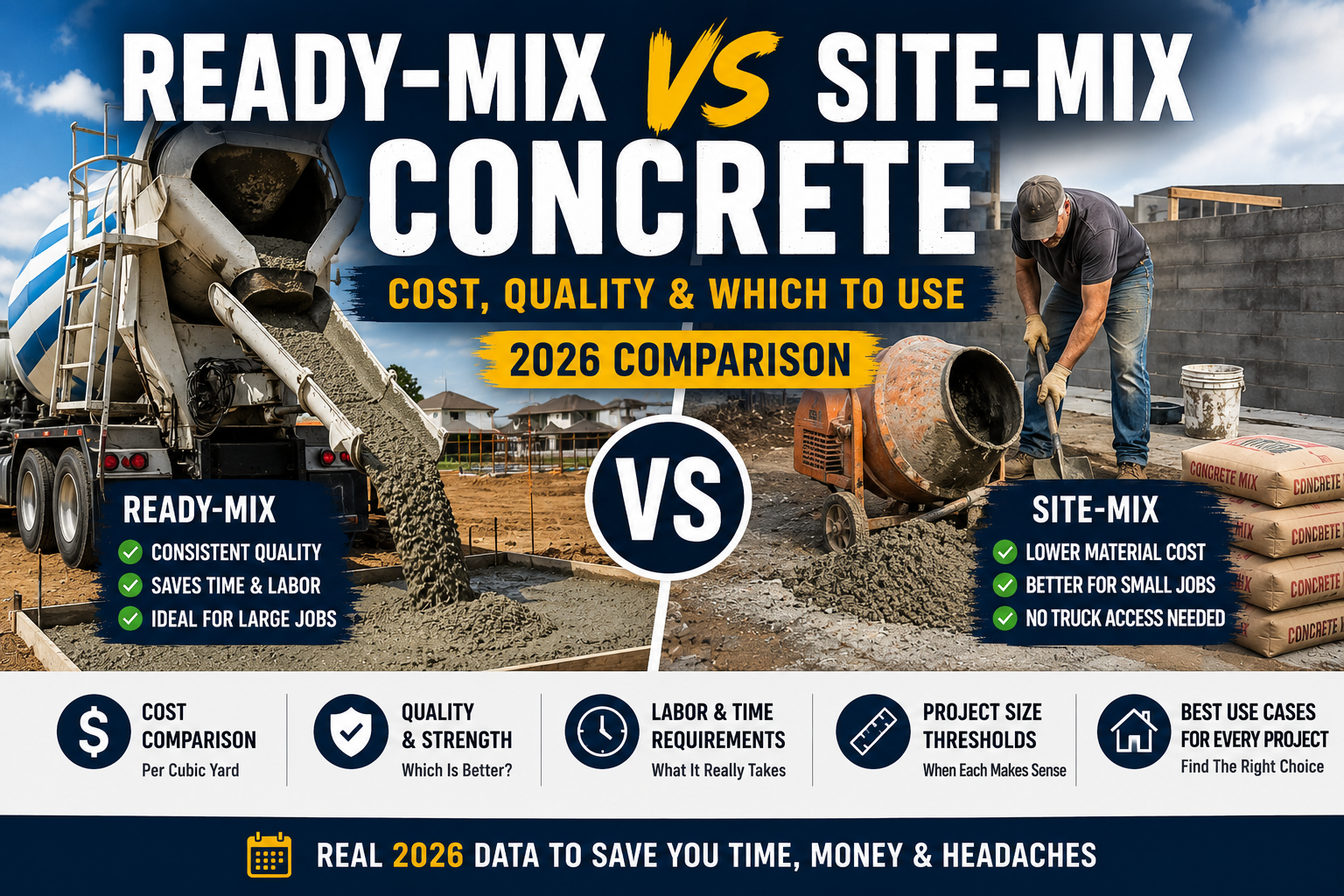
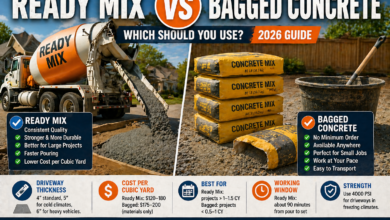
Ready mix concrete comes off a truck fully mixed and ready to pour. Site-mix concrete you measure, mix, and place yourself using bags or raw materials on-site. Both produce the same end product when done right – the difference is cost, quality consistency, and how much time and labor the job demands. The right choice depends almost entirely on how much concrete your project actually needs. This guide gives you the clear numbers and the honest answer for every project size.
What Ready-Mix and Site-Mix Actually Are
Ready-mix concrete (RMC) is manufactured at a centralized batching plant where cement, aggregate, sand, water, and admixtures are weighed and combined in precise proportions by automated equipment. The mixed concrete is loaded into a transit mixer truck – the drum rotating to keep the mix agitated – and delivered directly to your job site. When the truck arrives, the concrete is ready to pour immediately. You have a working window of approximately 60 to 90 minutes from the time mixing began before the concrete becomes too stiff to place.
Site-mix concrete means you produce the concrete yourself at the job site. For residential DIY projects, this usually means buying pre-blended dry mix in bags (Quikrete, Sakrete, or similar) and adding water. For larger or professional site mixing, it means sourcing bulk cement, aggregate, and sand separately, then proportioning and mixing them on-site using a drum mixer or forced-action mixer. Either way, you control the proportions, the water content, and the timing of each batch – and you bear full responsibility for the quality consistency across every mix.
✅ Ready-Mix Concrete
- Batched by weight at a controlled plant
- Automated, consistent proportions every time
- Delivered in a transit mixer truck
- 60 to 90 minute working window after delivery
- Sold by the cubic yard
- Best for projects over 1 cubic yard
🔵 Site-Mix Concrete
- Mixed on-site by hand or drum mixer
- Proportions depend on operator skill
- Uses bagged pre-blend or bulk materials
- Mix one batch at a time, as needed
- Sold by the bag or by bulk material weight
- Best for projects under 1 cubic yard
Quick Side-by-Side Comparison
| Factor | Ready-Mix Concrete | Site-Mix Concrete |
|---|---|---|
| Production location | Centralized batching plant | On-site by operator |
| Quality consistency | High – automated proportioning | Variable – depends on operator skill |
| Compressive strength | 3,000 to 5,000+ PSI as specified | 3,000 to 5,000 PSI if mixed correctly |
| Minimum practical volume | 1 cubic yard (short-load fees below this) | Any volume, including fraction of a bag |
| Material cost (per cubic yard) | $150 – $250 delivered | $130 – $175 (bags only, no labor) |
| True cost including labor | $150 – $250 (no mixing labor) | $280 – $525 per cubic yard (bags + labor) |
| Mixing labor required | None – arrives ready to pour | 3 to 5 hours per cubic yard hand-mixing |
| Equipment needed | Wheelbarrows, vibrator, finishing tools | Mixer, measuring buckets, wheelbarrows |
| Material storage needed | None | Dry storage for cement bags |
| Mix flexibility after ordering | Limited – order is pre-set at plant | Full – adjust each batch on-site |
| Waste | Minimal if yardage is calculated correctly | Some material loss during mixing/storage |
| ASTM quality testing | Plant-certified; slump/cylinder tests available | No independent QC unless you arrange testing |
| Best for | Driveways, foundations, slabs, commercial work | Post holes, small repairs, patches, footings |
Cost Comparison: Material and Labor in 2026
The cost comparison between ready-mix and site-mix concrete looks very different depending on whether you count labor or ignore it. Most people compare material-only costs and conclude site-mix is cheaper. When you count the full cost honestly – materials plus the labor to mix and place – the picture reverses on any job over 1 cubic yard.
Ready-Mix Concrete Pricing in 2026
Ready-mix concrete is priced per cubic yard, delivered to your site. National average pricing in 2026 runs $150 to $250 per cubic yard for standard 4,000 PSI residential mix, depending on region and current fuel and cement costs. Higher-strength mixes (5,000 PSI), fiber-reinforced mixes, or mixes with special admixtures cost $20 to $50 more per yard. Most plants also charge a short-load surcharge for orders below their minimum – typically 5 to 7 cubic yards – at $15 to $25 per yard under the minimum.
For a standard two-car driveway at 2.5 cubic yards, a typical 2026 ready-mix order costs approximately $375 to $625 in concrete material – possibly plus a short-load fee of $50 to $100. There is no mixing labor because the truck does all the work. Total concrete cost: $375 to $725 fully delivered and ready to pour.
Site-Mix Concrete Pricing in 2026
Standard 80 lb bagged concrete runs $4.25 to $6.50 per bag and yields 0.60 cubic feet. That works out to $130 to $175 per cubic yard in material cost alone – slightly cheaper than ready-mix on paper. But one cubic yard requires 45 bags of 80 lb mix. Mixing 45 bags by hand takes a two-person crew approximately 3 to 5 hours. At $50 to $90 per hour per laborer, that’s $300 to $900 in labor cost on top of the $175 in materials, bringing site-mix to $475 to $1,075 per cubic yard total.
| Volume | Ready-Mix Total Cost | Site-Mix Total Cost (bags + labor) | Ready-Mix Saves |
|---|---|---|---|
| 0.5 cubic yards (small) | $200 – $400 (incl. short-load fee) | $175 – $360 | Site-mix wins at small volumes |
| 1 cubic yard | $225 – $375 (incl. short-load fee) | $475 – $1,075 | Ready-mix saves $100 – $700 |
| 2 cubic yards | $350 – $550 | $950 – $2,150 | Ready-mix saves $400 – $1,600 |
| 4 cubic yards | $650 – $1,000 | $1,900 – $4,300 | Ready-mix saves $1,250 – $3,300 |
🔢 Calculate Your Exact Concrete Volume First
Know whether your project is above or below the ready-mix threshold before you decide. Enter your dimensions and get cubic yards instantly.
Open Slab Calculator →The Volume Threshold That Decides Everything
The clearest rule for deciding between ready-mix and site-mix is a volume threshold. Most concrete professionals use 1 cubic yard as the practical breakeven point. Below that, site-mix (bagged concrete) is more practical. Above that, ready-mix is almost always faster, cheaper in total cost, and produces a more consistent result.
One cubic yard equals 27 cubic feet – roughly the volume of a 10×10-foot slab at 3 inches thick, or a 9×9-foot slab at 4 inches. For most single-car driveways, patios, and shed bases, you’re looking at 1.5 to 3 cubic yards – well above the threshold. For fence posts, small footings, mailbox bases, and repair patches, you’re typically under 0.5 cubic yards – well within bagged concrete territory.
Use our yards-to-bags calculator to convert your volume to bag count and see immediately which side of the threshold your project falls on.
Quality and Strength Consistency
Ready-mix concrete is batched by weight using automated scales and centrally mixed under controlled temperature and humidity conditions. Every cubic yard meets the specified PSI because the proportions are computer-controlled and independently tested. When a ready-mix plant certifies 4,000 PSI concrete, it backs that up with regular cylinder break tests and ASTM C94 compliance. The quality is documented and repeatable.
Site-mix concrete quality depends entirely on the accuracy of the person doing the mixing. The biggest variable is water content – adding too much water is the most common mistake, and every extra quart per 80 lb bag reduces compressive strength noticeably. When multiple batches are mixed sequentially on a large pour, slight variations in water content between batches create inconsistencies in the final slab. Experienced tradespeople can mix site concrete accurately, but most residential DIY crews cannot maintain the consistency that an automated batching plant delivers.
Logistics and Site Access
Ready-mix concrete requires a transit mixer truck to access your site. Standard transit mixers are 8 to 10 feet wide, 13 feet tall, and weigh 60,000 to 70,000 pounds loaded. They need a clear, firm path from the street to within the truck’s chute reach of the pour location – the chute extends approximately 12 to 18 feet from the back of the truck. If your site has a narrow gate, a steep driveway, soft ground, or overhead wires, standard ready-mix delivery may not be possible without using an extendable chute, a concrete pump, or a wheelbarrow relay crew.
Site-mix concrete eliminates all access constraints. You carry bags to wherever the pour is located, mix in a portable drum mixer or wheelbarrow, and pour in small batches. This flexibility makes site-mix the only practical option for confined spaces: interior room additions, enclosed courtyards, backyard patio projects behind a narrow gate, or any location where a truck simply cannot get close enough to be useful.
Volumetric Concrete: The Third Option
Between ready-mix and bagged site-mix is a third option that most homeowners don’t know exists: volumetric concrete, also called a mobile mixer or mix-on-site truck. A volumetric truck carries separate compartments of dry cement, aggregate, sand, and water. When you’re ready to pour, the truck mixes the exact quantity of concrete you need at your site, batch by batch.
Volumetric concrete solves the two main problems with traditional ready-mix: you only pay for what you use (no minimum order, no wasted concrete), and it doesn’t have the 60 to 90 minute placement window of a drum-mixed truck. The driver can stop mixing at any point and resume when you’re ready. This makes it ideal for small to mid-sized residential projects – particularly projects between 0.5 and 3 cubic yards where bagged concrete is too much work and a standard ready-mix truck has short-load fees and a strict timing window.
Volumetric concrete pricing typically runs $175 to $280 per cubic yard – slightly more than standard ready-mix per yard, but with no minimum order surcharge and no wasted material. For projects of 1 to 2 cubic yards, the total delivered cost often matches or beats both bagged site-mix and standard ready-mix once labor and short-load fees are factored in.
Which to Use by Project Type
| Project Type | Typical Volume | Best Method | Reason |
|---|---|---|---|
| Single fence post | 0.02 cu yd | Bagged site-mix (fast-setting) | Tiny volume, fast-setting bags are ideal |
| 10 fence posts | 0.2 cu yd | Bagged site-mix | Still well under 1 cubic yard threshold |
| Mailbox or sign base | 0.03 – 0.05 cu yd | Bagged site-mix (1-2 bags) | Impractical to order a truck for 2 bags |
| Small footing pad (3×3 ft) | 0.15 – 0.30 cu yd | Bagged site-mix | Under threshold, manageable by hand |
| Concrete repair / patch | Under 0.2 cu yd | Bagged site-mix | Partial bags can be used, no waste |
| Small shed base (8×8 ft) | ~0.8 cu yd | Bagged site-mix or volumetric | Near threshold; volumetric if available |
| Standard patio (12×16 ft) | ~2.4 cu yd | Ready-mix or volumetric | Above threshold; bagging this is a half-day job |
| Single-car driveway | ~1.5 – 2 cu yd | Ready-mix (with short-load fee) | Labor savings vastly exceed short-load fee |
| Two-car driveway | ~2.5 – 4 cu yd | Ready-mix | Volume well above threshold; truck required |
| House foundation | 10 – 40+ cu yd | Ready-mix (required) | Structural, high-volume, quality must be certified |
| Garage floor slab | 3 – 6 cu yd | Ready-mix | Large volume, need consistent single-pour quality |
| Swimming pool deck | 4 – 10 cu yd | Ready-mix | Large area, uniform finish requires consistent mix |
📐 Find Out Exactly Which Side of 1 Yard You’re On
Enter your dimensions and thickness to get cubic yards instantly – then decide whether to order a truck or grab bags.
Open Bag Calculator →How the Ready-Mix Process Works
Understanding the ready-mix delivery process helps you avoid costly mistakes on pour day. Here’s what happens from the time you call to the time the truck leaves your site.
- Order and specify your mix: Call your local ready-mix plant and specify PSI strength (typically 3,000 to 4,000 for residential), slump (workability, typically 4 to 5 inches for residential pours), and any admixtures (air entrainment for freeze-thaw climates, fiber reinforcement, accelerators or retarders for temperature conditions). Use our concrete volume calculator to confirm your cubic yard order before calling.
- Schedule the delivery: Confirm the delivery window and have your crew, forming, rebar, and finishing tools completely ready before the truck arrives. Once the truck is on-site, the clock is running – you have 60 to 90 minutes from first mix to final placement.
- Inspect the delivery ticket: The driver brings a batch ticket showing the mix design, yardage, water content, and load time. Check that the PSI and yardage match your order. Note the time on the ticket – this tells you exactly how much of your 90-minute window has already elapsed in transit.
- Direct the pour: Position the truck as close to the pour area as possible. Use the chute to direct concrete into forms, moving the truck or chute to minimize wheelbarrow relay distance. Work wet-to-dry (pour from the far end back toward the truck) to avoid walking through fresh concrete.
- Consolidate and finish: Use a concrete vibrator or rod to consolidate the mix and eliminate air pockets immediately after placing. Screed level, then float and trowel finish as the concrete stiffens. Timing the finish pass correctly – not too early, not too late – is a skill that separates professional concrete crews from DIY pours.
- Cure properly: Keep the surface damp for at least 7 days using plastic sheeting, burlap, or a liquid curing compound. Proper curing is how the concrete reaches its rated PSI – without it, even premium ready-mix will underperform. See our curing guide for detailed protocols.
Site-Mix Tips for Better Results
If your project is below the 1 cubic yard threshold and site-mix is the right call, these steps will get you as close to ready-mix quality as bagged concrete allows.
- Use a drum mixer, not a wheelbarrow: A portable electric drum mixer ($80 to $150 rental for a day) produces a far more consistent mix than hand-mixing in a wheelbarrow and cuts mixing time by 60 percent. For anything over 10 bags, a mixer is worth the rental fee
- Measure water precisely: Both Quikrete and Sakrete specify approximately 3 quarts of water per 80 lb bag. Use a bucket marked at the quart line, not a running hose. Too much water is the single most common cause of weak site-mix concrete
- Mix all bags of a section before placing: For a footing or small slab, mix all the batches for that pour section before you start placing. Placing half a slab, then stopping to mix more creates a cold joint – a visible line of weakness in the finished concrete
- Keep consistent water ratio across all batches: Varying the water between bags produces varying strength across the slab. Use the same measuring bucket and same water volume for every single bag
- Don’t mix more than you can place in 20 to 30 minutes: Site-mix concrete begins to stiffen once water is added, just like ready-mix. Mix only what you can place and consolidate in one focused working window
- Cure the same way you would ready-mix: Cover with plastic or damp burlap for 7 days minimum. Site-mixed concrete doesn’t cure any differently than ready-mix once it’s placed
Common Mistakes to Avoid
- Ordering too much ready-mix: Over-ordering is expensive – you pay for every yard delivered, and the driver can’t take unused concrete back. Use our volume calculator for accurate cubic yards and add 5 to 10 percent for waste, not 20 to 30 percent
- Not being ready when the truck arrives: The 90-minute working window starts at the plant, not at delivery. If your forms, rebar, and crew aren’t fully ready when the truck pulls up, you lose 15 to 20 minutes of that window arranging things while the clock runs. Have everything staged and ready before the scheduled delivery time
- Ignoring short-load fees on small ready-mix orders: Most plants charge $15 to $25 per yard for orders under 5 to 7 yards. On a 2-yard order, that’s $75 to $175 in surcharges. Always ask about short-load fees when pricing ready-mix for small residential jobs – volumetric concrete is often cheaper once the surcharge is included
- Mixing site concrete in extreme temperatures: Bagged concrete doesn’t hydrate properly below 40°F or above 90°F any more than ready-mix does. Don’t pour bagged concrete as a workaround for weather constraints – the same temperature rules apply to both methods
- Storing cement bags in damp conditions: Pre-blended cement bags that absorb moisture before mixing will have lumps and reduced effective strength. Store bags off the ground on pallets and covered with plastic sheeting if they’ll be on-site more than a few days
- Creating cold joints on large pours: For any pour over about 15 cubic feet, you need a continuous pour without stopping. Stopping mid-slab allows the placed concrete to begin setting before the next batch arrives, creating a cold joint – a structural weak line visible in the finished surface
💼 Real Scenario: 12×20 Patio Slab — Bags vs Ready-Mix
Slab dimensions: 12×20 ft at 4 inches thick
Volume: 2.96 cubic yards (80 cubic feet)
Bags needed: 134 bags of 80 lb mix
Site-mix bagged cost: 134 bags x $5.50 avg = $737 materials
Site-mix labor: 2-person crew, 6-8 hours mixing = $600-$1,440
Site-mix total: $1,337 – $2,177
Ready-mix cost: 3 yards x $200 avg + short-load fee $60 = $660
Ready-mix labor: 2-person crew for placement/finish only, 3-4 hours = $300-$720
Ready-mix total: $960 – $1,380
Ready-mix saves: $380 to $800 on this project, plus the concrete is poured in one uniform 20-minute pour instead of multiple staggered batches over most of the day.
🏆 The Bottom Line
For small projects under 1 cubic yard (post holes, footings, patches, mailbox bases): Use bagged site-mix concrete. It’s flexible, practical, and doesn’t require scheduling a truck or paying short-load fees. Any standard bag brand at your nearest store works fine.
For medium projects between 1 and 3 cubic yards (small patios, shed bases, single-car driveways): Consider volumetric mix-on-site concrete if available in your area, or order ready-mix with a short-load fee. The labor savings over hand-mixing 45 to 135 bags make both options cheaper than bagged concrete once labor is counted honestly.
For large projects over 3 cubic yards (driveways, foundations, garage slabs, structural work): Always use ready-mix. It is cheaper in total cost, produces a more consistent and verifiable quality, completes the pour in a fraction of the time, and is required for structural applications. There is no scenario at this scale where bagged site-mix is the better choice.
✅ Key Takeaways
- Ready-mix arrives at your site fully mixed and ready to pour; site-mix requires you to proportion, mix, and place the concrete yourself using bags or bulk materials
- 1 cubic yard is the practical breakeven threshold: below it, use bagged site-mix; above it, order ready-mix or volumetric concrete
- Site-mix material costs $130 to $175 per cubic yard in bags, but mixing 45 bags adds $300 to $900 in labor – making the true cost $475 to $1,075 per cubic yard vs $150 to $250 for ready-mix delivered
- Ready-mix provides better strength consistency because it is batched by weight under automated, controlled conditions rather than by hand
- Site-mix wins on flexibility – you can pour in any location regardless of truck access, adjust batch size exactly, and mix only what you need with no waste and no timing pressure
- Volumetric (mobile mixer) concrete is the best of both worlds for projects between 0.5 and 3 cubic yards: plant-quality mixing, no minimum order, no 90-minute window
- For all structural applications – foundations, retaining walls, elevated slabs – always use ready-mix so strength is documented and ASTM-certified
🔧 Calculators to Plan Your Concrete Project
- Concrete Volume Calculator – Cubic yards for any slab, footing, or column
- Concrete Slab Calculator – Volume and cost for any flat slab
- Concrete Bag Calculator – Exact bag count for any volume
- Yards to Bags Calculator – Instantly convert cubic yards to 60 or 80 lb bags
- Ready-Mix Concrete Calculator – Cubic yards and estimated delivery cost
- Concrete Driveway Calculator – Volume and bags for any driveway size
- Post Hole Calculator – Bag count per post for fence or deck posts
- PSI Strength Calculator – Find the right mix design for your application
- Concrete Curing Guide – How long before your concrete is walkable and load-ready