Concrete Driveway vs Paver Driveway: Cost, Lifespan & Which to Choose (2026)
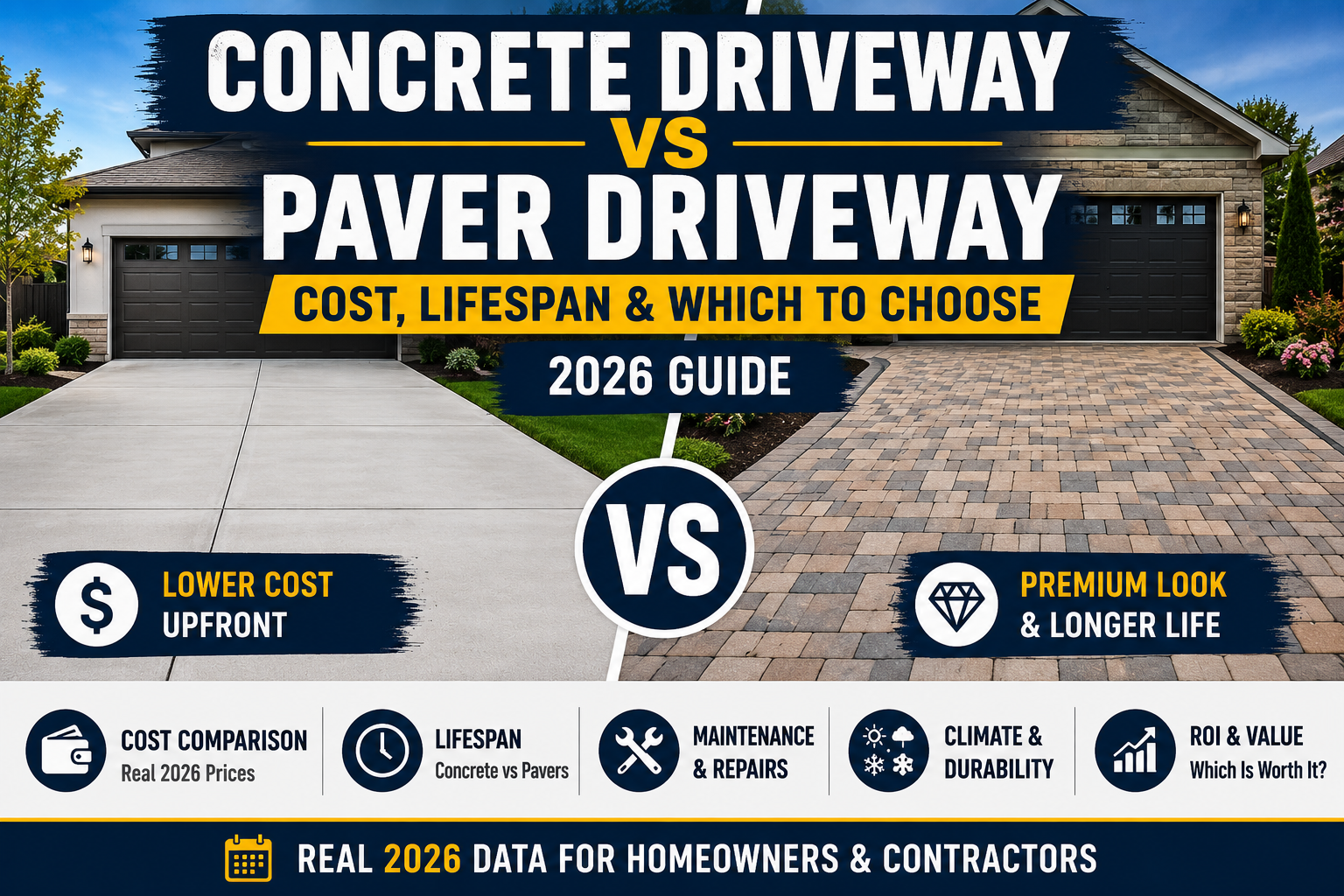
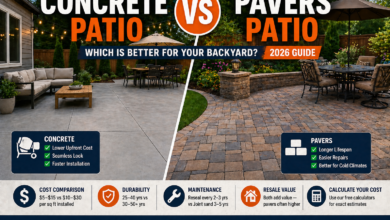
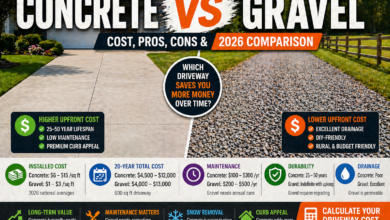
Concrete driveways cost less upfront. Paver driveways last longer and repair easier. But the real question isn’t which one is cheaper – it’s which one costs you less over 20 years, holds up in your climate, and fits what you actually need from a driveway. This guide runs the full numbers on both options using 2026 US pricing so you can make a decision you won’t regret five years from now.
Quick Side-by-Side Comparison
Before getting into the detailed breakdown, here’s the fast answer on how these two driveway types stack up across every major factor homeowners care about.
| Factor | Concrete Driveway | Paver Driveway | Winner |
|---|---|---|---|
| Installed cost (per sq ft) | $8 – $15 | $14 – $30 | Concrete |
| Lifespan | 25 – 30 years | 30 – 50 years | Pavers |
| Maintenance effort | Low (reseal every 3-5 yrs) | Moderate (joint sand, weeding) | Concrete |
| Repairability | Patches are visible | Individual unit replacement | Pavers |
| Freeze-thaw performance | Cracks under soil movement | Flexes, re-settles | Pavers |
| Hot weather performance | Excellent, doesn’t soften | Good if jointed properly | Concrete |
| Curb appeal | Clean, uniform look | Premium, custom patterns | Pavers |
| Installation speed | Fast pour, slow cure (7 days) | Longer install, faster use | Tie |
| 20-year total cost | Lower in most markets | Higher due to maintenance | Concrete |
| Home resale value boost | 40 – 60% cost return | 50 – 70% cost return | Pavers |
Installation Cost in 2026
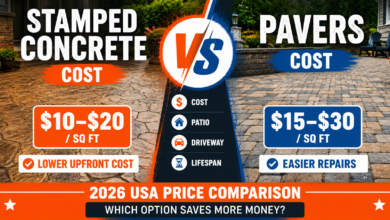
The biggest number most homeowners focus on is the per-square-foot installed price. In 2026, concrete driveways run $8 to $15 per square foot fully installed, and paver driveways run $14 to $30 per square foot. On a typical two-car driveway, that’s a real dollar difference of $3,600 to $9,000 in concrete’s favor before a single special finish or upgraded material is added.
What Drives Concrete Driveway Cost
A standard concrete driveway installation includes site prep and grading, compacted gravel base, formwork, rebar or fiber reinforcement, a 4-inch thick 4,000 PSI concrete pour, broom finish, and control joints. Labor runs $4 to $7 per square foot, materials another $4 to $8 per square foot. Decorative upgrades – stamped patterns, exposed aggregate, or colored concrete – add $4 to $12 per square foot on top of the base price.
The total concrete driveway cost also shifts based on thickness. Most residential driveways pour at 4 inches, which is adequate for passenger vehicles. Driveways that need to carry RVs, landscaping trucks, or boats should go to 5 or 6 inches – adding roughly $1.50 to $2.50 per square foot. Use our concrete driveway calculator to get your exact cubic yardage based on your dimensions and thickness.
What Drives Paver Driveway Cost
Paver installation is labor-intensive. Labor accounts for 50 to 60 percent of the total installed cost – a much higher share than concrete. The base system (compacted gravel sub-base, bedding sand, edge restraints, and polymeric joint sand) adds $6 to $10 per square foot before a single paver is set. Paver material costs range from $4 to $10 per square foot for standard concrete pavers and up to $20 per square foot for natural stone like travertine or bluestone.
Paver pattern complexity also affects cost. A simple running bond layout is cheapest. Herringbone, basket weave, and complex border designs require more cuts and more skilled labor, adding $2 to $6 per square foot to the installation quote. Circular patterns or custom medallion designs cost even more.
Cost by Driveway Size
Here’s what real projects cost in 2026 at different driveway sizes, using national average installed pricing for both options. These figures include site prep, base, materials, and labor for a standard finish on each type.
| Driveway Size | Concrete Cost Range | Paver Cost Range | Upfront Gap |
|---|---|---|---|
| 400 sq ft (single car) | $3,200 – $6,000 | $5,600 – $12,000 | $2,400 – $6,000 |
| 600 sq ft (standard 2-car) | $4,800 – $9,000 | $8,400 – $18,000 | $3,600 – $9,000 |
| 800 sq ft (large 2-car) | $6,400 – $12,000 | $11,200 – $24,000 | $4,800 – $12,000 |
| 1,200 sq ft (oversized) | $9,600 – $18,000 | $16,800 – $36,000 | $7,200 – $18,000 |
🔢 Calculate Your Exact Driveway Cost
Enter your driveway length, width, and thickness to get instant cubic yardage and cost estimates for your project.
Use the Driveway Calculator →Lifespan and Durability
A concrete driveway properly installed on a well-compacted base with 4,000 PSI concrete and correct joint placement lasts 25 to 30 years in most US climates. In mild climates with minimal freeze-thaw exposure and light vehicle use, 30 to 35 years is achievable. In the northern states where deicing salts and hard winters are routine, 20 to 25 years is more realistic without significant cracking or surface scaling.
A paver driveway with a properly constructed base – at least 6 to 8 inches of compacted gravel sub-base, 1 inch of bedding sand, and polymeric joint sand – commonly reaches 30 to 50 years. The pavers themselves rarely wear out. What fails first is the base: poor compaction, inadequate drainage, or tree root intrusion causes pavers to settle unevenly. A well-built base is the single biggest factor in paver driveway lifespan.
The Base Is Everything
For both driveway types, early failure almost always traces back to base problems, not the surface material. Concrete cracks when the soil beneath it shifts unevenly. Pavers sink and rock when the sub-base settles. Contractors who cut corners on excavation depth, base thickness, or compaction equipment are the leading cause of driveways that fail in year 5 instead of year 30. Always confirm your contractor is excavating at least 6 to 8 inches and using a plate compactor on the sub-base, not just hand tamping.
Maintenance: What Each One Needs
Maintenance is where the real long-term cost difference between these two options shows up – and where a lot of homeowners are surprised when they actually own a paver driveway for a few years.
Concrete Driveway Maintenance
Concrete driveways are genuinely low-maintenance. The main tasks are:
- Sealing every 3 to 5 years: A penetrating or film-forming sealer protects against moisture, oil stains, and deicing salt damage. DIY sealer runs $0.10 to $0.25 per square foot; professional application runs $0.35 to $0.75 per square foot
- Crack filling: Hairline cracks should be filled with polyurethane or epoxy filler when they appear to prevent water infiltration and freeze-thaw expansion. Cost: $5 to $15 per linear foot of crack
- Stain treatment: Oil and rust stains need degreaser treatment before sealing. Routine cleaning with a pressure washer once a year keeps surface staining manageable
- Minimizing deicing salt use: Calcium chloride and sodium chloride (road salt) accelerate concrete surface scaling. Use sand or kitty litter for traction when possible, especially in the first two winters after a fresh pour
Annual maintenance cost for a concrete driveway averages $80 to $200 per year over a 20-year period when sealing, occasional crack repair, and cleaning are factored in.
Paver Driveway Maintenance
Paver driveways require more ongoing attention than concrete, particularly around joint sand. Here’s what to budget for:
- Joint sand replenishment: Polymeric joint sand washes out or erodes over time and needs refreshing every 3 to 5 years. Cost: $0.50 to $1.50 per square foot professionally applied
- Weed and moss control: Joint gaps invite weed growth, especially in humid climates. Polymeric sand significantly reduces this, but weeding or pre-emergent herbicide applications are still needed annually
- Re-leveling sunken pavers: Any area where the base settles needs to be lifted, base material added, and pavers re-set. This runs $200 to $600 per affected area depending on size and severity
- Optional sealing: Paver sealing is not required but enhances color and makes cleaning easier. Professional application runs $0.75 to $1.50 per square foot every 3 to 5 years
Annual maintenance cost for a paver driveway averages $200 to $500 per year over a 20-year period when joint sand, weeding, re-leveling, and occasional sealing are included.
Repairability: The Critical Difference
This is where pavers win the argument convincingly – and it matters more than most homeowners realize when they’re comparing quotes on a new driveway.
When a concrete slab cracks from soil movement, root intrusion, or a heavy vehicle, you have two options: fill the crack with a filler compound (visible, mismatched) or cut out the section and pour a patch (still visible, because new and old concrete never match in color or texture). Neither repair looks good. In a front driveway visible from the street, this is a real aesthetic problem over time.
When a paver settles, shifts, or cracks, you lift the affected units, adjust the base, and replace the paver with a matching unit from your surplus stock. Done correctly by an experienced installer, the repair is nearly invisible. This is why contractors and landscape designers often recommend pavers specifically for driveways that sit in high-profile locations or on slopes where soil movement is more likely over time.
💼 Real Repair Scenario: Tree Root Damage
Situation: A large oak tree’s roots push up a 4-foot section of driveway over 10 years.
Concrete repair cost: Cut out the raised section, grind the roots, patch with new concrete. Cost: $400 to $900. Result: Visible patch that doesn’t match surrounding slab.
Paver repair cost: Lift affected pavers, cut the root, add base material, re-set the pavers. Cost: $250 to $600. Result: Near-invisible repair if spare pavers were saved from original install.
Key tip: Always ask your paver installer to leave 5 to 10% of the total paver count as spare units stored in your garage. That supply makes future repairs significantly cheaper and easier to match.
Climate Performance by Region
Where you live should influence which driveway you choose as much as your budget does. These two materials behave very differently in extreme cold, extreme heat, and high-rainfall environments.
Cold Climates (Northern States: MN, WI, MI, NY, PA, IL)
Freeze-thaw cycles are the primary enemy of concrete driveways in northern states. Water enters cracks, freezes, expands, and widens the crack – repeating every winter. Deicing salt accelerates surface scaling. Concrete in these markets needs 4,000 PSI with air entrainment, and even then, surface deterioration after 15 to 20 years is common.
Paver driveways handle freeze-thaw better because individual units can move slightly with soil heave and re-settle without fracturing across a large surface. However, pavers in cold climates require proper base depth – at least 8 inches of crushed stone – to prevent differential settling when the ground freezes and thaws repeatedly. Maintenance requirements also increase in northern climates due to more aggressive weed pressure in joint gaps during spring and summer.
Hot Climates (Southern and Southwestern States: TX, AZ, FL, CA)
Concrete performs well in heat. It doesn’t soften, rut, or deform the way asphalt does in southern summers, and properly cured concrete handles thermal expansion with control joints spaced correctly. In Florida and coastal southern states, the main issue is moisture – concrete in these markets benefits from sealing to resist the constant moisture cycling.
Pavers in hot climates also perform well, but light-colored pavers in Arizona and Nevada can experience joint sand degradation from UV exposure faster than in northern climates. Polymeric joint sand rated for UV resistance is worth the extra cost in these markets.
| Climate | Concrete Performance | Paver Performance | Recommendation |
|---|---|---|---|
| Freeze-thaw (Northern US) | Moderate – cracks over time | Good – flexes and re-settles | Pavers have the edge |
| Hot and dry (Southwest) | Excellent | Good with UV-rated joint sand | Either works well |
| Hot and humid (South/Florida) | Good with proper sealing | Good, but more weed pressure | Concrete simpler to maintain |
| Mild (Pacific Coast) | Excellent | Excellent | Personal preference decides |
| High rainfall (Pacific Northwest) | Good with sealed cracks | Good, but moss in joints | Concrete easier to maintain |
Curb Appeal and Home Value
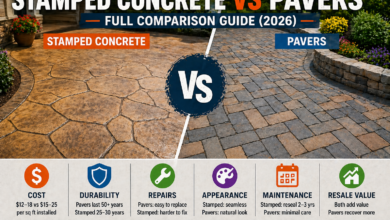
A plain broom-finish concrete driveway looks clean, professional, and appropriate for most neighborhoods. It’s not exciting, but it doesn’t detract from the home either. Stamped and colored concrete bridges the gap – a well-done stamped concrete driveway that mimics cobblestone or slate runs $14 to $25 per square foot and delivers significantly more visual impact than standard gray.
Paver driveways offer the widest design range of any driveway material. Color blends, pattern layouts (running bond, herringbone, basketweave, fan), border designs, and material options (concrete pavers, clay brick, natural stone) give homeowners flexibility that concrete – even stamped – can’t fully match. In high-value neighborhoods where curb appeal drives resale premiums, a premium paver driveway with natural stone accents genuinely stands out.
From a resale value standpoint, paver driveways typically return 50 to 70 percent of their installed cost at resale, while standard concrete returns 40 to 60 percent. However, the difference in actual dollar return is smaller than it looks. A $15,000 paver driveway returning 60 percent adds $9,000 to sale value. A $7,000 concrete driveway returning 55 percent adds $3,850. The paver driveway adds more – but you also spent $8,000 more to get there. In most markets, the ROI math favors concrete unless you’re specifically targeting buyers in a premium price range.
20-Year Total Cost Comparison
Upfront price tells only half the story. The real comparison is total cost of ownership over 20 years, which includes installation, maintenance, repairs, and eventual replacement or major refurbishment.
| Cost Category | Concrete (600 sq ft) | Pavers (600 sq ft) |
|---|---|---|
| Installation | $4,800 – $9,000 | $8,400 – $18,000 |
| Sealing (4x over 20 yrs) | $840 – $1,800 | $900 – $3,600 (optional) |
| Crack or joint repairs | $400 – $1,200 | $600 – $2,000 |
| Joint sand refresh (3x) | N/A | $900 – $2,700 |
| Weed/moss control | Minimal | $1,000 – $3,000 |
| Re-leveling (1-2 areas) | N/A | $400 – $1,200 |
| 20-Year Total | $6,040 – $12,000 | $12,200 – $30,500 |
On a standard 600 square foot driveway, concrete costs $6,040 to $12,000 over 20 years while pavers cost $12,200 to $30,500. Concrete wins the 20-year cost comparison in most residential scenarios. The exception is if you pour concrete in a freeze-thaw climate without adequate PSI and air entrainment – surface scaling and cracking can push the concrete total cost up significantly with early repairs and potential full replacement.
Which One to Choose
Choose a Concrete Driveway If:
- Budget is the primary concern and you want the most driveway for your dollar upfront
- You’re in a hot or mild climate (South, Southwest, Pacific Coast) where freeze-thaw cracking isn’t a major risk
- You prefer low, predictable maintenance – seal it every few years and leave it alone
- You plan to sell within 10 years and want a solid, well-maintained driveway without a premium price tag
- You want the option to upgrade later with a decorative overlay, stain, or resurfacing at lower cost than full replacement
Choose a Paver Driveway If:
- Curb appeal and design variety matter to you more than cost savings – you’re staying long-term and want the best-looking driveway on the street
- You’re in a northern state where freeze-thaw cycles are severe and you want a driveway that flexes instead of cracking
- You have tree roots or unstable soil conditions that make large concrete slabs prone to uneven cracking over time
- You want the flexibility to spot repair invisible future damage without patching and color-matching problems
- You’re in a premium-price market and the driveway is part of a full landscaping and hardscape upgrade that targets the high end of resale value
🏆 The Honest Verdict
For most US homeowners on a standard budget, concrete wins on total value. It costs less to install, less to maintain over 20 years, and performs well in most climates when specified correctly at 4,000 PSI with proper control joints.
Pavers win when you prioritize long-term appearance, freeze-thaw resilience, and repairability – and when you’re prepared to spend 50 to 100 percent more upfront and commit to ongoing joint maintenance. In the right neighborhood and the right climate, pavers are the better long-term investment.
✅ Key Takeaways
- Concrete driveways cost $8 to $15 per square foot installed; paver driveways cost $14 to $30 per square foot – a gap of $3,600 to $9,000 on a standard 600 sq ft driveway
- Paver driveways last 30 to 50 years vs 25 to 30 years for concrete when both are properly installed on good bases
- Concrete is easier and cheaper to maintain annually ($80 to $200/year vs $200 to $500/year for pavers)
- Pavers are dramatically easier to repair – individual unit replacement looks invisible; concrete patches always show
- In freeze-thaw climates, pavers handle soil movement better than concrete slabs; in hot climates, concrete performs just as well or better
- Over 20 years, concrete total cost runs $6,040 to $12,000 vs $12,200 to $30,500 for pavers on a 600 sq ft driveway
- Stamped concrete is the middle ground – premium appearance at closer to concrete pricing when pavers are out of budget