Poured Concrete Walls vs Block Cost: 2026 Comparison Guide
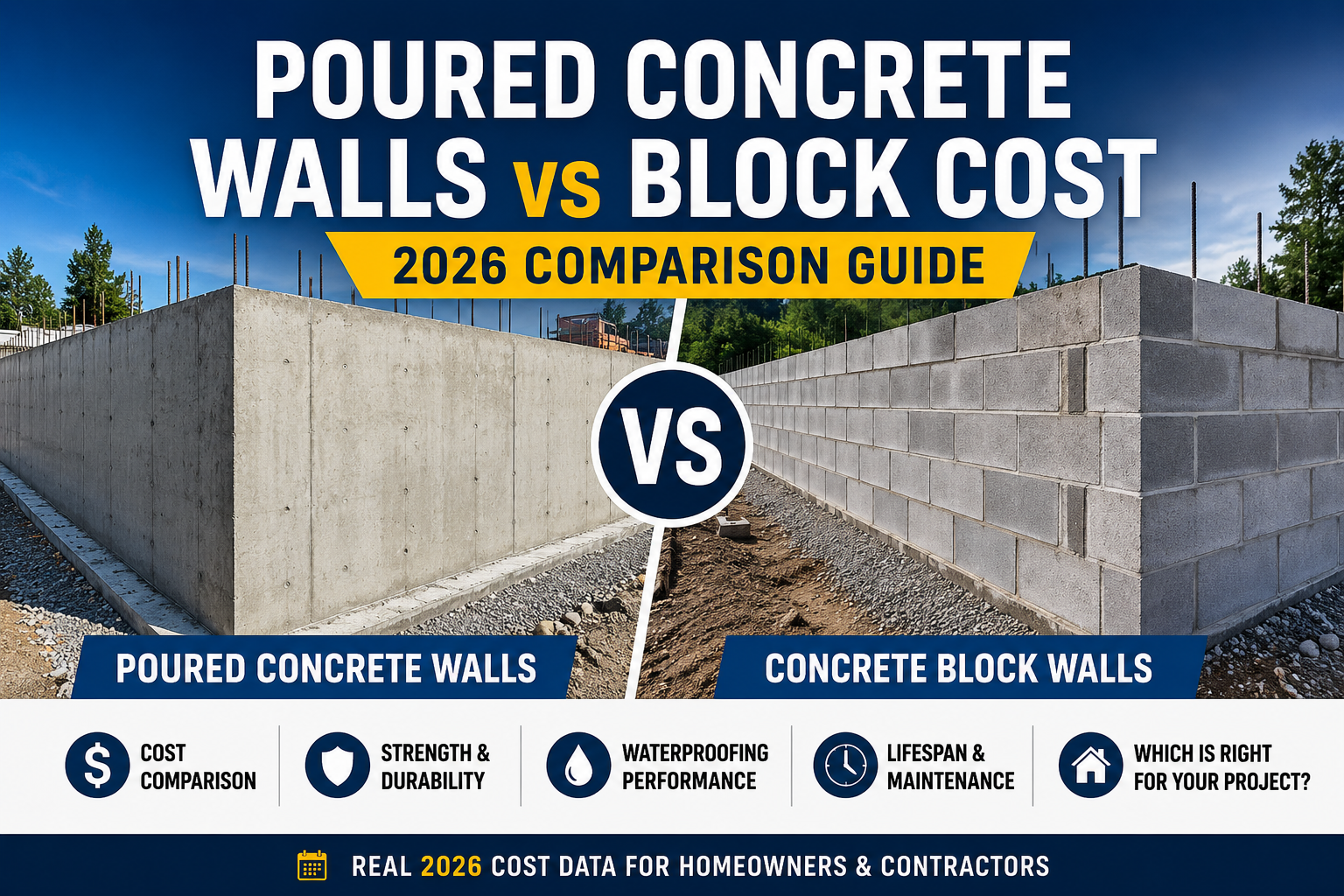
Choosing between poured concrete walls and concrete block (CMU) walls is one of the most common cost decisions in residential construction. The wrong choice can cost you thousands upfront or thousands more in maintenance over the next 20 years. This guide breaks down real 2026 pricing, structural differences, waterproofing performance, and the exact situations where each option wins.
Cost Overview: Poured Concrete vs Block
At the surface level, block walls are cheaper per square foot than poured concrete walls. Concrete block walls run $12 to $20 per square foot installed, while poured concrete walls run $18 to $40 per square foot installed. Both figures include materials, labor, basic reinforcement, and a standard finish.
On a linear foot basis for foundation walls, poured concrete typically runs $110 to $180 per linear foot while block foundations cost $90 to $160 per linear foot. For a standard home with a 40×30-foot footprint (140 linear feet of perimeter wall), that gap works out to roughly $2,800 to $2,800 more for poured concrete before project-specific variables.
The gap narrows or flips in some markets. In regions with strong masonry labor supply, block walls come in significantly cheaper. In markets where poured wall contractors use reusable form systems and concrete pump trucks efficiently, poured walls can match or beat block pricing on large, simple jobs.
Detailed Cost Breakdown by Component
The total project cost for either wall type breaks down into five main categories: materials, labor, equipment, permits, and contingency. Each category shifts differently between poured and block construction.
Materials
For poured walls, materials include ready-mix concrete, rebar, formwork (either purchased or rented), form ties, and waterproofing sealant. Formwork alone can add $3 to $7 per square foot to the material bill. For a typical basement wall project, material costs run $6,000 to $15,000 depending on wall area and thickness.
Block wall materials include CMU blocks, mortar, rebar, grout (for filled cores), and sealant. Standard 8-inch concrete blocks cost roughly $1.50 to $2.50 each from a building supply store. A wall covering 400 square feet uses around 450 standard blocks. Total material costs for block walls typically run $4,000 to $12,000 for the same wall area.
Labor
Poured wall labor involves form assembly, rebar placement, the concrete pour, vibration, and form stripping after curing. This work requires a skilled crew and is time-sensitive – once you start pouring, you can’t stop. Labor typically runs $4,000 to $12,000 for a standard residential project, scaling with wall height and the number of openings for windows and doors.
Block wall labor uses mason crews who lay course after course with mortar joints. It is slower per linear foot but can be paused and restarted. Labor runs $3,000 to $10,000 for a comparable wall area. The rate is usually $5 to $13 per square foot for installation and equipment. In regions with strong mason labor pools – particularly the Mid-Atlantic and South – this number can drop significantly.
Equipment
Poured walls often require a concrete pump truck, especially for deep or confined pours. Pump rental typically runs $800 to $1,500 per day. Block walls need scissor lifts or scaffolding and occasionally a forklift for pallet deliveries. Equipment costs for both methods generally fall between $1,000 and $4,000 for residential jobs.
| Cost Component | Poured Concrete Wall | Concrete Block Wall |
|---|---|---|
| Materials | $6,000 – $15,000 | $4,000 – $12,000 |
| Labor | $4,000 – $12,000 | $3,000 – $10,000 |
| Equipment | $1,000 – $4,000 | $1,000 – $3,000 |
| Permits | $200 – $2,000 | $200 – $2,000 |
| Contingency (10%) | $1,100 – $3,300 | $800 – $2,700 |
| Total Range | $12,300 – $36,300 | $9,000 – $29,700 |
💰 Get Your Full Project Cost Estimate
Enter your wall dimensions and get instant cost estimates for both poured and block construction options.
Use the Concrete Cost Calculator →Cost by Project Type
The right choice and the true total cost vary significantly depending on what you’re actually building. Foundation walls, retaining walls, and above-grade walls each have different structural demands and cost profiles.
Foundation Walls and Basements
This is where the poured vs block debate matters most for residential construction. Poured concrete foundation walls run $110 to $180 per linear foot installed. Block foundations typically run $90 to $160 per linear foot. On a standard 40×30-foot home (140 linear feet of perimeter wall), poured concrete runs $15,400 to $25,200 and block runs $12,600 to $22,400.
Over 20 years, poured wall homes typically spend $3,000 to $10,000 on crack monitoring and drainage maintenance. Block foundations commonly run $4,500 to $14,000 in joint, mortar, and moisture management over the same period. Factor in lifetime cost, not just upfront cost, when deciding. Use our concrete foundation calculator to size your wall volumes before requesting quotes.
Retaining Walls
For retaining walls, poured concrete starts around $25 to $50 per square foot of wall face, while block retaining walls run $20 to $35 per square foot. For a 4-foot-tall retaining wall, poured concrete typically costs $35 to $55 per linear foot and block walls run $25 to $45 per linear foot. Drainage, footing design, and backfill conditions can shift these numbers by 20% or more. Check our retaining wall calculator to estimate footing and wall volume together.
Above-Grade Walls and Perimeter Fencing
For perimeter fencing walls or above-grade garden walls, concrete block is usually the clear winner on cost. A standard 6-foot-tall block fence wall costs roughly $15 to $20 per square foot installed. On a 350-linear-foot perimeter fence, total installed cost runs around $18,000 to $22,000. Poured concrete at this scale requires expensive form systems that add cost without adding proportional strength benefit.
💼 Real Example: Basement Foundation in Ohio
Project: Full perimeter basement foundation, 40×28 ft home
Perimeter: 136 linear feet, 9-foot wall height
Poured concrete quote: $19,000 – $22,000 (includes forms, 4000 PSI concrete, rebar, damp-proofing)
Block wall quote: $15,500 – $18,500 (includes 8-inch CMU, mortar, rebar, grout-filled cores, damp-proofing)
Upfront difference: $3,500 – $4,500 more for poured concrete
20-year maintenance estimate: $2,000 less for poured walls due to fewer joint repairs
Net 20-year cost advantage: Roughly breakeven in this climate zone
Structural Strength Comparison
Poured concrete walls are monolithic – one continuous reinforced section with no joints. This gives them a clear edge in lateral strength, which is the load that matters most for basement walls pushing back against soil pressure. A properly designed poured wall handles lateral loads better than block in most soil conditions.
Block walls have mortar joints every 8 inches vertically and every 16 inches horizontally. Each joint is a potential weak point under lateral load. The fix is full core grouting and rebar at close spacing, but many block foundations are built with only partial grouting to cut cost. A fully grouted, properly reinforced CMU wall performs well, but the quality depends heavily on the mason and the specs on the job.
What the Numbers Say
Standard poured concrete walls use 3,000 to 4,000 PSI concrete throughout, giving a uniform strength profile. Block units themselves are typically rated at 1,900 to 2,800 PSI, but the mortar joints are the weak link. ACI 318 minimum for structural concrete is 2,500 PSI. Engineers almost always specify 3,500 to 4,000 PSI for poured foundation walls. Use our PSI strength calculator to verify your mix meets code minimums at 28 days.
Waterproofing and Moisture Performance
Poured concrete walls are easier and cheaper to waterproof. A single continuous membrane applied to the exterior face, combined with a footing drain and proper grading, creates a reliable moisture barrier. There are no joints to seal, no cores to fill, and no mortar to repoint years later.
Block walls have more potential water entry paths: mortar joints, unfilled cores, and the interface between mortar and block face. Standard damp-proofing (a tar coat) on a block wall is not enough in areas with high water tables, clay soils, or heavy annual rainfall. Block foundations in these conditions need a full waterproofing membrane, drain board, and footing drain to perform reliably.
Long-Term Moisture Costs
Water infiltration repairs are the main long-term cost differentiator between the two wall types. Interior crack injection on a poured wall typically costs $300 to $1,000 per crack, and cracks are usually few and isolated. On block walls, mortar joint repointing runs $5 to $25 per linear foot, and bowing wall repairs using carbon fiber anchors cost $1,500 to $3,000 per anchor system. In wet climates, block wall moisture repair costs accumulate faster over a 20 to 30-year period.
Pros and Cons Side by Side
| Factor | Poured Concrete Wall | Concrete Block Wall |
|---|---|---|
| Upfront cost | Higher ($18-$40/sq ft) | Lower ($12-$20/sq ft) |
| Lateral strength | Stronger (monolithic) | Weaker if not fully grouted |
| Waterproofing ease | Easier (no joints) | More complex (joints and cores) |
| Installation speed | Faster for long straight walls | Slower but can be paused |
| Repairability | Crack injection, injection ports | Targeted block/joint replacement |
| Lifetime maintenance | Lower in wet climates | Higher joint and moisture upkeep |
| Lifespan | 80-100 years | 70-100 years (reinforced) |
| Best for | High water table, wet soils, strong lateral loads | Budget builds, staged construction, strong mason markets |
When to Choose Each Option
Choose Poured Concrete When:
- Your lot has a high water table or clay-heavy soil that stays wet seasonally
- You’re in a northern state with severe freeze-thaw cycles – fewer joints means fewer places for water to freeze and expand
- The wall faces significant lateral soil pressure (deep basement, steep lot, heavy surcharge loads)
- You want the strongest possible structure with the least ongoing maintenance
- Your local concrete contractors use reusable form systems, which can close the cost gap with block
Choose Block Walls When:
- You’re in a region with strong mason labor availability and competitive block pricing – particularly the Mid-Atlantic states, the Southeast, and parts of Texas
- The project involves irregular shapes, curved walls, or multiple openings where block construction adapts more easily
- You need staged construction and can’t pour the entire wall in one session due to site constraints
- It’s an above-grade application like a garden wall, perimeter fence, or decorative retaining wall where waterproofing pressure is lower
- Budget is the primary constraint and soil conditions are favorable (dry, well-draining)
Hidden Costs to Budget For
Both wall types carry costs that rarely show up in the initial contractor quote. Missing these can blow a construction budget fast.
Poured Concrete Hidden Costs
- Form rental or purchase: Reusable steel forms are expensive to buy outright but save money long-term; rental costs $300 to $800 per day depending on wall area
- Concrete pump truck: Required for deep or tight pours; adds $800 to $1,500 per day to project cost
- Cold weather protection: If pouring in temperatures below 40°F, insulated blankets and possible heating systems add $500 to $2,000 per pour event – see our cold weather concrete guide
- Wall openings: Every window or door opening requires extra form bracing and adds $200 to $600 per opening in labor
Block Wall Hidden Costs
- Core grouting: Filling block cores with grout adds $1.50 to $3.00 per square foot but is necessary for structural and waterproofing performance
- Parging or surface treatment: Exposed block surfaces often need a parge coat (thin mortar layer) for aesthetics and moisture resistance; runs $3 to $6 per square foot
- Mortar joint sealing: Long-term mortar joint maintenance adds up; budget $500 to $2,000 every 10 to 15 years in harsh climates
- Waterproofing upgrade: Standard damp-proofing is often insufficient for block; a full membrane system adds $4 to $8 per square foot over basic coating cost
📐 Estimate Your Full Project Budget
Use our concrete project estimator to get a complete picture of material, labor, and equipment costs for your wall project.
Open Project Estimator →Regional Price Differences Across the US
Concrete and labor prices vary by region. The national averages cited in this guide are useful starting points, but your actual quote will reflect local conditions. Here’s how pricing typically shakes out across the country.
| Region | Poured Wall (per sq ft) | Block Wall (per sq ft) | Key Driver |
|---|---|---|---|
| Northeast (NY, MA, CT) | $30 – $45 | $22 – $35 | High labor rates, strict codes |
| Midwest (OH, IL, MI) | $20 – $35 | $15 – $25 | Competitive contractor market |
| South (TX, GA, FL) | $18 – $32 | $12 – $22 | Strong mason labor availability |
| West (CA, WA, OR) | $28 – $50 | $20 – $38 | High labor costs, seismic requirements |
| Mountain (CO, AZ, UT) | $22 – $38 | $16 – $28 | Mid-range labor, material availability varies |
For state-specific concrete pricing, use our dedicated cost calculators for Texas, California, Florida, Ohio, New York, Georgia, and Arizona.
✅ Key Takeaways
- Block walls cost $12 to $20 per square foot installed vs $18 to $40 per square foot for poured concrete – block is cheaper upfront in most markets
- Poured concrete is stronger, faster to waterproof, and has lower lifetime maintenance costs in wet or freeze-thaw climates
- On a standard residential foundation, the upfront difference is typically $3,000 to $5,000 in favor of block walls
- Over 20 years, block walls often cost $1,500 to $4,000 more in maintenance due to mortar joints and moisture management
- Block walls are the better value in dry climates with strong mason labor supply; poured walls win in wet, cold, or high-pressure soil conditions
- Always get quotes from both poured and block contractors in your specific market before deciding – regional differences can flip the cost equation entirely