Brick vs Concrete Patio 2026: Cost, Durability, Maintenance & Which Wins
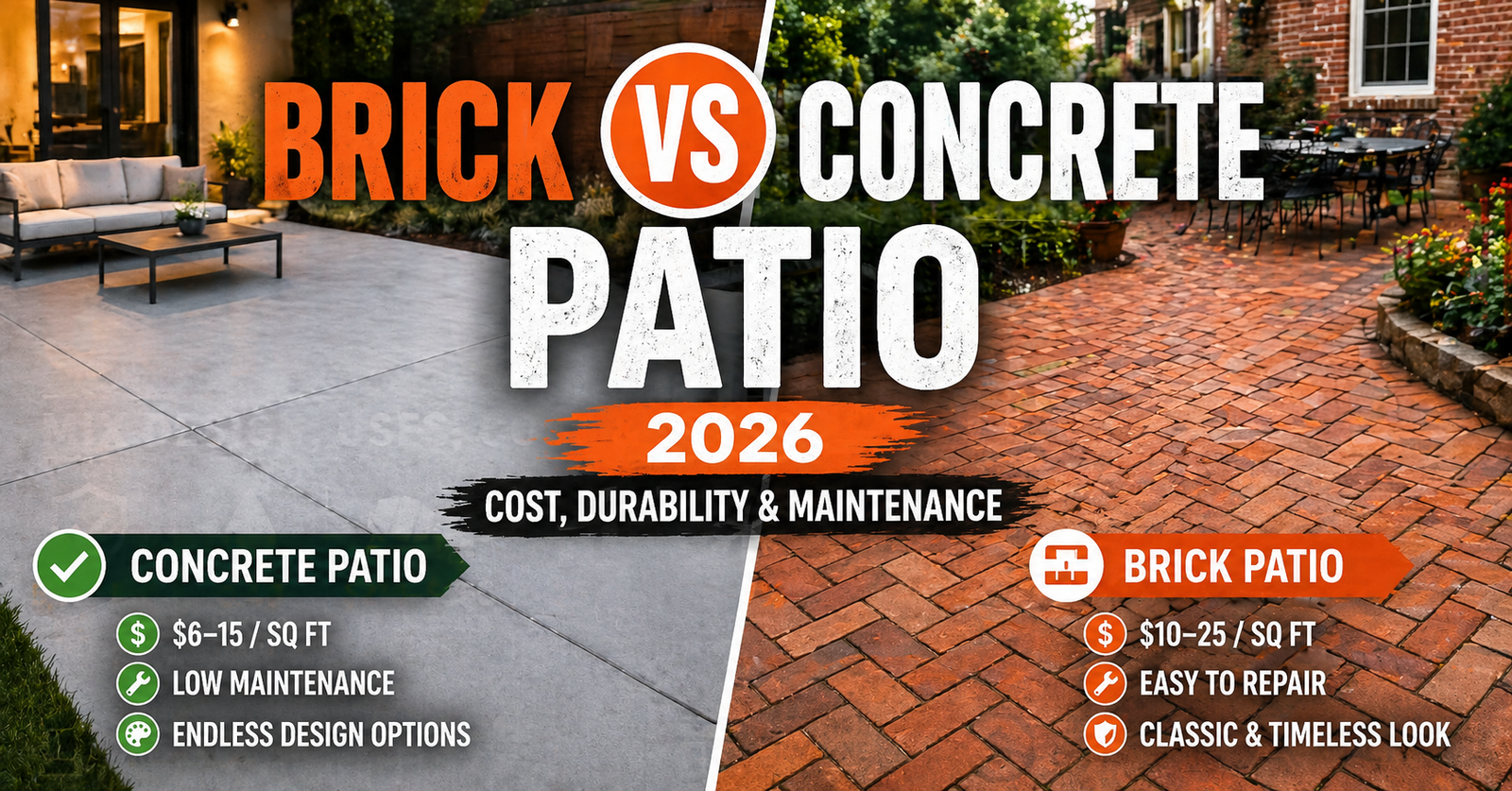
Brick and concrete are the two most popular hard-surface patio materials in the US. Concrete costs less upfront and gives you more design flexibility. Brick adds classic curb appeal and is easier to repair one piece at a time. This guide breaks down every factor that matters – cost, lifespan, maintenance, repair, climate performance, and resale value – with real 2026 numbers so you can make a clear decision for your yard.
Brick vs Concrete Patio: Key Differences at a Glance
A concrete patio is a poured slab, typically 4 inches thick, set on a compacted gravel base. It is a single continuous surface finished by hand with a broom, exposed aggregate, stamp, or stain. Once poured and cured, it requires minimal structural intervention for decades.
A brick patio is built from individual clay or concrete brick units set on a sand-and-gravel base. The bricks are either mortared or dry-laid with polymeric sand in the joints. The jointed construction gives brick patios natural flexibility – individual units can shift, be lifted, releveled, and reset without disturbing the rest of the surface.
Both are durable, low-maintenance options compared to wood. The choice comes down to budget, aesthetic preference, and how much you value repairability versus seamless design. The table below gives a fast comparison before the detail sections.
| Factor | Concrete Patio | Brick Patio | Winner |
|---|---|---|---|
| Installed Cost (per sq ft) | $6-15 (basic), $14-25 (stamped) | $10-25 (clay pavers) | Concrete |
| Lifespan | 30-50 years | 25-100+ years (clay) | Brick |
| Annual Maintenance Cost | $50-200/year | $100-300/year | Concrete |
| Repair Ease | Difficult – patches rarely match | Easy – replace individual bricks | Brick |
| Design Flexibility | Any shape, color, stamp, or stain | Classic patterns, limited color range | Concrete |
| Freeze-Thaw Performance | Good with 4000 PSI + air entrainment | Excellent – individual unit flex | Brick |
| Drainage | Requires slope and drain planning | Natural drainage between joints | Brick |
| DIY Friendliness | Difficult – requires forming and finishing | Manageable with basic tools | Brick |
| Curb Appeal | Modern and clean – customizable | Classic and timeless | Tie – style-dependent |
| Resale Value (ROI) | 50-90% (avg 70%) | Typically higher buyer appeal | Brick (slight edge) |
| Fire Resistance | Non-combustible | Non-combustible | Tie |
Cost Comparison: Installed Price Per Square Foot
Cost is the clearest advantage concrete has over brick. For a basic installation, concrete almost always comes in below brick – sometimes by 40-60% per square foot.
Concrete Patio Cost (2026)
A standard broom-finish concrete patio runs $6-15 per square foot installed across most US markets in 2026. The price depends on your region, slab thickness, site access, and whether you need extra sub-base work. Decorative finishes raise the price but still compete favorably with brick:
- Broom finish (standard): $6-12 per square foot
- Exposed aggregate: $10-16 per square foot
- Stamped concrete: $14-22 per square foot
- Acid stained concrete: $12-20 per square foot
- Resurfaced or overlay concrete: $3-8 per square foot over existing slab
Brick Patio Cost (2026)
Brick patio installation costs more because of higher material prices and labor-intensive individual unit placement. Pricing varies by brick type and pattern complexity:
- Standard clay brick pavers (dry-laid): $10-20 per square foot installed
- Thin clay half-bricks: $10-18 per square foot – lighter, easier to handle, less material cost
- Mortared brick patio: $15-25 per square foot – requires more skill and longer labor time
- Premium reclaimed brick: $20-35 per square foot – historic character, sourcing costs more
- Complex herringbone or circular patterns: Add $3-6 per square foot to any brick price for cutting-intensive layouts
💰 Side-by-Side Cost Example: 400 Square Foot Patio
Basic concrete (broom finish): 400 sq ft × $9 avg = $3,600
Stamped concrete: 400 sq ft × $18 avg = $7,200
Standard clay brick patio (dry-laid): 400 sq ft × $15 avg = $6,000
Mortared clay brick patio: 400 sq ft × $20 avg = $8,000
Premium reclaimed brick: 400 sq ft × $27 avg = $10,800
Bottom line: A basic concrete patio is $2,400 cheaper than a standard brick patio of the same size. Stamped concrete competes directly with mid-range brick on installed price while giving you more design options.
Also factor in the base preparation cost for both options. Both require excavation (typically 6-8 inches), a 4-6 inch compacted gravel base, and in brick’s case, a 1-inch sand bedding layer. Use our excavation calculator to estimate your dig volume and our base material calculator to price the gravel sub-base before getting quotes.
🧮 Get Your Concrete Patio Cost Before Calling Anyone
Enter your dimensions and get an instant concrete volume, yardage, and cost estimate for your project.
Use Concrete Patio Cost Calculator →Durability and Lifespan
Both materials are durable – far more so than wood or asphalt. The difference is in how they age and what they look like when they eventually fail.
How Long Does Concrete Last?
A well-installed concrete patio with proper sub-base preparation, adequate PSI specification, and periodic resealing typically lasts 30-50 years. The concrete itself is structurally sound for decades. Surface wear – minor scaling, hairline cracking, and color fade – begins to appear over 15-25 years depending on climate and maintenance consistency.
The primary durability threats to concrete are:
- Freeze-thaw cycling – causes surface scaling if the slab was not specified with air entrainment and adequate PSI
- Sub-base failure – soil erosion or poor compaction causes slab sections to sink and crack
- Deicing salts – chlorides penetrate and accelerate surface deterioration if the slab is not properly sealed
- Tree roots – roots growing under a slab lift and crack sections over 10-20 years
How Long Does Brick Last?
Quality clay brick pavers have an outstanding lifespan. Well-maintained clay brick installations last 25-50 years, and high-fired clay bricks in protected applications can last well over 100 years – look at any century-old brick walkway on a historic American street. The key variables are clay quality, firing temperature, and the stability of the base.
Brick durability threats are different from concrete’s:
- Base failure – the most common issue; pavers sink and shift when the gravel and sand base settles unevenly
- Joint material breakdown – sand washes out or polymeric sand degrades, allowing weed growth and loosening
- Individual brick spalling or cracking – less common with quality pavers; affected bricks are simply replaced
- Color fade – concrete brick pavers fade over time; clay brick retains color far better because the color is inherent to the fired clay
Not all “brick patios” use fired clay. Concrete brick pavers look similar but are made from cast concrete, not clay. Concrete brick pavers cost less ($3-10 per square foot) but fade faster and have shorter lifespans (25-40 years). When this guide says “brick,” it refers to genuine clay brick pavers unless specified otherwise. If a contractor quotes you brick-look pavers at a very low price, confirm whether the product is clay or concrete.
Maintenance Requirements and Annual Costs
Both brick and concrete are low-maintenance compared to wood decking or asphalt. The maintenance tasks are just different in type and timing.
Concrete Patio Maintenance
A sealed concrete patio is one of the lowest-effort outdoor surfaces you can own:
- Regular: Sweep and rinse as needed – no cost, 15 minutes
- Every 3-5 years: Reseal the surface to maintain moisture resistance and color protection. DIY cost: $0.50-1.50 per square foot in sealer. Professional: $2-4 per square foot. Use our concrete sealer calculator to estimate how much product you need.
- As needed: Fill hairline cracks with polyurethane or epoxy filler – $20-60 per repair
- Every 10-20 years: Consider resurfacing if surface wear is significant. Resurfacing costs $3-8 per square foot and can restore appearance without a full replacement. Our concrete resurfacing calculator can estimate that cost.
- Average annual cost (400 sq ft patio): $50-200 per year
Brick Patio Maintenance
Brick maintenance is slightly more involved than concrete but still reasonable for most homeowners:
- Regular: Sweep and rinse. Pull weeds from joints in spring and summer.
- Every 2-3 years: Power wash the surface to remove dirt and biological growth ($150-300 professional). Reapply polymeric sand to joints if needed ($0.50-1 per square foot materials).
- Every 5-10 years: Reseal brick pavers if sealant was originally applied – optional but extends color vibrancy and reduces staining
- Every 15-25 years (mortared brick): Repoint mortar joints where they have cracked or worn away – $8-15 per square foot in labor for affected areas
- As needed: Relevel sunken sections – lift affected pavers, add sand, and reset. DIY-able for most homeowners.
- Average annual cost (400 sq ft patio): $100-300 per year
Weeds growing between pavers are the most common brick patio complaint. Polymeric sand – a sand-polymer blend that hardens when wet – significantly reduces weed infiltration in the joints. Apply it after installation and replenish it every 3-5 years. Polymeric sand costs $25-45 per bag and covers approximately 40-60 square feet per bag depending on joint width. It is one of the best investments you can make in a brick patio.
Repair: Which Is Easier and Cheaper to Fix?
This is where brick has a clear and significant advantage over concrete. Brick patios are dramatically easier and cheaper to repair than concrete slabs.
Repairing a Brick Patio
When a brick patio sinks, tilts, or has a cracked individual unit, the repair is simple and invisible when finished. You pry up the affected bricks, add or regrade the sand base underneath, and reset the bricks. If a brick is cracked or chipped, you swap in a replacement from your remaining stock. The repaired section is indistinguishable from the original installation if you saved extra bricks at the time of install.
According to Angi, brick patio repairs run approximately $11-14 per square foot for professional work on affected areas. For most homeowners with basic tools, sunken sections are a DIY repair that costs only the time spent.
Repairing a Concrete Patio
Concrete repairs are more involved and the results are harder to hide. A crack in a concrete slab can be filled with polyurethane or epoxy caulk for surface sealing, but the repair line is almost always visible. Larger cracks or sunken sections require saw-cutting the damaged area, removing the broken concrete, addressing the sub-base issue, and pouring a new section.
The new pour will never perfectly match the surrounding concrete in color or texture, especially on an aged slab. Professional concrete repair runs $5-20 per square foot depending on the scope of damage, per Angi 2026 data. Mudjacking a sunken section costs $500-1,500 per zone.
Always order 10-15% extra brick pavers at installation and store them. Brick batches vary in color and texture – replacement bricks from a different production run may not match exactly. With saved originals, repairs are invisible. This applies to stamped concrete as well – ask your contractor to save leftover color hardener and release agent for any future repair needs.
Appearance and Design Options
Appearance is often the deciding factor for homeowners choosing between brick and concrete. Both look good; they just look different in ways that suit different home styles.
Brick Patio Aesthetics
Brick patios have a classic, timeless look that has been popular in American homes for over 200 years. The natural variation in fired clay color – ranging from pale salmon to deep reds and browns – gives brick a warmth and organic quality that is difficult to fully replicate with cast materials. Common patterns include running bond (most popular), herringbone (more labor, more visual interest), basket weave, and circular fan designs.
Brick works best with traditional, craftsman, colonial, and cottage-style homes. On contemporary or modern architecture, plain clay brick can look dated. The fixed module size and limited color range of clay brick are the main design constraints.
Concrete Patio Aesthetics
Concrete is the most design-flexible patio surface available. It can be formed into any shape – curved edges, irregular perimeters, custom cutouts for tree wells or planting areas. Color options are extensive: integral pigment mixes and chemical stains produce everything from earth tones to slate blues. Stamped patterns can convincingly mimic stone, slate, cobblestone, tile, or even wood plank.
Stamped concrete patios are visually competitive with brick at comparable price points. The limitation is that damaged concrete is harder to repair without a visible patch, and stamped patterns may fade over 15-20 years as the color hardener wears. See our guide on how to finish concrete for a full breakdown of decorative options and costs.
Climate and Freeze-Thaw Performance
Your climate is one of the most important factors in this decision, particularly if you live in a northern state that sees regular freezing winters.
Northern States: Freeze-Thaw Climates
Brick pavers handle freeze-thaw cycles better than poured concrete slabs for one structural reason: the joints. When water infiltrates a poured slab and freezes, the expanding ice exerts pressure on the rigid monolithic surface, causing surface scaling and slab cracking over multiple cycles. Individual brick units absorb this movement by shifting slightly in their sand bed without propagating damage across the entire surface.
That said, a properly specified concrete slab – poured at 4,000 PSI with 5-7% air entrainment and a maximum 0.45 water-cement ratio – resists freeze-thaw damage well. The microscopic air voids created by air entrainment give ice room to expand without cracking the concrete matrix. If you choose concrete in a freeze-thaw climate, these three specs are non-negotiable.
Southern States: Heat and Sun Exposure
In hot, sunny climates like the Southeast and Southwest, both materials perform well structurally. Clay brick retains its color better than concrete under prolonged UV exposure because the color is baked into the clay. Concrete pigments and stamped releases can fade over 10-15 years and may need periodic sealing to maintain appearance.
Both materials retain heat in direct sunlight. Lighter-colored concrete finishes and natural clay tones tend to reflect more solar energy than dark concrete or dark brick, reducing surface temperature in summer.
High-Moisture and Coastal Areas
In high-humidity coastal areas, brick’s natural drainage between joints is an advantage. Water moves off the surface quickly rather than pooling. A solid concrete slab requires intentional slope (a minimum 1/8 inch per foot away from the house) and proper drainage planning to prevent standing water. If drainage is not designed in at the concrete pour, puddling becomes a chronic issue. Use our gravel calculator to plan adequate base depth for drainage in high-moisture sites.
Installation Process and DIY Potential
The installation process is where brick and concrete diverge most significantly in terms of DIY accessibility.
Concrete Patio Installation
Pouring concrete requires precise forming, a timed pour sequence, proper finishing technique, and no room for error once the truck arrives. You cannot stop midway and come back – the concrete keeps setting. Sub-base preparation must be correct, forms must be set to the exact grade, and finishing requires practice to avoid tearing the surface or leaving finish marks.
Most contractors and builders strongly recommend professional installation for any concrete patio over 100 square feet. Use the concrete patio calculator and yardage calculator to confirm your order before the truck arrives – running short or over-ordering on a pour is a common and costly mistake.
Brick Patio Installation
Dry-laid brick patio installation is manageable as a DIY project for handy homeowners. The process is forgiving – if a brick is not level, you simply pull it up, add or remove sand, and reset it. There is no time pressure. The steps are:
- Excavate 6-8 inches deep – use our excavation calculator to estimate the volume
- Compact the soil sub-grade
- Add a 4-6 inch compacted gravel base – estimate with our base material calculator
- Lay 1 inch of sand bedding, screeded level
- Set bricks in your chosen pattern, using spacers or natural joint gaps
- Sweep polymeric sand into joints and compact
- Wet the surface to activate the polymeric sand binder
Renting a plate compactor ($75-100 per day) is the only specialized equipment required. Total DIY labor for a 200 square foot brick patio runs 1-2 full weekends for an experienced homeowner. Use our paver calculator to estimate brick quantities before purchasing materials.
Patios over a certain size (typically 200-300 square feet, or any patio within a set distance of property lines) require a building permit in most US jurisdictions. Brick patios in most cities are classified as permeable hardscape and may have lower permit thresholds than poured concrete. Check with your local building department before starting either project – unpermitted hardscape can create complications at resale and may need to be removed.
Resale Value and ROI
Both brick and concrete patios add real value to a home – the difference is in how much and for which buyer type.
Concrete patios deliver an average ROI of 50-90% at resale, with stamped or decorative concrete approaching 90-100% in outdoor-friendly markets, according to Angi. The appeal is practical: buyers see a durable, low-maintenance surface that will not need attention for years. A basic concrete patio costing $3,600 adds roughly $1,800-3,200 in home value, per Angi 2026 data.
Brick patios tend to generate stronger emotional response from buyers in traditional home markets. The classic look signals quality and permanence. Brick and paver patios often outperform plain concrete on perceived value and buyer preference, particularly with buyers who appreciate craftsmanship and heritage materials. However, the higher installation cost means the raw percentage ROI may not always exceed concrete’s.
Condition at the time of sale matters more than material choice. A freshly sealed concrete patio in excellent shape adds more buyer value than a brick patio with loose, sunken pavers and weed-choked joints. Maintain either surface well before listing, and consider a professional cleaning and reseal in the 6-12 months before you sell.
Which One Should You Choose?
Here is a straightforward decision guide based on the factors that matter most.
✅ Choose Concrete If:
- You want the lowest upfront installed cost
- Your project is large (400+ sq ft) where concrete savings are largest
- You want a custom shape, curved edge, or irregular perimeter
- You prefer stamped or stained decorative finishes
- You want the lowest maintenance workload (no weed joints)
- Your home has a modern, contemporary, or transitional style
- You plan a covered patio where UV fading is minimal
- You need the project completed and usable quickly
🧱 Choose Brick If:
- You prefer a classic, timeless look that complements traditional homes
- Easy future repair matters – you want to fix problems one brick at a time
- You live in a heavy freeze-thaw climate and want natural flex tolerance
- You plan a DIY install and want a forgiving process
- Natural drainage between joints is important for your site
- Long-term color retention matters more than upfront savings
- You want to match existing brick on the home’s exterior
For most US homeowners focused on cost and low maintenance, concrete wins. For homeowners who prioritize repairability, natural drainage, freeze-thaw tolerance, and a traditional aesthetic, brick earns its higher price. Neither choice is wrong – they just serve different priorities.
Before committing to either, pin down your total project cost. Use our concrete patio calculator for concrete estimates, our paver calculator for brick quantities, and our concrete volume calculator to convert dimensions to cubic yards for your ready-mix order. You can also compare other patio surface options in our guides on stamped concrete vs pavers and concrete patio vs pavers for a broader material comparison.
🎯 Key Takeaways: Brick vs Concrete Patio
- Concrete patios cost $6-15 per square foot installed; brick pavers cost $10-25 per square foot – concrete saves $2,000-4,000 on a 400 sq ft project
- Concrete lasts 30-50 years; quality clay brick can last 25-100+ years depending on base quality and maintenance
- Concrete is harder to repair – patches rarely match. Brick is easy to repair by lifting and resetting individual units
- Brick pavers handle freeze-thaw cycles better due to joint flexibility. Concrete needs 4,000 PSI + 5-7% air entrainment in northern climates
- Concrete offers unlimited design flexibility – any shape, stamp, color, or stain. Brick is limited to classic patterns and a narrower color range
- Annual maintenance: concrete averages $50-200/year; brick averages $100-300/year – both far less than wood decking
- Brick allows natural drainage between joints. Concrete needs planned slope and drainage at the pour stage
- Brick patio installation is DIY-accessible. Concrete pouring requires professional skill for most projects over 100 sq ft
- Concrete patios return 50-90% ROI at resale; brick patios tend to generate stronger buyer emotional response in traditional home markets
- If you choose concrete, use 4,000 PSI with air entrainment in freeze-thaw climates and seal every 3-5 years to maximize lifespan
Frequently Asked Questions
🔧 Plan Your Patio Project with Accurate Numbers
Get concrete volume, yardage, and cost estimates before you call a contractor – so you negotiate from a position of knowledge.
Use Concrete Patio Calculator →