
Best Time to Pour Concrete in 2026 (Complete Guide)

How to evaluate the whole weather window, not just the thermometer, before scheduling your pour.
Quick Answer
The best time to pour concrete is when temperature, humidity, wind, sun exposure, and rain risk are manageable together, concrete temperature can be kept within an appropriate range, and your crew has a realistic plan for finishing and curing before conditions change.
There is no single best month, season, or time of day that applies to every project. A moderately warm, windy, dry afternoon can sometimes be more difficult to manage than a hotter but calm, humid day, because evaporation from the fresh concrete surface depends on the combination of these factors, not any one of them alone.
The technically accurate answer is this: the best pour happens during a manageable weather window with an appropriate placement and curing plan, not on a day defined by one ideal temperature.
In This Guide
- Best Time of Day to Pour Concrete
- Best Temperature for Pouring Concrete
- Best Weather Conditions for Pouring Concrete
- Why Concrete Temperature Matters More Than Air Temperature Alone
- How to Read the Weather Forecast Before Pouring Concrete
- The 24-Hour Weather Window for a Concrete Pour
- How Temperature Affects Concrete Setting and Strength
- Best Season to Pour Concrete
- Spring Concrete Pouring
- Summer Concrete Pouring
- Fall Concrete Pouring
- Winter Concrete Pouring
- Season vs. Time-of-Day Decision Guide
- Can You Pour Concrete in the Rain?
- How Wind Affects the Best Time to Pour
- How Humidity Affects Concrete Pouring
- How Sun Exposure Affects Concrete Placement
- Concrete Weather Risk Matrix
- How to Choose the Best Concrete Pour Window
- Best Time to Pour Concrete by Project Type
- Best Time to Pour a Concrete Slab
- Best Time to Pour a Concrete Driveway
- When Should You Postpone a Concrete Pour?
- When Concrete Can Still Be Poured in Difficult Weather
- Concrete Temperature Limits and Weather Planning
- How to Prepare the Site Before the Best Pour Day
- How to Schedule a Ready-Mix Delivery
- Concrete Curing After the Pour
- Weather Conditions That Increase Cracking Risk
- Concrete Pouring Weather Checklist
- Common Mistakes When Choosing a Concrete Pour Day
- Best Time to Pour Concrete FAQs
Best Time of Day to Pour Concrete
Rather than a fixed rule like “always pour at 6 AM,” think in terms of the coolest practical period that still lets your crew place, finish, and begin curing properly.
| Time | Advantages | Risks |
|---|---|---|
| Early morning | Cooler air and concrete temperatures, less solar heating | Early logistics, limited daylight before work starts |
| Midday | Convenient scheduling, good visibility | Often the hottest, highest-evaporation period |
| Afternoon | Longer daylight remaining for finishing | Often the hottest part of the day in most climates |
| Evening | Cooling temperatures | Reduced light, crew scheduling constraints |
| Night | Lowest heat in many hot climates | Lighting, visibility, and safety logistics |
Morning placement is commonly favored specifically because cooler air and concrete temperatures reduce the rate of moisture loss from the fresh surface. In hot climates, evening or night placement is sometimes used for the same reason, but it introduces real logistical tradeoffs around lighting, visibility, and crew safety that need to be weighed against the temperature benefit.
Best Temperature for Pouring Concrete
| Conditions | General Assessment | Planning Approach |
|---|---|---|
| Very cold | Higher risk | Cold-weather protection plan required |
| Cool | Manageable | Monitor concrete and air temperature |
| Moderate | Generally favorable | Normal placement and curing procedures |
| Hot | Increased risk | Hot-weather plan and evaporation control |
| Very hot | Higher risk | Active temperature-control measures |
There Is No Single Magic Temperature
Avoid treating any single number, such as “50 to 60°F is ideal,” as a universal rule. ACI’s own hot-weather and cold-weather guidance does not define these conditions by one thermometer reading. ACI 305R defines hot weather as any combination of high ambient temperature, high concrete temperature, low relative humidity, high wind speed, and solar radiation that accelerates moisture loss and cement hydration enough to affect quality, referenced against an evaporation-rate threshold rather than a single air temperature. ACI 306R defines cold weather as a period when air temperature has fallen, or is expected to fall, below 40°F during the concrete’s required protection period, not simply any day that feels cold.
Air temperature, concrete temperature, and surface temperature can all differ meaningfully from each other and from the forecast high or low, which is exactly why this guide treats them separately throughout.
Best Weather Conditions for Pouring Concrete
Rather than judging a pour day by temperature alone, evaluate every major weather factor together. Each one affects the concrete through a different mechanism, and none of them should be treated as a stand-alone deciding factor.
| Weather Factor | Favorable Condition | Why It Matters |
|---|---|---|
| Temperature | Moderate, stable | Supports predictable setting time and strength development |
| Rain | Low probability during placement/finishing | Protects the finishing window and surface quality |
| Wind | Low to moderate | Reduces surface evaporation and plastic shrinkage risk |
| Humidity | Moderate to high | Slows evaporation from the fresh surface |
| Sun exposure | Limited or manageable with shading | Reduces radiant surface heating beyond air temperature |
| Overnight forecast | Stable, no sharp drop | Reduces thermal stress and early-freezing risk |
These describe generally favorable planning conditions, not universal code requirements. Applicable project specifications, where they exist, always govern.
Why Concrete Temperature Matters More Than Air Temperature Alone
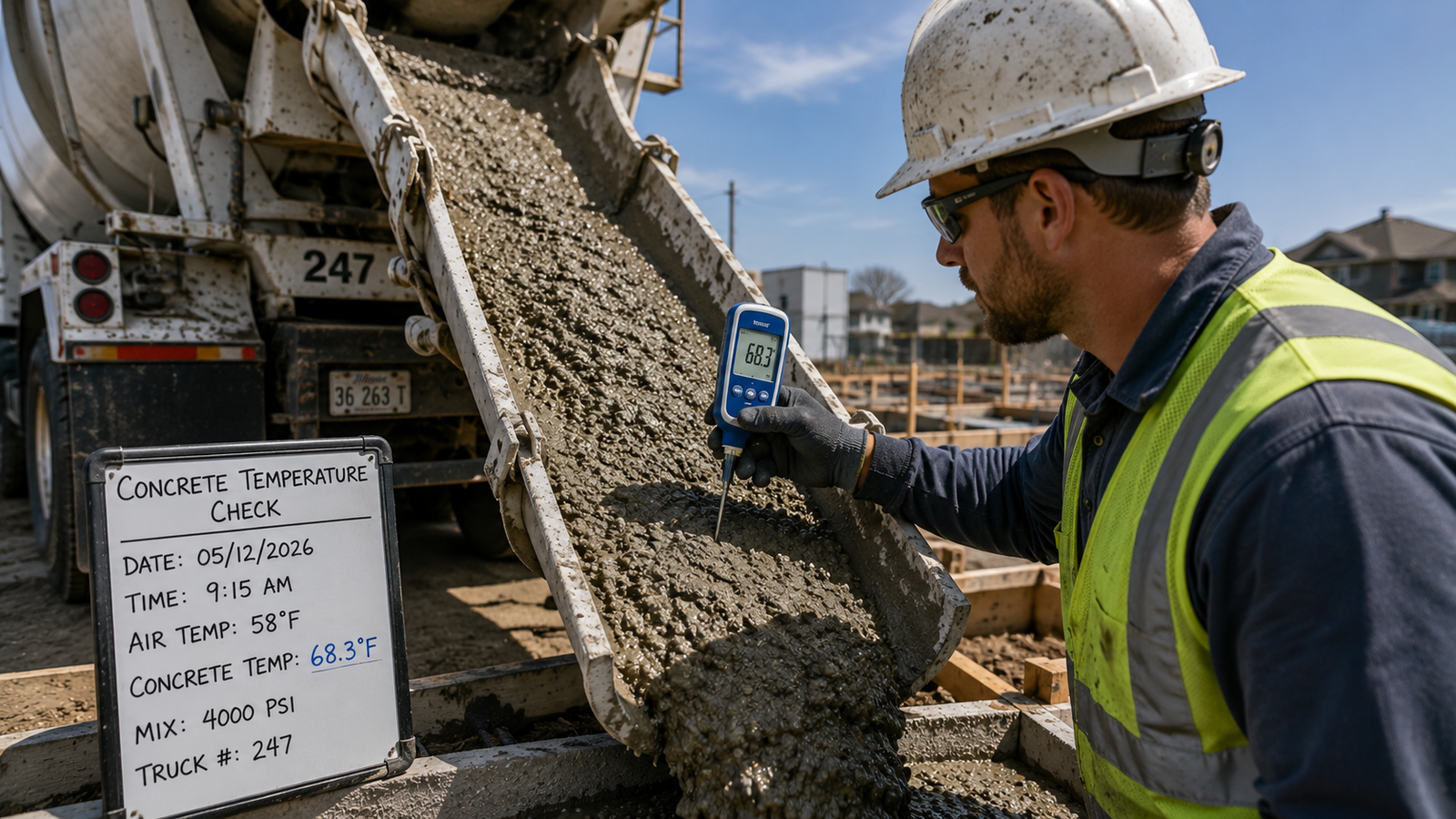
The concrete mixture itself can run significantly warmer or cooler than the surrounding air, depending on aggregate temperature, mixing water temperature, cement temperature, how long the load sits in the truck before delivery, sun exposure on the truck and forms, and ambient conditions at the batch plant versus the jobsite.
A mix batched with sun-warmed aggregate on a moderate 75°F day can arrive at the jobsite considerably hotter than the air temperature suggests, while a load held in a shaded, cool truck yard overnight in early spring can arrive cooler than expected. This is why project specifications sometimes set limits on concrete temperature at discharge, separate from any air temperature guidance. See Concrete Temperature Limits for the detailed technical treatment of these limits.
How to Read the Weather Forecast Before Pouring Concrete
Checking “is it going to rain” is not enough. Before booking a pour, review:
- Forecast high temperature
- Forecast low temperature, especially overnight
- Hourly temperature through the placement and early finishing window
- Rain probability, not just for the pour time but for several hours afterward
- Expected precipitation amount if rain is likely
- Wind speed, including gusts
- Relative humidity
- Cloud cover and expected direct sun exposure
- Overnight low temperatures for at least the first night after placement
The 24-Hour Weather Window for a Concrete Pour
The forecast at the moment of placement is only part of the picture. A complete weather review covers the full cycle from before the truck arrives through the first days of curing.
| Period | What to Check |
|---|---|
| 24 hours before | Overall forecast trend and any incoming fronts |
| Morning of the pour | Actual site temperature and conditions on-site |
| During placement | Concrete temperature at discharge, active weather |
| During finishing | Wind, rain risk, evaporation conditions |
| Overnight | Temperature drop, freeze risk |
| Following days | Conditions for curing and continued protection |
Evaluating just one point in this timeline, such as the forecast high for the day, misses the conditions that actually determine whether the pour goes well.
How Temperature Affects Concrete Setting and Strength
Hot conditions accelerate cement hydration and setting time while increasing the rate of moisture loss from the fresh surface, which raises the risk of plastic shrinkage cracking and can make finishing more difficult within the available working time. ACI’s hot-weather guidance also notes that concrete cured at higher initial temperatures, such as around 100°F during the first 24 hours, can show meaningfully lower 28-day compressive strength than concrete cured at a standard reference temperature, even though it gains strength faster at first.
Cold conditions slow hydration and strength development, and concrete that freezes before it reaches adequate strength can suffer permanent damage, which is the central concern behind ACI’s cold-weather protection requirements.
Best Season to Pour Concrete
Rather than ranking seasons as universally better or worse, treat each season as carrying a different primary concern to manage.
| Season | General Suitability | Main Concern |
|---|---|---|
| Spring | Good, with active monitoring | Rain and rapid temperature swings |
| Summer | Good with hot-weather planning | Heat and evaporation |
| Fall | Often favorable | Cold overnight temperatures |
| Winter | Possible with cold-weather protection | Freezing and slow strength gain |
Spring Concrete Pouring
Spring generally offers moderate temperatures, but forecasts can change quickly and rain risk is often elevated compared to other seasons. Wet or saturated subgrade left over from spring thaw or rain is a real concern independent of the day’s air temperature.
Check overnight lows closely in early spring, since a mild afternoon can still be followed by a near-freezing night. Check the weather shortly before ordering concrete rather than relying on a forecast from several days out, and consult Pouring Concrete in the Rain if precipitation is a realistic possibility.
Summer Concrete Pouring
Summer can produce excellent results when heat, evaporation, solar radiation, humidity, and wind are actively managed, and when scheduling accounts for the hottest part of the day. Early morning or evening placement is commonly used specifically to reduce concrete temperature and evaporation risk during summer pours.
This guide summarizes the summer decision points; for the complete hot-weather procedure, including specific evaporation-control techniques and scheduling detail, see Pouring Concrete in Hot Weather.
Fall Concrete Pouring
Fall is often favorable because daytime temperatures are moderate and solar radiation is typically less intense than midsummer, which generally keeps evaporation risk lower. The main things to watch are overnight lows that can approach or drop below freezing well before the calendar suggests winter has arrived, along with a rapidly shortening daylight window that can compress your available finishing time.
Winter Concrete Pouring
Concrete can be placed in cold weather, but it requires planning and active protection rather than being avoided outright. ACI’s cold-weather guidance focuses on preventing early-age freezing, maintaining the conditions needed for continued strength development, and avoiding rapid temperature changes during the protection period.
Common cold-weather measures include using heated mixing water or aggregate to raise concrete temperature, insulated blankets over the fresh concrete, heated enclosures for larger or more sensitive pours, and appropriate accelerating admixtures where the project allows them. The protection period itself, meaning how long these measures need to stay in place, depends on the cement type used and whether an accelerator is included.
For the complete cold-weather procedure, see Pouring Concrete in Winter and Cold Weather Concrete.
Season vs. Time-of-Day Decision Guide
| Season | Preferred Timing Tendency | Main Consideration |
|---|---|---|
| Spring | Mid-morning, after overnight moisture clears | Rain risk, swinging temperatures |
| Summer | Early morning or evening | Heat and evaporation |
| Fall | Mid-morning, once overnight cold clears | Overnight cold, shorter daylight |
| Winter | Warmest practical part of the day | Cold-weather protection through the protection period |
These are general planning tendencies, not fixed scheduling rules. Local climate, project specification, and site-specific conditions should always take priority over this general pattern.
Can You Pour Concrete in the Rain?
The answer depends heavily on timing. Rain before placement is primarily a site-condition issue, since standing water or saturated subgrade needs to be addressed before concrete goes in. Rain during placement can disrupt finishing and may require postponement depending on the intensity and how long it’s expected to last.
Rain after finishing carries risk that depends on how mature the surface is, how far along finishing has progressed, site drainage, and whether protective covering is available. This guide covers the scheduling decision; see Pouring Concrete in the Rain for the detailed procedures for each of these scenarios.
How Wind Affects the Best Time to Pour
Wind is one of the most commonly overlooked factors in basic “best time to pour” advice, and ACI specifically identifies high wind speed as one of the defining hot-weather conditions alongside temperature and humidity. Wind increases the rate of evaporation from the fresh concrete surface, which speeds up surface drying and raises the risk of plastic shrinkage cracking.
A Genuinely Useful Insight
A moderately warm, windy, dry day can sometimes present more evaporation risk than a hotter but calm, humid day, because evaporation from the concrete surface responds to the combination of wind, humidity, and temperature together, not temperature alone. Wind speed for evaporation calculations is typically measured close to the concrete surface, since that’s the air movement that actually matters for moisture loss.
How Humidity Affects Concrete Pouring
Low humidity accelerates evaporation from the fresh concrete surface, while higher humidity generally slows it. Humidity doesn’t act alone, though; it interacts directly with temperature, wind, and solar radiation to determine the actual evaporation rate the concrete experiences.
A hot day with high humidity can sometimes be more manageable than a cooler day with very low humidity and strong wind, which is exactly why this guide avoids ranking any single weather variable as the deciding factor on its own.
How Sun Exposure Affects Concrete Placement
Direct sunlight on the slab, hot forms, and hot subgrade all contribute radiant heat that can raise the effective surface temperature well above the ambient air temperature reported in a forecast. This additional heating increases evaporation risk independent of the air temperature reading.
Shaded placement conditions, whether from natural shade, temporary sunshades, or simply timing the pour before direct sun reaches the work area, are generally easier to manage than a slab poured under full, direct summer sun.
Concrete Weather Risk Matrix
| Condition | Risk | Typical Response |
|---|---|---|
| Moderate temperature, calm, adequate humidity | Low | Normal planning and procedures |
| High heat | Higher | Hot-weather plan, cooler scheduling |
| Strong wind | Higher | Evaporation control, windbreaks |
| Low humidity combined with heat or wind | Higher | Fogging, evaporation retarders, faster curing start |
| Heavy rain during placement window | High | Consider postponement |
| Freezing conditions during protection period | High | Cold-weather protection required |
How to Choose the Best Concrete Pour Window
- Check hourly temperature through the placement and finishing window
- Check rain probability for the placement period and several hours after
- Check wind speed and relative humidity together
- Check overnight lows for at least the first night after placement
- Check what concrete temperature your project specification requires or allows
- Confirm your curing and protection plan is ready before committing to a date
- Choose the delivery window that keeps all of the above within a manageable range
Best Time to Pour Concrete by Project Type
| Project | Main Consideration |
|---|---|
| Driveway | Large exposed surface increases evaporation and finishing-window pressure |
| Patio | Usually smaller, but still fully exposed to sun and wind |
| Slab | Thickness and total surface area both affect the available finishing time |
| Footing/foundation | Section size and structural requirements affect protection needs |
| Sidewalk | Exposure and a relatively short finishing window |
Best Time to Pour a Concrete Slab
For a slab, weigh slab size against available crew capacity, since a larger exposed surface area needs to be finished within the same weather window as a small one, but with more square footage per finisher. Solar exposure and wind both increase evaporation risk in proportion to the exposed surface area, and delivery sequencing matters more on larger slabs where multiple truck loads need to arrive in a coordinated schedule. See How to Pour a Concrete Slab for the complete placement procedure.
Best Time to Pour a Concrete Driveway
Driveway scheduling should weigh morning versus afternoon delivery against your finishing crew’s capacity, since driveways are large, fully exposed surfaces that need steady progress from placement through finishing. Confirm truck scheduling and access in advance, factor in hot-weather exposure if pouring in summer, and check rain probability closely, since a driveway’s large surface area makes it more vulnerable to a sudden downpour mid-finish than a small patio would be.
When Should You Postpone a Concrete Pour?
Reasons to Consider Postponing
- Severe weather in the forecast
- High probability of heavy rain during critical placement or finishing time
- Frozen subgrade
- Conditions that exceed what your project’s temperature-control plan can actually handle
- Extreme wind or evaporation conditions beyond your available control measures
- Inadequate curing or weather protection materials on hand
- Insufficient crew or equipment for the conditions
- Unsafe site access conditions
Rather than applying an arbitrary universal temperature cutoff, evaluate whether the conditions exceed what your specific project’s specification and protection plan can reasonably manage.
When Concrete Can Still Be Poured in Difficult Weather
Difficult weather doesn’t automatically mean cancellation. ACI’s hot-weather and cold-weather guidance both emphasize planning and active control measures rather than treating challenging weather as an automatic stop condition.
- Adjusting the schedule to a cooler or calmer part of the day
- Ordering temperature-controlled concrete from the supplier
- Applying evaporation-control measures such as fogging or evaporation retarders
- Using curing compounds appropriate to the conditions
- Installing insulated blankets for cold protection
- Using heated enclosures for cold-weather placement
- Using appropriate admixtures within the project’s specification
- Providing shading for hot, sunny conditions
- Providing windbreaks to reduce evaporation on windy days
Concrete Temperature Limits and Weather Planning
Project specifications may establish specific temperature limits, since fresh concrete temperature at discharge matters independent of the air temperature outside. ACI 301 and ACI 305.1 commonly limit fresh concrete temperature to 95°F at discharge for general hot-weather construction, subject to the specific project’s applicable specification, while cold-weather minimums depend on section size, cement type, and the required protection period rather than one fixed number.
See Concrete Temperature Limits for the complete technical treatment of these limits and how they apply to different project conditions.
How to Prepare the Site Before the Best Pour Day
The best weather window can still produce a poor result if the site isn’t ready when the truck arrives.
- Finish excavation to the required grade
- Prepare and compact the subgrade
- Install forms, checked for square and level
- Install reinforcement per the project design
- Verify elevations at multiple points
- Confirm truck access to the pour location
- Prepare all placement and finishing tools in advance
- Confirm your finishing crew is scheduled and available
- Prepare curing materials before the truck arrives
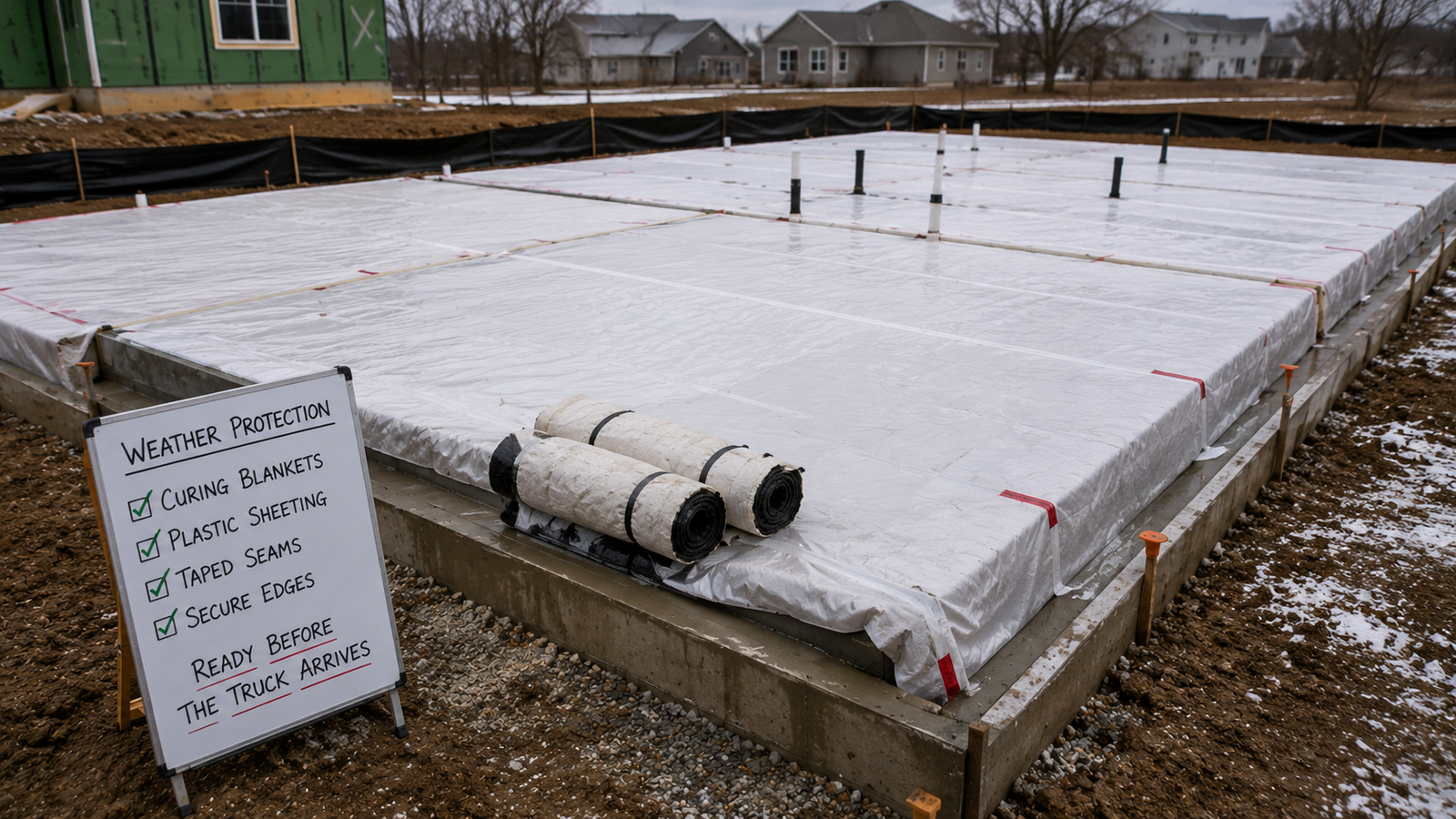
- Prepare weather protection materials appropriate to the forecast
How to Schedule a Ready-Mix Delivery
Choose a delivery window that accounts for local traffic patterns and haul time from the plant, and coordinate that window directly with your finishing crew’s availability. Confirm the weather forecast again shortly before the scheduled delivery, since conditions can shift from what was forecast days earlier.
Avoid unnecessary truck waiting time on-site, since most suppliers charge for excessive standby, and have a contingency plan in case weather or site conditions change unexpectedly close to the delivery window.
Concrete Curing After the Pour
Choosing good weather for placement is only half the job. Curing needs to begin at the appropriate time after finishing, and it involves maintaining adequate moisture, managing temperature, protecting against early freezing in cold conditions, protecting against excessive heat and rapid drying in hot conditions, and continuing for the appropriate duration for your specific mixture and conditions.
See the Concrete Curing and Drying Time Guide, Concrete Curing Time Chart, and Concrete Curing Temperature Chart for the complete curing reference.
Weather Conditions That Increase Cracking Risk
Several weather-driven mechanisms connect directly to cracking risk: rapid moisture loss leading to plastic shrinkage cracking, thermal stress from large temperature swings, early freezing before adequate strength develops, and rapid temperature changes during the curing period. See Why Is My Concrete Cracking? for the complete discussion of these and other cracking mechanisms.
Concrete Pouring Weather Checklist
Before Booking
- Temperature, both forecast high and low
- Rain probability and timing
- Wind speed
- Relative humidity
- Overnight lows for the first night after placement
- Current site condition
Before Truck Arrival
- Forms ready and checked
- Reinforcement in place per design
- Tools and equipment ready
- Curing materials on hand
- Weather protection materials ready
After Placement
- Curing begins at the appropriate time
- Protection from rain, freezing, or rapid drying in place
- Conditions monitored through the protection period
Common Mistakes When Choosing a Concrete Pour Day
- Checking only the daily forecast high and ignoring the rest of the weather window
- Ignoring overnight temperatures after placement
- Ignoring wind speed entirely
- Ignoring humidity and its interaction with temperature and wind
- Ignoring the specific timing of forecast rain relative to placement and finishing
- Pouring onto frozen, saturated, or otherwise problematic subgrade
- Scheduling a pour too late in the day during extreme heat
- Having no curing plan ready before the pour
- Having no weather contingency plan
- Assuming air temperature and concrete temperature are the same thing
Best Time to Pour Concrete FAQs
What is the best time of day to pour concrete?
Generally the coolest practical period that still allows your crew to complete placement, finishing, and begin curing properly, often early morning in warm climates.
What is the best season to pour concrete?
There is no single best season. Spring, summer, fall, and winter can all work with the appropriate weather monitoring and, where needed, hot-weather or cold-weather protection measures.
What temperature is best for pouring concrete?
There is no single ideal temperature. What matters is the combination of air temperature, concrete temperature, humidity, wind, and sun exposure, evaluated together against your project’s specification and protection plan.
Can you pour concrete in 90°F weather?
Often yes, with hot-weather planning such as cooler scheduling, evaporation control, and possibly temperature-controlled concrete, since ACI’s hot-weather provisions focus on managing conditions rather than an automatic stop at a specific temperature.
Can you pour concrete when it is 40°F?
Potentially, but this falls within ACI’s cold-weather threshold and generally requires a cold-weather protection plan appropriate to the expected temperatures during the protection period.
Can you pour concrete in winter?
Yes, with proper cold-weather procedures, including temperature management, insulation or heated enclosures, and monitoring through the required protection period.
Can you pour concrete in summer?
Yes, and it can produce excellent results when heat, evaporation, wind, and sun exposure are actively managed and scheduling avoids the hottest part of the day.
Can you pour concrete before rain?
It depends on the timing and intensity of the expected rain relative to your placement and early finishing window. See Pouring Concrete in the Rain for detailed guidance.
Can you pour concrete in the rain?
Sometimes, though it depends heavily on rain intensity, timing, and available protection measures. Rain during active finishing is generally more problematic than light rain well after finishing is complete.
Is morning or afternoon better for pouring concrete?
Morning is often preferred in warm climates because cooler temperatures reduce evaporation risk, but the better choice depends on your specific weather window and crew schedule.
Does wind affect concrete pouring?
Yes. Wind increases evaporation from the fresh concrete surface and is specifically identified by ACI as one of the defining hot-weather conditions alongside temperature and humidity.
Does humidity affect concrete curing?
Yes. Low humidity accelerates moisture loss from the surface, while higher humidity generally slows it, though humidity interacts with temperature and wind rather than acting alone.
What temperature is too cold for concrete?
ACI defines cold weather as air temperature falling to or below 40°F during the required protection period, not a single universal cutoff for every project. Below that threshold, cold-weather protection is generally required.
What temperature is too hot for concrete?
There is no single universal cutoff. Hot weather is defined by ACI as a combination of high air and concrete temperature, low humidity, high wind, and solar radiation, and project specifications may separately limit concrete temperature at discharge, commonly around 95°F under ACI 305.1 for general construction.
How long should good weather continue after pouring concrete?
Favorable conditions should ideally continue through the initial curing and protection period, which varies by mixture, cement type, and project conditions rather than one fixed number of days.
Should you pour concrete at night?
It can be advantageous in hot climates for temperature control, but it introduces lighting, visibility, and crew safety considerations that need to be weighed against the temperature benefit.
What happens if it rains after pouring concrete?
The risk depends on how mature the concrete surface is, how far finishing has progressed, drainage, and whether protective covering is available. See Pouring Concrete in the Rain for the detailed response for different scenarios.
Should you postpone a concrete pour because of rain?
It depends on the timing and intensity of the rain relative to your placement and finishing schedule. Light rain well after finishing is a different situation than heavy rain during active placement.
Does concrete cure better in hot or cold weather?
Neither extreme is inherently better. Hot conditions accelerate hydration but increase evaporation and cracking risk, while cold conditions slow strength development and introduce freezing risk. Moderate, well-managed conditions are generally easiest to work with.
What should I check before scheduling a concrete pour?
Temperature, concrete temperature requirements, rain probability, wind, humidity, overnight lows, site condition, and whether your curing and protection plan is ready.
Planning a Pour in Challenging Weather?
Get the detailed hot-weather or cold-weather procedure for your specific conditions before you schedule delivery.
Check Concrete Temperature Limits