
Beam Size Chart – Span, Load, Species, Grade & Design Values

Beam Size Chart
Span, Load, Species, Grade & Design Values
A detailed beam sizing reference built around the same inputs a designer actually uses: clear span, uniform and point load, tributary width, species and grade design values, deflection criteria, shear and bearing, not span alone.
⭐ Master Beam Size Chart
Beam selection is a multi variable problem. The master chart below organizes the inputs a designer checks together rather than presenting one size per span, which is not how allowable load tables actually work.
| Design input | Typical range or value | Role in beam selection | Governing check |
|---|---|---|---|
| Beam size | Nominal 2×6 through 6×12, or built up, LVL, glulam, steel | Sets section modulus, moment of inertia and self weight | All checks |
| Clear span | 6 to 24+ ft in residential work | Drives bending moment (M = wL squared over 8 for uniform load) and deflection | Bending, deflection |
| Uniform load | Expressed in pounds per linear foot, plf | Distributed load along the beam length | Bending, shear, deflection |
| Total load | Expressed in pounds | Must be paired with distribution pattern to be meaningful | Load modeling |
| Species and grade | Southern Pine, Douglas Fir Larch, Hem Fir, SPF; Select Structural, No.1, No.2, No.3 | Sets reference design values Fb, Fv, E, Fc perpendicular | All checks |
| Design values | Fb (bending), Fv (shear), E (stiffness), Fc perp (bearing) | Species and grade specific allowable stress values | Bending, shear, deflection, bearing |
| Deflection criteria | Commonly L/360 live load, L/240 total load for floors; L/240 or L/180 for roofs, per applicable code | Serviceability limit independent of strength | Deflection |
Reference design values for visually graded dimension lumber (Fb, Fv, E) are published in the National Design Specification Supplement, and allowable spans additionally require checking shear and stiffness alongside bending, consistent with AWC beam design guidance.
⭐ Beam Size by Span
Span alone never determines beam size. The table below is a planning checklist, not a capacity table, for common residential clear spans.
| Clear span | Bending demand trend | Typical planning direction |
|---|---|---|
| 6 ft | Low, for moderate loads | Solid sawn lumber often feasible under verified light to moderate loads |
| 8 ft | Moderate | Depth and ply count become more important as tributary width grows |
| 10 ft | Moderate to high | Compare solid sawn, built up and shallow engineered options |
| 12 ft | High | Deeper built up lumber or engineered wood commonly evaluated |
| 14 ft | High | Point loads and deflection often govern over bending alone |
| 16 ft | Very high | Engineered wood or steel frequently more efficient |
| 18 ft | Very high | Project specific engineering strongly recommended |
| 20 ft | Very high | Do not use a generic dimensional lumber rule |
| 24 ft | Extreme | Engineered wood, steel or a designed system is typical |
⭐ Beam Size by Lumber Dimensions
Nominal size is a trade name, not a structural dimension. Section modulus and moment of inertia must be computed from actual dressed size.
| Nominal size | Actual size (in) | Actual size (mm) | Typical structural use |
|---|---|---|---|
| 2×6 | 1.5 x 5.5 | 38 x 140 | Rafters, short joists, light framing |
| 2×8 | 1.5 x 7.25 | 38 x 184 | Joists, ledgers, headers, built up beam plies |
| 2×10 | 1.5 x 9.25 | 38 x 235 | Floor systems, common built up beam ply |
| 2×12 | 1.5 x 11.25 | 38 x 286 | Main beams, long span joists, built up beam ply |
| 4×6 | 3.5 x 5.5 | 89 x 140 | Short beams, posts |
| 4×8 | 3.5 x 7.25 | 89 x 184 | Solid sawn beam, moderate spans |
| 4×10 | 3.5 x 9.25 | 89 x 235 | Solid sawn beam |
| 4×12 | 3.5 x 11.25 | 89 x 286 | Solid sawn beam, longer spans |
| 6×6 | 5.5 x 5.5 | 140 x 140 | Heavy posts, short heavy beams |
| 6×8 | 5.5 x 7.5 | 140 x 191 | Timber beam |
| 6×10 | 5.5 x 9.5 | 140 x 241 | Timber beam |
| 6×12 | 5.5 x 11.5 | 140 x 292 | Heavy timber beam |
| Built up 2x members | Width multiplies by ply count at 1.5 in per ply | Varies | Double or triple 2x beams, common residential girders |

⭐ Beam Span Chart by Beam Depth
Section modulus for a rectangular section is S = b d squared / 6, and moment of inertia is I = b d cubed / 12. Depth has a squared or cubed effect, so increasing depth is usually far more efficient than increasing width.
| Approximate depth | Relative section modulus at equal width | Practical effect |
|---|---|---|
| 8 in deep | Baseline | Suitable starting point for shorter spans or lighter loads only, subject to full design check |
| 10 in deep | About 1.6x the 8 in baseline | Noticeable gain in bending resistance and stiffness |
| 12 in deep | About 2.25x the 8 in baseline | Common depth for longer residential spans |
| 14 in deep | About 3.1x the 8 in baseline | Often reached with engineered wood rather than solid sawn lumber |
| 16 in deep | About 4x the 8 in baseline | Typically an engineered wood or steel member |
Beam Span by Beam Width
Section modulus and moment of inertia scale linearly with width, so widening a beam helps but is a less efficient way to add capacity than increasing depth.
| Nominal width | Actual width | Effect on section properties |
|---|---|---|
| 2 in nominal | 1.5 in | Baseline single ply width, common in built up beams |
| 3 in nominal | 2.5 in | Roughly 1.7x the section modulus of a single 2 in ply at equal depth |
| 4 in nominal | 3.5 in | Roughly 2.3x the section modulus of a single 2 in ply at equal depth |
| 6 in nominal | 5.5 in | Roughly 3.7x the section modulus of a single 2 in ply at equal depth |
⭐ Beam Size by Load
Numerical capacities are only meaningful when tied to stated assumptions. The table below shows how stated uniform loads translate to total load over a fixed 10 ft span, for illustration only.
| Uniform load | Total load over a 10 ft span | Planning implication |
|---|---|---|
| 500 lb/ft | 5,000 lb | Light residential floor or roof condition, still requires full check |
| 1,000 lb/ft | 10,000 lb | Common moderate residential beam loading range |
| 1,500 lb/ft | 15,000 lb | Wider tributary width or multi story load common at this level |
| 2,000 lb/ft | 20,000 lb | Deeper built up or engineered member frequently needed |
| 2,500 lb/ft | 25,000 lb | Engineered wood or steel commonly evaluated |
| 3,000 lb/ft | 30,000 lb | Professional structural design strongly recommended |
⭐ Beam Total Load vs Uniform Load
These two figures are frequently confused, but they describe different things and can produce very different structural demands even when the numbers look similar.
| Term | Definition | Example |
|---|---|---|
| Total load | The full weight the beam carries, in pounds | 10,000 lb total on the beam |
| Uniform load | Load spread evenly along the beam, in pounds per linear foot (plf) | 1,000 lb/ft over a 10 ft span equals 10,000 lb total |
The same 10,000 lb total can produce very different maximum moment, shear and deflection depending on whether it is spread out or concentrated. A generic uniform load table cannot be applied directly to a beam carrying a large point load.
⭐ Beam Size by Tributary Width
Tributary width is the width of floor or roof area assumed to deliver load to a given beam. A simplified uniform line load is w = q times tributary width, where q is the area load in psf.
| Tributary width | Load at 40 psf floor load | Load at 60 psf floor load |
|---|---|---|
| 6 ft | 240 plf | 360 plf |
| 8 ft | 320 plf | 480 plf |
| 10 ft | 400 plf | 600 plf |
| 12 ft | 480 plf | 720 plf |
Illustrative values only, combining a stated psf area load with tributary width; actual design loads must include dead, live and, where applicable, snow load per the governing code.
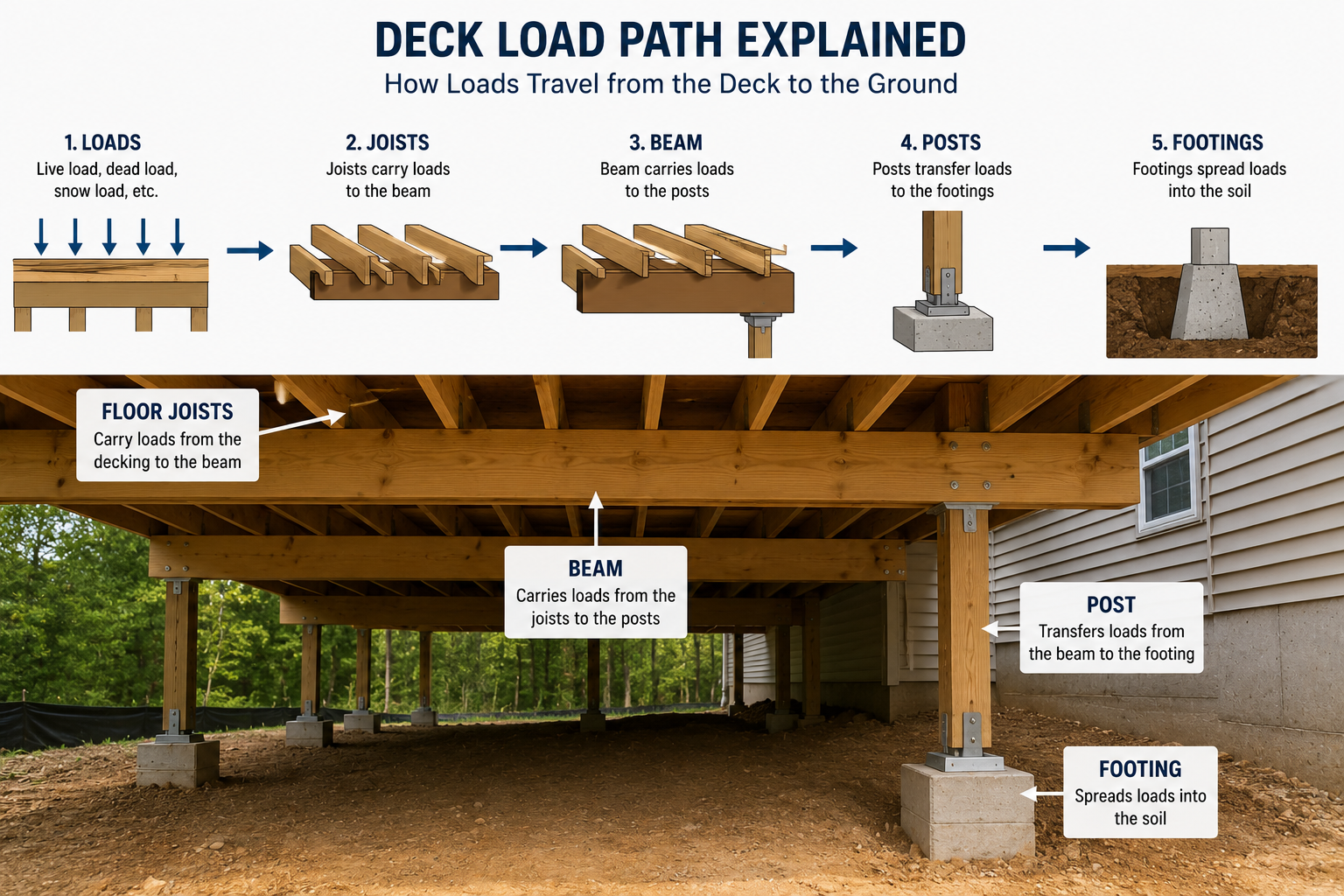
⭐ Beam Load Chart
Floor beam
Floor load, dead plus live, transfers through joists to the beam, then to posts and the foundation below.
Roof beam
Roof load, including dead load and snow where applicable, transfers through rafters or trusses to the beam and down to posts.
Deck beam
Deck load transfers through joists to the beam, then to posts and footings. See the Lumber Span Chart and related deck resources below for joist and footing sizing.
Beam Size for Floor Loads
Floor joists
Joist span and spacing determine tributary width delivered to the supporting beam.
Residential floor beams
Interior beams often carry two joist spans, roughly doubling tributary width compared with an exterior wall.
Open plan floors
Removing intermediate supports increases joist span and beam tributary width simultaneously.
Crawlspace and basement beams
These beams often carry the same floor loads as above grade beams, plus consider moisture exposure and bearing on foundation walls or piers.
Beam Size for Roof Loads
Rafters and trusses
Rafters transfer roof load directly; trusses concentrate reactions at bearing points, which can create larger point loads on a supporting beam.
Ridge beams
A structural ridge beam supports rafter ends directly and carries different loading than a non structural ridge board.
Snow and dead load
Roofing, sheathing, insulation and structure make up dead load; snow load is a separate, location specific design input.
Beam Size for Decks
Deck beams, joists, posts and footings should be sized together as one connected system rather than in isolation.
Beam Size for Garage Beams
Wide garage door openings concentrate roof or floor load onto short header or jamb sections, producing substantial point reactions. Garage floor beams and roof support beams over large openings frequently require engineered members rather than standard dimensional lumber.
⭐ Beam Size for Load Bearing Wall Removal
Wall removal beam sizing should never be reduced to a simple DIY table. It requires identifying every load the wall currently supports and designing a complete replacement load path.
Beam Size for Open Concept Rooms
Removing multiple interior walls to create an open concept space often creates long spans, concentrated point loads from above, and new post and foundation requirements. Evaluate the full structure above, not just the room being opened.
⭐ Beam Size by Number of Floors
The same clear span can require very different beam sizes depending on how many levels of structure it actually supports.
| Supported structure | Relative load level | Sizing implication |
|---|---|---|
| Roof only | Lowest | Often the smallest beam for a given span, subject to snow load |
| One floor | Low to moderate | Larger than roof only under comparable tributary width |
| Two floors | Moderate to high | Cumulative floor loads significantly increase demand |
| Floor plus roof | High | Combined loads often require deeper or engineered members |
| Multiple levels | Highest | Professional structural design essential |
⭐ Beam Size and Snow Load
Ground snow load, roof snow load, snow accumulation and unbalanced or drifted snow are location specific design inputs. A beam supporting a roof in a high snow region should never be sized using a generic low load table intended for milder climates. Always use the locally applicable design snow load.
Beam Size and Dead Load
Dead load is permanent and includes roofing, sheathing, flooring, ceiling finishes, insulation, wall weight, mechanical systems and the beam’s own self weight. These loads act continuously and must be included in every load combination, not just live or snow load cases.
Beam Size and Live Load
Live load varies by occupancy and use, such as residential floors, storage areas, garages and commercial applications. The applicable building code sets the minimum required design live load for each occupancy, and local requirements should always be confirmed rather than assumed.
⭐ Beam Size and Point Loads
A uniform load spreads evenly along the beam. A concentrated or point load acts at a specific location and can govern design even when the total load looks similar.
| Point load source | Typical cause |
|---|---|
| Beam reaction | End reaction from another beam framing into this one |
| Post above | Column or post load transferred from an upper level |
| Roof truss reaction | Concentrated bearing point from a truss |
| Girder reaction | Load transferred from a girder to a supporting beam |
| Wall load | Short wall segment or header bearing on the beam |
A generic uniform load beam table does not automatically apply when significant point loads are present. Point loads should be modeled at their actual location for an accurate moment and shear check.
⭐ Beam Size and Deflection
Strength and stiffness are separate checks. A beam can have adequate bending strength but still deflect more than is acceptable for serviceability.
| Member and condition | Live load deflection limit | Total load deflection limit |
|---|---|---|
| Floor members, general | L/360 | L/240 |
| Floor supporting brittle finishes or partitions | L/480 | L/240 |
| Roof members, supporting plaster ceiling | L/360 | L/240 |
| Roof members, no ceiling | L/180 | L/120 |
Deflection limits shown are common code and industry reference values for illustration; always confirm the limit that applies under the governing building code and project conditions.
⭐ Beam Size and Bending Strength (Fb)
Fb is the reference bending design value for a species and grade combination. Bending stress in a beam equals moment divided by section modulus, so a larger section modulus, achieved mainly through greater depth, lowers bending stress for a given moment. Selection requires comparing the calculated bending stress against the adjusted allowable Fb for the chosen material.
⭐ Beam Size and Shear Strength
Shear stress is generally highest near the supports rather than at midspan, which is the opposite location from where bending moment usually peaks. Short, heavily loaded spans are more likely to be governed by shear. Fv is the reference shear design value used for this check, and it must be satisfied in addition to bending and deflection.
Beam Size and Modulus of Elasticity (E)
E measures material stiffness and directly controls deflection under a given load and span. Species and grade both affect E, so two beams of identical size can deflect differently if they are different species or grades. Selecting a beam based on bending alone can miss a deflection failure if E is too low for the span and load.
⭐ Beam Size by Lumber Species
Reference design values differ meaningfully by species group even at the same grade, which is why the same nominal beam size can carry different loads depending on species.
| Species group, Select Structural grade | Fb, bending (psi) | Fv, shear (psi) | E, modulus of elasticity (psi) |
|---|---|---|---|
| Southern Pine | 2,550 | 175 | 1,800,000 |
| Douglas Fir Larch | 1,500 | 180 | 1,900,000 |
| Hem Fir | 1,400 | 150 | 1,600,000 |
| Spruce Pine Fir | 1,250 to 1,300 (varies by table) | 135 | 1,400,000 |
Reference design values shown are for Select Structural grade dimension lumber and are illustrative of typical published magnitudes from the National Design Specification Supplement tables; always confirm current grade stamped values for the actual material being used, since supplement tables are periodically revised.
Beam Size by Lumber Grade
| Grade | Relative strength and stiffness | Availability |
|---|---|---|
| Select Structural | Highest allowable design values within a species | Less common, often special order |
| No. 1 | High, below Select Structural | Moderately available |
| No. 2 | Moderate, the most common structural grade stocked | Widely available |
| No. 3 | Lower allowable values, more restrictions | Available but less used for primary beams |
Within the same species, Fb generally decreases from Select Structural through No. 3, for example Douglas Fir Larch No. 2 has a lower reference Fb than Douglas Fir Larch Select Structural. Always match the design value table to the actual grade stamp on the lumber being used.
⭐ Solid Sawn Beam vs Built Up Beam
| Feature | Solid sawn beam | Built up lumber beam |
|---|---|---|
| Number of plies | Single member | Two or more 2x members fastened together |
| Fastening | Not applicable | Nails, structural screws or bolts per a designed schedule |
| Load sharing | Not applicable | Plies must be adequately fastened to share load as intended |
| Stability | Depends on grade and moisture content of one piece | Can be more dimensionally stable when properly assembled |
| Availability | Limited by timber size and species availability | Readily built from common dimensional lumber |
Built Up Beam Size Chart
Double 2x, triple 2x and multiple ply beams require proper ply alignment, a fastening schedule sized to transfer shear between plies, full and level bearing at each support, and verification that all plies participate in load sharing as assumed in the design.
⭐ Beam Size vs LVL
| Feature | Dimensional lumber | LVL |
|---|---|---|
| Long spans | Limited by available solid sawn sizes | Can often achieve longer spans at a given depth |
| Higher loads | Requires larger or built up sections | Higher design values can reduce required depth for the same load |
| Stiffness | Variable, species and grade dependent | More consistent, manufacturer controlled properties |
| Availability | Widely available in standard sizes | Available through suppliers carrying the specific manufacturer product |
| Design values | Species and grade tables (NDS Supplement) | Manufacturer specific published design values |
Beam Size for Engineered Wood
LVL, PSL, glulam and other structural composite lumber products each have product specific design values published by the manufacturer. Structural glued laminated timber design should follow the applicable NDS provisions together with the manufacturer’s product data, rather than a generic table intended for solid sawn lumber.
Glulam Beam Size Chart
Glulam is manufactured in a range of standard widths and depths, and appropriate span and load capacity depend on the specific combination symbol, layup and manufacturer’s published design tables. Keep any stated glulam capacity tied to a specific published design table rather than presenting one general purpose chart.
⭐ Steel Beam Size Chart vs Wood Beam Size Chart
| Feature | Wood beam | Steel beam |
|---|---|---|
| Weight | Lighter, easier to handle on site | Heavier, may need equipment to place |
| Strength | Good for typical residential spans and loads | Higher strength to depth ratio for long spans or heavy loads |
| Span capability | Practical up to moderate spans before engineered wood is needed | Efficient for longer spans and heavier loads |
| Deflection | Governed by species and grade E value | Governed by steel modulus of elasticity, generally higher and more consistent |
| Installation | Familiar to most residential framing crews | Often requires specialized connections and lifting |
| Corrosion | Not applicable in the same way, but subject to decay and moisture issues | Requires corrosion protection where exposed to moisture |
| Cost | Often lower material cost for typical residential spans | Can be more cost effective for long spans or heavy point loads despite higher unit cost |
See the Steel Beam Size Chart for steel section specific information.
I Beam vs Solid Beam
| Member type | Design basis |
|---|---|
| Wood I joist | Manufacturer specific span and load tables |
| Solid sawn beam | Species and grade design values, NDS Supplement |
| LVL | Manufacturer specific design values |
| Steel I beam | Steel design standards and section properties |
Any I shaped structural member, whether wood I joist, LVL or steel I beam, should be designed using its specific manufacturer or material standard design data rather than a table intended for a different product type.
⭐ Beam Bearing Requirements
A beam can pass bending, shear and deflection checks and still fail if the bearing at its supports is inadequate.
| Bearing element | What to verify |
|---|---|
| End bearing | Beam end must fully and evenly contact the support |
| Bearing length | Sufficient length is required to keep compression perpendicular to grain within allowable limits |
| Posts | Post size and species must support the beam reaction without excessive crushing |
| Walls | Wall framing and any required blocking must transfer the load down to the foundation |
| Compression perpendicular to grain (Fc perp) | Species and grade specific value that limits allowable bearing stress |
| Bearing plates | Steel or engineered bearing plates may be required to distribute load, especially on steel or masonry supports |
Beam Connection and Fastening
Beam to post connections, beam to column connections, built up beam fastening, joist hangers, bolts and structural screws each have specific manufacturer or code based requirements. Avoid presenting one universal connection detail, since the correct hardware and fastening schedule depends on the actual loads, member sizes and materials involved.
⭐ Beam Post Size and Support
A beam is only as good as the post and footing supporting it. This is a complete load path: beam, then post, then footing.
| System element | Key consideration |
|---|---|
| Post size | Must be sized for the concentrated axial load delivered by the beam |
| Post spacing | Directly sets the beam clear span between supports |
| Post load | Equal to the beam reaction at that support, including tributary width and load type |
| Foundation and footing | Must safely transfer the concentrated post load into the supporting soil or structure |
See the Deck Footing Size Chart resources for footing sizing guidance connected to post loads.
Beam Cantilever and Overhang
Key terms to understand: cantilever, the portion of the beam extending past its support; back span, the supported portion between two bearing points; overhang, the unsupported extension; and point loads, which can significantly change cantilever behavior depending on location.
⭐ Beam Span vs Clear Span
Clear span is the distance between the faces of supports. Beam length is the full physical length of the member, including material resting on each support. Bearing to bearing span is often measured center to center of supports. Always confirm which definition a published table or calculator is using before comparing numbers.
Beam Span vs Overall Beam Length
A 12 ft physical beam does not necessarily have a 12 ft structural span. Some of its length rests on bearing at each end, so the clear opening it spans is shorter than the total beam length. Always account for bearing length, support width and the true clear opening when comparing a beam to a published span table.
Beam Size for Door Openings
Single doors, double doors and larger openings each transfer different tributary loads to the header or beam above them. A header and a beam are related but distinct concepts. See the Header Span Chart for opening specific guidance.
Beam Size for Window Openings
Window openings, large picture windows and multiple adjacent openings in a load bearing wall each require their own header or beam sizing based on the tributary load above the opening. See the Header Span Chart for details.
Beam Size for Garage Openings
| Garage opening width | Sizing consideration |
|---|---|
| 8 ft | Common single door width, moderate header or beam demand |
| 9 ft | Slightly wider single door, incrementally higher demand |
| 10 ft | Larger single or compact double opening |
| 12 ft | Common double door width, increased reactions at jambs |
| 16 ft | Standard two car opening, often requires engineered header or beam |
| 18 ft and wider | Frequently moves beyond simple dimensional lumber solutions |
As garage openings widen, jamb reactions grow substantially, and many of these conditions are sized using engineered wood or steel headers rather than standard dimensional lumber.
📐 Visual Beam Size Guide
Original SVG diagrams strengthen this page and make it more linkable. Recommended diagrams and where to place them:
1. Beam load path
Floor to joists to beam to posts to footing, already included above in the tributary width section.
2. Beam span diagram
Clear span, bearing, beam length and supports, already included in the clear span section.
3. Tributary width diagram
Joists feeding load into the beam, already included above.
4. Uniform load vs point load
Already included in the total load versus uniform load section.
5. Beam deflection diagram
Undeformed versus deflected beam, already included in the deflection section.
6. Beam bending diagram
Add a cross section showing compression on top and tension on the bottom fiber of a simply supported beam.
7. Built up beam diagram
Single, double and triple ply comparison, already included above.
8. Beam vs header
Add a wall elevation showing a header over an opening compared with a beam spanning between posts.
9. Wood beam vs LVL
Add a side by side visual comparing a built up dimensional lumber beam with an LVL of similar depth.
10. Beam to post to footing load path
Add a vertical section view showing the reaction traveling from beam to post to footing to soil.
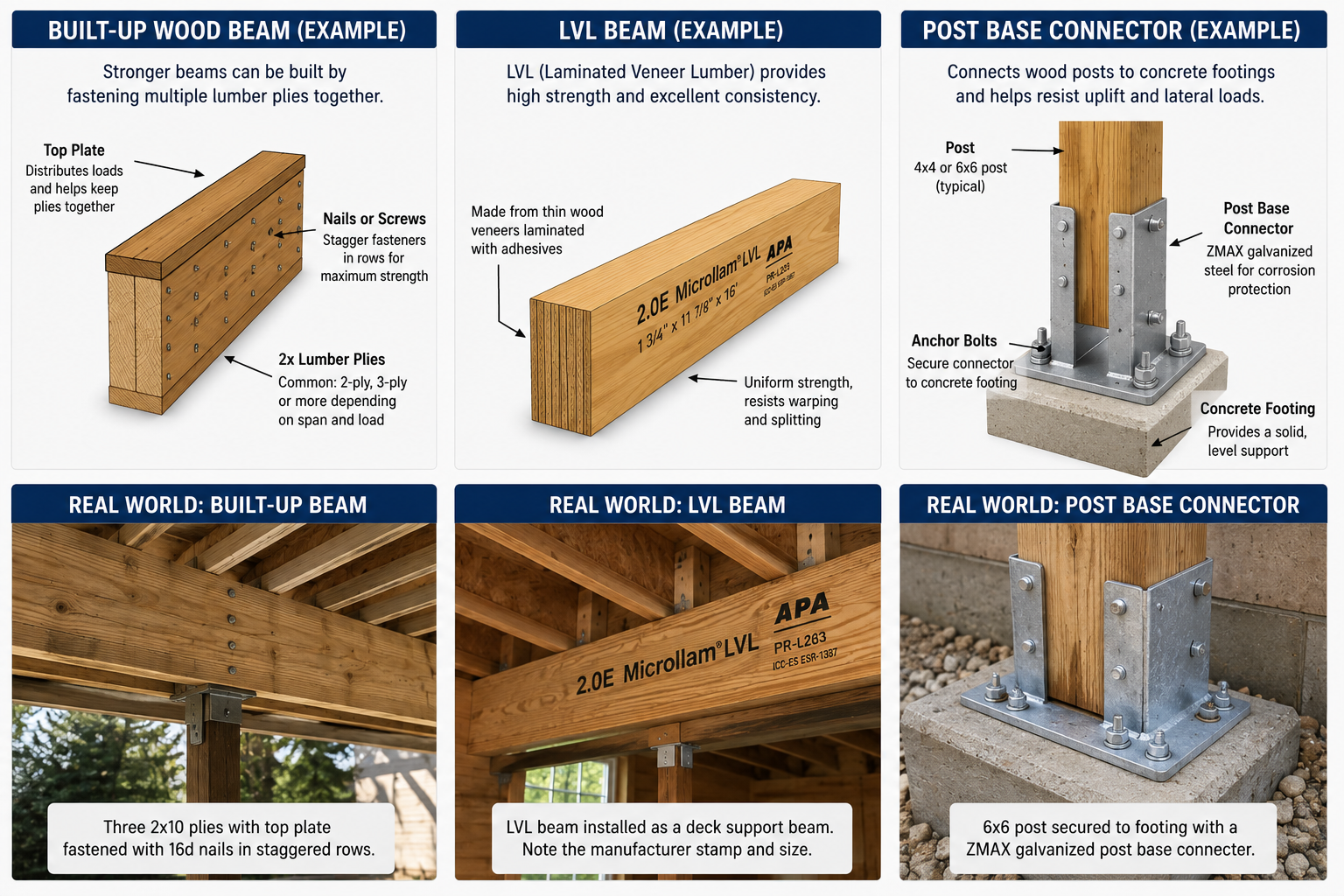
⭐ How to Read a Beam Size Chart
Before trusting any beam number, confirm it states all of the following.
Span and load
Beam span, beam load and load type (uniform, point, or combined).
Material
Species, grade, or manufacturer product for engineered wood.
Design values
Fb, E, and the shear value used, plus the beam size itself.
Serviceability and support
Bearing condition, deflection limit applied, and number of plies if built up.
This mirrors the AWC beam design procedure, which starts from a known span and load, then evaluates species, size and grade design values to confirm bending, stiffness and shear are all satisfied.
⭐ How to Calculate Beam Size
Use the Beam Size Calculator and Beam Load Calculator for preliminary analysis, and have safety critical structural work verified by a qualified professional.
⭐ Beam Size Worked Examples
1. Eight foot floor beam
Establish joist direction and an 8 ft tributary width, convert the floor psf load into a plf line load, add any point loads, then evaluate trial sizes against bending, shear and deflection.
2. Ten foot beam comparison
Hold span, load, species, grade and deflection limit constant, then compare a solid sawn member, a double ply built up member and an LVL of similar depth.
3. Twelve foot span
Under the same load as the 10 ft example, moment and deflection both increase, typically requiring greater depth or an engineered product.
4. Sixteen foot span
At this span, deflection often governs before bending strength, making deeper or engineered members more attractive than adding plies to dimensional lumber.
5. Tributary width change
Increasing tributary width from 8 ft to 12 ft raises the line load by 50 percent for the same psf floor load, which can require a larger beam even though the span is unchanged.
6. Uniform load vs point load
A beam carrying a 10,000 lb total load spread uniformly experiences different maximum moment and shear than an identical beam carrying the same 10,000 lb as a single concentrated load at midspan.
Common Beam Sizing Mistakes
Choosing from span alone
Span without load, material and support information is not a complete input set.
Ignoring tributary width
Missing joist direction or supported area can significantly understate the actual line load.
Ignoring floor, roof or snow load
Each load source must be included and combined per the applicable code.
Ignoring point loads
A generic uniform load table does not capture concentrated reactions.
Ignoring species or grade
Design values differ enough between species and grades to change the required size.
Ignoring deflection or shear
A bending only check is incomplete; stiffness and end reactions can govern.
Ignoring bearing, posts or footings
The beam must safely transfer load to posts, then footings, then soil.
Assuming more plies solve everything
Plies must be properly fastened and bearing must still be verified.
Using wood tables for LVL or steel
Each material requires its own product or material specific design data.
Treating cantilevers as simple spans
Cantilever design depends on back span and load placement, not a simple span table.
Frequently Asked Questions
Related Calculators and Charts
📥 Download Beam Size Chart PDF
Use the print button to generate a current, print ready PDF. The printable reference includes the master beam size chart, beam span chart, beam load chart, tributary width guide, species and grade guide, Fb, E and shear explanation, deflection guide, bearing guide, built up beam guide, LVL versus dimensional lumber comparison, beam versus header guidance, beam load path diagrams, worked examples and a contractor quick reference sheet.


![Rebar Size Chart - Complete #3 to No. 20 [64] Diameter, Area & Grade Reference](https://concretecalculate.com/wp-content/uploads/2026/07/Rebar-Size-Chart-2026-Complete-3-to-No.-20-64-Diameter-Area-Grade-Reference-390x220.png)