Stamped Concrete vs Pavers Cost: 2026 USA Price Comparison
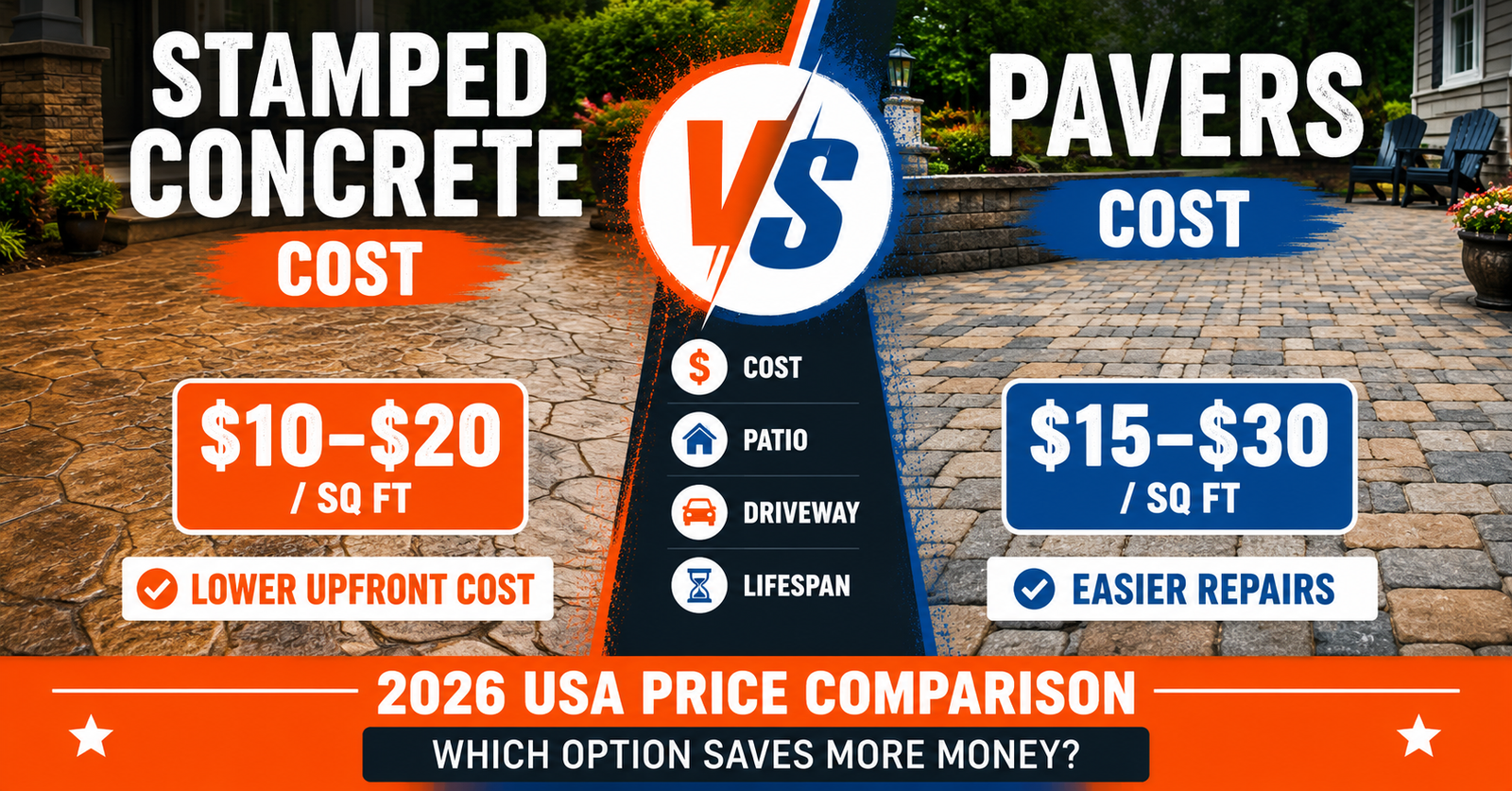
Stamped concrete costs $10 to $20 per square foot installed. Concrete pavers cost $15 to $30 per square foot. Natural stone pavers go even higher at $20 to $50 per square foot. On a typical 400-square-foot patio, stamped concrete saves you $2,000 to $12,000 upfront over pavers – but pavers have advantages that can justify the premium depending on your situation. This guide lays out every number you need to make the right call for your project in 2026.
Quick Cost Comparison at a Glance
Before getting into project-specific numbers, here is how stamped concrete and all major paver types stack up on installed cost per square foot in 2026. These are national averages for a standard residential patio or driveway with a standard gravel base, no unusual access issues, and mid-range design complexity.
| Surface Option | Installed Cost/Sq Ft | Typical Lifespan | Repairability |
|---|---|---|---|
| Stamped Concrete (basic) | $10 to $13 | 25 to 35 years | Difficult |
| Stamped Concrete (mid-range) | $13 to $17 | 25 to 35 years | Difficult |
| Stamped Concrete (premium) | $17 to $25 | 25 to 35 years | Difficult |
| Concrete Pavers | $15 to $30 | 30 to 50 years | Easy |
| Brick Pavers | $12 to $25 | 25 to 50 years | Easy |
| Travertine Pavers | $20 to $40 | 30 to 50 years | Moderate |
| Natural Bluestone Pavers | $25 to $50 | 50+ years | Moderate |
| Flagstone Pavers | $20 to $45 | 50+ years | Moderate |
Use the stamped concrete cost calculator to see exactly what stamped concrete would cost for your dimensions. Then use the paver calculator to estimate paver material quantities. Coming to contractor meetings with your own numbers puts you in a much stronger position.
Cost Comparison by Project Type
Cost per square foot only tells part of the story. Total project cost changes based on what you’re building, how thick the concrete needs to be, and how much base preparation is required. Here are side-by-side numbers for the three most common applications.
Patio Cost: Stamped Concrete vs Pavers
| Option | Cost/Sq Ft | 12×12 (144 sq ft) | 20×20 (400 sq ft) | 20×30 (600 sq ft) |
|---|---|---|---|---|
| Stamped Concrete (mid) | $12 to $16 | $1,730 to $2,300 | $4,800 to $6,400 | $7,200 to $9,600 |
| Concrete Pavers | $15 to $30 | $2,160 to $4,320 | $6,000 to $12,000 | $9,000 to $18,000 |
| Brick Pavers | $12 to $25 | $1,730 to $3,600 | $4,800 to $10,000 | $7,200 to $15,000 |
| Natural Stone Pavers | $20 to $45 | $2,880 to $6,480 | $8,000 to $18,000 | $12,000 to $27,000 |
Use the concrete patio calculator and concrete patio cost calculator for a precise stamped concrete estimate. Also check our detailed guides on the 12×12 concrete patio cost and 10×20 concrete patio cost for specific size breakdowns.
Driveway Cost: Stamped Concrete vs Pavers
Driveways need 5 to 6 inches of concrete thickness for vehicle loads. For pavers, this means a thicker compacted gravel base – typically 6 to 8 inches. Both factors add cost compared to a patio, but they add roughly equally to both options.
| Option | Cost/Sq Ft | Single-Car (350 sq ft) | Two-Car (700 sq ft) |
|---|---|---|---|
| Stamped Concrete (mid) | $13 to $18 | $4,550 to $6,300 | $9,100 to $12,600 |
| Concrete Pavers | $20 to $35 | $7,000 to $12,250 | $14,000 to $24,500 |
| Brick Pavers | $18 to $30 | $6,300 to $10,500 | $12,600 to $21,000 |
| Natural Stone Pavers | $25 to $50 | $8,750 to $17,500 | $17,500 to $35,000 |
For driveway-specific planning, use the concrete driveway calculator and the concrete driveway cost calculator. Our guide on how thick a concrete driveway should be covers thickness requirements for both concrete and paver driveways.
Pool Deck Cost: Stamped Concrete vs Pavers
Pool decks are where the comparison gets interesting. Both options work well, but they come with different trade-offs around slip resistance, heat absorption, and drainage.
| Option | Cost/Sq Ft | 800 Sq Ft Pool Deck | Slip Resistance | Heat Retention |
|---|---|---|---|---|
| Stamped Concrete | $14 to $22 | $11,200 to $17,600 | Good (textured) | High |
| Concrete Pavers | $18 to $32 | $14,400 to $25,600 | Excellent | Moderate |
| Travertine Pavers | $20 to $40 | $16,000 to $32,000 | Excellent | Low (stays cool) |
| Natural Stone Pavers | $25 to $45 | $20,000 to $36,000 | Very Good | Low to Moderate |
Travertine pavers are popular around pools specifically because they stay cooler underfoot than concrete in direct sun. Use the pool deck cost calculator for a complete estimate on your specific pool deck dimensions.
See Your Exact Numbers Side by Side
Use the stamped concrete cost calculator to estimate your project, then compare with paver material quantities from the paver calculator.
Use Stamped Concrete Cost CalculatorWhy Pavers Cost More to Install
The price gap between stamped concrete and pavers isn’t random. It comes from real differences in materials, installation labor, and time on site. Understanding this helps you evaluate contractor quotes more critically.
Material Cost
Concrete mix for a stamped slab costs $155 to $195 per cubic yard delivered. Coloring and stamping supplies add $1.50 to $3.00 per square foot in materials. By contrast, quality concrete pavers cost $3 to $12 per square foot in material alone, before any installation labor. Brick pavers run $2 to $8 per square foot. Natural stone pavers can cost $6 to $25 per square foot just for the material. The raw material cost of pavers is simply higher than the concrete mix for an equivalent area.
Installation Labor
Pouring, finishing, and stamping a concrete slab is a high-skill but relatively fast process – a crew of 4 can pour and stamp a 600-square-foot patio in a single day. Installing pavers is slower because every piece must be individually placed, leveled, and compacted. A 600-square-foot paver patio typically takes a crew of 3 to 4 workers two to three days. More labor hours at the same crew rate means higher total labor costs for pavers on every project.
Base Requirements
Both options need a compacted gravel base. However, paver installations typically require a deeper base – 4 to 8 inches of compacted gravel plus a 1-inch sand setting bed. Stamped concrete uses a 4-inch gravel base. More base material plus more excavation depth adds $1 to $3 per square foot to paver jobs compared to concrete. For large driveways or areas with soft soil, this difference becomes significant. Use the base material calculator to estimate gravel requirements for either option.
Cuts and Curves
Curved or irregular-shaped areas cost significantly more with pavers than with concrete. Concrete pours into any shape easily. Pavers require cutting each piece at curves and edges, adding labor time and generating material waste. A curved paver patio can cost 20 to 35% more than the same square footage in a straight layout. Stamped concrete handles curves with zero additional cost.
Lifespan and Durability Compared
Both options are durable – neither is a fragile choice for outdoor use. But they age differently and fail in different ways.
| Factor | Stamped Concrete | Concrete Pavers | Brick Pavers |
|---|---|---|---|
| Structural lifespan | 30 to 50 years | 30 to 50 years | 25 to 50 years |
| Surface appearance | 25 to 35 yrs with sealing | 30 to 40 years | 25 to 40 years |
| Freeze-thaw performance | Good (4000 PSI + sealer) | Excellent (flex joints) | Good to Excellent |
| Ground settling response | Cracks as one rigid slab | Individual pieces shift | Individual pieces shift |
| Deicing salt resistance | Good when sealed | Good | Moderate |
| Stain resistance | High when sealed | Moderate | Low to Moderate |
| Weed growth risk | None | Moderate (joints) | Moderate (joints) |
The biggest structural difference is how each option responds to ground movement. A stamped concrete slab is one rigid piece. When the ground under it settles or shifts – especially in clay-heavy soils or freeze-thaw regions – the slab cracks. That crack runs across the full surface and is very hard to repair invisibly. Pavers, by contrast, move with the ground. A few pavers may settle or shift, but the surrounding ones stay in place. You reset the affected pieces and the surface looks normal again.
If your property has expansive clay soil that swells and shrinks seasonally, pavers are strongly preferable to stamped concrete for patios and walkways. The paver joints accommodate that movement. Stamped concrete slabs over expansive clay are at high risk of cracking within 5 to 10 years even with proper control joints. Check your soil type before choosing your surface. The subbase calculator can help you plan adequate base depth for either option.
Maintenance Costs Over 30 Years
Upfront cost is only one number. What you spend maintaining the surface over its life can equal or exceed the original installation cost. Here’s how both options compare over a 30-year period on a 400-square-foot patio.
Stamped Concrete Maintenance
- Resealing every 2 to 3 years: $1 to $2 per square foot contractor-applied, $0.25 to $0.50 per square foot DIY. On 400 sq ft, that’s $100 to $800 per application. Over 30 years: $1,000 to $8,000 in resealing costs.
- Joint refilling every 5 to 7 years: $40 to $180 per cycle for a 400 sq ft patio.
- Pressure washing (annual): $50 to $200 per year or $20 to $50 DIY.
- Crack repair (if needed): $200 to $600 per repair – color matching is difficult.
- Estimated 30-year maintenance total: $2,000 to $6,000
Use the concrete sealer calculator to figure out product quantities for each resealing job, and the expansion joint calculator to plan your joint maintenance.
Paver Maintenance
- Polymeric sand replenishment every 3 to 5 years: $150 to $400 per application for 400 sq ft.
- Re-leveling settled pavers (occasional): $200 to $800 per repair area depending on scope.
- Weed control in joints: $30 to $100 per year in herbicide or manual removal.
- Pressure washing (annual): $50 to $200 per year or $20 to $50 DIY.
- Optional sealing: $0.50 to $1.50 per square foot every 3 to 5 years for enhanced stain resistance.
- Estimated 30-year maintenance total: $2,500 to $5,500
💰 True 30-Year Cost – 400 Sq Ft Patio: All Options
Stamped Concrete: $5,200 install + $4,000 maintenance = $9,200 total
Concrete Pavers (mid-range): $9,000 install + $4,000 maintenance = $13,000 total
Brick Pavers (mid-range): $7,200 install + $3,500 maintenance = $10,700 total
Natural Stone Pavers: $13,000 install + $3,000 maintenance = $16,000 total
Over 30 years, stamped concrete remains the most cost-effective decorative option by a significant margin in most scenarios.
Repair Costs When Things Go Wrong
This is one area where pavers have a clear, undeniable advantage. The repairability difference is real and worth factoring into your decision.
Stamped Concrete Repair
If a stamped concrete slab cracks, your options are limited. Small hairline cracks can be filled with a flexible polyurethane sealant ($20 to $80 in materials). The crack will still be visible since no filler matches the original color and texture exactly. For larger structural cracks, a contractor grinds out the damaged area, fills with patching compound, and retextures and recolors – a process that rarely looks invisible. Major slab failure from ground heave or settling may require tearing out and replacing the entire section. Use the concrete repair cost calculator to estimate repair costs before deciding whether to repair or replace.
Paver Repair
Paver repair is straightforward. If a paver cracks or a section settles, you pull up the affected pieces, regrade the sand base underneath, and reset them. If you kept spare pavers from the original job (which every paver contractor should recommend), the repair is nearly invisible. Cost: typically $50 to $300 in labor for a small repair area. No color matching, no grinding, no special equipment. This advantage becomes most valuable 10 to 15 years into the surface’s life when subtle settling starts to occur.
Which Holds Up Better by Climate
Where you live matters significantly for this decision. The performance gap between stamped concrete and pavers in freeze-thaw climates is much larger than in warm-weather states.
Cold Climates (Zone 5 and Above: Illinois, Minnesota, Michigan, New York, etc.)
In northern states with significant freeze-thaw cycles, pavers have a meaningful advantage. The joints between pavers allow for the micro-movement caused by freezing and thawing ground without cracking the surface. Stamped concrete in these climates must use 4000 PSI air-entrained concrete, proper control joints, and diligent sealing to perform well. Without all three, surface scaling and cracking are common within 5 to 10 years.
Pavers also handle deicing salts better. Salt-filled meltwater gets absorbed through paver joints and drains away. On stamped concrete, de-icer salt pools on the surface and attacks the sealer and concrete matrix directly – especially damaging if the sealer is worn. If you live north of Interstate 80 and plan to use deicers, pavers are the lower-risk choice for driveways and front walkways.
Warm and Moderate Climates (Southeast, Southwest, Texas, Florida)
In mild climates without freeze-thaw exposure, stamped concrete performs just as reliably as pavers over the long term. The main durability factors – UV color fade, surface wear, and deicing salt damage – are minimal or nonexistent. Stamped concrete is the clear cost winner in these markets. A stamped patio in Florida or Texas installed at $12 per square foot performs just as well as a $25 per square foot paver patio over a 30-year period. Check state-specific concrete cost pages for your market: Florida, Texas, Arizona, and Georgia.
Hot and Sunny Climates (Southwest, Pool Areas)
For pool decks in hot climates, travertine and light-colored natural stone pavers have a notable advantage: they stay cooler underfoot than dark stamped concrete in direct sun. If you have a pool in Arizona, Nevada, or Southern California, pavers – especially travertine – are worth the premium for barefoot comfort alone. Stamped concrete pool decks in these markets should use light-colored integral colors and acrylic sealers with UV inhibitors to reduce surface temperature and color fade.
When to Choose Each Option
After comparing costs, durability, maintenance, and repairability, here is a clear decision framework based on actual project conditions.
Choose Stamped Concrete When:
- Budget is a priority. For the same decorative appearance, stamped concrete consistently costs $5 to $15 per square foot less than pavers. On a 700-square-foot driveway, that’s $3,500 to $10,500 in real savings.
- The area has curves, irregular shapes, or custom borders. Concrete pours into any shape at no extra cost. Paver cuts add labor cost on every curved edge.
- You’re in a warm climate without heavy freeze-thaw cycles. Stamped concrete performs as well as pavers in mild climates and costs significantly less.
- You want a seamless, monolithic look. Pavers always have visible joints. Stamped concrete, especially seamless stone patterns, can look like a single continuous surface.
- The project is large (over 600 sq ft). The per-square-foot savings on stamped concrete versus pavers multiply substantially on larger areas.
Choose Pavers When:
- You’re in a heavy freeze-thaw climate with clay soils. Paver joint flexibility dramatically reduces cracking risk compared to a rigid stamped slab.
- Long-term repairability matters most. If you want to be able to fix a 2-square-foot problem in 15 years without disturbing the rest of the surface, pavers win outright.
- You have a pool and want cooler surface temps. Travertine and light stone pavers stay noticeably cooler underfoot in hot sun than any concrete surface.
- The property is high-end and appearance longevity is the priority. Natural stone pavers age gracefully. Stamped concrete without regular resealing looks faded and worn.
- You want to add or remove sections later. Pavers can be pulled up, extended, or reconfigured. Stamped concrete cannot.
Final Verdict by Project
✅ Budget patio in warm climate: Stamped concrete – clear winner on cost
✅ Large driveway anywhere: Stamped concrete – saves $5,000 to $15,000
✅ Curved or organic-shaped area: Stamped concrete – no cutting cost
✅ Pool deck in hot climate: Travertine or light stone pavers – cooler underfoot
✅ Northern driveway on clay soil: Pavers – better freeze-thaw and repairability
✅ High-end front entrance: Natural stone or brick pavers – premium look and longevity
✅ Any project where future flexibility matters: Pavers – can be lifted, reset, or extended
Calculators for This Decision
- Stamped Concrete Cost Calculator – full stamped project estimate
- Paver Calculator – paver quantity estimate
- Concrete Patio Cost Calculator – patio cost comparison
- Pool Deck Cost Calculator – pool deck pricing
- Concrete Driveway Cost Calculator – driveway estimate
- Base Material Calculator – gravel base planning
- Concrete Sealer Calculator – resealing material cost
- Concrete Repair Cost Calculator – repair cost planning
- Paver Installation Cost Calculator – full paver project cost
- Subbase Calculator – base depth and material planning
Key Takeaways
- Stamped concrete costs $10 to $20 per square foot installed. Concrete pavers cost $15 to $30. Brick pavers run $12 to $25. Natural stone reaches $20 to $50.
- On a 400-square-foot patio, stamped concrete saves $2,000 to $12,000 upfront compared to pavers.
- Over 30 years including maintenance, stamped concrete remains the most cost-effective decorative option in most scenarios.
- Pavers repair far more easily – individual pieces can be lifted, releveled, and reset without disturbing the rest of the surface.
- In freeze-thaw climates with clay soils, pavers handle ground movement better because the joints allow flex rather than cracking.
- In warm southern climates, stamped concrete performs just as well as pavers at roughly half the installed price.
- For pool decks in hot climates, travertine and light stone pavers stay cooler underfoot than any concrete surface.
- Curved or complex-shaped areas are significantly cheaper in stamped concrete since paver cuts add cost on every edge.
Frequently Asked Questions
Related Articles
-
Concrete vs Asphalt Cost: 2026 Price Comparison GuideApril 29, 2026