
Why Is My Concrete Cracking – Causes, Prevention and Repair Tips
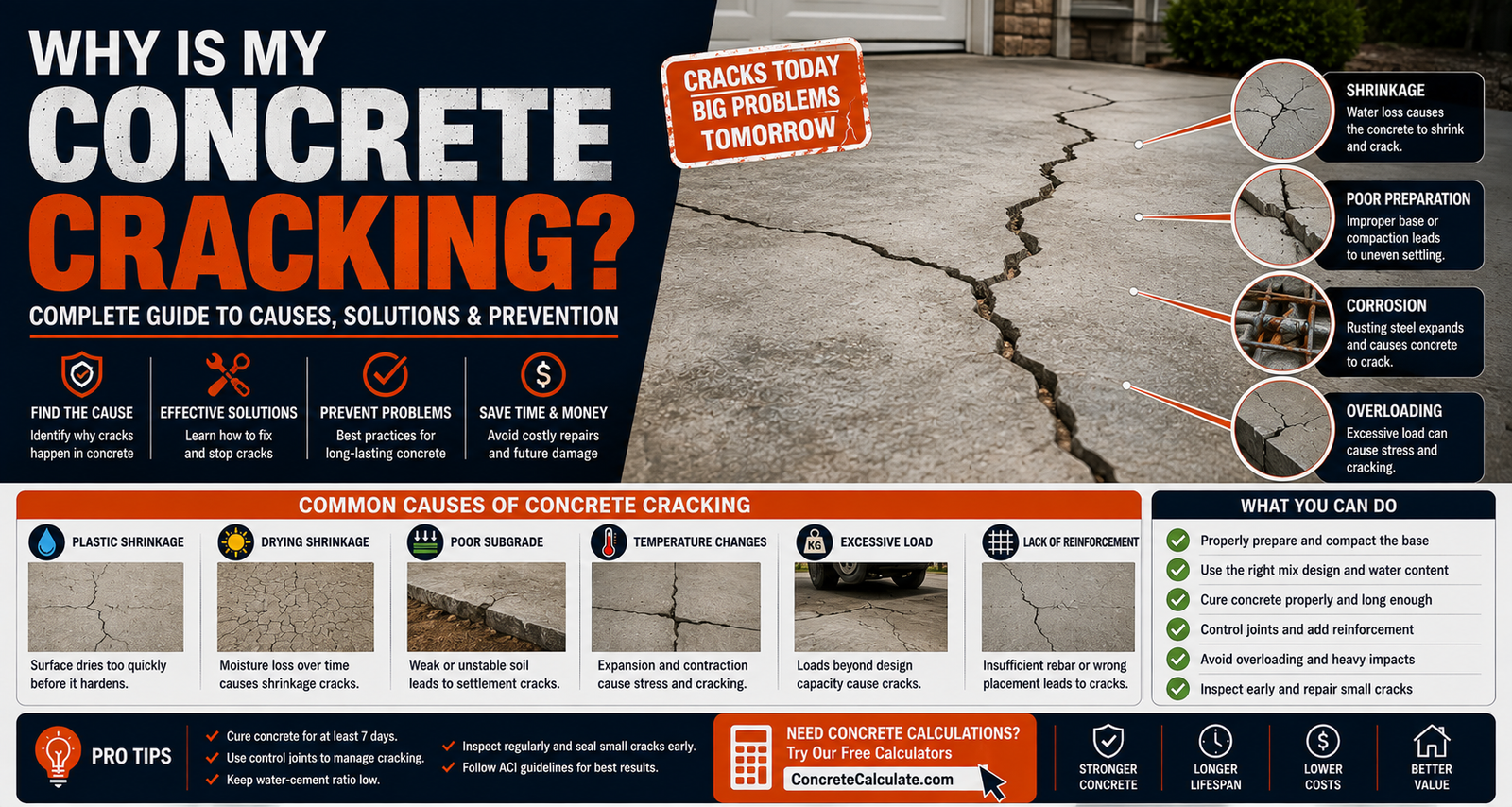
Diagnose your crack, understand what caused it, decide whether it matters, and know what to do next.
Quick Answer
Concrete cracking can result from shrinkage, rapid moisture loss, poor curing, settlement, thermal movement, freeze-thaw exposure, improper joint layout, excessive loading, poor subgrade support, reinforcement corrosion, chemical deterioration, or construction and design problems.
Some cracking is expected in concrete. The important question is not whether a crack exists, but what type of crack you have and whether it indicates an underlying problem that needs attention.
ACI’s guidance on evaluating cracks in concrete treats cracking as having multiple distinct mechanisms, each evaluated according to its cause and context, not as a single problem with one universal fix.
In This Guide
- Is It Normal for Concrete to Crack?
- How to Tell If a Concrete Crack Is Serious
- Concrete Crack Severity: A Practical Screening Guide
- What Does the Crack Pattern Tell You?
- The Main Causes of Concrete Cracking
- Plastic Shrinkage Cracks
- What Causes Plastic Shrinkage Cracking?
- How to Prevent Plastic Shrinkage Cracking
- Plastic Settlement Cracks
- Drying Shrinkage Cracks
- Why Concrete Shrinks as It Dries
- Thermal Cracking in Concrete
- Freeze-Thaw Cracking and Surface Damage
- Settlement Cracks from Soil or Base Movement
- How Drainage Causes Concrete Cracking
- Cracking from Heavy Loads and Overloading
- Cracking from Poor Concrete Mix or Excess Water
- How Poor Finishing Causes Concrete Cracks
- How Poor Curing Causes Concrete Cracking
- Control Joints: Why Concrete Cracks Where It Does
- Control Joints vs. Expansion, Isolation and Construction Joints
- Corner Cracks and Re-Entrant Corners
- Cracks Around Rebar or Embedded Elements
- Concrete Cracking from Reinforcement Corrosion
- Chemical and Environmental Causes of Concrete Cracking
- How to Diagnose a Concrete Crack Yourself
- How to Monitor a Concrete Crack
- When Should You Call a Professional?
- Can You Repair a Cracked Concrete Slab?
- How to Repair Hairline Concrete Cracks
- How to Repair Wider or Moving Cracks
- When Concrete Crack Repair Is Not Enough
- Concrete Resurfacing vs. Crack Repair vs. Replacement
- How to Prevent Concrete Cracks Before Pouring
- Concrete Crack Prevention by Cause
- Common Concrete Cracking Mistakes
- Concrete Crack Repair Cost
- Concrete Cracking: Quick Decision Guide
- Concrete Cracking FAQs
Is It Normal for Concrete to Crack?
Concrete is a brittle, cementitious material. It changes volume as it hydrates and dries, and that volume change often gets restrained by reinforcement, subgrade friction, adjoining slabs, or the concrete’s own geometry.
Restraint against volume change creates tensile stress inside the concrete. Concrete has limited tensile capacity compared to its compressive strength, so cracks can develop even in well-designed, properly built concrete.
The Distinction That Actually Matters
Not every crack signals a problem, and not every crack is harmless. The important distinction is between normal, manageable cracking that concrete is expected to develop, and cracking that indicates an active or worsening issue with the slab’s support, materials, or structure.
How to Tell If a Concrete Crack Is Serious
Crack width alone doesn’t tell the whole story. Work through these factors together for a more complete picture:
- Width: measure it, and note whether it varies along its length
- Depth: does it appear to be a superficial surface crack, or does it seem to run through the slab?
- Vertical displacement: is one side of the crack higher than the other?
- Horizontal movement: has the crack visibly opened wider over time?
- Growth: is it getting longer or wider, or has it stayed the same?
- Location: is it in the middle of a slab, at a corner, along a control joint, near a wall, in a foundation, or around a column?
- Water: is water entering through the crack?
- Structural symptoms nearby: leaning walls, sticking doors, uneven floors, settlement, bulging, spalling, or exposed reinforcement
Looking at these factors together gives a far more reliable read on a crack than width by itself.
Concrete Crack Severity: A Practical Screening Guide
| What You Observe | Possible Significance | Recommended Action |
|---|---|---|
| Very fine, stable surface cracks | Often cosmetic | Monitor |
| Fine crack along a control joint | Often expected | Monitor, seal if appropriate |
| Crack with surface crazing | Surface deterioration | Evaluate finishing and curing history |
| Crack that is visibly widening | Active movement | Investigate the cause |
| Crack with vertical displacement | Settlement or heave | Investigate the underlying cause |
| Wide or through-depth crack | Potentially significant | Professional evaluation depending on location |
| Foundation wall crack with water intrusion | Potential foundation or drainage issue | Investigate promptly |
| Crack with exposed or corroding reinforcement | Durability or structural concern | Professional assessment |
There is no arbitrary width, such as one-eighth of an inch, that universally separates cosmetic from structural cracking. Location, movement, and accompanying symptoms matter more than a single measurement.
What Does the Crack Pattern Tell You?
- Random hairline cracks: possible shrinkage
- Map-like surface cracking: possible crazing from surface drying or finishing issues
- Long straight crack: possible shrinkage, joint layout, or restraint
- Crack from a re-entrant corner: stress concentration at an inside corner or opening
- Diagonal crack: possible settlement, geometry, or stress concentration
- Offset slab sections: possible differential settlement or heave
- Crack parallel to an edge: possible edge or support issue
- Cracks around reinforcement: possible settlement or reinforcement-related issues
- Horizontal wall crack: possible lateral pressure or wall movement
Pattern Alone Doesn’t Prove the Cause
These patterns point toward likely mechanisms, but they don’t replace a full evaluation. Two cracks that look identical can have different causes depending on the slab’s age, support conditions, and history.
The Main Causes of Concrete Cracking
| Cause | When It Occurs | Typical Clue |
|---|---|---|
| Plastic shrinkage | Fresh concrete, before final set | Early random or roughly parallel surface cracks |
| Plastic settlement | Before hardening | Cracks over reinforcement or restraints |
| Drying shrinkage | Hardened concrete, weeks to months later | Cracks from restrained shrinkage, often at joints |
| Thermal movement | Temperature changes, days to weeks | Seasonal or restraint-related cracking |
| Settlement | Any time, often gradual | Offset or sunken slab sections |
| Freeze-thaw | Repeated freezing cycles, years | Cracking alongside scaling or spalling |
| Overload | Under applied load | Load-related cracking near the loaded area |
| Reinforcement corrosion | Long-term | Cracks or spalls following the line of embedded steel |
| Chemical reactions | Long-term | Expansion or map cracking, sometimes with gel exudation |
| Construction defects | Varies | Pattern depends on the specific defect |
FHWA’s crack-cause literature groups causes into plastic shrinkage, settlement, drying shrinkage, thermal stresses, chemical reactions, weathering, corrosion of reinforcement, poor construction practices, construction overloads, design and detailing errors, and externally applied loads. This guide walks through each of these in turn.
Plastic Shrinkage Cracks
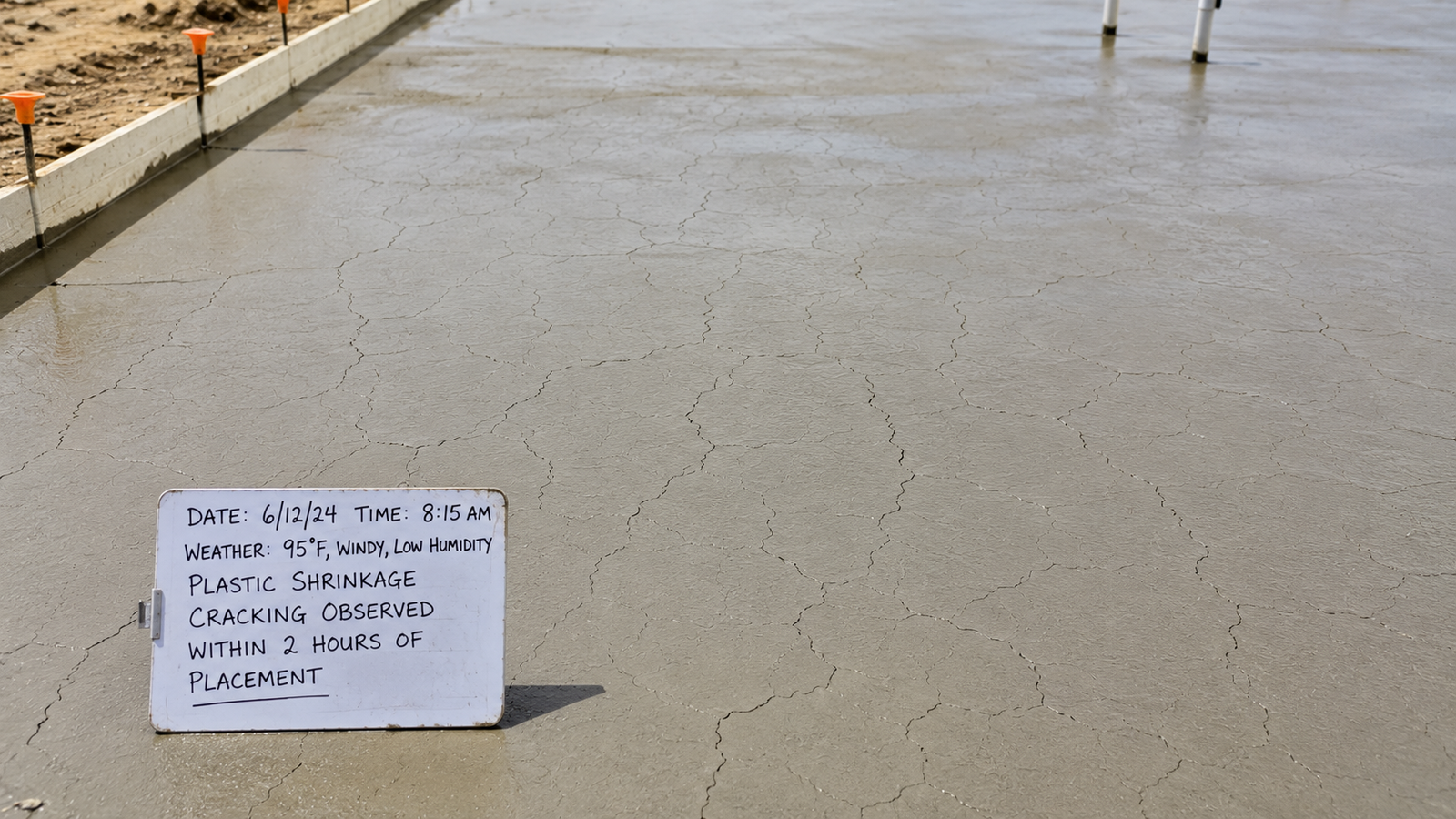
Plastic shrinkage cracking occurs while concrete is still plastic, meaning it hasn’t reached final set. The surface loses water rapidly, and when the rate of surface evaporation exceeds the rate at which bleed water can replace it, the surface layer shrinks while the concrete beneath restrains it.
That restraint creates tensile stress in a weak, still-forming surface layer that has little bond strength yet, and cracking results. According to FHWA’s crack research, plastic shrinkage typically appears within roughly 30 minutes to 6 hours after placement, well before the concrete has hardened.
These cracks look shallow, appear early, and are typically random or roughly parallel, most commonly on slabs and pavements.
What Causes Plastic Shrinkage Cracking?
ACI’s cracking guidance identifies air and concrete temperature, relative humidity, and wind velocity at the concrete surface as the key factors driving the rate of evaporation. Several site conditions combine to increase risk:
- High evaporation rates driven by combined heat, wind, and low humidity
- Direct wind exposure across the fresh surface
- Low ambient or relative humidity
- Solar radiation heating the surface
- Elevated concrete temperature at placement
- Dry, absorptive subgrade drawing moisture from the mix
- Delayed start of curing after finishing
Don’t treat any single temperature or humidity number as a universal cutoff. Risk builds from the combination of conditions present at placement, not one factor alone.
How to Prevent Plastic Shrinkage Cracking
- Monitor weather conditions, including temperature, humidity, and wind, before and during placement
- Take steps to reduce the surface evaporation rate when conditions are severe
- Plan placement timing to avoid the most extreme heat, wind, or dryness where practical
- Protect fresh concrete from wind and direct sun with windbreaks or sunshades where appropriate
- Use mixture adjustments suited to the conditions, as recommended by the concrete supplier or specifier
- Begin curing as soon as the surface can tolerate it without damage
- Use evaporation-control methods, such as evaporation retarders or fogging, when conditions warrant them
ACI’s hot-weather concreting guidance addresses concrete temperature, evaporation, placement, finishing, curing, and protection together as a connected system, rather than treating any one step in isolation.
Plastic Settlement Cracks
Plastic settlement cracks are a distinct mechanism from plastic shrinkage, even though both occur before the concrete hardens. As fresh concrete settles under its own weight, solid particles move downward while some of the mixture’s water rises to the surface as bleed water.
When that settlement is restrained locally, by reinforcement, forms, embedded objects, or a change in section thickness, the concrete above the restraint can’t settle as much as the surrounding material. This difference in settlement produces a crack directly over or beside the restraint.
ACI’s guidance associates settlement cracking with factors including reinforcement placement, slump, cover depth, consolidation, and form conditions. According to FHWA’s timing data, plastic settlement cracks typically appear roughly 10 minutes to 3 hours after placement, generally earlier than plastic shrinkage cracks.
Drying Shrinkage Cracks
Drying shrinkage is one of the most common causes of cracking in hardened concrete. As the cement paste loses moisture over time, the paste itself can shrink by as much as 1 percent in volume.
Aggregate within the mix provides internal restraint that reduces this effect substantially, down to roughly 0.06 percent volume change for typical concrete, according to ACI’s cracking guidance. Even that reduced shrinkage generates tensile stress wherever the concrete is restrained from moving freely, whether by subgrade friction, adjoining construction, or reinforcement.
When that stress exceeds the concrete’s tensile capacity, a crack forms. Drying shrinkage cracks typically don’t appear until weeks or months after placement, and they’re strongly influenced by mixture water content, cement paste volume, aggregate characteristics, slab geometry, restraint conditions, curing quality, and joint layout.
Why Concrete Shrinks as It Dries
Fresh concrete contains more water than is chemically needed for cement hydration. As the excess water evaporates from the hardened paste over time, the microscopic pore structure loses moisture and the paste contracts slightly.
This is a different process from curing, which refers to maintaining adequate moisture and temperature during early strength development. Drying shrinkage continues over a much longer timeframe, as the concrete gradually equilibrates with the surrounding environment’s humidity.
Thermal Cracking in Concrete
Concrete expands when heated and contracts when cooled, just like most materials. When that expansion or contraction is restrained, whether by adjoining structure, subgrade friction, or the concrete’s own mass, tensile stress develops and cracking can result.
Temperature gradients within a single concrete element, meaning one part is warmer than another, can also produce internal stress and cracking even without overall restraint. According to FHWA’s crack-timing research, thermal cracking related to heat of hydration and temperature gradients commonly appears from about 1 day to 2 to 3 weeks after placement.
Larger temperature swings, heavily restrained slabs, mass concrete elements that generate significant internal heat during curing, and rapid cooling all increase thermal cracking risk.
Freeze-Thaw Cracking and Surface Damage
When water within concrete’s pore structure freezes, it expands and creates internal pressure. Repeated freezing and thawing cycles can progressively deteriorate concrete that isn’t adequately protected, leading to cracking alongside surface scaling and spalling.
Air-entrained concrete, meaning concrete with intentionally incorporated microscopic air bubbles, is important for freeze-thaw durability. Those air voids give freezing water somewhere to expand into without generating damaging pressure in the surrounding paste, according to ACI’s guidance on freeze-thaw resistance.
Not Every Pore Behaves the Same Way
Freeze-thaw damage doesn’t come from a single fixed expansion percentage applied uniformly through the concrete. It depends on the degree of saturation, the pore structure, whether the concrete is air-entrained, and the aggregate’s own freeze-thaw susceptibility. Some deterioration, known as D-cracking, actually originates inside vulnerable coarse aggregate particles rather than in the surrounding paste, and air entrainment alone doesn’t prevent that specific mechanism.
Settlement Cracks from Soil or Base Movement
When the ground beneath a slab moves, the concrete above it often has no choice but to follow. Common causes include:
- Poorly compacted fill placed beneath the slab during construction
- Erosion of supporting soil, often from water movement
- Drainage problems that saturate or wash out the subgrade
- Expansive soils that shrink and swell with moisture changes
- Organic material left in the subgrade that decomposes over time
- Voids that develop beneath the slab from any of the above
- Changes in groundwater level
- Tree or root effects in some situations
Filling the Crack Doesn’t Fix a Moving Foundation
If the concrete is cracking because the support beneath it is actively moving, patching the visible crack only addresses the symptom. The underlying soil or drainage problem needs to be identified and corrected, or the same crack, or a new one nearby, will likely reappear.
How Drainage Causes Concrete Cracking
Water management around a slab is closely tied to its long-term crack performance. Common drainage-related contributors include:
- Downspouts discharging directly next to or under a slab edge
- Standing water that repeatedly saturates the subgrade
- Water flowing or seeping beneath the slab from an unrelated source
- Erosion of fine material from beneath the slab
- Chronically saturated soils that lose bearing capacity
- Freeze-thaw cycling in soil that stays wet
- Poor site grading that channels water toward the slab instead of away from it
For a complete discussion of preparing the ground beneath a slab, including drainage, see How to Prepare Soil for a Concrete Slab.
Cracking from Heavy Loads and Overloading
Concrete slabs are designed for a specific range of loads. Exceeding that range, even briefly, can crack a slab that would otherwise perform fine under its intended use.
Common overload sources include construction dumpsters, RVs and trailers parked in one spot for extended periods, heavy trucks, construction equipment, concentrated point loads from stacked materials, and equipment outriggers that focus enormous force on a small area.
Capacity Depends on the Specific Slab
Whether a given load will crack a slab depends on that slab’s thickness, support conditions, and reinforcement, not a generic weight limit. A driveway slab designed for passenger vehicles may not be designed for a fully loaded dumpster or a concrete truck, even briefly.
Cracking from Poor Concrete Mix or Excess Water
Problems with the concrete mixture itself can increase cracking risk independent of site conditions. Contributing factors include excessive mixing water beyond the mix design, an inappropriate mixture for the application, poor-quality or poorly graded aggregate, improper admixture use or dosing, retempering with added water after initial mixing, and inadequate control of slump at delivery.
Avoid treating any specific number, such as a fixed strength loss per gallon of added water, as a universal rule. The actual effect depends on the mix design and how much water is added relative to the batch.
How Poor Finishing Causes Concrete Cracks
Finishing technique has a real, and often underappreciated, effect on cracking risk. Problems that commonly contribute include finishing while bleed water is still present on the surface, overworking the surface with excessive troweling, adding water to the surface to ease finishing, dusting dry cement onto the surface to absorb moisture, finishing too early before the concrete is ready, and other improper surface manipulation.
Each of these practices can weaken the surface layer, separate it from the concrete beneath, or trap excess water near the surface. That weakened layer is prone to crazing, reduced surface strength, scaling, and surface cracking that may not become visible until later.
How Poor Curing Causes Concrete Cracking
Curing, meaning maintaining adequate moisture and favorable temperature after placement, is essential to both strength development and crack resistance. Concrete that loses moisture too early, especially in hot, dry, or windy weather, is prone to plastic shrinkage cracking and reduced surface durability.
Cold weather curing brings its own risks, since low temperatures slow hydration and can leave concrete vulnerable to early-age damage. ACI’s concrete construction guidance treats curing and protection as essential components of both developing adequate concrete properties and preventing damage during the vulnerable early-age period.
For curing timing and methods across different conditions, see the Concrete Curing and Drying Time Guide and Concrete Curing Time Chart.
Control Joints: Why Concrete Cracks Where It Does
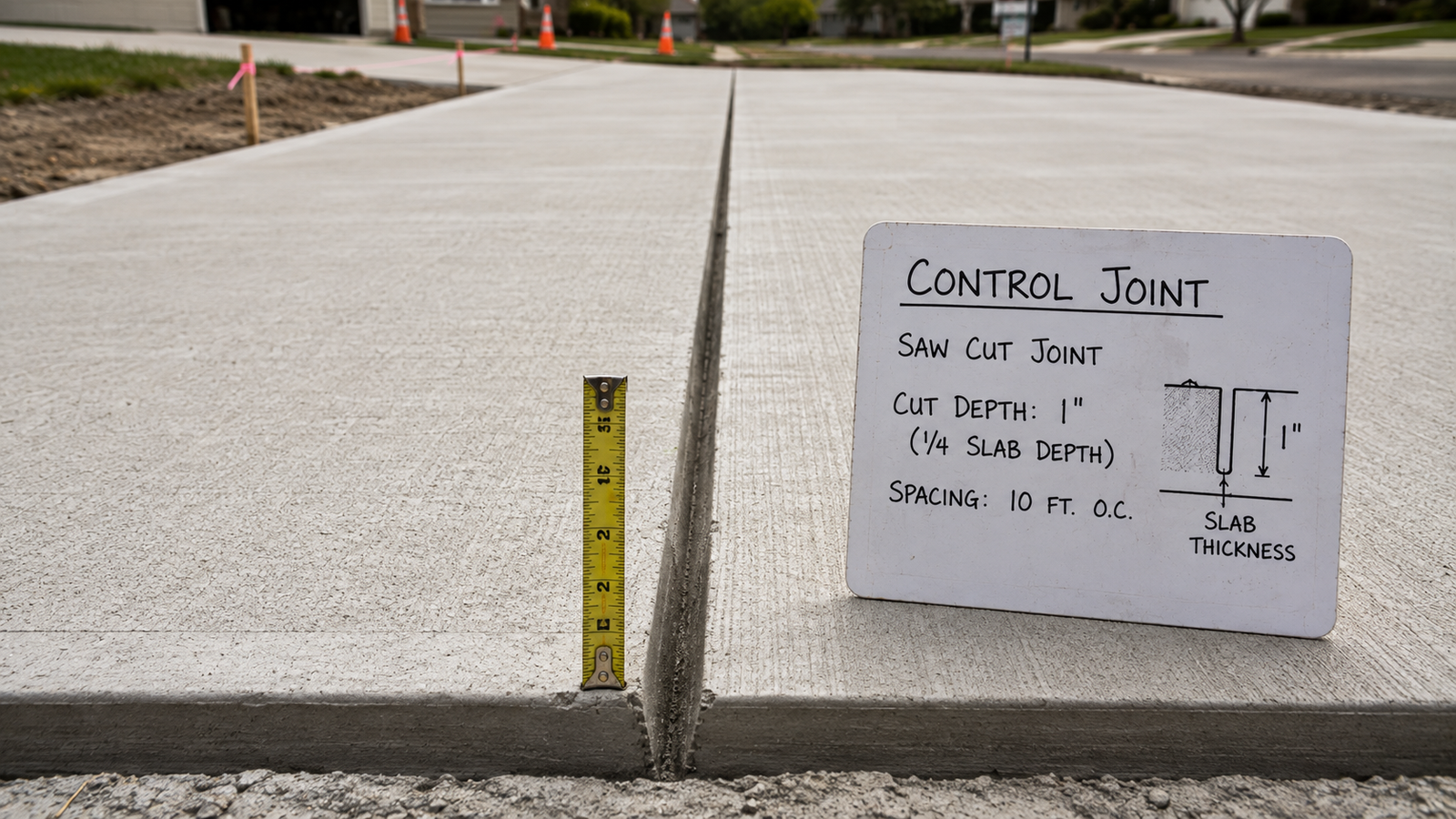
You cannot eliminate shrinkage in concrete. What you can do is give that shrinkage a planned, controlled location to occur, rather than letting it crack randomly across a slab.
A control or contraction joint is a deliberately weakened plane, typically created by a saw cut or tooled groove, that encourages the slab to crack along that line rather than elsewhere. ACI’s floor and slab construction guidance describes contraction joints as forming a weakened plane below which cracking is expected to occur, with joint spacing depending on multiple design and environmental factors rather than one fixed rule.
Joint depth, timing of the cut relative to placement, and overall panel geometry all affect how well the joint actually controls the crack.
Control Joints vs. Expansion, Isolation and Construction Joints
| Joint Type | Main Purpose |
|---|---|
| Contraction / control joint | Creates a planned weak plane to manage shrinkage cracking |
| Isolation joint | Separates a slab from restraints such as walls, columns, or footings so it can move independently |
| Construction joint | Separates concrete placed at different times, such as the end of one day’s pour |
| Expansion joint | Allows for thermal expansion between adjoining elements where significant movement is anticipated |
Corner Cracks and Re-Entrant Corners
Cracks frequently originate at inside corners, openings, drains, posts, columns, and any location where slab geometry changes abruptly. These re-entrant corners concentrate stress in a way that a simple rectangular slab area doesn’t experience.
This is a well-recognized geometric effect rather than evidence of a material defect. A crack radiating from an inside corner of an L-shaped patio, for example, is a common and largely predictable outcome of that geometry.
Cracks Around Rebar or Embedded Elements
Cracking that follows the line of reinforcement or other embedded elements can have more than one explanation. Possible causes include plastic settlement around the bar during placement, insufficient consolidation leaving voids near the reinforcement, insufficient concrete cover over the steel, restraint effects from the embedded element, or, in older concrete, reinforcement corrosion.
Don’t Assume Corrosion Automatically
A crack over reinforcement doesn’t automatically mean the steel is corroding. In newer concrete, plastic settlement or consolidation issues from the original placement are common. Corrosion becomes a more likely explanation in older concrete, especially where rust staining or spalling accompanies the crack.
Concrete Cracking from Reinforcement Corrosion
Reinforcement corrosion is a genuinely different mechanism from the shrinkage and settlement cracks discussed above, and it deserves separate treatment. Steel embedded in concrete is normally protected by a passive oxide layer, but that protection can break down through two primary pathways.
Carbonation occurs when atmospheric carbon dioxide reacts with alkaline compounds in the cement paste, gradually lowering the concrete’s pH until the steel’s passive layer is no longer stable. Chloride-induced corrosion occurs when chloride ions, commonly from deicing salts or marine exposure, penetrate the concrete and reach the steel surface, breaking down the passive layer even without a broad pH change.
Once active corrosion begins, the resulting iron oxide corrosion products occupy several times the volume of the original steel, generating expansive pressure around the bar. That pressure creates tensile hoop stresses in the surrounding concrete, and once those stresses exceed the concrete’s tensile capacity, cracking and eventually spalling occur along the line of the reinforcement.
This differs fundamentally from a shrinkage crack: it’s driven by a chemical and electrochemical process that progresses over time, and simply filling the visible crack does nothing to stop the ongoing corrosion beneath it.
Chemical and Environmental Causes of Concrete Cracking
Beyond corrosion, several other chemical and environmental mechanisms can produce cracking, particularly in older concrete:
- Alkali-silica reaction (ASR): a chemical reaction between certain reactive aggregates and alkalis in the cement paste, producing an expansive gel that can crack the surrounding concrete, sometimes visible as a gel exudate within the cracks
- Sulfate-related deterioration: chemical attack from sulfates in soil or groundwater that can expand and crack concrete over time
- Freeze-thaw deterioration: discussed earlier in this guide, a physical rather than chemical mechanism, but often grouped with weathering-related distress
- Corrosion of reinforcement: discussed in the previous section
- Aggressive environmental exposure: combinations of moisture, chemicals, and temperature cycling that accelerate other deterioration mechanisms
These mechanisms are distinct from ordinary shrinkage cracking, and they generally require a different diagnostic and repair approach since the underlying material itself is deteriorating, not simply responding to normal volume change.
How to Diagnose a Concrete Crack Yourself
- Measure the width at a few points along its length.
- Check whether both sides are level with each other, or if one side sits higher.
- Check the depth, as best you can tell, superficial versus appearing to run through the slab.
- Check the pattern: random, straight, diagonal, map-like, or following an edge or embedded element.
- Check the location: mid-slab, corner, joint, wall, foundation, or around a column.
- Look for water entering through or near the crack.
- Look at drainage around the slab, including downspouts and grading.
- Check whether it’s changing compared to when you first noticed it.
- Check surrounding concrete for related cracks, spalling, or staining.
- Photograph and document it, including a ruler or coin for scale.
How to Monitor a Concrete Crack
For cracks that don’t require immediate professional attention but warrant watching, a simple monitoring routine works well:
- Photograph the crack clearly, including something for scale
- Note the date
- Measure the width at a few marked points
- Mark the visible ends of the crack so you can tell if it extends further
- Re-measure periodically, and specifically after heavy rainfall or major seasonal temperature changes
For cracks that appear structurally significant, professional monitoring methods, such as crack gauges or survey-grade measurements, provide more reliable data than homeowner measurements alone.
When Should You Call a Professional?
Signs That Warrant Professional Evaluation
- The crack is actively widening over a period of weeks or months
- There is visible vertical displacement between the two sides
- The crack is in a structural wall, column, or load-bearing element
- There is visible bulging or outward movement of a wall
- The crack is accompanied by settlement or heaving of the surrounding area
- Significant water intrusion accompanies the crack
- Reinforcement is exposed or visibly corroded
- The affected element is load-bearing and the crack’s significance is unclear
- Cracking is widespread and doesn’t match any obvious, benign explanation
There is no single crack width that automatically requires an engineer. These behavioral and locational signs are more reliable indicators than a measurement alone.
Can You Repair a Cracked Concrete Slab?
Often, yes, but the right approach depends on the cause, whether the crack is still actively moving, its depth, its location, whether it affects a structural element, and the overall condition of the slab. Potential options range widely:
- Leave it and monitor, for very minor stable cracks
- Seal it to prevent water intrusion and debris accumulation
- Use a flexible crack filler suited to cracks that may continue to move slightly
- Epoxy injection, where appropriate for the crack type and structural context
- Routing and sealing, widening the crack slightly to accept a proper sealant
- Slab lifting, when the underlying cause is loss of support rather than the concrete itself
- Partial replacement, for localized severe damage
- Full replacement, when the slab is too deteriorated to repair economically
- Structural repair, for cracks affecting load-bearing elements
For general crack repair procedures, see How to Fix Cracked Concrete. For large driveway-specific cracks, see How to Repair Large Cracks in a Concrete Driveway.
How to Repair Hairline Concrete Cracks
For stable, nonstructural surface cracks, a straightforward approach generally works:
- Clean the crack of debris, dust, and loose material.
- Dry the area completely before applying any product.
- Select a compatible product designed for the crack width and your surface type.
- Apply according to the manufacturer’s instructions, not a generic online method.
- Monitor the repair over time to confirm it holds and the crack doesn’t reopen or extend.
Don’t promise yourself, or a client, that a hairline crack repair is permanent. Even well-executed cosmetic repairs can be affected by future movement if the underlying cause wasn’t addressed.
How to Repair Wider or Moving Cracks
Rigid crack fillers can fail when the crack continues to move, since a rigid material can’t accommodate ongoing expansion, contraction, or settlement. For cracks that show signs of continued movement, consider a flexible sealant designed to accommodate some movement, routing and sealing to create a properly shaped joint for the sealant, and addressing any underlying drainage or settlement issue driving the movement.
If movement is significant or clearly structural in nature, professional evaluation should happen before any repair, since the repair method needs to match the actual cause, not just the crack’s current appearance.
When Concrete Crack Repair Is Not Enough
| Situation | Why Simple Repair Falls Short |
|---|---|
| Sinking slab | The support problem beneath the slab needs to be repaired, not just the visible crack |
| Heaving slab | Soil, frost, or root-related movement needs to be addressed directly |
| Severely broken slab | Replacement is often more appropriate than attempting extensive repair |
| Structural wall crack | Requires structural diagnosis, not surface-level crack filling |
| Corroded reinforcement | The deterioration mechanism itself must be addressed, not simply the visible crack |
Concrete Resurfacing vs. Crack Repair vs. Replacement
| Condition | Likely Approach |
|---|---|
| Minor, stable surface cracking | Seal or monitor |
| Widespread surface deterioration, sound substrate | Resurfacing, if the underlying slab is structurally sound |
| Localized structural crack | Repair after investigating the cause |
| Settled slab | Lifting or stabilization, or replacement if lifting isn’t viable |
| Severely fractured slab | Replacement |
| Structural foundation movement | Professional repair and design |
Resurfacing only makes sense over a structurally sound substrate. Resurfacing over an unstable or actively cracking base simply telegraphs the same problems through the new surface.
How to Prevent Concrete Cracks Before Pouring
- Use a proper structural or slab design suited to the intended loads
- Select a suitable mixture for the application and exposure conditions
- Control water content to the mix design’s specified proportions
- Use quality, well-graded aggregate
- Prepare a sound, uniform subgrade
- Address drainage before placing concrete
- Use the correct slab thickness for the intended use
- Include appropriate reinforcement where the design calls for it
- Plan correct joint layout and spacing before placement
- Follow proper placement practices, avoiding segregation and excessive drop heights
- Finish at the correct time, not too early and not too late
- Cure properly for the specified duration and conditions
- Plan around weather conditions rather than ignoring them
- Plan for the actual loads the slab will experience, not just its nominal use
Concrete Crack Prevention by Cause
| Cause | Prevention Approach |
|---|---|
| Plastic shrinkage | Control evaporation through timing, protection, and appropriate curing start |
| Drying shrinkage | Appropriate mix design, joint layout, and curing |
| Settlement | Proper subgrade preparation, compaction, and drainage |
| Thermal movement | Adequate joints, design consideration, and environmental protection |
| Freeze-thaw | Appropriate air entrainment and durability-focused exposure design |
| Overload | Correct structural design for anticipated loads |
| Corrosion | Durable concrete mix and adequate reinforcement protection and cover |
| Poor finishing | Correct timing and technique during finishing operations |
Common Concrete Cracking Mistakes
- Assuming every crack is a failure requiring immediate replacement
- Assuming every crack is harmless without checking for warning signs
- Repairing a crack without first diagnosing its cause
- Adding water to concrete during placement or finishing
- Skipping or shortening proper curing
- Poor joint layout or spacing at the design stage
- Cutting control joints too late after placement
- Treating expansion and contraction joints as interchangeable
- Ignoring drainage problems around the slab
- Pouring over poorly prepared or uncompacted support
- Assuming rebar prevents all cracking
- Assuming higher PSI concrete eliminates cracking risk
- Using rigid repair material on a crack that’s still actively moving
- Resurfacing a structurally unsound slab instead of addressing the underlying problem
Concrete Crack Repair Cost
Rather than a single nationwide figure, crack repair cost depends on several project-specific drivers: crack length, width and depth, the repair material selected, site accessibility, the underlying cause, whether slab lifting is required, whether replacement is more appropriate than repair, whether professional engineering evaluation is needed, and whether drainage correction is part of the scope.
For a project-specific estimate, use the Concrete Driveway Repair Cost Calculator.
Concrete Cracking: Quick Decision Guide
- Fine, stable, and level: usually monitor or seal
- Fine surface web pattern: evaluate the finishing and curing history
- Crack plus water intrusion: investigate drainage
- Crack plus settlement: fix the underlying support problem
- Crack plus visible movement: investigate the active cause
- Crack plus exposed steel: professional evaluation
- Foundation wall plus significant movement: professional evaluation
Concrete Cracking FAQs
Is it normal for concrete to crack?
Yes, to some degree. Concrete has limited tensile capacity and changes volume as it hydrates and dries, so some cracking is expected even in well-built concrete. The key question is whether the specific crack indicates a normal, manageable process or an active problem.
Why is my new concrete cracking?
New concrete commonly cracks from plastic shrinkage, occurring within hours of placement due to rapid surface evaporation, or plastic settlement, occurring as fresh concrete settles around restraints such as reinforcement.
Why did my concrete crack after a few days?
Cracking that appears within the first few days to a couple of weeks often relates to thermal effects, including heat generated during early hydration and temperature gradients within the concrete.
Why is my concrete cracking months later?
Cracking that develops weeks to months after placement is commonly associated with drying shrinkage, as the cement paste continues losing moisture and restrained volume change produces tensile stress.
Why does concrete crack in a straight line?
A long, straight crack often reflects shrinkage occurring along a natural weak point, sometimes near where a control joint should have been placed or was placed too far away or too late.
Why is my concrete cracking at the corners?
Corners, especially re-entrant or inside corners where slab geometry changes, concentrate stress. This makes them a common and largely predictable location for cracks to originate.
Why is my driveway cracking?
Driveway cracking can stem from shrinkage, thermal movement, freeze-thaw exposure, settlement of the subgrade beneath it, or vehicle loading, sometimes in combination. For driveway-specific large crack repair, see How to Repair Large Cracks in a Concrete Driveway.
Why is my patio cracking?
Patios commonly crack from the same shrinkage, thermal, and settlement mechanisms as other exterior flatwork, and corner or edge geometry on patios frequently contributes to crack location.
Why is my garage floor cracking?
Garage floors can crack from shrinkage, settlement of the subgrade, or vehicle loading, and they may also be exposed to deicing salts tracked in on vehicles, which introduces a corrosion risk for any embedded reinforcement over time.
Are hairline cracks in concrete normal?
Fine, stable, non-widening hairline cracks are common and often cosmetic, particularly along control joints or from ordinary shrinkage. They still deserve periodic monitoring to confirm they remain stable.
When is a concrete crack serious?
A crack is more likely to be serious when it’s actively widening, shows vertical displacement, affects a structural or foundation element, allows significant water intrusion, or is accompanied by exposed or corroded reinforcement.
Does rebar prevent concrete from cracking?
No. Reinforcement helps hold cracked concrete together and manage crack width, but it does not prevent shrinkage, thermal, or settlement cracks from forming in the first place.
Does higher PSI prevent cracking?
Not by itself. Higher compressive strength doesn’t directly address the shrinkage, restraint, curing, or subgrade issues that actually drive most cracking.
Does adding water cause concrete to crack?
Adding water beyond the mix design changes the water-cementitious ratio and can increase shrinkage and cracking risk, though the exact effect depends on the specific mix and amount added.
Can cracked concrete be repaired?
Often, yes, depending on the cause, whether the crack is still moving, and its location. Options range from simple sealing to slab lifting or replacement, depending on what’s actually driving the crack.
Should I fill or seal a concrete crack?
It depends on whether the crack is stable or still moving. Rigid fillers work best on stable cracks, while flexible sealants are more appropriate for cracks that may continue to move slightly.
When should cracked concrete be replaced?
Replacement generally makes more sense when the slab is severely fractured, deteriorated beyond reasonable repair, or when the underlying cause cannot be corrected without removing the existing concrete.
Can a settled slab be repaired without replacing it?
Often, yes, through slab lifting or stabilization techniques, provided the slab itself is still structurally sound and the underlying support issue can be corrected.
Need to Estimate Repair Cost?
Once you’ve diagnosed your crack and decided repair is the right path, estimate your project cost with the Concrete Driveway Repair Cost Calculator.
Use the Repair Cost Calculator



6 Comments