Concrete vs Asphalt Cost: 2026 Price Comparison Guide
Asphalt is cheaper to install. Concrete costs less over time. That is the short version, but the numbers are more specific than that – and your climate, budget, and priorities shift which one actually saves you money. This guide breaks down concrete vs asphalt cost per square foot, 30-year total costs, maintenance expenses, and the situations where each material clearly wins.
Installed Cost Per Square Foot: Concrete vs Asphalt
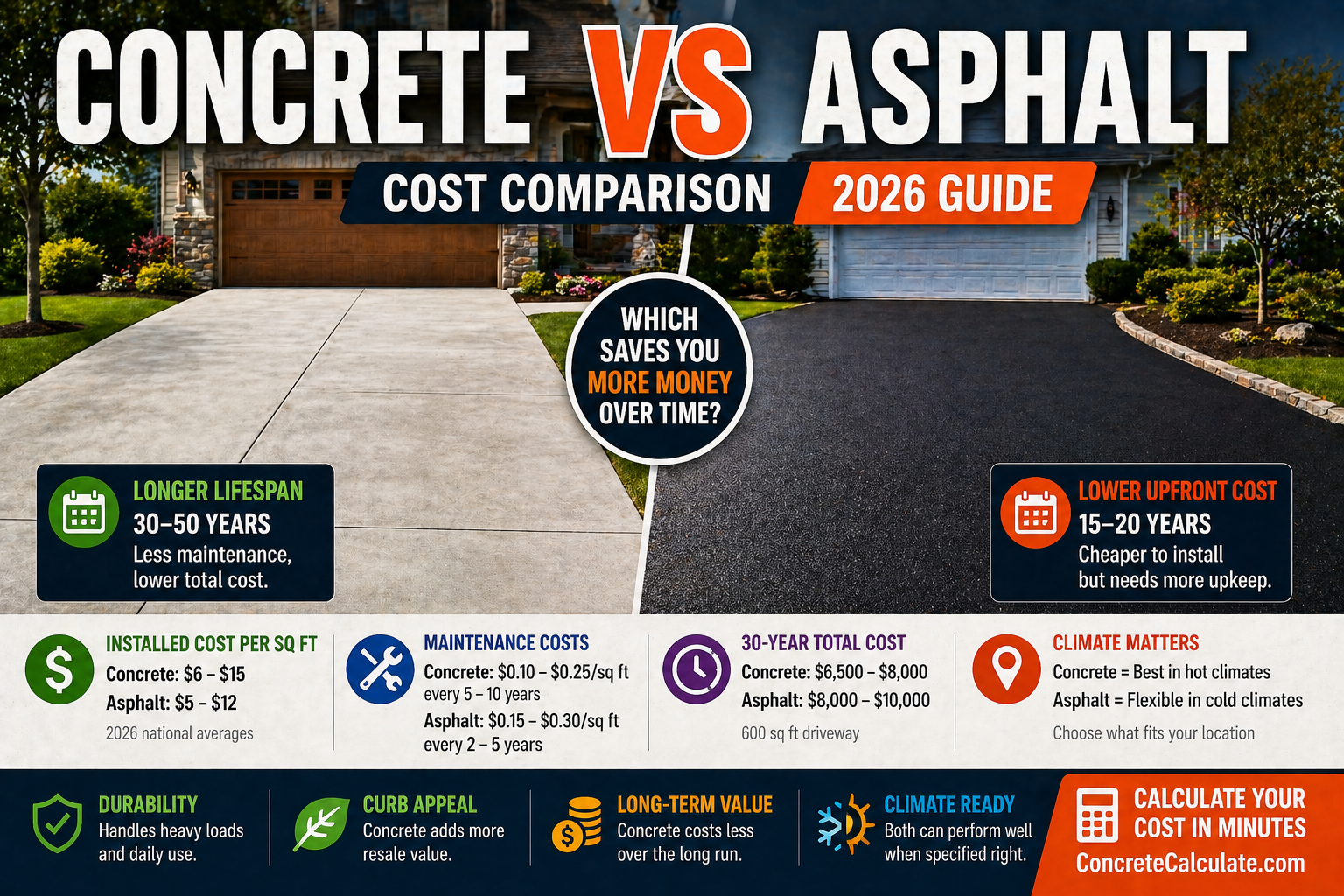
Asphalt is typically 30-50% cheaper than concrete for upfront installation. In 2026, asphalt driveways cost $5-$12 per square foot installed. Concrete driveways cost $6-$15 per square foot installed for a standard brushed or broom finish.
That range is wide because your local labor market, material prices, project size, and subgrade conditions all move the number. A small 200 sq ft repair in a high-cost market hits the top of that range. A full 800 sq ft driveway on a flat lot with good soil in a mid-cost city lands near the bottom.
What Is Included in the Installed Price
Both figures above include site preparation, base gravel, materials, labor, and basic finishing. They do not include decorative upgrades like stamping, exposed aggregate, or colored concrete – those add $4-$8 per square foot to the concrete cost. Standard brushed concrete and plain asphalt are the baseline comparison.
| Cost Factor | Asphalt | Concrete |
|---|---|---|
| Materials only | $2-$5/sq ft | $3-$7/sq ft |
| Labor | $3-$7/sq ft | $3-$8/sq ft |
| Installed total (standard) | $5-$12/sq ft | $6-$15/sq ft |
| Decorative/upgraded finish | $8-$15/sq ft | $12-$20/sq ft |
| Installation time | 1-2 days + 24 hr cure | 3-5 days + 7 day cure |
Use our concrete cost per square foot calculator to get a price estimate based on your specific dimensions and local rates.
Full Driveway Cost Comparison by Size
Real-world costs depend on the size of your driveway. Here is how the concrete vs asphalt cost comparison plays out at common residential driveway sizes.
| Driveway Size | Asphalt Cost (Installed) | Concrete Cost (Installed) | Difference |
|---|---|---|---|
| Small – 1 car (10×20 ft, 200 sq ft) | $1,000-$2,400 | $1,200-$3,000 | $200-$600 more for concrete |
| Standard – 2 car (20×30 ft, 600 sq ft) | $3,000-$7,200 | $3,600-$9,000 | $600-$1,800 more for concrete |
| Large – 2 car wide (20×40 ft, 800 sq ft) | $4,000-$9,600 | $4,800-$12,000 | $800-$2,400 more for concrete |
| Long – rural/long driveway (1,500+ sq ft) | $7,500-$18,000 | $9,000-$22,500 | $1,500-$4,500 more for concrete |
These ranges are based on 2026 national averages from HomeGuide, Angi, and contractor industry data. Local prices vary significantly. Labor in high-cost metro areas (California, New York, Seattle) runs 30-50% above these ranges. Rural markets in the Midwest or South may fall 15-25% below. Always get at least three local contractor quotes before budgeting. Use our contractor bid calculator to compare quotes side by side.
💰 Get Your Driveway Cost Estimate
Enter your exact dimensions and get side-by-side concrete and asphalt estimates for your area.
Concrete Driveway Cost Calculator →Maintenance and Repair Costs Over Time
Upfront price is only part of the concrete vs asphalt cost story. Asphalt needs more frequent and more expensive ongoing maintenance. Concrete needs less – but when concrete does need repair, it typically costs more per square foot to fix than asphalt.
Asphalt Maintenance Costs
Asphalt requires seal coating every 2-5 years to protect against UV degradation, oxidation, and water intrusion. Sealing costs $0.15-$0.30 per square foot, or $90-$180 for a standard 600 sq ft driveway each time. Over 20 years, that adds up to $360-$900 in sealing alone – plus any crack filling or pothole repairs.
- Seal coating: $0.15-$0.30/sq ft every 2-5 years
- Crack filling: $100-$300 per service, every few years as needed
- Pothole repair: $200-$600 per pothole (more in cold climates)
- Resurfacing (overlay): $2-$5/sq ft at year 10-15 to extend life another 10 years
- Full replacement: $5-$12/sq ft at year 15-20
Concrete Maintenance Costs
Concrete maintenance is lighter. Sealing is recommended every 5-10 years at $0.10-$0.25 per square foot. The bigger cost risk with concrete is crack repair – concrete cracks are more expensive to address properly than asphalt cracks because concrete cannot be hot-patched or simply resurfaced.
- Sealing: $0.10-$0.25/sq ft every 5-10 years
- Crack repair: $300-$1,000 per section, less frequent than asphalt
- Section replacement: $6-$15/sq ft for damaged panels
- Stain removal/cleaning: Minimal cost, primarily pressure washing
Individual asphalt repairs cost $1-$3 per square foot vs $5-$15 for concrete. But asphalt typically needs repairs 2-3 times more frequently. Over a 20-year period on a 600 sq ft driveway, total repair and maintenance costs often run $2,500-$6,500 for asphalt vs $1,200-$3,000 for concrete. Check out our guide on why concrete cracks to learn how to minimize repair needs from the start.
30-Year Total Cost: Which Costs Less Overall?
When you add installation plus all maintenance and replacement costs over 30 years, the picture flips. Asphalt, which costs less on day one, typically costs more by year 30. Concrete, which costs more upfront, usually wins on total lifetime cost.
30-Year Cost Breakdown: 600 sq ft Driveway
| Cost Category | Asphalt (30 Years) | Concrete (30 Years) |
|---|---|---|
| Initial installation | $5,250 (avg) | $6,400 (avg) |
| Seal coating (periodic) | $540-$900 | $180-$450 |
| Crack fills and repairs | $600-$1,500 | $300-$800 |
| Resurfacing or replacement | $1,200-$3,000 (resurfacing at ~yr 12) | $0-$2,000 (panel replacement if needed) |
| 30-Year Total (est.) | $7,590-$10,650 | $6,880-$9,650 |
Concrete saves roughly $700-$1,200 over 30 years on a 600 sq ft driveway under average conditions. In harsher climates where asphalt maintenance needs increase, that gap widens further. In mild southern climates where asphalt holds up better, the gap narrows.
💼 Real Example: Two-Car Driveway in Columbus, OH (600 sq ft)
Asphalt installed cost (2026): ~$5,100
Asphalt maintenance over 20 years: ~$3,200 (sealing x6, 1 resurfacing, crack fills)
Asphalt replacement at year 20: ~$4,500
Asphalt 30-year total: ~$12,800
Concrete installed cost (2026): ~$6,400
Concrete maintenance over 30 years: ~$1,500 (sealing x4, minor repairs)
Concrete 30-year total: ~$7,900
Concrete saves roughly $4,900 over 30 years in this scenario – nearly covering its own installation cost compared to asphalt.
Use our project budget calculator to model your own 30-year scenario.
Climate: How Location Affects Your Choice and Cost
Climate is one of the biggest factors in the concrete vs asphalt cost equation. The right choice in Minnesota is different from the right choice in Phoenix – and ignoring climate pushes costs up significantly in both directions.
Cold Climates: Northern States (Zone 5 and Below)
Asphalt has a flexibility advantage in freeze-thaw conditions. It can flex slightly as the ground heaves, which reduces cracking from frost movement. Concrete in cold climates must be specified at 4000 PSI with air entrainment per ACI 318 requirements. Improperly specified concrete in cold climates will surface-scale and spall within 5-10 years.
That said, asphalt in cold climates requires more frequent sealing and is damaged by deicing salts. Maintenance costs are higher in northern states for both materials. Either material can perform well with proper installation specs. See our guide on how thick a concrete driveway should be for cold-climate thickness recommendations.
Hot Climates: Southern States (Zone 7 and Above)
Asphalt softens in extreme heat. In states like Texas, Arizona, and Florida, summer temperatures regularly exceed 100°F. Hot asphalt can rut under sustained loads, like a parked RV or heavy vehicle sitting in the same spot. Concrete stays rigid in heat and does not soften – a significant advantage in the South and Southwest.
Heat also accelerates asphalt oxidation, which turns black asphalt gray and brittle, requiring more frequent sealing. In hot climates, concrete typically lasts significantly longer relative to asphalt than the national average comparison suggests.
❄️ Cold Climate Pick
- ✓ Asphalt: Lower crack risk from freeze-thaw movement
- ✓ Concrete: Longer lifespan when spec’d correctly at 4000 PSI + air entrainment
- ✓ Asphalt repairs are cheaper per occurrence in cold climates
- ✓ Budget pick: asphalt; long-term value: concrete at correct spec
☀️ Hot Climate Pick
- ✓ Concrete wins more clearly in heat
- ✓ Asphalt softens, ruts, and degrades faster in sustained high temps
- ✓ Concrete stays rigid and resistant to surface damage from UV and heat
- ✓ Concrete lifespan advantage over asphalt is larger in hot climates
Factors That Change Your Final Price
Both asphalt and concrete prices move based on several project-specific factors. Understanding these helps you budget accurately and compare bids from contractors.
1. Subgrade and Site Preparation
Both materials require a properly compacted aggregate base, typically 4-6 inches of crushed stone. If your soil is soft, expansive, or has poor drainage, the base work adds cost for both materials equally. Excavation depth, tree root removal, and grading all add to your total before a single cubic yard of concrete or ton of asphalt is placed.
2. Thickness
Standard residential concrete driveways are poured at 4-5 inches thick. Standard asphalt is 3-4 inches total (2-inch base course + 1.5-2 inch surface course). Increasing thickness adds cost but increases load capacity. Going from 4-inch to 6-inch concrete increases material cost by about 50% for that layer. Use our concrete driveway calculator to see how thickness affects your volume and cost.
3. Access and Grade
Steep driveways, tight access, or sites requiring a concrete pump add cost. A pump truck adds $800-$1,500 to a concrete job. Asphalt laying equipment also needs reasonable access. Curved driveways require more formwork for concrete and more handwork for asphalt, raising labor costs for both.
4. Market and Season
Asphalt prices are directly tied to petroleum prices. When oil prices spike, so does asphalt material cost. Concrete prices are driven more by cement and aggregate prices. Ordering in late fall or winter may get you better contractor rates in northern markets since demand drops. Spring and summer are peak season when prices run highest.
5. Local Labor Market
Labor in California, New York, Massachusetts, or Seattle can run 30-50% above the national average. Labor in rural Midwest or Southern states often runs 15-25% below average. Always get local bids and use the concrete project estimator to build your baseline budget before calling contractors.
Asphalt Driveway Cost Formula
Example: 600 sq ft x $8.50/sq ft avg = $5,100
With 10% contingency: $5,610 budget
Use our asphalt driveway cost calculator for a precise estimate with your dimensions.
Resale Value and Curb Appeal
Driveway material affects how buyers perceive your property. A concrete driveway is generally viewed as a premium finish that signals quality. An asphalt driveway in good condition is perfectly acceptable, but it does not add the same visual or perceived-value impact as concrete.
A plain brushed concrete driveway can add $4,000-$10,000 to a home’s curb appeal value in most US markets. Stamped or colored decorative concrete can push that higher. Asphalt adds less perceived value but is far from a negative – a well-maintained, freshly sealed asphalt driveway presents well.
If your neighborhood has primarily concrete driveways, matching that standard is worth the upfront premium for resale purposes. If your area has mostly asphalt, a standard asphalt install will not hurt you at sale.
Standard brushed concrete costs $6-$15/sq ft. Stamped concrete runs $12-$20/sq ft. Exposed aggregate runs $8-$14/sq ft. Colored concrete adds $2-$4/sq ft to any of those bases. If you are in a mid-to-upper price bracket neighborhood, decorative concrete is one of the highest ROI home improvements you can make to exterior hardscaping. See our full comparison guide at concrete vs asphalt driveways for more on aesthetics and value.
When to Choose Concrete vs Asphalt
The right choice depends on your budget, timeline, climate, and how long you plan to stay in the house. Neither material is universally better – each has specific situations where it is the clear winner.
Choose Concrete When:
- You plan to stay in the house 10+ years and want lower lifetime cost
- You live in a hot climate (South, Southwest, Texas, Arizona, Florida)
- You want a decorative finish – stamps, colors, or exposed aggregate
- You want to maximize curb appeal and resale value
- You regularly park heavy vehicles, RVs, or boats on the driveway
- You want minimal long-term maintenance responsibility
You are on a tight upfront budget and the lower installation cost matters more than long-term savings. You live in a cold northern climate and want the flexibility advantage in freeze-thaw conditions. You plan to sell the property within 5-7 years, so the long-term concrete advantage does not apply. You are OK with periodic sealing and maintenance. You want a faster installation with a shorter cure wait before driving on it.
If you are still comparing options, also check our gravel vs concrete driveway guide – gravel is significantly cheaper upfront and works well for long rural driveways or temporary solutions. Use our gravel driveway cost calculator to compare all three options.
🎯 Key Takeaways: Concrete vs Asphalt Cost
- Asphalt costs $5-$12 per square foot installed in 2026; concrete costs $6-$15 per square foot
- Asphalt is 30-50% cheaper upfront – roughly $600-$1,800 less on a standard 600 sq ft driveway
- Over 30 years, concrete typically costs $700-$4,000 less than asphalt due to lower maintenance and longer lifespan
- Asphalt lasts 15-20 years; concrete lasts 30-50 years – concrete lasts roughly twice as long
- Asphalt sealing costs $90-$180 per 600 sq ft every 2-5 years; concrete sealing costs $60-$150 every 5-10 years
- Asphalt repairs are cheaper per job ($1-$3/sq ft vs $5-$15/sq ft for concrete) but are needed more often
- Asphalt performs better in cold climates due to flexibility; concrete performs better in hot climates due to heat resistance
- Concrete adds more resale value and curb appeal than asphalt in most US markets
- Decorative concrete (stamped, colored, exposed aggregate) runs $12-$20/sq ft but significantly increases property value
- Asphalt prices are tied to oil prices and can spike unpredictably; concrete prices are more stable
- Both materials need a properly compacted 4-6 inch aggregate base – do not skip this step
- Always get at least 3 local contractor bids – national averages shift significantly by market
Frequently Asked Questions
🧮 Calculate Your Exact Driveway Cost
Get precise concrete and asphalt cost estimates for your driveway dimensions, thickness, and local market in minutes.
Use Concrete Cost Calculator →