Concrete Driveway Cost 2026: Per Square Foot, Full Project & By Size
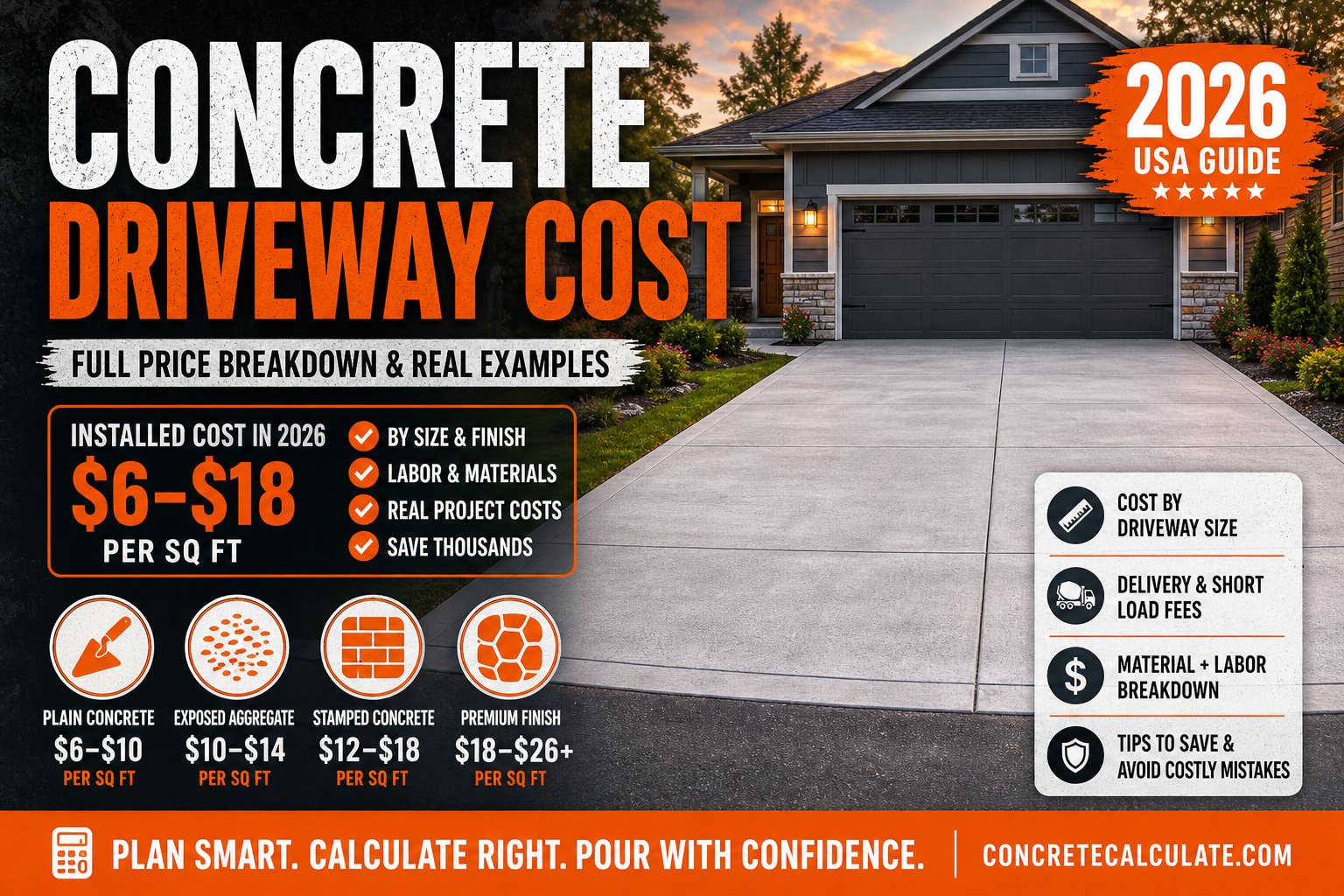
Most homeowners spend between $5 and $18 per square foot for a concrete driveway in 2026, or $3,200 to $11,500 for a typical residential project. The final number depends on size, thickness, finish type, site prep, and your local labor market. This guide breaks every cost down so you know exactly what you are paying for before you sign a contract.
2026 Concrete Driveway Cost Summary
A concrete driveway price estimate in 2026 ranges from under $2,000 for a small single-car slab to over $30,000 for a large decorative installation. The national average sits around $6,400 for a standard two-car driveway, according to data from Angi and multiple contractor sources.
The per-square-foot price is the most useful benchmark. For standard plain gray concrete with a broom finish, expect $5 to $10 per square foot installed. Upgrade to decorative finishes, coloring, or stamped patterns and that jumps to $10 to $18 per square foot.
| Driveway Type | Cost per Sq Ft | 600 Sq Ft Total | Lifespan |
|---|---|---|---|
| Basic broom finish | $5–$8 | $3,000–$4,800 | 25–30 years |
| Standard reinforced | $8–$12 | $4,800–$7,200 | 30–40 years |
| Exposed aggregate | $10–$14 | $6,000–$8,400 | 30–40 years |
| Stamped concrete | $12–$18 | $7,200–$10,800 | 25–35 years |
| Colored concrete | $10–$15 | $6,000–$9,000 | 25–35 years |
All figures in this guide cover installed cost – materials plus labor – for a professionally poured residential driveway in the continental US. Costs in Hawaii and Alaska run 25 to 75% higher. High-cost metros like New York City, San Francisco, or Boston can push totals 20 to 30% above these averages.
Cost Per Square Foot Breakdown
The concrete driveway cost per square foot breaks into two main buckets: materials and labor. Understanding both helps you evaluate contractor quotes and spot inflated pricing.
Materials Cost Per Square Foot
Concrete materials – the ready-mix, rebar, gravel base, and forming lumber – typically run $3 to $8 per square foot. That range shifts based on concrete grade, whether you add reinforcement, and local ready-mix pricing in your area.
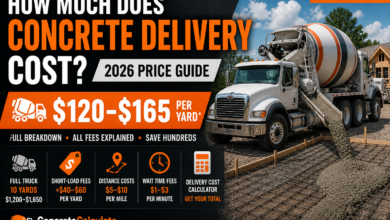
Ready-mix concrete costs $125 to $180 per cubic yard delivered nationally in 2026. Use our concrete yardage calculator to find out how many yards your project needs, or run your numbers through the concrete cost calculator to get a direct price estimate.
Labor Cost Per Square Foot
Labor runs $3 to $7 per square foot and accounts for roughly 40% of total project cost. Contractors charge $40 to $55 per hour, and an experienced crew pours about 15 to 20 square feet per hour. Forming, grading, pouring, and finishing a 600 sq ft driveway typically takes a full day with a 3- to 4-person crew.
| Cost Component | Cost per Sq Ft | % of Total |
|---|---|---|
| Ready-mix concrete | $2.00–$4.50 | 35–45% |
| Gravel base | $0.50–$1.25 | 8–12% |
| Rebar / wire mesh | $0.50–$1.50 | 6–10% |
| Forms and labor | $3.00–$7.00 | 35–45% |
| Finishing and sealing | $0.50–$2.00 | 5–10% |
💰 Calculate Your Driveway Cost
Enter your dimensions and get an instant cost estimate for your concrete driveway project.
Cost by Driveway Size
Driveway size is the single biggest variable in your total project cost. Bigger driveways cost more, but the per-square-foot price often drops slightly on larger pours because fixed costs (mobilization, setup, finishing equipment) are spread over more area.
Single-Car Driveway Cost
A single-car driveway is typically 10 to 12 feet wide and 20 to 25 feet long, giving you 200 to 300 square feet. Total installed cost in 2026 runs $1,600 to $4,000 for a basic broom finish.
Two-Car Driveway Cost
Most residential driveways are sized for two cars – typically 20 by 20 feet (400 sq ft) to 24 by 24 feet (576 sq ft). Budget $3,200 to $8,600 for a standard two-car installation. This is where most homeowners land.
Three-Car Driveway Cost
Three-car driveways typically run 24 by 36 feet (864 sq ft) to 30 by 30 feet (900 sq ft). Expect to pay $5,200 to $13,500 for a standard pour in this size range.
| Driveway Size | Square Feet | Basic Finish | Stamped Finish |
|---|---|---|---|
| Single car (10×20) | 200 | $1,600–$3,000 | $2,400–$4,500 |
| Single car (12×24) | 288 | $2,300–$4,300 | $3,500–$6,500 |
| Two car (20×20) | 400 | $3,200–$6,000 | $4,800–$9,000 |
| Two car (24×24) | 576 | $4,600–$8,600 | $6,900–$12,900 |
| Three car (24×36) | 864 | $5,200–$13,000 | $10,000–$18,000 |
| Large/extended | 1,200+ | $8,000–$18,000+ | $14,000–$30,000+ |
Not sure how many yards of concrete your project needs? Use our concrete driveway calculator to get the exact volume in cubic yards based on length, width, and thickness. You can also check ready-mix bag needs with the ready-mix bags calculator.
Labor Cost to Pour a Concrete Driveway
Labor is the hardest part of any concrete driveway cost to predict. Rates vary significantly by region, crew experience, and current local demand. Nationally, concrete labor runs $40 to $55 per hour per worker in 2026.
For a standard 600 sq ft two-car driveway, total labor typically runs $1,500 to $3,500. That includes site grading, forming, pouring, finishing, and cleanup. High-cost metros like Boston, New York, or Seattle push labor higher – sometimes $4,500 to $6,000 for the same scope of work.
What Labor Covers
- Site prep and grading – leveling the subgrade, removing soft or unstable soil
- Forming – setting wood or steel forms to shape the slab perimeter
- Base preparation – placing and compacting 4 to 6 inches of gravel base
- Rebar or mesh placement – laying reinforcement before the pour
- Pouring and screeding – placing and leveling the concrete
- Finishing – broom finish, troweling, edging, and control joint cutting
- Curing and cleanup – applying curing compound and removing forms
Some low bids exclude gravel base prep, rebar, saw-cut joints, or concrete removal. Always ask your contractor for a scope breakdown, not just a total number. A quote that seems 20% lower may actually skip $800 to $1,500 in work that still needs to happen.
Concrete Driveway Materials Cost
Materials typically make up 55 to 60% of a standard driveway installation. Here is a breakdown of each line item and what it costs in 2026.
Ready-Mix Concrete
Ready-mix is your biggest material cost. In 2026, ready-mix runs $125 to $180 per cubic yard delivered nationally, with averages around $150 per yard. A 600 sq ft driveway at 4 inches thick needs about 7.5 cubic yards – putting ready-mix material cost alone at $1,125 to $1,350 before delivery fees.
Use the concrete price per yard calculator to see exact material costs for your volume. For delivery cost estimates, the concrete delivery cost calculator factors in truck size, distance, and short-load fees.
Gravel Base
A properly prepared driveway needs 4 to 6 inches of compacted gravel base under the slab. Gravel costs $25 to $65 per cubic yard delivered, and the base for a 600 sq ft driveway typically runs $200 to $600 in materials. Use the gravel calculator or the base material calculator to size your base layer before ordering.
Reinforcement
Rebar costs $0.40 to $0.65 per linear foot. A 600 sq ft driveway typically uses 300 to 400 linear feet of #4 rebar in a grid pattern – roughly $120 to $260 in materials. Wire mesh is cheaper at $0.15 to $0.30 per square foot but provides less tensile strength than rebar.
Concrete Delivery Surcharges
Ready-mix trucks typically carry 8 to 10 cubic yards. If your job needs less than a full load, most suppliers charge a short-load fee of $75 to $200. If the truck sits on site more than 7 to 10 minutes waiting, you pay overtime charges of $1 to $2 per minute. Factor these in when budgeting small jobs.
💼 Example: Material Cost for a Standard 20×30 Driveway
Dimensions: 20 ft x 30 ft = 600 sq ft
Thickness: 4 inches (0.33 ft)
Volume: 600 x 0.33 = 198 cubic feet / 27 = 7.4 cubic yards
Ready-mix (at $150/yd): $1,110 + delivery ($150) = $1,260
Gravel base (4″ deep, ~7.5 cu yds): $375–$450
Rebar (#4, grid pattern): $140–$200
Forms and consumables: $80–$150
Total materials: approximately $1,855–$2,060
Use the driveway cost calculator to run your exact dimensions instantly.
How Driveway Thickness Affects Cost
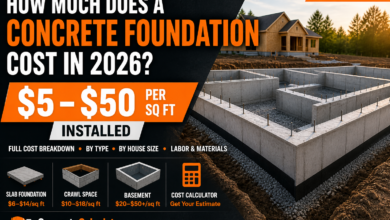
Thickness directly drives concrete volume – and volume drives material cost. Going from 4 inches to 5 inches increases concrete volume by 25%, adding roughly $1 to $2.50 per square foot to the project total.
For most residential driveways with standard passenger car use, 4 inches is the industry standard and the minimum most contractors recommend. Go to 5 or 6 inches if you regularly park a pickup truck, SUV, RV, or any commercial vehicle on the surface. Read more on our concrete driveway thickness guide for detailed recommendations by use case.
Use the concrete thickness calculator to see exactly how different thickness choices affect total cubic yards and material cost for your project.
| Thickness | Best For | Cubic Yards (600 sq ft) | Added Cost vs 4″ |
|---|---|---|---|
| 3.5 inches | Walkways only (not recommended for driveways) | 6.5 cu yd | -$100 to -$200 |
| 4 inches | Standard passenger vehicles | 7.4 cu yd | Baseline |
| 5 inches | Light trucks, SUVs, regular heavy use | 9.3 cu yd | +$300–$600 |
| 6 inches | RVs, heavy trucks, commercial vehicles | 11.1 cu yd | +$600–$1,200 |
Finish Types and Stamped Concrete Driveway Cost
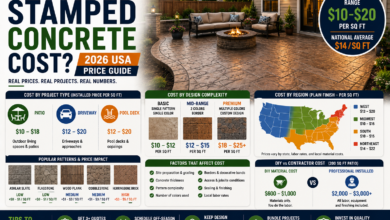
The finish you choose is the second-biggest cost variable after size. A basic broom finish adds minimal labor and no material surcharge. A stamped concrete driveway adds $3 to $10 per square foot to the base pour cost.
Broom Finish
This is the standard, most affordable option. After screeding, a broom is dragged across the surface while wet to create a textured, slip-resistant finish. No extra material cost, minimal added labor. Total installed cost: $5 to $8 per square foot.
Exposed Aggregate
After placing the concrete, contractors wash away the surface cement paste to reveal decorative stone or pea gravel. It costs $1 to $3 per square foot more than broom finish. Total installed: $8 to $12 per square foot. Durable and easy to maintain.
Stamped Concrete
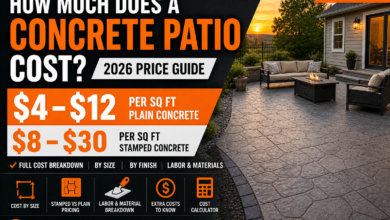
Stamped concrete uses pattern molds pressed into fresh concrete to mimic brick, slate, cobblestone, or wood. Add coloring (integral color or surface-applied) and you get a premium decorative look for a fraction of the cost of natural stone. Stamped concrete driveway cost runs $12 to $18 per square foot installed – sometimes higher for complex multi-color designs.
Colored or Stained Concrete
Integral color (pigment mixed into the concrete before pouring) adds $1 to $3 per square foot. Acid staining an existing slab after it cures costs $2 to $5 per square foot. Both options add visual appeal without the full premium of stamped work.
Stamped concrete looks great but the color and texture require sealing every 2 to 5 years ($0.50 to $2.50 per sq ft per application) to maintain appearance. Factor in this ongoing maintenance cost when comparing finishes. Plain broom-finish concrete needs minimal upkeep beyond crack filling.
🧮 Get Your Cost Per Square Foot
Use our calculator to see exactly what each finish type costs for your driveway dimensions.
Extra Costs to Budget For
The base install quote covers pouring a new slab on prepared ground. Several common additional costs are frequently excluded from initial estimates. Know these before you commit.
Old Driveway Removal
Removing an existing concrete or asphalt driveway costs $1 to $3 per square foot, or $500 to $2,500 for an average residential driveway. Disposal fees add another $200 to $500 depending on haul distance. Always ask if your quote includes removal before signing.
Grading and Site Preparation
If the ground needs significant regrading, tree root removal, or drainage correction, expect to add $500 to $2,500 or more. A flat, stable site with existing proper drainage is a best-case scenario for keeping costs low.
Permits
Many municipalities require a permit for new driveway installations or replacements, especially if the project affects drainage or the public right-of-way. Permit costs range from $50 to $500 depending on your city or county. Your contractor should pull the permit, but the cost typically gets passed to you.
Sealing
Sealing a new concrete driveway within the first year extends its life and improves stain resistance. Professional sealing costs $0.50 to $2.50 per square foot, or $300 to $1,500 for a 600 sq ft driveway. Some contractors include one application in the project price – confirm this upfront.
Heated Driveway (Radiant Heat)
Heated driveway systems (electric coils or hydronic tubing embedded in the slab) eliminate snow removal but add $12 to $25 per square foot to the project cost. For a 600 sq ft driveway, that is $7,200 to $15,000 more – plus operating costs. Worth considering in heavy-snow regions if you want a maintenance-free surface.
Concrete vs Asphalt Driveway Cost
The most common comparison homeowners make is concrete vs asphalt. Asphalt is cheaper upfront – typically $3 to $7 per square foot installed vs $5 to $18 for concrete. But the full-lifespan picture tells a different story.
Concrete lasts 30 to 50 years with minimal maintenance. Asphalt lasts 15 to 20 years and needs resealing every 3 to 5 years plus occasional patching. Over a 30-year period, asphalt usually ends up costing more when you account for two full replacements and ongoing sealing. Read the full comparison in our concrete vs asphalt driveways guide.
| Factor | Concrete | Asphalt |
|---|---|---|
| Installed cost (600 sq ft) | $3,000–$10,800 | $1,800–$4,200 |
| Lifespan | 30–50 years | 15–20 years |
| Maintenance | Seal every 5–10 years | Seal every 3–5 years, patch cracks |
| Hot climate performance | Excellent | Softens, can rut |
| Cold climate performance | Good (needs 4000 PSI) | Better freeze flexibility |
| Curb appeal | High (decorative options) | Moderate |
| 30-year total cost | $3,000–$12,000 | $5,000–$14,000+ |
How to Save on Your Driveway Project
You do not need to compromise on quality to lower the concrete driveway cost. These strategies reduce your bill without cutting corners on the installation itself.
- Get at least three quotes. Contractor pricing for the same job can vary by 20 to 40%. Do not accept the first number you get.
- Schedule in the off-season. Spring and fall are peak driveway season. Booking a late-fall or winter pour (in mild climates) often gets you a lower rate from contractors filling slower periods.
- Skip decorative finishes. A broom-finish driveway costs $3 to $5 per square foot less than stamped or colored work. The durability is identical.
- Do your own demo. Removing old asphalt yourself with a rental jackhammer and hauling it away in a rented dumpster saves $500 to $2,000 on a standard job.
- Combine jobs. If you need a patio or walkway, get them poured in the same visit. Contractors give better rates when mobilization costs are spread over a larger job.
- Use the right thickness – not more. Paying for a 6-inch driveway when 4 inches is adequate adds $600 to $1,200 with no benefit. Check our thickness guide before specifying.
- Use calculators before calling contractors. Walk into every conversation knowing your volume, estimated cost, and the right PSI for your climate. Contractors are less likely to upsell informed homeowners. Start with the concrete slab calculator.
DIY concrete driveways can save 40 to 50% on labor costs but require equipment rentals, physical effort, and proper technique to avoid costly mistakes. Read our full how to pour a concrete driveway guide before deciding if DIY makes sense for your project size and skill level.
🎯 Key Takeaways: Concrete Driveway Cost 2026
- Standard concrete driveways cost $5 to $10 per square foot installed for plain broom finish; decorative options run $10 to $18 per square foot
- A typical two-car driveway (400 to 600 sq ft) costs $3,200 to $8,600 with the national average around $6,400
- Labor makes up 40% of total project cost – rates run $40 to $55 per hour depending on region
- Ready-mix concrete costs $125 to $180 per cubic yard delivered nationally in 2026
- A standard 4-inch-thick driveway is appropriate for passenger vehicles; go to 5 to 6 inches for trucks and heavy vehicles
- Use 4000 PSI concrete in any state with freezing winters – the upgrade costs only $15 to $20 more per cubic yard
- Old driveway removal adds $1 to $3 per square foot and is often excluded from base quotes
- Concrete outlasts asphalt 2x to 3x, making it cheaper per year over the full lifespan in most regions
- Get at least three contractor quotes – pricing for identical work varies 20 to 40% depending on local competition
- Use a driveway cost calculator before you meet any contractor so you walk in knowing your numbers
Frequently Asked Questions
🔧 Ready to Estimate Your Driveway?
Use our full suite of concrete calculators to size your project, calculate volume, and estimate materials before you talk to a single contractor.