Concrete Prices 2026 (USA): Cost Per Yard, Per Square Foot & By Project
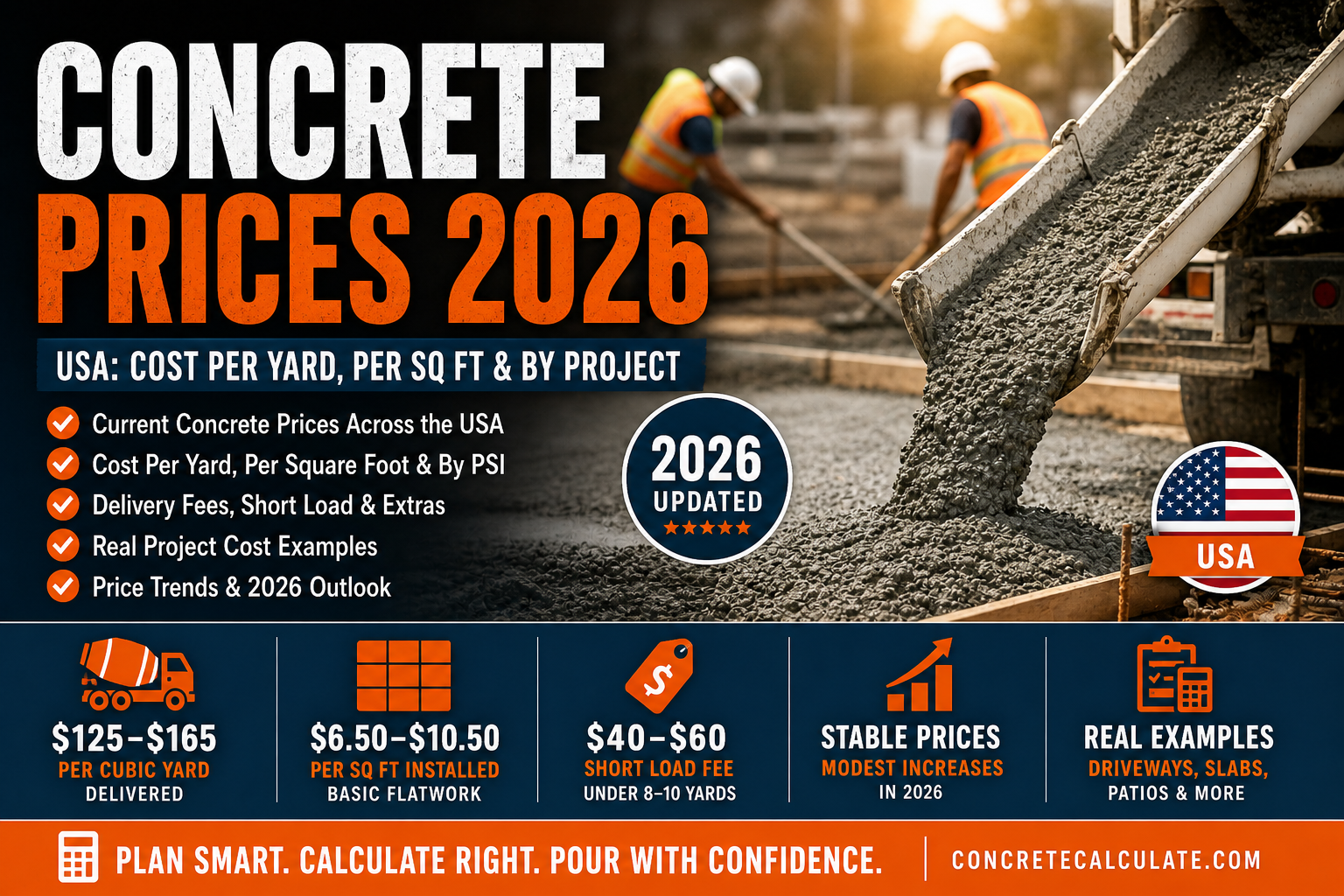
Concrete prices in 2026 are higher than they were a few years ago, but they have finally started to stabilize. Most homeowners now pay between $125 and $165 per cubic yard for ready mix concrete in the United States, plus delivery and short load fees on small orders. This guide pulls together current price data from national cost surveys and industry sources so you can budget accurately before you call a supplier.
2026 Concrete Price Snapshot (USA)
Several national cost guides publish ready mix concrete prices each year. In early 2026, those sources are consistent on where concrete prices have landed for typical residential work.
The rest of this guide explains how to use those numbers for real projects, what changes the price in your zip code, and how to use calculators to go from square feet to a realistic concrete budget.
Cost of Concrete Per Yard in 2026
Concrete is sold by the cubic yard. One cubic yard is 27 cubic feet, which is enough to pour a 4 inch thick slab about 81 square feet in size. In 2026, most homeowners are paying between $125 and $165 per cubic yard for standard ready mix delivered.
| Type of Concrete | Typical 2026 Price per Cubic Yard (Delivered) | Notes |
|---|---|---|
| Standard 3,000 PSI ready mix | $120–$150 | Most basic residential slabs and flatwork |
| 3,500–4,000 PSI ready mix | $130–$165 | Garages, driveways, patios in freeze-thaw climates |
| 4,500–5,000 PSI ready mix | $140–$180 | Structural slabs, heavy duty driveways, commercial work |
| Fiber-reinforced or specialty mixes | $150–$190+ | Fibers, corrosion inhibitors, or special admixtures |
| Short loads under 8–10 yards | $150–$200 effective | Base price plus short load premiums |
These ranges assume a full truckload delivered within roughly 20–30 miles of the batch plant. Longer hauls, congested urban routes, and remote rural deliveries can add $10–$30 per yard on top of the base price.
🧮 Find Your Local Price Per Yard
Use live pricing for your state and project type before you call local suppliers.
Use Concrete Price Per Yard Calculator →Concrete Price Per Square Foot 2026
Homeowners often think in square feet, not cubic yards. To get from per yard pricing to a number you can compare with other materials, you need to consider slab thickness.
Material Cost Per Square Foot
For a standard 4 inch thick slab, each cubic yard covers about 81 square feet. That means:
- At $125 per yard, material cost is about $1.55 per square foot
- At $150 per yard, material cost is about $1.85 per square foot
- At $165 per yard, material cost is about $2.05 per square foot
In practice, a basic 4 inch thick slab in 2026 usually ends up between $6.50 and $10.50 per square foot installed once you include concrete, base prep, forming, placing, finishing, and typical reinforcement.
| Slab Thickness | Material Cost per Sq Ft (at $125–$165/yard) | Typical Installed Cost per Sq Ft |
|---|---|---|
| 4 inches (0.33 ft) | $1.55–$2.05 | $6.50–$10.50 |
| 5 inches (0.42 ft) | $1.95–$2.55 | $7.50–$12.00 |
| 6 inches (0.50 ft) | $2.35–$3.05 | $8.50–$13.50 |
Labor is the big variable. Slabs that require extensive grading, thick base rock, or complex forming push the installed cost toward the high end of the range.
Concrete Price by PSI Strength
Higher PSI concrete costs more per yard, but the difference is smaller than many people expect. The cost gap between 3,000 PSI and 4,000 PSI is usually $10–$20 per yard in 2026.
| Strength Class (PSI) | Typical 2026 Price per Yard | Common Uses |
|---|---|---|
| 2,500 PSI | $115–$135 | Light duty slabs in warm climates, some footpaths |
| 3,000 PSI | $120–$150 | Standard slabs and interior floors |
| 3,500–4,000 PSI | $130–$165 | Driveways, garages, exterior slabs in freeze-thaw areas |
| 4,500–5,000 PSI | $140–$180 | Structural elements, heavy equipment slabs |
If you are unsure whether 3,000 PSI is enough or if you should pay for 4,000 PSI, use the numbers above together with your local building code and soil conditions, and check the ready mix concrete cost per yard guide and the how to calculate concrete guide.
Concrete Prices by Region and City
Concrete pricing is local. National averages help with budgeting, but your actual cost of concrete per yard in 2026 depends on where you live. City level pricing shows real variation across the country.
| City / Region | Typical 2026 Price per Yard | Notes |
|---|---|---|
| Houston, TX | $120–$140 | Plenty of suppliers, short haul distances |
| Atlanta, GA | $140–$165 | Higher demand and traffic add delivery cost |
| Chicago, IL | $125–$160 | Wide range depending on supplier and season |
| Los Angeles, CA | $135–$170 | Urban haul, higher labor and fuel costs |
| Miami, FL | $125–$150 | Strong competition holds prices near national average |
| New York City, NY | $150–$185 | Premium for logistics, tolls, and crew time |
| Phoenix, AZ | $125–$160 | Demand from growth areas keeps prices elevated |
| Seattle, WA | $135–$180 | Higher material and labor costs in the Northwest |
The national average cost per yard can be misleading if you live in a high cost coastal city or a very rural area. It is best to combine a national baseline with at least two local quotes to get a real number for your budget.
Delivery, Short Load & Extra Fees
Delivery is part of the cost of concrete per yard, especially for small pours. Many suppliers quote a single ready mix price that includes delivery inside a base radius. The fine print is where the extra charges show up.
Common Delivery and Service Fees
- Short load fee: Charged when you order less than 8–10 yards. Many plants add $40–$60 per yard under the minimum or a flat $80–$150 fee per truck.
- Fuel surcharge: Added when diesel prices spike or when the haul distance exceeds the standard delivery radius. Often $10–$30 per truck.
- Saturday or off hours fee: Extra charge for weekend, night, or holiday deliveries. This can add $50–$150 per truck.
- Waiting time: Many suppliers include 5–10 minutes per yard for unloading. Past that, expect $3–$5 per minute standby fees.
- Environment / washout fees: Some companies charge for onsite washout solutions or environmental surcharges.
For small projects like 2–3 yard patios or pads, these fees matter more than the base cost of concrete per cubic yard. A short load fee can double your effective per yard price if you are not careful with batching and scheduling.
🚚 Estimate Your Delivery and Short Load Costs
Quickly see how small load premiums and distance will change your price per yard.
Use Concrete Delivery Cost Calculator →Installed Cost by Project Type
Concrete material is only part of your budget. Labor, base rock, forming lumber, reinforcement, and equipment time all factor into your total project cost. Typical installed price ranges in 2026 look like this.
| Project Type | Typical Size | Installed Cost Range (2026) | Notes |
|---|---|---|---|
| Small slab / shed pad | 10 ft × 10 ft (100 sq ft) | $800–$1,800 | Short load premiums increase cost per sq ft |
| Single car driveway | 10 ft × 40 ft (400 sq ft) | $2,600–$5,000 | 4 inch thickness, 3,000–4,000 PSI |
| Two car driveway | 16 ft × 40 ft (640 sq ft) | $4,000–$7,500 | Includes base prep, forming, and broom finish |
| Patio | 12 ft × 20 ft (240 sq ft) | $1,700–$4,000 | Higher cost for decorative finishes |
| Sidewalk | 4 ft × 50 ft (200 sq ft) | $1,200–$3,000 | More linear forming work per square foot |
| Monolithic slab foundation | 1,200–1,800 sq ft | $9,000–$30,000+ | Site specific, heavy engineering, rebar, thickened edges |
For tighter budgeting, use the project specific tools:
How to Go From Volume to Cost
To answer “how much is concrete per yard for my project,” you first need to know how many yards you are actually pouring. That means converting your slab dimensions into cubic yards.
Step 1: Measure and Convert to Cubic Yards
- Measure length and width in feet.
- Convert thickness to feet (4 inches = 0.33 feet, 5 inches = 0.42 feet, 6 inches = 0.50 feet).
- Multiply length × width × thickness to get cubic feet.
- Divide cubic feet by 27 to get cubic yards.
📏 Example: 20 ft × 30 ft Driveway, 5 Inches Thick
Dimensions: 20 ft × 30 ft = 600 square feet
Thickness: 5 inches = 0.42 ft
Volume: 20 × 30 × 0.42 = 252 cubic feet
Cubic yards: 252 ÷ 27 ≈ 9.3 cubic yards
Round up: Order at least 10 cubic yards to cover waste, edges, and grade variation.
You can plug your dimensions into the concrete volume calculator or concrete yardage calculator to get cubic feet and cubic yards instantly. For odd shapes, the concrete cubic yard calculator helps break the slab into rectangles and circles and totals the result.
Step 2: Multiply by Current Price Per Yard
Once you have cubic yards, estimating the raw concrete material cost is simple:
- Material cost = cubic yards × ready mix price per yard
- Total project cost (installed) = material cost + delivery and short load fees + labor + overhead
💵 Example: Cost of Concrete Per Yard for the 20 ft × 30 ft Driveway
Volume: 10 cubic yards (rounded)
Ready mix price: $140 per yard for 4,000 PSI in a typical 2026 market
Material cost: 10 × $140 = $1,400
Delivery fees: Full load within base radius = included
Estimated installed cost: 600 sq ft × $8.50 per sq ft ≈ $5,100 total for materials, labor, and equipment
📊 Get a Full Concrete Project Estimate in Minutes
Enter your slab dimensions once and get volume, per yard cost, and full project budget in a single report.
Use Concrete Project Estimator →Concrete Price Trends and 2026 Outlook
Between 2020 and 2024, ready mix concrete prices climbed steadily as cement, fuel, and labor costs increased. Current data suggests 2026 is more stable, with modest increases rather than the sharp jumps seen earlier in the decade.
Recent Concrete and Cement Price Movement
- National concrete cost guides report ready mix prices up roughly 15–20 percent compared to 2020 levels.
- Concrete cost indices show year over year increases of about 1–3 percent heading into 2026.
- Global cement price reports list early 2026 cement prices in the United States around the mid‑$90s per metric ton, with moderate pressure from fuel and infrastructure demand.
Industry analyses expect only modest ready mix price growth for the rest of 2026, barring an unexpected spike in fuel or a major change in infrastructure funding. That means planning your project this year is less risky than it was during the rapid price swings of 2021–2022.
National averages and index data are helpful for planning, but they cannot capture job specific factors like tight access, steep driveways, unusual mix requirements, or local labor shortages. It is best to combine calculator based estimates with at least two written quotes from ready mix suppliers and contractors in your area.
🎯 Key Takeaways: Concrete Prices 2026 (USA)
- Ready mix concrete in 2026 typically costs $125–$165 per cubic yard delivered for 3,000–4,000 PSI mixes in the United States.
- Material alone for a 4 inch slab runs about $1.50–$2.25 per square foot, while installed cost including labor and equipment runs roughly $6.50–$10.50 per square foot for basic flatwork.
- Small orders under 8–10 yards pay short load fees that can add $40–$60 per yard or $80–$150 per truck, pushing effective per yard cost toward $180–$200 on very small jobs.
- 3,000 PSI concrete sits at the low end of the price range, while 4,000–5,000 PSI and specialty mixes can cost $10–$25 more per yard.
- Large coastal cities and remote rural areas often pay 10–20 percent more than the national average for concrete.
- Bagged concrete is more expensive per yard than ready mix, at roughly $150–$225 per cubic yard before your own labor, so it only makes sense for very small pours.
- Concrete prices in 2026 are relatively stable, with modest year over year increases around low single digits instead of sharp jumps.
- Cement prices and trucking fuel costs remain key drivers of ready mix pricing, but competition between local suppliers often matters just as much in your final quote.
- The fastest way to get a realistic budget is to calculate your volume in cubic yards with a yardage calculator, apply your regional price per yard, and then layer on labor and overhead with a project estimator.
Frequently Asked Questions
🔧 Plan Your 2026 Concrete Budget With Confidence
Use calculators that combine current per yard pricing with your exact dimensions so you can negotiate with suppliers from a position of strength.
Start With Concrete Cost Calculator →🛠️ Concrete Cost & Estimation Tools
- → Concrete Cost Calculator
- → Concrete Price Per Yard Calculator
- → Concrete Delivery Cost Calculator
- → Concrete Slab Cost Calculator
- → Concrete Driveway Cost Calculator
- → Concrete Patio Cost Calculator
- → Concrete Project Estimator
- → Contractor Bid Calculator
- → Project Budget Calculator
- → Construction Overhead Calculator
- → Concrete Yardage Calculator
- → Concrete Volume Calculator