5000 PSI Concrete Guide 2026: Mix Design, Uses, Cost & Specs
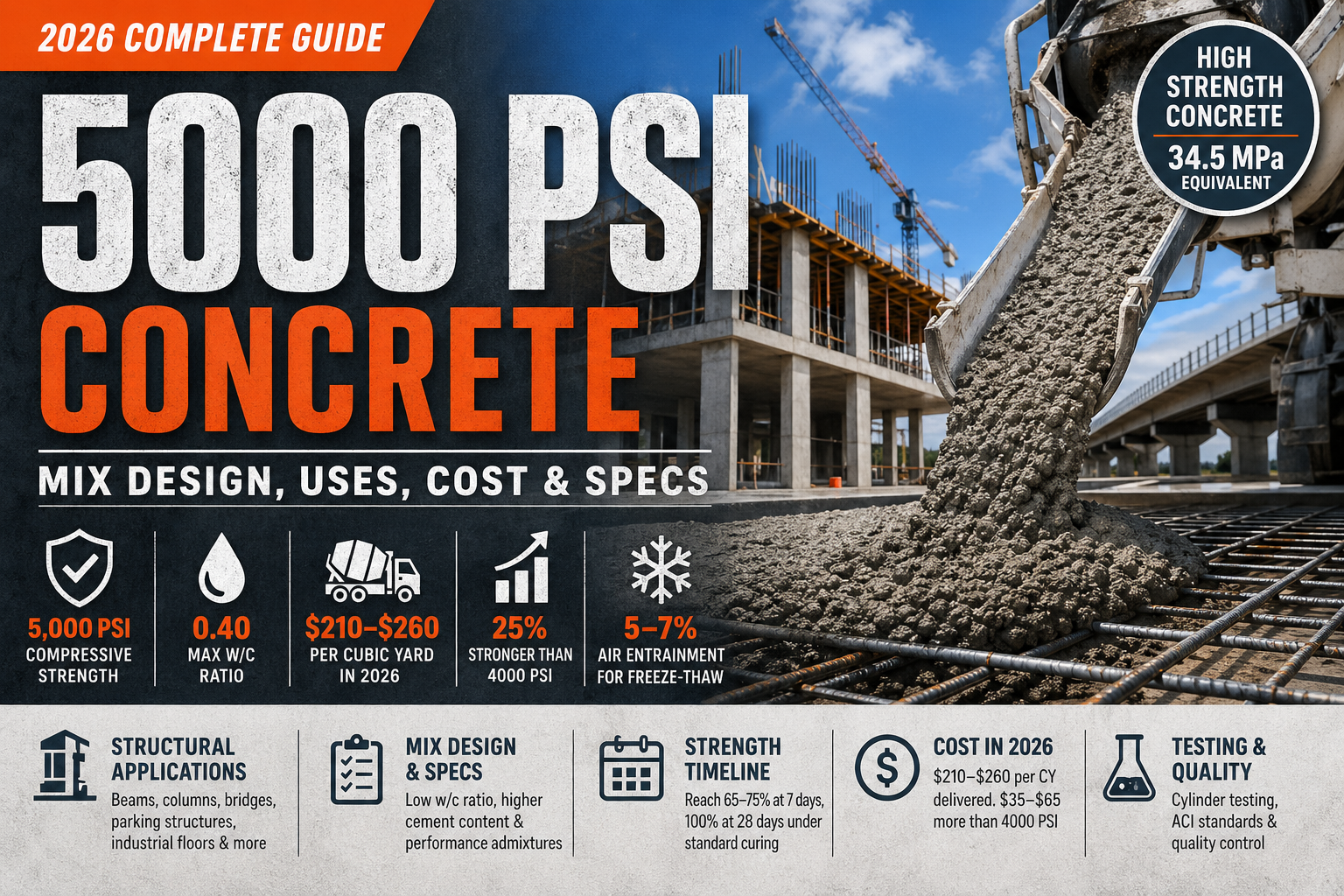
Most residential projects max out at 4000 PSI. But some applications – structural columns, bridge decks, parking structures, heavily loaded industrial floors – need more. That is where 5000 PSI concrete comes in. This guide covers exactly what 5000 PSI concrete is, when you actually need it, how to specify it correctly, what it costs in 2026, and the mix design specs that make it work.
What Is 5000 PSI Concrete?
5000 PSI concrete is a high-strength concrete mix that reaches a compressive strength of 5,000 pounds per square inch at 28 days of age under standard curing conditions. That means every square inch of hardened surface can resist 5,000 pounds of crushing force before failing.
In practical terms, it is 25% stronger than 4000 PSI concrete and nearly 67% stronger than standard 3000 PSI residential concrete. It achieves that strength through a tight water-cement ratio (typically 0.35-0.40), higher cement content per cubic yard, and sometimes supplementary materials like silica fume or fly ash.
5000 PSI is the lower boundary of what engineers call high-strength concrete. Below this range sits standard residential and light commercial concrete. Above it, you get specialty structural mixes going to 8,000, 10,000, and 12,000+ PSI for high-rise columns and bridge structures. For most contractors and engineers, 5000 PSI is the go-to specification when the job demands more than 4000 PSI can deliver.
In metric units, 5000 PSI equals 34.5 MPa (megapascals). If you’re working with international specs or an engineering firm that uses metric, divide PSI by 145.04 to convert. Use our concrete PSI guide for a full breakdown of all strength grades and conversions.
5000 PSI vs 4000 PSI: When the Upgrade Matters
For most residential work, 4000 PSI is the right specification. It meets ACI 318 requirements for freeze-thaw exposure, handles typical vehicle loads, and costs significantly less than 5000 PSI. The upgrade to 5000 PSI only makes sense when specific conditions justify the extra cost.
Here is when 5000 PSI is worth specifying over 4000 PSI:
- Structural elements carrying heavy loads – beams, columns, and load-bearing walls where an engineer specifies 5000 PSI minimum
- Pre-stressed or post-tensioned concrete – these systems require 4000-5000 PSI minimum for adequate strand bonding and transfer strength
- Driveways with heavy truck or commercial vehicle traffic – logging trucks, concrete mixers, or heavy equipment that regularly cross the same slab
- Parking structures and bridge decks – where chloride penetration, freeze-thaw cycles, and sustained load exposure demand higher durability
- Industrial floors with forklift and pallet jack traffic – warehouse floors under constant heavy point loads benefit from 5000 PSI
- Thin structural sections – higher PSI allows thinner sections to carry equivalent loads, saving material cost overall
| Property | 4000 PSI Concrete | 5000 PSI Concrete |
|---|---|---|
| Compressive Strength | 4,000 PSI (27.6 MPa) | 5,000 PSI (34.5 MPa) |
| Max Water-Cement Ratio | 0.44 | 0.40 |
| Cement Content (per CY) | ~564 lbs (6.2 bags) | ~658 lbs (7.2 bags) |
| Permeability | Low | Very Low |
| Freeze-Thaw Resistance | Excellent | Superior |
| Typical 2026 Cost / CY | $175-195 | $210-260 |
| Primary Applications | Driveways, garages, structural slabs | Beams, columns, bridge decks, industrial floors |
| ACI 318 Structural Minimum | Meets requirements | Exceeds requirements |
🧮 Calculate Your Concrete Volume and Cost
Get an instant estimate for how much 5000 PSI concrete you need and what it will cost for your project.
Use Concrete Slab Calculator →Applications That Require 5000 PSI Concrete
5000 PSI concrete appears across a range of structural and heavy-duty applications. Below are the situations where contractors, engineers, and building codes point to this strength grade.
Structural Beams and Columns
ACI 318 sets 4000 PSI as the practical minimum for structural concrete elements in most residential and commercial construction. Engineers routinely specify 5000 PSI for beams and columns when spans are long, loads are heavy, or when thinner cross-sections are required to meet architectural constraints.
In multi-story commercial buildings, columns carrying three or more floors are commonly specified at 5000-6000 PSI. The higher strength allows smaller column cross-sections, which saves floor space and reduces foundation load.
Parking Structures
Parking garages are among the most demanding concrete environments. They face daily vehicle loads, chloride infiltration from road salt tracked in by vehicles, freeze-thaw cycles on exposed decks, and continuous moisture exposure. The industry standard per ACI 362 for parking structure decks is 5000 PSI with 5-7% air entrainment and a maximum water-cement ratio of 0.40.
Anything less deteriorates fast. A 4000 PSI deck in a northern climate parking garage can show delamination and rebar corrosion within 10-15 years. The upgrade to 5000 PSI extends service life by decades.
Bridge Decks and Highway Structures
State DOTs across the US typically specify 4,500-5,000 PSI for bridge deck concrete. The combination of heavy live loads, deicing chemicals, freeze-thaw exposure, and the cost of repair or replacement on an operational bridge makes high-strength concrete essential. Most AASHTO bridge specifications call for a minimum 4,000-5,000 PSI depending on exposure class.
Pre-stressed and Post-Tensioned Concrete
Pre-stressed concrete requires higher strength because the tendons or strands apply high compressive forces during the transfer phase. Standard pre-stressed applications specify 5,000 PSI minimum at transfer and 5,000-6,000 PSI at 28 days. Post-tensioned slabs typically require 4,000-5,000 PSI for adequate bearing strength at the anchor zones.
Industrial Warehouse Floors
Warehouses with forklifts, heavy racking systems, or pallet jacks putting concentrated loads on floor slabs need more than the 3,000-4,000 PSI common in residential work. 5,000 PSI improves point load capacity, reduces cracking under heavy equipment, and resists surface wear from constant traffic. ACI 360 (design of slabs-on-ground) recommends higher PSI for these heavy-duty applications.
Heavy-Duty Residential Driveways
If your driveway regularly handles concrete mixer trucks, delivery trucks, RVs over 20,000 lbs, or farm equipment, 5,000 PSI is a reasonable choice. The extra strength reduces flex cracking under heavy axle loads. Standard 4,000 PSI handles normal passenger vehicles fine, but repeated heavy vehicle crossings can cause sub-threshold cracking in weaker slabs over time.
Swimming Pool Shells (Gunite/Shotcrete)
Pool shells formed with gunite or shotcrete are typically specified at 4,000-5,000 PSI. The applied concrete method actually tends to produce higher in-place strength than cast-in-place work due to the low water content of the dry-mix process. Most pool contractors and structural engineers specify 4,000-5,000 PSI for residential pools and 5,000 PSI for commercial aquatic facilities.
💼 Example: When a Contractor Upgrades to 5000 PSI
Project: Commercial warehouse floor, 20,000 sq ft, Chicago, IL
Forklift capacity: 15,000 lbs with pneumatic tires
Original spec: 4,000 PSI, 6 inches thick
Engineer recommendation: Upgrade to 5,000 PSI, 5.5 inches thick
Reasoning: Higher PSI allows a 0.5-inch thickness reduction while improving point load resistance. The thinner slab saves about $1.20/sq ft in material cost ($24,000 total), which more than offsets the $35/CY premium on 5,000 PSI concrete (total premium: ~$11,500).
Net result: Better floor performance at a lower total project cost. Higher PSI concrete often pays for itself in structural applications where thickness can be reduced.
5000 PSI Concrete Mix Design and Specs
Achieving 5,000 PSI requires tight mix design control. The primary lever is a low water-cement ratio – typically 0.35 to 0.40. Everything else in the mix design supports hitting that target consistently.
Typical 5000 PSI Mix Proportions per Cubic Yard
| Material | Quantity per Cubic Yard | Notes |
|---|---|---|
| Portland Cement (Type I/II) | 658 lbs (7.2 bags) | Higher content than 4000 PSI mixes |
| Water | 240 lbs (28.8 gallons) | w/c ratio = 0.37 |
| Fine Aggregate (Sand) | 1,180-1,250 lbs | ASTM C33 specification |
| Coarse Aggregate (3/4″ Stone) | 1,750-1,850 lbs | ASTM C33, clean crushed stone |
| Water Reducer (Plasticizer) | Per manufacturer spec | Improves workability without raising w/c |
| Air Entrainment (if exterior) | 5-7% by volume | Required for freeze-thaw exposure |
Water-Cement Ratio for 5000 PSI Concrete
240 lbs ÷ 658 lbs = 0.365
Maximum allowable w/c for 5000 PSI: 0.40. Never exceed this on site. Use our water-cement ratio calculator to verify your mix.
Supplementary Cementitious Materials (SCMs)
Many 5,000 PSI mixes include supplementary materials to improve strength and durability. Fly ash (15-25% replacement of cement) improves workability and boosts long-term strength. It slows early strength gain, so confirm your project schedule allows adequate cure time before loading. Slag cement (25-40% replacement) improves density and chemical resistance. Both reduce cost slightly compared to straight Portland cement mixes.
Silica fume is the most effective SCM for achieving 5,000-6,000 PSI. At 5-10% of cement weight, it fills the microscopic pores between cement particles and produces a very dense, low-permeability matrix. Silica fume concrete is harder to place and finish due to its sticky consistency – experienced crews and proper admixture dosing are required.
Chemical Admixtures for High-Strength Mixes
A mid-range or high-range water reducer (superplasticizer) is almost always included in 5,000 PSI ready-mix. It allows the low water-cement ratio mix to remain workable with a slump of 4-7 inches without adding extra water. Without a superplasticizer, a 0.37 w/c ratio mix would be nearly unworkable for most crews.
Accelerating admixtures (like calcium chloride or non-chloride alternatives) speed up early strength gain for cold-weather pours. For reinforced 5,000 PSI concrete, use non-chloride accelerators – calcium chloride can accelerate rebar corrosion over time. Check our concrete PSI guide for more on admixture selection by application.
Per ACI 318, ready-mix plants must target a higher average strength than the specified value to ensure no more than 1 in 10 tests falls below 5,000 PSI. For 5,000 PSI concrete, the plant typically targets 5,700-6,200 PSI average. This built-in margin protects you – the concrete you receive is almost always stronger than the number on your order ticket.
Strength Development Timeline
5,000 PSI concrete gains strength faster in absolute terms than lower-grade concrete, but follows the same relative timeline. The higher cement content accelerates early strength development compared to 3,000-4,000 PSI mixes.
| Age | % of 28-Day Strength | Estimated PSI Achieved | What You Can Do |
|---|---|---|---|
| 1 day | 15-20% | 750-1,000 PSI | Light foot traffic only |
| 3 days | 45-55% | 2,250-2,750 PSI | Form removal possible (check engineer) |
| 7 days | 65-75% | 3,250-3,750 PSI | Light vehicle access with care |
| 14 days | 85-92% | 4,250-4,600 PSI | Normal vehicle traffic acceptable |
| 28 days | 100% | 5,000 PSI | Full design loads can be applied |
| 56 days | 108-115% | 5,400-5,750 PSI | Continued strength gain beyond design |
Temperature has a major effect on these timelines. Cold weather below 50 degrees F significantly slows hydration. At 40 degrees F, 5,000 PSI concrete may only reach 35-40% of design strength at 7 days. Use cold-weather protection – insulated blankets, heated enclosures, or accelerating admixtures – to maintain the strength gain schedule on winter pours.
Never load structural 5,000 PSI elements before confirming strength with cylinder tests. A column carrying floor loads at 5 days (roughly 2,500 PSI) is carrying that load at less than 50% of its design capacity. Always defer to your structural engineer’s shoring and form removal schedule. See our concrete curing guide for detailed timing by temperature.
🌡️ Predict Strength at Any Temperature
Get accurate PSI development predictions adjusted for your actual site temperature and curing conditions.
Use PSI Strength Calculator →Placement, Consolidation, and Curing Tips
High-strength concrete is less forgiving than standard residential mixes. Lower water content makes it stiffer. Silica fume adds stickiness. Superplasticizer effects can slump off quickly if placement is delayed. Getting it right requires attention at every step.
Placement Best Practices
- Place promptly – 5,000 PSI mixes with superplasticizer can lose workability fast. Confirm pour is ready before the truck arrives. Never let the truck sit more than 90 minutes after batching.
- Do not add water – even one gallon per cubic yard drops PSI by 200-300 PSI and destroys the carefully engineered w/c ratio. If slump is low, return the load or call the batch plant for a plasticizer addition.
- Avoid segregation – do not drop concrete from heights over 5 feet. Use a tremie or pump for deep pours. Free-falling high-strength concrete through rebar can cause aggregate segregation and weak zones.
- Use internal vibrators – 5,000 PSI stiff mixes require proper vibration to consolidate around rebar and fill forms completely. Vibrate in lifts of 12-18 inches, inserting every 18-24 inches across the pour.
Curing Requirements
Proper curing is critical for 5,000 PSI concrete to actually reach its target strength. The high cement content means significant heat of hydration – protect against thermal cracking in large pours by monitoring internal temperature and limiting the differential between core and surface to 35 degrees F maximum.
Minimum curing duration: 7 days of moist curing for standard conditions. Use wet burlap covered with plastic sheeting, curing compounds per ASTM C309, or fogging systems. For silica fume mixes, extend curing to 10-14 days – the pozzolanic reaction requires extended moisture to fully develop strength. See our walk-on concrete guide for traffic timing.
High-strength mixes with silica fume or low w/c ratios are harder to finish than standard concrete. They bleed little water, so the surface can appear ready before the concrete below is workable. Finishing too early traps bleed water under the surface and causes delamination. Wait for the full bleed water sheen to disappear before final finishing. Use experienced finishers who have worked with high-strength mixes before.
Cost of 5000 PSI Concrete in 2026
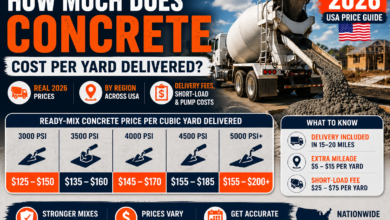
5,000 PSI concrete costs more than standard grades due to higher cement content, tighter quality control requirements, and the admixtures needed to maintain workability at low water-cement ratios. Here is what to expect from ready-mix suppliers across the US in 2026.
| Concrete Grade | Typical 2026 Cost per CY | Premium Over 4000 PSI |
|---|---|---|
| 3000 PSI | $155-175 | Baseline – $20-30 less than 4000 PSI |
| 4000 PSI | $175-195 | Reference point |
| 4500 PSI | $195-220 | +$20-25 per CY |
| 5000 PSI | $210-260 | +$35-65 per CY |
| 6000 PSI | $240-290 | +$65-95 per CY |
| 8000+ PSI | $280-400+ | Special order, limited suppliers |
Prices vary by region, haul distance from the batch plant, and current cement market prices. Urban markets with multiple competing ready-mix suppliers tend to have lower prices than rural areas with limited options. Always get quotes from at least two suppliers for any pour over 10 cubic yards.
Cost for Common 5000 PSI Projects
- Heavy-duty driveway (600 sq ft, 6 inches thick, ~11 CY): $2,310-2,860 just for concrete material
- Warehouse floor (5,000 sq ft, 6 inches thick, ~93 CY): $19,530-24,180 for concrete material
- Structural columns (4 columns, 1 CY each): $840-1,040 for concrete material
- Parking structure deck (10,000 sq ft, 8 inches thick, ~247 CY): $51,870-64,220 for concrete material
For small repairs and DIY projects, QUIKRETE 5000 Concrete Mix (No. 1007) is available at most hardware stores. It achieves 5,000 PSI at 28 days and is available in 60 lb and 80 lb bags. Cost is typically $7-9 per 80 lb bag in 2026. One 80 lb bag makes about 0.6 cubic feet of concrete. For anything over 10 cubic feet, ordering ready-mix is more cost-effective and produces more consistent results.
Testing 5000 PSI Concrete Strength
For any structural application using 5,000 PSI concrete, cylinder testing is not optional. It is the only way to confirm the concrete you poured actually hit the design strength. This matters for structural adequacy, warranty claims, and legal liability on commercial projects.
Cylinder Break Testing (ASTM C39)
The standard method involves casting 4×8-inch or 6×12-inch cylinders at the job site from the same truck going into the structure. The cylinders are cured under controlled lab conditions (ASTM C31) and tested at 7 and 28 days. Testing cost in 2026: $75-150 per set of three cylinders, including lab curing, testing, and a written report.
Per ACI 318, a strength test is the average of two cylinders from the same sample. A test fails if the average of any two cylinders is below the specified strength, or if any single cylinder falls more than 500 PSI below the specified strength when fc is 5,000 PSI or less.
What to Do When a Test Comes Back Low
If your 28-day break comes back below 5,000 PSI, do not immediately condemn the concrete. First, verify the cylinders were properly cured and tested per ASTM C31 and C39. Improperly cured companion cylinders frequently test lower than the actual in-place concrete. If the test is confirmed valid, the next step is core drilling per ASTM C42 to get actual in-place strength from the hardened structure. In-place core strength is often higher than companion cylinder results.
⚖️ Check Load Capacity Before You Pour
Calculate the safe working load for your 5000 PSI slab, beam, or column before specifying thickness or dimensions.
Use Load Bearing Calculator →Common Mistakes with High-Strength Concrete
5,000 PSI concrete is less forgiving than standard grades. The tight mix design means any deviation – adding water, poor consolidation, inadequate curing – has a bigger impact on final strength than it would with a more standard mix.
1. Adding Water to Improve Workability
This is the single most damaging thing you can do to a 5,000 PSI pour. Adding 5 gallons of water to a 10-yard truck drops PSI by roughly 500-750 PSI across the entire load – turning your 5,000 PSI specification into a 4,250-4,500 PSI result. If the concrete arrives stiff, call the batch plant and request a plasticizer dose. Never add water to high-strength concrete under any circumstances.
2. Ordering 5000 PSI Without Specifying Admixtures
A 5,000 PSI mix without a water reducer is very stiff and difficult to place properly around rebar or in forms. Always confirm with your ready-mix supplier that the mix includes a water reducer or superplasticizer. Ask for the mix design ticket to verify w/c ratio, air content, and admixture type before the pour starts.
3. Under-Vibrating the Pour
Stiff high-strength mixes do not self-consolidate the way wetter standard mixes do. Under-vibration leaves air pockets and honeycombing that can cut actual in-place strength by 20-30% in affected zones. Use internal vibrators on every structural 5,000 PSI pour, and do not rely on rodding or tapping forms for anything structural.
4. Cutting Curing Short
High cement content mixes generate more heat and need longer moisture curing than standard concrete. Pulling curing blankets or compounds off at 3 days can leave 5,000 PSI concrete at only 50-55% of design strength – around 2,500-2,750 PSI. Maintain moist curing for a minimum of 7 days, longer in cold weather or when silica fume is in the mix. See our curing and drying time guide for a complete timing breakdown.
5. Specifying 5000 PSI When 4000 PSI Is Adequate
Over-specifying concrete wastes money. Most residential work does not need 5,000 PSI. Driveways, patios, foundations, and garage floors in cold climates perform well at 4,000 PSI per ACI 318. Reserve 5,000 PSI for applications where the structural load, durability environment, or engineer specification genuinely requires it. Check our full concrete PSI guide if you are unsure which grade fits your project.
🎯 Key Takeaways: 5000 PSI Concrete Guide
- 5,000 PSI concrete reaches 5,000 pounds per square inch compressive strength at 28 days – 25% stronger than 4,000 PSI
- The maximum water-cement ratio for 5,000 PSI is 0.40; most mixes target 0.35-0.37 for a statistical margin
- 5,000 PSI equals 34.5 MPa in metric units used internationally
- Primary applications include structural beams and columns, parking structures, bridge decks, pre-stressed concrete, and heavy industrial floors
- A superplasticizer (high-range water reducer) is almost always required to keep a 0.37 w/c ratio mix workable without adding water
- Typical ready-mix cost in 2026 is $210-260 per cubic yard – $35-65 more per yard than 4,000 PSI
- Never add water to a 5,000 PSI mix on site – each gallon per cubic yard drops strength by 200-300 PSI
- Concrete reaches 65-75% of 5,000 PSI at 7 days; full design strength at 28 days under standard curing at 70 degrees F
- Moist cure for a minimum of 7 days – silica fume mixes benefit from 10-14 days of curing
- Always use cylinder testing per ASTM C39 for structural 5,000 PSI pours – never skip verification on load-bearing elements
- For most residential work, 4,000 PSI is the right spec; upgrade to 5,000 PSI only when load, durability, or engineer requirements justify it
Frequently Asked Questions
🔧 Plan Your Concrete Project with Confidence
Use our full suite of concrete calculators to estimate volume, cost, strength, and mix requirements for any application.
Explore All Calculators →