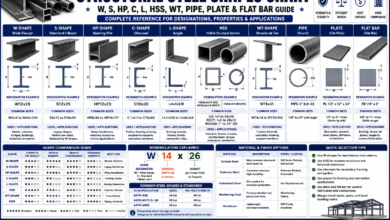
Steel Square Tube Size Chart – Square HSS Dimensions & Properties
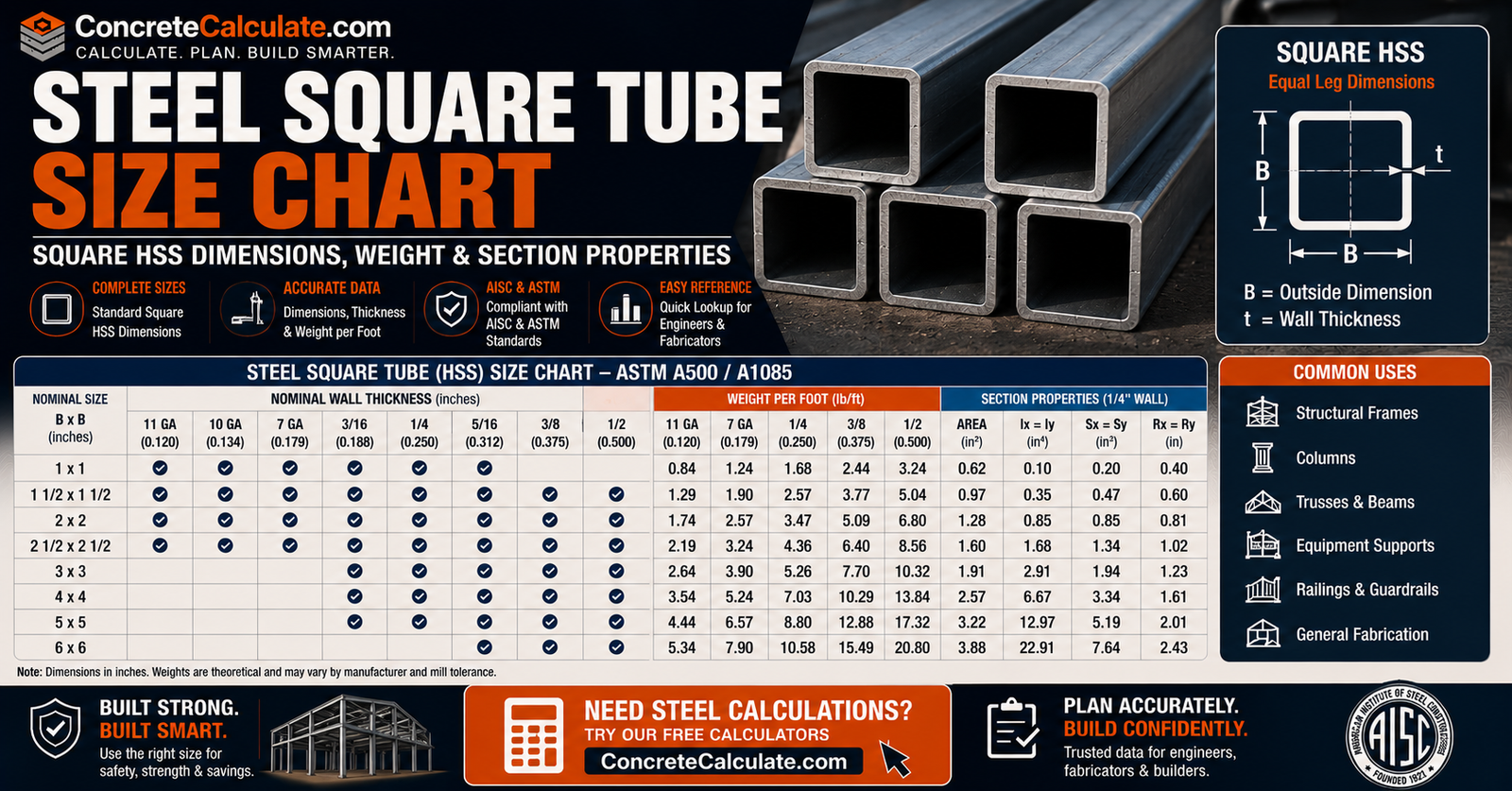
Steel Square Tube Size Chart
Square HSS Dimensions & Properties
Structural square tube dimensions, the critical difference between nominal and design wall thickness, and how square HSS differs from mechanical square tubing, cross-verified against AISC and ASTM sources.
 Reviewed by Muhammad Ramzan Babar, PhD Researcher (Plasma Physics) & Calculator Developer, View Profile
This chart covers structural square steel tubing, not mechanical tubing
Mechanical square tubing may use different specifications, tolerances, wall sizes, and availability than the structural square HSS covered here. This page focuses on ASTM A500/A1085 structural square tube in an AISC design context. For the broader HSS family including rectangular and round sections, see the HSS Size Chart.
Steel Square Tube Size Chart, Quick Reference
Because square sections are symmetric, Ix = Iy, Sx = Sy, and rx = ry for every size in this table.
| HSS Designation | Outside Size (in) | Nominal Wall (in) | Design Wall (in) | Weight (lb/ft) | Area (in²) | Ix=Iy (in⁴) | Sx=Sy (in³) | rx=ry (in) |
|---|---|---|---|---|---|---|---|---|
| HSS2x2x1/8 | 2 x 2 | 0.125 | 0.116 | 3.14 | 0.869 | 0.32 | 0.32 | 0.61 |
| HSS3x3x1/4 | 3 x 3 | 0.250 | 0.233 | 8.68 | 2.44 | 3.16 | 2.11 | 1.14 |
| HSS4x4x1/4 | 4 x 4 | 0.250 | 0.233 | 12.21 | 3.37 | 7.80 | 3.90 | 1.52 |
| HSS4x4x3/8 | 4 x 4 | 0.375 | 0.349 | 17.27 | 4.78 | 10.30 | 5.13 | 1.47 |
| HSS6x6x1/4 | 6 x 6 | 0.250 | 0.233 | 19.02 | 5.24 | 28.60 | 9.54 | 2.34 |
| HSS6x6x3/8 | 6 x 6 | 0.375 | 0.349 | 27.48 | 7.58 | 39.50 | 13.20 | 2.28 |
| HSS8x8x1/4 | 8 x 8 | 0.250 | 0.233 | 25.82 | 7.10 | 70.70 | 17.70 | 3.16 |
| HSS8x8x3/8 | 8 x 8 | 0.375 | 0.349 | 37.69 | 10.40 | 100.00 | 25.10 | 3.10 |
| HSS10x10x1/2 | 10 x 10 | 0.500 | 0.465 | 58.10 | 17.00 | 245.00 | 49.10 | 3.80 |
| HSS12x12x1/2 | 12 x 12 | 0.500 | 0.465 | 76.07 | 20.90 | 457.00 | 76.20 | 4.68 |
Values cross-checked across CivilAxis, OptimalBeam, BuildRefs, and Atlas Tube’s published ASTM A500 property tables, with radius of gyration confirmed via rx = √(Ix ÷ A). Design wall thickness reflects the 0.93 × nominal factor for ASTM A500. Use actual numeric values from the current AISC Shapes Database rather than reconstructed sharp-corner formulas for sizes not shown here.
Square Tube Size Categories
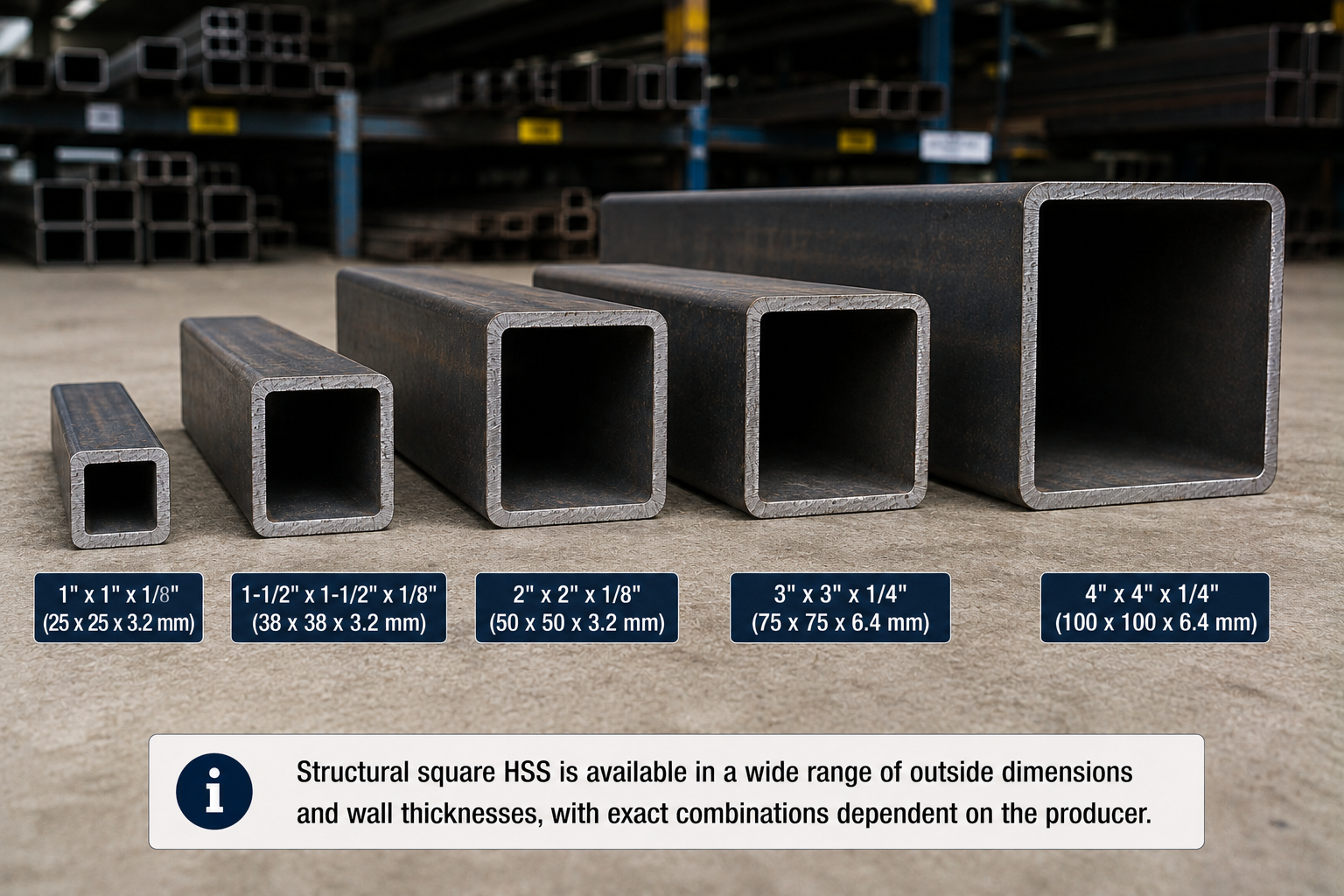
The full searchable table is organized into small square tubing (roughly 1-1/2 to 3 in.), medium square tubing (roughly 4 to 8 in.), large square tubing (roughly 10 to 20 in.), and jumbo/special HSS under ASTM A1065 for sizes beyond ordinary A500/A1085 scope.
What Is Steel Square Tubing?
A hollow steel section having equal outside width and height, four flat faces, rounded corners, and a constant nominal wall thickness around the section.
Structural Square Tube
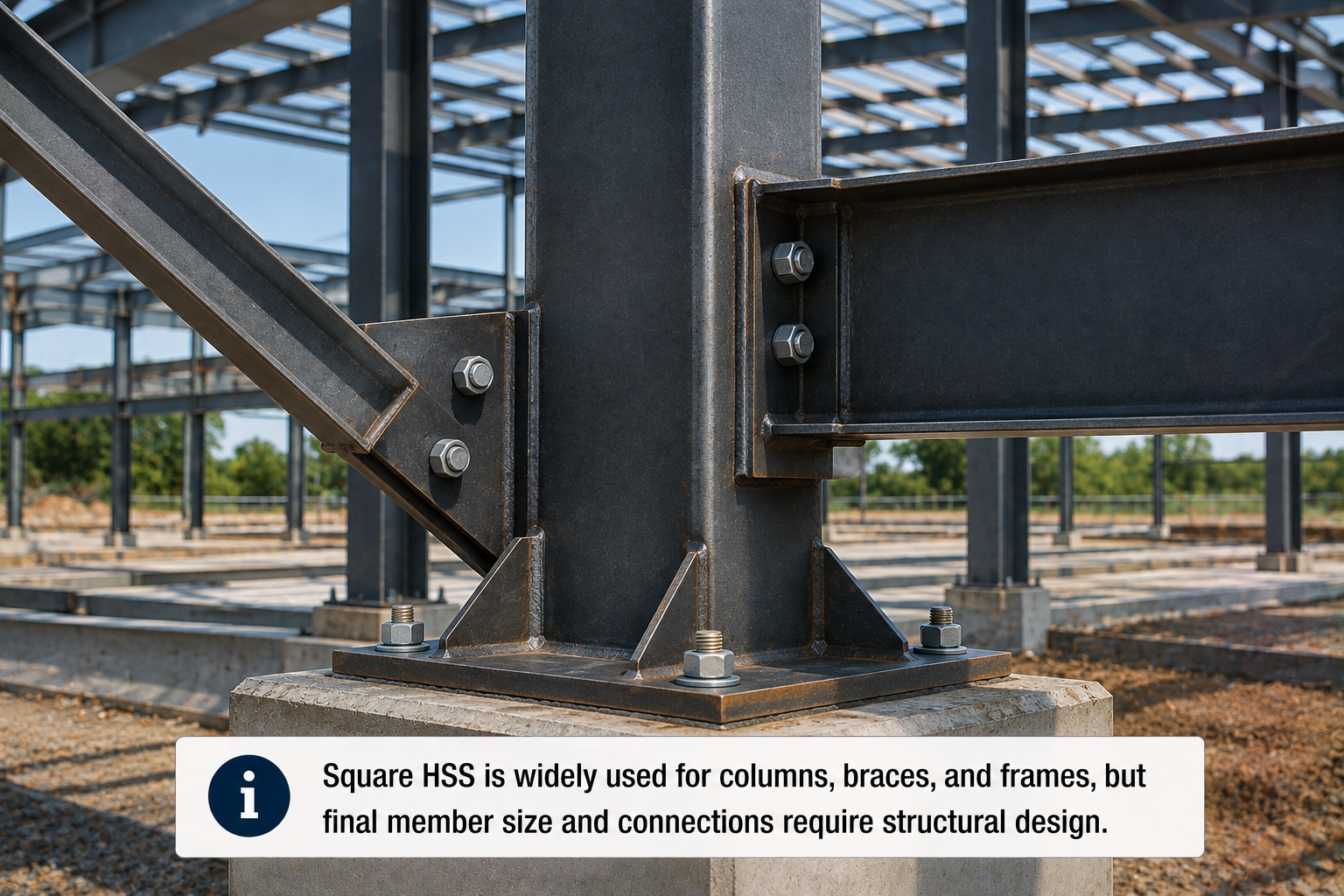
Used for columns, frames, braces, trusses, canopies, architectural framing, and miscellaneous structural steel.
Mechanical Square Tube
Used more commonly for machinery, furniture, trailers, equipment, and fabricated products. This distinction deserves early treatment since it affects which specification and tolerance apply.
Square Tube vs Square HSS
In structural-engineering terminology, square HSS is the preferred formal designation for structural hollow square sections.
HSS means Hollow Structural Section. AISC’s current shape database contains square HSS dimensions and properties as part of the structural-steel shape system.
Why “Square Tube” Is Still Common
Contractors, suppliers, and fabricators often use square tube, square tubing, and structural tubing as everyday terminology, even when referring to the same formal HSS product.
Structural Square Tube vs Mechanical Square Tube
One of this page’s strongest differentiators, and the most important distinction for search intent.
| Feature | Structural Square HSS | Mechanical Square Tubing |
|---|---|---|
| Primary purpose | Structural load-bearing | Fabrication/mechanical |
| Typical specification | ASTM A500/A1085 | Product-specific mechanical tubing specs |
| AISC section properties | Yes | Usually not AISC structural shapes |
| Structural design use | Yes | Only if properly specified/evaluated |
| Nominal/design wall distinction | Important | Specification-dependent |
| Typical applications | Columns, braces, frames | Equipment, furniture, machinery |
Do not mix mechanical-tube retailer sizes into the main structural HSS table above.
How to Read a Square HSS Designation
Since square HSS is symmetric, B = H in every designation.
Example: HSS6x6x1/4
HSS4x4x1/4 and HSS8x8x3/8 follow the same logic, with outside dimensions and thickness only.
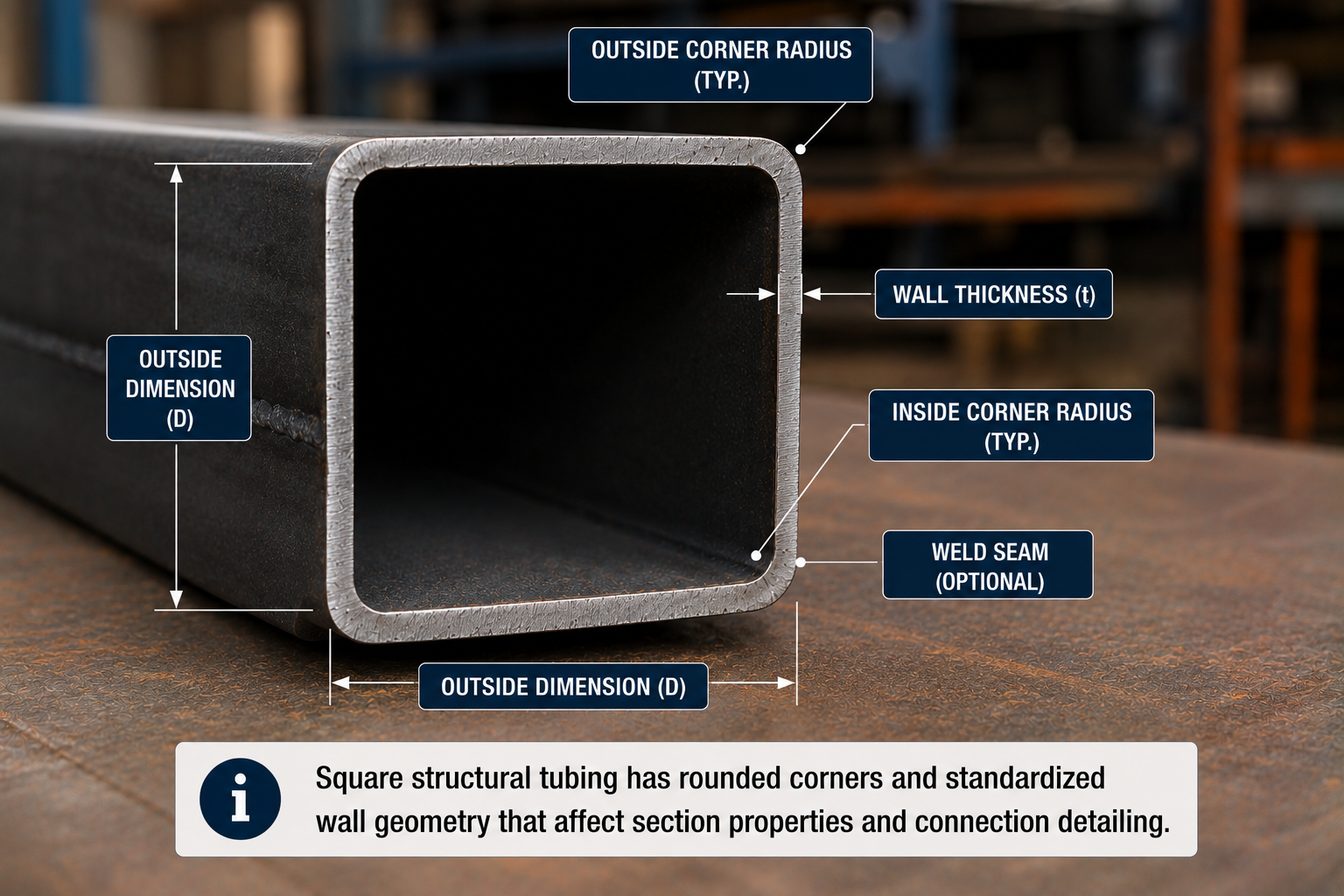
Square Tube Dimension Anatomy
Because square HSS has B = H, the geometry is biaxially symmetric.
| Term | Description |
|---|---|
| Outside width/height (B = H) | Nominal outside dimension, equal on both sides |
| Nominal wall (tnom) | As-manufactured wall thickness |
| Design wall (tdes) | Reduced thickness used in structural calculations |
| Inside clear dimension | Approximate inside opening, affected by corner rounding |
| Outside/inside corner radius | Rounded transition, not a sharp corner |
| Workable flat | Usable flat portion of each face for connections |
Outside vs Inside Square Tube Dimensions
HSS designation uses outside nominal dimensions.
Conceptual formula only
Binside ≈ B − 2t. But actual corner geometry is rounded, so do not use B − 2t as the exact clear dimension near corners for fabrication. HSS4x4x1/4 means approximately 4 in. by 4 in. outside, not inside.
Square Tube Wall Thickness Chart
A major lookup table for nominal and design wall thickness.
| Nominal Wall | Decimal (in) | Approx. (mm) | A500 Design Wall (0.93t) |
|---|---|---|---|
| 1/8 | 0.125 | 3.18 | 0.116 |
| 3/16 | 0.1875 | 4.76 | 0.174 |
| 1/4 | 0.250 | 6.35 | 0.233 |
| 5/16 | 0.3125 | 7.94 | 0.291 |
| 3/8 | 0.375 | 9.53 | 0.349 |
| 1/2 | 0.500 | 12.70 | 0.465 |
| 5/8 | 0.625 | 15.88 | 0.581 |
| 3/4 | 0.750 | 19.05 | 0.698 |
| 1 | 1.000 | 25.40 | 0.930 |
ASTM A500 allows nominal wall thickness up to 1 in. and an overall section perimeter up to 88 in. Availability depends on outside size and producer; not every wall option exists for every outside dimension.
Nominal vs Design Wall Thickness
One of this page’s most important sections.
ASTM A500
Formula
tdes = 0.93 tnom. Example, 3/8-in. wall: tnom = 0.375 in., tdes = 0.93(0.375) = 0.349 in.
STI explains that A500 permits a negative wall-thickness tolerance and current AISC design therefore uses 93% of nominal wall for design calculations.
ASTM A1085
Formula
tdes = tnom, because of tighter wall tolerances. AISC provides dedicated square, rectangular, and round A1085 dimension and property databases.
| Specification | Nominal Wall | Design Wall |
|---|---|---|
| ASTM A500 | tnom | 0.93 tnom |
| ASTM A1085 | tnom | tnom |
Small Square Tube Sizes
| Size | Wall Options | Weight Range (lb/ft) | Area Range (in²) |
|---|---|---|---|
| 2×2 | 1/8 to 1/4 in. | 3.14 to 5.41 | 0.87 to 1.51 |
| 3×3 | 1/8 to 3/8 in. | 4.85 to 12.30 | 1.36 to 3.62 |
Not every wall option exists for every size; verify current availability against AISC/STI data before final specification.
Medium Square Tube Sizes
| Size | Wall Options | Weight Range (lb/ft) | Area Range (in²) |
|---|---|---|---|
| 4×4 | 1/8 to 1/2 in. | 6.45 to 21.63 | 1.77 to 5.86 |
| 6×6 | 3/16 to 5/8 in. | 14.53 to 42.05 | 4.00 to 11.60 |
| 8×8 | 3/16 to 5/8 in. | 19.63 to 58.10 | 5.41 to 16.00 |
Large Square Tube Sizes
| Designation | Weight (lb/ft) | Area (in²) | Ix=Iy (in⁴) |
|---|---|---|---|
| HSS10x10x1/2 | 58.10 | 17.00 | 245.00 |
| HSS12x12x1/2 | 76.07 | 20.90 | 457.00 |
| HSS16x16x1/2 | 103.30 | 28.30 | 1,090.00 |
| HSS20x20x1 | 249.85 | 68.70 | 4,100.00 |
Largest and Jumbo Square HSS Sizes
The dimensional limits and where jumbo sections apply.
ASTM A500/A1085
Under A500, 4B ≤ 88 in. implies a nominal maximum square outside dimension of B ≤ 22 in. AISC’s Shapes Database confirms this, with the largest standard listed shape being HSS22x22x1. ASTM dimensional scope does not mean every possible 22×22 wall combination is commercially available; use STI’s HSS Capability Tool or manufacturer data for actual production availability.
ASTM A1065
For sizes beyond ordinary A500/A1085 range, ASTM A1065 covers larger square and rectangular HSS with total perimeter up to approximately 200 in. This becomes relevant for very large columns, long-span framing, major architectural steel, and heavy industrial construction. Do not mix A1065 jumbo shapes into the ordinary A500 main chart without labeling them separately.
✓ Verified: Largest AISC-Listed Square HSS Is HSS22x22x1 (A500), with A1065 Covering Larger Jumbo SectionsSquare Tube Weight per Foot Chart
STI’s square HSS property tables include nominal size, weight per foot, wall thickness, area, I, S, r, Z, and J.
| HSS Size | Nominal Wall | Design Wall | Area (in²) | Weight (lb/ft) | kg/m |
|---|---|---|---|---|---|
| HSS4x4x1/4 | 0.250 | 0.233 | 3.37 | 12.21 | 18.17 |
| HSS6x6x1/4 | 0.250 | 0.233 | 5.24 | 19.02 | 28.31 |
| HSS6x6x3/8 | 0.375 | 0.349 | 7.58 | 27.48 | 40.88 |
| HSS8x8x3/8 | 0.375 | 0.349 | 10.40 | 37.69 | 56.10 |
| HSS12x12x1/2 | 0.500 | 0.465 | 20.90 | 76.07 | 113.20 |
See the Structural Steel Weight Chart for weight data across all structural shape families, and the steel weight calculator for project-specific calculations.
Square Tube Cross-Sectional Area
A conceptual sharp-corner formula versus the published value.
Conceptual formula
A ≈ B² − (B − 2t)², which simplifies to A ≈ 4t(B − t). Real HSS has rounded corners, so use AISC/STI published gross area for structural design, as shown in the tables above.
Square Tube Moment of Inertia
For square HSS, Ix = Iy because of its symmetry.
This matters for flexural stiffness, deflection, and column behavior. For example, HSS6x6x1/4 has Ix = Iy = 28.6 in⁴. The AISC/STI published values should be used because actual corner geometry is included in the calculation.
Square Tube Section Modulus
S = I/c, and square HSS has equal elastic section modulus about either principal geometric axis.
For example, HSS8x8x3/8 has Sx = Sy = 25.1 in³. This page keeps actual flexural capacity calculations outside its scope.
Plastic Section Modulus
Elastic section modulus (S) and plastic section modulus (Z) are related but distinct properties. STI’s published square HSS tables include Z, which is useful for professional readers evaluating flexural strength under plastic design provisions.
Square Tube Radius of Gyration
r = √(I/A). For square HSS, rx = ry.
This makes square HSS particularly intuitive for columns compared with rectangular HSS, since slenderness behavior is identical about either axis. See the Column Size Chart for broader column-sizing context.
Square Tube Torsional Properties
Torsional constant J and closed-section behavior.
STI’s square HSS tables explicitly publish torsional properties, including J. Closed square HSS is generally much more torsionally efficient than open L- or C-shaped sections, but torsional capacity is not determined by J alone; it depends on the full design check under ANSI/AISC 360.
Square Tube Width-to-Thickness Ratio
b/t matters for local buckling and compact/noncompact/slender classification.
Why B/t Is Not the Same as AISC b/t
STI explains that the flat width used in AISC HSS slenderness calculations is based on the square HSS geometry and design wall thickness, not simply outside width divided by nominal thickness. This is a very useful technical distinction: b (the AISC flat width) accounts for corner rounding and uses tdes, while a naive B/tnom calculation does not.
Square Tube Corner Radius and Workable Flat
Structural square tube corners are rounded, not square.
ASTM A500 permits a maximum corner radius related to wall thickness, while AISC/STI uses different representative radii for different property calculations. STI gives examples such as approximately 1.5t for certain slenderness calculations, approximately 2.25t for workable flat, and approximately 2t for several section-property calculations.
Do not reduce this to one universal “corner radius equals 2t” rule for every purpose.
Workable Flat Width
The entire outside face width is not necessarily available as a flat connection surface because the corners curve into the adjoining walls. This matters for plate welding, bolt layout, gussets, and connection fit-up.
Square Tube Inside Clearance and Weld Seam
Useful for sleeves, inserts, internal plates, concrete filling, and telescoping applications.
| Concept | Description |
|---|---|
| Nominal inner flat dimension | Conceptual, based on B − 2t |
| Actual clear corner geometry | Affected by wall, bend radius, weld seam, and manufacturing tolerance |
ASTM A500 HSS may be welded or seamless; welded cold-formed HSS commonly uses an electric-resistance weld seam. Seam location and connection detailing considerations should be checked, but the weld seam does not make structural HSS inherently weak, since its quality is controlled by the governing specification. Do not create a universal telescoping-fit chart from structural HSS dimensions alone.
Square Tube Material Grades
Tube size does not determine steel grade.
For ordinary structural HSS, STI says ASTM A500 Grade C is the predominant domestic material and recommends it as the default structural HSS grade, with a minimum yield strength of 50 ksi and minimum tensile strength of 62 ksi.
ASTM A500 Grade B vs Grade C
Grade C offers higher strength than Grade B and is most commonly available domestically.
ASTM A1085
A separate specification with tighter dimensional tolerances, discussed in more detail below.
Higher-Strength HSS
Higher-strength HSS specifications exist, but availability and design-code recognition can differ from standard Grade C material; confirm with the specific producer before specifying.
✓ Verified: ASTM A500 Grade C, Fy=50 ksi, Fu=62 ksi (Steel Tube Institute)ASTM A500 Square Structural Tubing
The primary standards section for ordinary square structural tubing.
ASTM A500 covers cold-formed welded and seamless structural tubing and, per STI, allows total perimeter up to 88 in., nominal wall up to 1 in., and square HSS up to approximately 22×22 in. within scope. Grade C is the predominant structural purpose material, with the nominal versus design wall distinction (0.93 factor) applying to dimensional tolerances.
ASTM A1085 Square Structural Tubing
An important professional-level distinction from A500.
ASTM A1085 has tighter wall tolerance than A500, permits full nominal wall for design, and has dedicated AISC property tables. It is often produced on demand rather than being as widely stocked as A500, so availability should be confirmed with the specific producer before specification.
AISC 16th Edition Square HSS Tables
The master numerical-source section.
AISC Shapes Database v16.0 corresponds to the 16th Edition Steel Construction Manual, includes U.S. customary and metric values, adds 222 shapes relative to the previous database, includes structural section dimensions and properties, and also links dedicated A1085 datasets. Use AISC v16.0 as the primary source for final structural square HSS dimensions and properties.
✓ Verified against AISC Shapes Database v16.0 (16th Edition Manual)Published Square Tube Sizes vs Actual Availability
A critical commercial distinction.
STI explicitly provides an HSS Capability Tool because size availability varies by manufacturer. Specification allows it, AISC publishes it, a producer makes it, and a service center stocks it are four different questions.
| Category | Description |
|---|---|
| Standard stock | Regularly stocked by service centers |
| Mill / production order | Requires special mill order |
| Regional availability | Varies by market and distributor |
Common Square Tube Stock Lengths
Kept short, since this is a cross-section page.
Stock lengths can vary with producer, service center, size, wall, and market. This page avoids a universal “square tube comes in 20-ft sticks” claim.
Square Tube by Structural Application
Columns
Square symmetry is especially useful for biaxial column framing.
Braces and Trusses
Common in diagonal bracing and truss members.
Frames and Canopies
Used for architecturally exposed and general framing.
Do not give simplistic size prescriptions such as “use 4x4x1/4 for a column.”
How to Choose a Steel Square Tube Size
Selection depends on structural analysis, not dimensions alone.
Selection depends on axial load, bending, shear, torsion, effective length, unbraced length, b/t, local buckling, connection design, material grade, fire or corrosion exposure, and availability.
The size chart identifies available sections and properties; it does not determine structural capacity for a project by itself.
Square Tube vs Rectangular Tube, Pipe, Channel, and Angle
Useful comparisons without ranking one universally.
Square Tube vs Rectangular Tube
| Feature | Square Tube | Rectangular Tube |
|---|---|---|
| Outside dimensions | B = H | B ≠ H |
| Ix vs Iy | Equal | Different |
| Biaxial stiffness | Equal axes | Strong/weak axes |
| Typical column use | Very suitable | Orientation-dependent |
See the HSS Size Chart for full rectangular HSS dimensions.
Square Tube vs Round Tube / Pipe
Square HSS is designated by outside side dimensions times wall. Round HSS is designated by actual outside diameter times wall. Pipe uses the Nominal Pipe Size or schedule system. Do not mix NPS pipe with square or round HSS. See the Pipe Schedule Chart and Steel Pipe Weight Chart.
Square Tube vs Channel and Angle
| Property | Square HSS | Channel | Angle |
|---|---|---|---|
| Section | Closed | Open | Open |
| Symmetry | Two-axis | One-axis | Limited |
| Torsional behavior | Strong | Lower | Lower |
| Connection accessibility | More difficult | Easier | Easier |
| Architectural appearance | Clean | Open | Open |
See the Steel Channel Size Chart, Steel Angle Size Chart, and Structural Steel Shapes Chart for shape-specific reference.
Common Steel Square Tube Size Mistakes
Confusing square tube with mechanical tubing
These use different specifications and design frameworks.
Confusing square tube with square solid bar
Solid bar has no hollow interior.
Calling every square tube “HSS” without checking specification
Verify the exact governing ASTM specification.
Using inside dimensions as the nominal size
HSS designation always uses outside dimensions.
Forgetting rounded corners
Real HSS geometry is not sharp-cornered.
Assuming B-2t gives exact internal clear dimensions
Corner rounding affects the actual clear opening.
Assuming nominal wall equals A500 design wall
The 0.93 factor applies for design calculations.
Forgetting the 0.93 A500 factor
A common source of undersized design assumptions.
Applying the 0.93 factor to A1085 automatically
A1085 uses full nominal thickness instead.
Using gauge instead of specified structural wall thickness
Gauge is a market label, not the design value.
Treating weight as part of the HSS designation
Unlike W-shapes, HSS designations describe geometry only.
Using simplified sharp-corner area for structural properties
AISC/STI published values account for actual geometry.
Ignoring local slenderness b/t
Affects compactness classification and buckling behavior.
Using outside B/t as though it were AISC flat-width b/t
AISC’s b/t uses design wall thickness and accounts for corner rounding.
Ignoring the weld seam in fabrication details
Seam location matters for detailing, though quality is spec-controlled.
Assuming every AISC size is stocked locally
Database listing does not guarantee availability.
Assuming all HSS is ASTM A500 Grade C without checking
Other grades and specifications exist and must be verified.
Selecting tube size from dimensions alone
Structural design must confirm adequacy for the actual loads.
Assuming larger outside dimension automatically means adequate capacity
Wall thickness, grade, and slenderness also govern capacity.
Steel Square Tube Size Chart Limitations
Read before specifying a square tube on a project
Main tables cover structural square HSS, not every mechanical tubing product. Availability varies by manufacturer. Nominal dimensions are subject to manufacturing tolerances. ASTM A500 uses reduced design wall thickness in AISC calculations. ASTM A1085 uses different wall-thickness treatment. Rounded corners affect area, section properties, and connection geometry. Published AISC/STI values should replace simplified formulas for structural work. Local buckling and member buckling must be checked. Connection design can govern. Fire, seismic, fatigue, and corrosion may introduce additional requirements. Material grade must be verified independently. Final structural size must follow engineering and project documents.