
Ready Mix Concrete Prices in 2026: Cost Per Yard, By PSI & Location
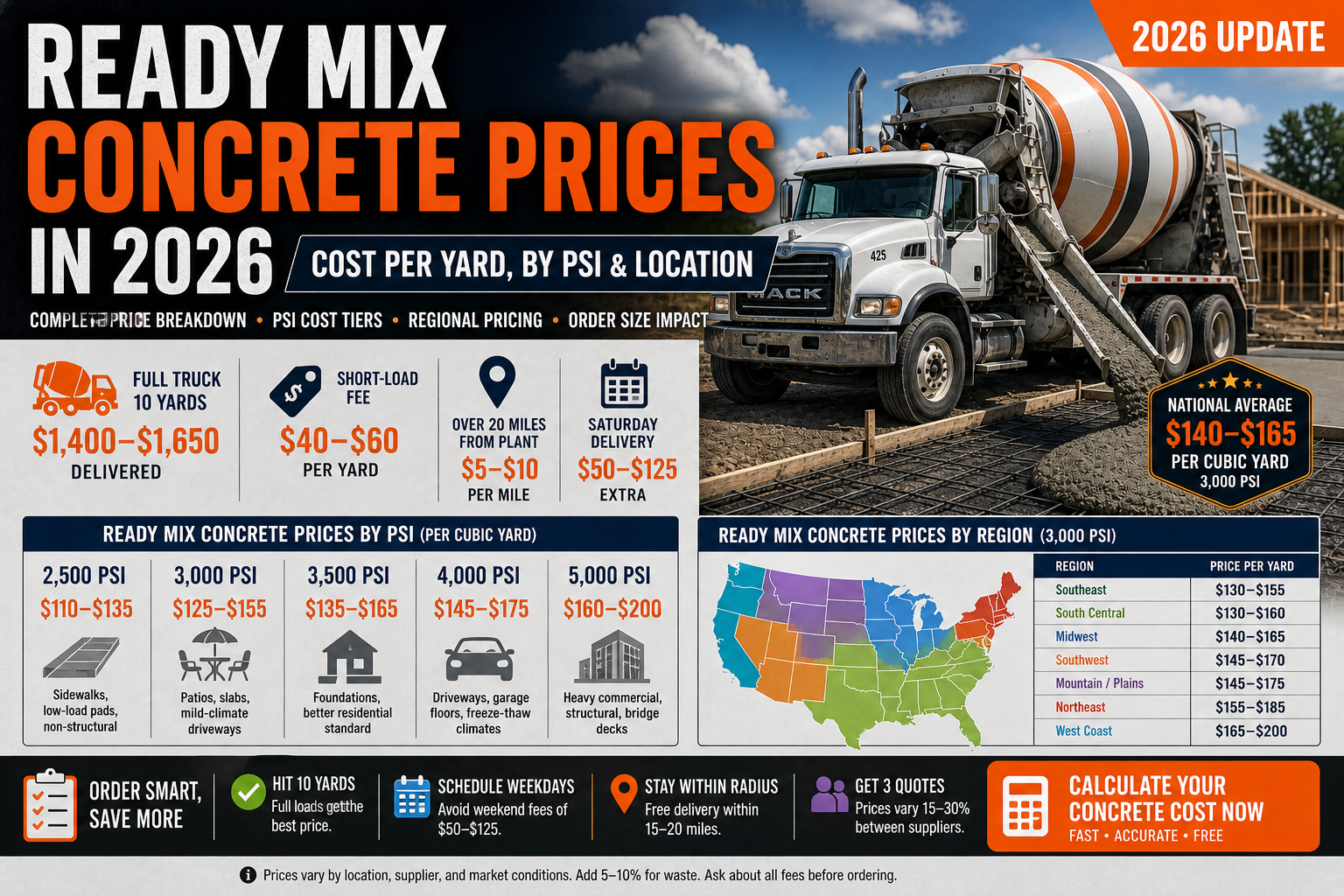
Ready mix concrete prices in 2026 range from $125 to $200 per cubic yard depending on PSI strength, where you are in the country, and how much you order. The national average for standard 3,000 PSI concrete sits at $140 to $165 per yard for a full truckload. This guide breaks down pricing by PSI, by region, and by order size so you know exactly what to expect before calling a supplier.
2026 Ready Mix Concrete Prices at a Glance
Concrete pricing moves with cement costs, diesel prices, and regional labor rates. After steady increases from 2022 to 2025, the National Ready Mixed Concrete Association (NRMCA) reported the 2024 national average at $179.89 per cubic yard across all mix types and delivery conditions. For standard residential-grade concrete in a full-load order, most homeowners pay $140 to $165 per yard in 2026.
Here is the full pricing picture across all the main variables:
| Scenario | Price Per Yard | Total for 10 Yards |
|---|---|---|
| 3,000 PSI – full load, within 20 mi | $125 – $155 | $1,250 – $1,550 |
| 3,500 PSI – full load, within 20 mi | $135 – $165 | $1,350 – $1,650 |
| 4,000 PSI – full load, within 20 mi | $145 – $175 | $1,450 – $1,750 |
| 5,000 PSI – full load, within 20 mi | $160 – $200 | $1,600 – $2,000 |
| Any PSI – short load under 10 yards | Add $40 – $60/yd | Varies by order size |
| Any PSI – over 20 miles from plant | Add $5 – $10/mile | Depends on distance |
Get a full estimate that includes delivery fees, short-load surcharges, and distance charges with our concrete price per yard calculator.
Ready Mix Concrete Price by PSI Strength
PSI – pounds per square inch – measures concrete’s compressive strength after it cures for 28 days. Higher PSI requires more cement per cubic yard, which is the single biggest ingredient cost in any mix. That is why every step up in PSI adds to the per-yard price.
Understanding PSI Cost Differences
The price gap between 3,000 PSI and 4,000 PSI is $10 to $25 per cubic yard in most US markets. On a standard 7-yard driveway pour, that is $70 to $175 total – a small premium for significantly better durability in any climate that sees below-freezing temperatures.
The American Concrete Institute’s ACI 318 standard requires 4,000 PSI minimum for any exterior concrete exposed to freeze-thaw cycles and deicing salts. Skipping this upgrade to save $100 on a pour and then replacing a failed driveway 5 years later for $5,000 to $12,000 is a bad trade.
Moving from 4,000 to 5,000 PSI adds $15 to $25 more per yard and requires a more carefully controlled mix design. Most residential contractors never need to order above 4,500 PSI. Commercial and structural applications are where 5,000 PSI and above becomes relevant.
In states with freezing winters, you need air-entrained concrete – microscopic air bubbles mixed in to prevent freeze-thaw scaling. Air entrainment adds $3 to $6 per cubic yard to the base PSI price. Always confirm your quote includes air entrainment if you’re in a cold-climate state. Without it, even 4,000 PSI concrete will scale and deteriorate on exterior surfaces.
📊 Get a Price for Your PSI and Location
Enter your cubic yards, PSI requirement, and location to get an accurate ready mix price estimate.
Ready Mix Concrete Cost by Order Size: 1 Yard vs 10 Yards
Order size is the second biggest pricing variable after PSI. A full truckload gets you the base per-yard price. Every yard short of a full load adds a short-load fee that significantly raises your effective cost per yard.
Full Load vs Short Load: The Numbers
A standard ready mix drum truck holds 10 cubic yards. When you fill it, the supplier runs the truck at peak efficiency and charges the base per-yard rate. When you need 4 yards, they still send a truck and driver, start up the plant, and mix a batch – but at 40% of capacity. The short-load fee covers that gap.
| Order Size | Base Price/yd | Short-Load Penalty | Effective Cost/yd | Total Bill |
|---|---|---|---|---|
| 10 yards (full) | $150 | None | $150/yd | $1,500 |
| 8 yards | $150 | +$50 x 2 = $100 | $162.50/yd | $1,300 |
| 5 yards | $150 | +$50 x 5 = $250 | $200/yd | $1,000 |
| 3 yards | $150 | +$50 x 7 = $350 | $267/yd | $800 |
| 1 yard | $150 | Flat $250 fee | $400/yd | $400 |
A 1-yard order costs nearly 2.7 times more per yard than a 10-yard order at the same plant. That math is why ordering even a few extra yards – to hit the full-load threshold – almost always saves you money overall.
What Counts as a Full Load?
Most plants set their full-load threshold at 9 to 10 cubic yards. Some regional suppliers will waive the short-load fee at 7 or 8 yards, especially for repeat customers or during slow winter months. Always ask directly: “What is your minimum for no short-load fee?”
Use our ready mix truck calculator to see whether your project volume hits the full-load threshold, and which truck type makes the most sense for your pour.
💼 Real Ordering Example: Two-Car Driveway, Denver, CO
Project: 20 x 30 ft driveway, 5 inches thick
Concrete needed: 9.26 cubic yards + 10% waste = 10.2 yards. Round up to 10.5 yards.
PSI: 4,000 PSI with air entrainment (required in Colorado’s freeze-thaw climate)
Per-yard price: $162 (4,000 PSI, Southwest region)
Full load threshold: 10 yards – no short-load fee
Concrete material cost: 10.5 x $162 = $1,701
Delivery fee: $75 (within 20 miles)
Fuel surcharge: $30
Total concrete delivery cost: $1,806 – before labor, forms, rebar, and base prep
Ready Mix Concrete Prices by Region
Location affects ready mix concrete pricing through three main channels: proximity to cement manufacturing plants, local labor rates, and fuel costs for delivery trucks. The spread from cheapest to most expensive region is roughly $50 to $70 per yard on the same 3,000 PSI mix.
| US Region | 3,000 PSI Per Yard | 4,000 PSI Per Yard | Notes |
|---|---|---|---|
| Southeast (GA, FL, AL, SC, MS) | $130 – $155 | $140 – $170 | Lowest in nation; strong cement manufacturing base |
| Midwest (OH, IN, IL, MI, MN) | $140 – $165 | $150 – $180 | Near national average; 4,000 PSI required in most states |
| South Central (TX, OK, AR, LA) | $130 – $160 | $140 – $175 | Texas has active cement production; competitive market |
| Southwest (AZ, NM, NV, CO) | $145 – $170 | $155 – $185 | Moderate; remote areas pay 10 to 15% more |
| Mountain/Plains (MT, WY, ID, SD, ND) | $145 – $175 | $158 – $190 | Fewer plants means less competition; delivery radius adds cost |
| Northeast (NY, MA, CT, NJ, PA) | $155 – $185 | $165 – $200 | High labor costs; dense urban traffic affects delivery |
| West Coast (CA, OR, WA) | $165 – $200 | $180 – $220 | Highest in nation; environmental regulations and labor costs |
Urban areas within every region run 10 to 20 percent higher than rural markets in the same state. A concrete pour in downtown Los Angeles costs more per yard than the same pour in a rural Central Valley town, even from the same supplier. See our concrete delivery cost guide for a full breakdown of how distance and location affect your total bill.
States with active cement manufacturing – Texas, Pennsylvania, California, Indiana, and Michigan – tend to have more competitive ready mix pricing because raw material transportation distances are shorter. The U.S. Geological Survey’s mineral commodity data shows cement production concentrated in these states, which benefits contractors and homeowners with closer supplier networks and lower transport costs.
What the Per-Yard Price Includes and Excludes
The base ready mix price per yard covers specific services only. Knowing what is and isn’t included prevents budget surprises on pour day.
What’s Included in the Base Price
- Concrete materials: Portland cement, aggregate (stone and sand), water, and standard admixtures
- Batching and mixing at the plant to your specified PSI
- Delivery within the plant’s standard radius (usually 15 to 20 miles)
- Standard delivery during weekday business hours
- Driver time and unloading within the allotted window (5 to 7 minutes per yard)
What’s NOT Included (and Costs Extra)
- Short-load fee: $40 to $60 per yard for orders under 10 yards
- Distance fee: $5 to $10 per mile beyond the free delivery radius
- Saturday delivery: $50 to $125 per load
- Fuel surcharge: $20 to $40 per load (standard in 2026)
- Standby/waiting time: $1 to $3 per minute after the allotted unloading window
- Pump truck: $150 to $750 when the truck can’t reach the pour location
- Labor: Pouring, finishing, and forming adds $3 to $8 per square foot
- Specialty additives: Color, fiber, accelerators, retarders – see below
Always ask for the total-to-site price when calling suppliers. That question forces them to include all fees in one number, making it easy to compare suppliers accurately. Use our concrete delivery cost calculator to model all fees before calling.
Cost of Additives and Specialty Mixes
Standard gray ready mix at your specified PSI is the baseline. Any modification to that baseline adds cost per yard. Here is what common upgrades cost in 2026.
| Additive or Modification | Added Cost Per Yard | When You Need It |
|---|---|---|
| Air entrainment | +$3 – $6 | All exterior concrete in freeze-thaw climates |
| Fiber reinforcement | +$5 – $15 | Surface crack resistance, light-duty flatwork |
| Accelerator (speeds set) | +$6 – $15 | Cold weather pours, tight project schedules |
| Retarder (slows set) | +$5 – $12 | Hot weather, large pours, long delivery distances |
| Water reducer / plasticizer | +$5 – $10 | Better workability without adding water and losing PSI |
| Integral color pigment | +$20 – $80 | Decorative colored concrete, matches architectural finishes |
| High-early-strength Type III cement | +$10 – $25 | Reaches design PSI in 3 to 7 days vs standard 28 days |
| Silica fume (high-strength) | +$20 – $40 | Required for 6,000+ PSI mixes, parking decks, bridge work |
| Winter heating (hot water) | +$5 – $15 | Pours in temperatures below 40°F in northern states |
Specialty concrete – fiber-reinforced, high-early-strength, or integrally colored – typically costs $15 to $30 more per yard than a standard mix at the same PSI. For decorative work requiring integral color plus stamping, budget for the additive cost in ready mix plus the stamping labor premium on the installation side.
Ready Mix vs Bagged Concrete Cost
The question of ready mix vs bags comes up on small projects all the time. The answer is almost always ready mix for anything over 1 cubic yard – but the math is worth understanding.
Bagged Concrete Cost Per Yard
An 80-pound bag of standard concrete mix (Quikrete, Sakrete, or equivalent) costs $5 to $6.50 at home improvement stores in 2026. You need approximately 45 bags to make 1 cubic yard. That puts bagged material cost at $225 to $290 per cubic yard – significantly more than ready mix on a per-yard basis.
But bagged concrete has no delivery fee, no short-load fee, and no minimum order. For tiny projects, that matters. Use our yards to bags calculator to find the exact break-even point for your specific project volume.
✅ Choose Bagged Concrete When:
- ✓ Project needs less than 0.75 cubic yards
- ✓ Small repairs, patch work, or single fence posts
- ✓ You want to avoid a delivery visit entirely
- ✓ The project is spread over multiple sessions
- ✓ No truck access to the pour location
✅ Choose Ready Mix When:
- ✓ Project needs more than 1 cubic yard
- ✓ Driveways, patios, slabs, or foundations
- ✓ Consistent strength and quality matter
- ✓ You need a specific PSI that bags can’t guarantee
- ✓ Mixing 225+ bags by hand isn’t practical
The concrete material cost crossover is roughly 0.75 to 1 cubic yard. Below that volume, bags and ready mix cost about the same per yard once you factor in the short-load fee. Above 1 cubic yard, ready mix is definitively cheaper – and produces a far more consistent and reliable concrete.
Use our ready mix bags calculator to compare the total material cost for bags vs delivered concrete side by side for any project volume.
💼 Side-by-Side: 3 Yards of Concrete
Bagged concrete: 45 bags x 3 yards x $6/bag = $810 in material. Plus 4+ hours of mixing labor per yard.
Ready mix with short-load fee: 3 yards x $150 + $350 short-load fee = $800 total delivered. No mixing labor required.
Ready mix wins at the same total cost – and it produces higher-quality, more consistent concrete with zero mixing work. At 5 yards, ready mix is clearly cheaper. Only at volumes under 0.75 yards do bags typically win on total cost.
How to Get the Best Ready Mix Concrete Price
Ready mix pricing is not fixed. These strategies consistently reduce the per-yard cost without cutting quality.
Order a Full Truckload
The biggest single lever is hitting the 10-yard full-load threshold to eliminate short-load fees. If your project needs 8 yards, design a small walkway extension, extra stepping stones, or a garden pad to get to 10. The cost of the extra 2 yards of concrete is almost always less than the short-load penalty you’d pay on the 8 yards you were already ordering.
Use our concrete volume calculator to plan your order around the full-load threshold before calling any supplier.
Schedule Tuesday Through Thursday
Saturday delivery adds $50 to $125 per load at most plants. Weekday morning deliveries – Tuesday through Thursday – give you the best rates, the most scheduling flexibility, and typically the most experienced crews available. If the job can flex on timing, pick a mid-week pour.
Shop Multiple Suppliers
Ready mix pricing varies 15 to 30 percent between suppliers in the same market. Call at least three plants and request a total-to-site price including all fees. The supplier with the highest per-yard quote can end up cheaper after delivery once a competitor’s distance fees or surcharges are included. Our concrete project estimator helps you build a baseline budget before reaching out to suppliers so you can evaluate quotes accurately.
Pour in Fall or Early Spring
Spring (April through June) and summer are peak season for concrete work. Demand is high and suppliers are less flexible on pricing. Scheduling a pour for September through November – when temperatures are still ideal for curing – often unlocks better pricing and faster scheduling. In warm-climate states, winter pours can also be slightly cheaper. According to Concrete Network data, off-peak scheduling can reduce ready mix costs 5 to 10 percent in competitive markets.
Don’t Over-Specify PSI
Specifying 4,000 PSI when 3,000 PSI is code-compliant for your application costs $70 to $175 more on a typical residential pour. Know your code requirements before ordering. For sidewalks and patios in mild climates, 3,000 PSI is typically adequate. For driveways and any outdoor concrete in freeze-thaw states, 4,000 PSI is the right choice and worth every dollar. Don’t go to 5,000 PSI for residential work – that’s a waste of money for standard home projects.
Be Ready When the Truck Arrives
Standby time charges of $1 to $3 per minute kick in after the driver’s allowed unloading window. A 30-minute delay adds $30 to $90 to your bill. Have all forms set, rebar in place, and your full crew ready at least 30 minutes before the truck is scheduled to arrive. Never schedule a ready mix delivery until site prep is 100 percent complete.
🎯 Key Takeaways: Ready Mix Concrete Prices 2026
- Ready mix concrete costs $125 to $200 per cubic yard in 2026 depending on PSI, region, and order size
- The national average for 3,000 PSI in a full 10-yard load is $140 to $165 per yard delivered within 20 miles
- 4,000 PSI adds $10 to $25 per yard and is required in any freeze-thaw climate per ACI 318 standards
- 5,000 PSI runs $160 to $200 per yard and is reserved for commercial and structural applications
- Short-load fees of $40 to $60 per yard apply for orders under 10 yards – always try to hit the full-load threshold
- The Southeast is cheapest at $130 to $155 per yard; the West Coast is highest at $165 to $200 per yard
- Urban markets run 10 to 20 percent higher than rural areas in every region
- Air entrainment adds $3 to $6 per yard and is non-negotiable for exterior concrete in cold-climate states
- For projects over 1 cubic yard, ready mix is almost always cheaper than bagged concrete once you compare total cost
- Schedule Tuesday to Thursday weekday pours to avoid $50 to $125 in Saturday surcharges
- Get three total-to-site quotes before ordering – pricing varies 15 to 30 percent between local suppliers
Frequently Asked Questions
🧮 Price Out Your Concrete Before You Order
Use our free calculators to estimate volume, pricing, and delivery cost for your specific project and location.
💰 Related Calculators
- → Concrete Price Per Yard Calculator – Current ready mix pricing by PSI and region
- → Concrete Delivery Cost Calculator – Total delivery bill including short-load fees and distance charges
- → Concrete Yardage Calculator – Cubic yard estimates for any project dimensions
- → Concrete Volume Calculator – Precise volume for any shape and thickness
- → Ready Mix Truck Calculator – See which truck size fits your order and how many loads you need
- → Ready Mix Bags Calculator – Compare delivered concrete vs bagged concrete material cost
- → Yards to Bags Calculator – Find the break-even point between bags and ready mix for your volume
- → Concrete Cost Calculator – Material and delivery cost combined for any project
- → Concrete Project Estimator – Full project budget from volume through delivery to total installed cost
- → Concrete Cost Per Square Foot Calculator – Per-square-foot pricing for driveways, patios, and slabs
- → Gravel Calculator – Base material cost for your project footprint
- → Concrete Aggregate Calculator – Aggregate quantity and cost for mix proportioning
📚 Related Guides
- → How Much Does Concrete Delivery Cost? (2026) – Full breakdown of delivery fees, short-load charges, and distance costs
- → How to Calculate Concrete – Volume, mix ratios, and cubic yard formulas explained
- → Concrete Mixing Instructions – When to mix your own vs order ready mix for any project size