How Much Does a Concrete Foundation Cost in 2026: Per Sq Ft, Full Project & By Size
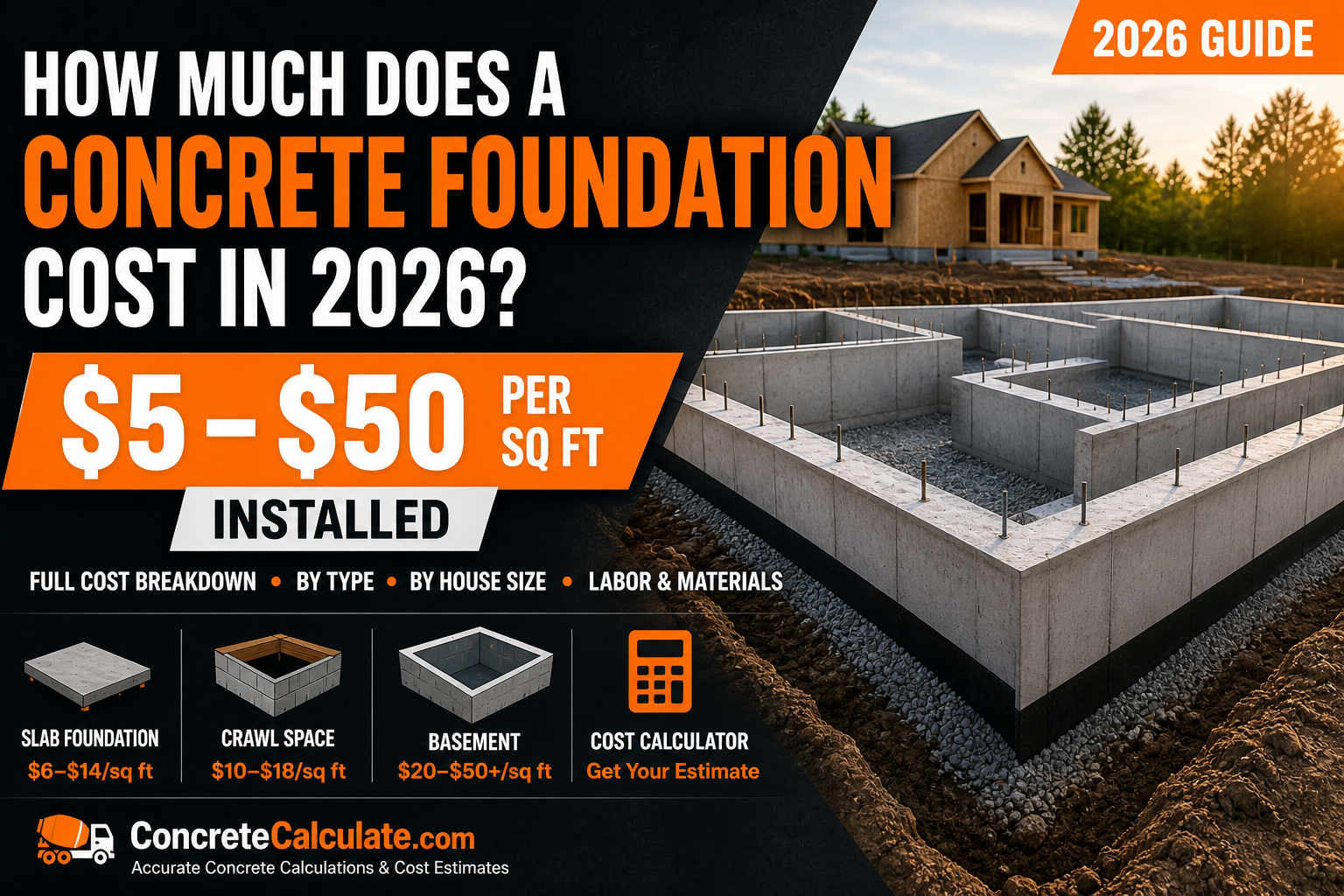
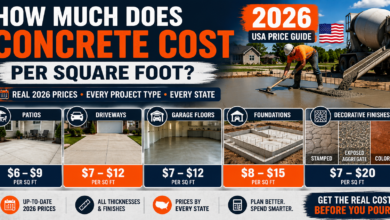
A concrete foundation costs $5 to $50 per square foot in 2026, depending on the type. A slab runs $6 to $14 per square foot. A crawl space costs $10 to $18. A full basement can reach $20 to $50 or more. This guide breaks down every cost component with real 2026 data so you can set an accurate budget before the first shovel hits the ground.
Quick Cost Numbers for 2026
Foundation type drives your per-square-foot cost more than any other variable. Here is where each type lands in 2026, with installed prices including labor and materials.
| Foundation Type | Cost Per Sq Ft | Best For |
|---|---|---|
| Concrete slab (monolithic) | $5 – $12 | Flat lots, warm and mild climates |
| Concrete slab (stem wall) | $6 – $18 | Sloped lots, added perimeter support |
| Crawl space | $10 – $18 | Uneven terrain, utility access needs |
| Pier and beam | $6 – $15 | Flood zones, slopes, unstable soil |
| Basement (unfinished) | $20 – $37 | Cold climates, storage, added living area |
| Basement (finished) | $35 – $50+ | Maximum livable square footage |
Jump straight to your numbers with our concrete foundation cost calculator – enter your square footage and foundation type for an instant estimate.
Foundation Cost by Type: Slab vs Crawl Space vs Basement
Foundation type is the single biggest decision you will make on any new build. The right choice depends on your climate, soil, site conditions, and how much space you need below the living floor.
Concrete Slab Foundation: $6 to $14 Per Square Foot
The concrete slab is the most common residential foundation in the US. According to the U.S. Census Bureau, approximately 75 percent of all homes are built on slab foundations. They cost the least because they require minimal excavation and the footing and floor can be poured in one continuous operation.
A monolithic slab runs $5 to $12 per square foot. A stem wall slab – which adds a concrete perimeter wall for extra support – costs $6 to $18 per square foot due to additional forming and labor. For a 2,000 sq ft home, a slab foundation totals $12,000 to $28,000.
Slabs are the right call for flat, stable ground in moderate or warm climates – the Southeast, Southwest, and parts of the Midwest. In states with deep frost lines, a slab without proper insulation and depth can heave and crack. Check your local frost line depth with your building department before finalizing the foundation type.
Crawl Space Foundation: $10 to $18 Per Square Foot
A crawl space sits 18 to 48 inches below the floor, giving access to plumbing, wiring, and HVAC without a full basement excavation. It requires more site work than a slab – excavation around the perimeter and concrete foundation walls – which drives up cost.
For a 2,000 sq ft home, a crawl space runs $30,000 to $36,000 on average. Add $3,000 to $8,000 for vapor barriers and proper waterproofing, which most contractors strongly recommend regardless of climate.
Crawl spaces without vapor barriers develop mold, rot, and structural damage within a few years. Crawl space encapsulation costs $3 to $10 per square foot – but that cost is a fraction of what mold remediation and structural repairs run later. Budget for it upfront.
Basement Foundation: $20 to $50 Per Square Foot
A full basement requires excavating 7 to 8 feet below grade across the entire footprint, forming and pouring concrete walls, and installing drainage and waterproofing systems. It is the most expensive option but also the only one that significantly adds usable square footage to the home.
An unfinished basement for a 2,000 sq ft home costs $70,000 to $100,000 or more, including excavation. Finishing the basement adds another $30 to $50 per square foot on top of the build cost. In cold-climate states like Minnesota, Michigan, and upstate New York, basements are effectively required – the frost line runs 4 to 5 feet deep, which is too deep for any standard slab footing to reach.
Pier and Beam Foundation: $6 to $15 Per Square Foot
Pier and beam foundations use concrete piers set into the ground with structural beams spanning between them. The home sits elevated above grade with crawl space access below. These work best on sloped lots, in coastal flood zones, and on sites with shifting or expansive soils.
For a 2,000 sq ft home, budget $16,000 to $30,000. These are common in Texas, Louisiana, and coastal Gulf states. Use our concrete footing calculator to estimate volume and cost for individual piers before ordering concrete.
Concrete Foundation Cost by House Size
Foundation cost scales directly with your home’s footprint. Below are total project estimates by house size for each foundation type in 2026. These include labor, materials, and standard site prep on a reasonably flat lot.
| House Size | Concrete Slab | Crawl Space | Basement (Unfinished) |
|---|---|---|---|
| 1,000 sq ft | $6,000 – $14,000 | $10,000 – $18,000 | $20,000 – $37,000 |
| 1,200 sq ft | $7,200 – $16,800 | $12,000 – $21,600 | $24,000 – $44,400 |
| 1,500 sq ft | $9,000 – $21,000 | $15,000 – $27,000 | $30,000 – $55,500 |
| 2,000 sq ft | $12,000 – $28,000 | $30,000 – $36,000 | $70,000 – $100,000+ |
| 2,500 sq ft | $15,000 – $35,000 | $37,500 – $45,000 | $87,500 – $125,000+ |
These are national average ranges. Regional labor rates, soil conditions, and your specific engineering requirements will shift your actual cost. Use our concrete foundation calculator to get volume and cost estimates for your exact dimensions.
📐 Get Your Foundation Cost Estimate Now
Enter your square footage and foundation type to get an accurate estimate in under 60 seconds.
Full Foundation Cost Breakdown: Labor, Materials & Excavation
A foundation quote breaks down into four main buckets. Knowing each one helps you evaluate bids and catch where corners are being cut.
Labor: 40 to 60 Percent of Total Cost
Labor is the largest single line item on any foundation project. Concrete contractors charge $50 to $150 per hour. A standard three-person crew typically needs a full 8-hour day to pour a residential slab, working out to $3 to $7 per square foot for a basic pour.
Labor costs rise sharply for crawl spaces and basements because of the excavation, forming, and waterproofing work involved. Nationally, expect to spend $4,500 to $18,500 in total labor across a residential foundation project, per data from Angi’s contractor cost database.
Ready-Mix Concrete: $3 to $7 Per Square Foot in Materials
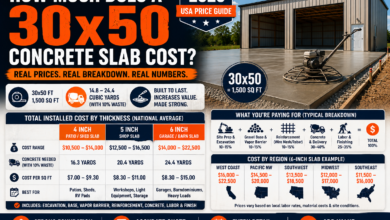
Ready-mix concrete runs $125 to $175 per cubic yard delivered in 2026. A 6-inch slab for a 1,500 sq ft home needs roughly 28 cubic yards. At $150 per yard, that is $4,200 in concrete material before delivery fees.
Most foundation contractors specify 3,000 to 4,000 PSI concrete. Use 4,000 PSI for any foundation in a climate with freeze-thaw cycles. See our concrete PSI guide for full strength recommendations by application. Check current ready-mix pricing in your area with our concrete price per yard calculator.
Reinforcement: $1 to $3 Per Square Foot
Rebar is required for most residential foundation slabs and all basement walls. It adds $2 to $3 per square foot installed. Wire mesh is an alternative for light-duty slabs at $0.20 to $0.30 per square foot, but it does not provide the same tensile strength as rebar in structural foundation applications.
Adding rebar to a 1,500 sq ft foundation adds $3,000 to $4,500 to the total. This is not a cost to cut. Use our concrete rebar calculator to estimate quantity and cost for your foundation footprint.
Excavation and Site Preparation
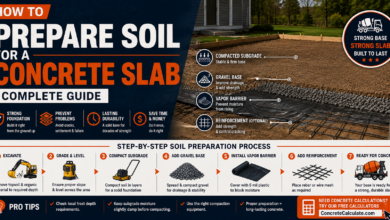
For a slab foundation, site prep is mostly scraping, leveling, and laying a compacted gravel base. Grading costs $0.40 to $2 per square foot. Basic site prep for a slab runs $500 to $2,000 on a straightforward lot.
Crawl space excavation costs more because the contractor digs 2 to 4 feet below grade around the perimeter. Full basement excavation – 7 to 8 feet deep across the full footprint – can cost $5,000 to $20,000 or more depending on soil type, equipment access, and rock conditions.
Use our gravel calculator to estimate the base material volume and cost for your foundation footprint before your contractor quotes that line item.
| Cost Component | Slab Foundation | Crawl Space | Basement |
|---|---|---|---|
| Labor | $3 – $7/sq ft | $5 – $10/sq ft | $10 – $20/sq ft |
| Concrete materials | $3 – $7/sq ft | $3 – $7/sq ft | $5 – $12/sq ft |
| Rebar or mesh | $1 – $3/sq ft | $1 – $3/sq ft | $2 – $4/sq ft |
| Excavation and site prep | $500 – $2,000 | $2,000 – $8,000 | $5,000 – $20,000+ |
| Waterproofing | Not required | $3,000 – $8,000 | $5,000 – $15,000 |
| Permits and inspections | $450 – $2,300 | $450 – $2,300 | $450 – $2,300 |
💼 Real-World Example: 1,500 Sq Ft Slab Foundation in Atlanta, GA
Foundation type: Monolithic concrete slab, 6 inches thick
Concrete needed: ~28 cubic yards at $148/yd = $4,144 in material
Labor: $5/sq ft x 1,500 sq ft = $7,500
Rebar: $2/sq ft x 1,500 sq ft = $3,000
Gravel base and grading: $1,500
Concrete delivery fee: $300
Building permit: $800
Total estimated cost: $17,244 – or about $11.50 per square foot for this size and region.
Factors That Change Your Final Price
Two identical-size homes in different conditions can have foundation costs that are thousands of dollars apart. Here is what moves the number most.
Soil Conditions
Soil is the variable most homeowners underestimate. Clay-heavy soil expands when wet and contracts when dry, putting pressure on foundation walls that can cause cracking over time. Rocky soil requires mechanical breaking before excavation can begin. Unstable or expansive soils may need deeper footings, additional rebar, or soil stabilization treatments.
A geotechnical soil test costs $1,000 to $5,000 and is often required by your building department before permit approval. It is money well spent – a soil problem found before the pour is a design challenge. The same problem found after the pour is a catastrophic and expensive failure.
Frost Line Depth
Footings must extend below the local frost line to prevent frost heave from lifting and cracking the foundation. Frost lines range from zero in Florida to 60 or more inches in Minnesota and Maine. Deeper footings mean more excavation, more concrete, and more forming labor. Your local building department or the International Residential Code (IRC) frost depth maps define the required footing depth for your area.
Foundation Thickness
Standard residential slabs run 4 to 6 inches thick. Multi-story homes and homes in cold climates typically use 6-inch slabs throughout. Each additional inch of thickness adds $0.50 to $1.50 per square foot in concrete. Use our concrete volume calculator to see exactly how thickness changes your cubic yard requirement.
Region and Labor Market
Foundation labor rates vary by 20 to 35 percent across the US. Northeast and West Coast metro markets consistently run above the national median. A 1,500 sq ft slab that costs $15,000 in rural Texas might cost $22,000 to $25,000 in the Boston or Los Angeles markets. Scheduling work in late fall or early spring often brings more competitive pricing in most regions.
Waterproofing and Drainage
Crawl space and basement foundations need waterproofing. Skipping it is the number one cause of foundation problems in the first decade of a home’s life. Exterior membranes and interior drainage systems add an average of $5,000 for a standard basement – a small number compared to a full remediation later that can run $20,000 to $50,000.
Concrete Footing Cost
Every foundation rests on footings – concrete strips or pads that spread the structural load into the soil. Footing cost runs about $6.50 per square foot as a standalone item, though most foundation contractors include it in the total quote. Use our concrete footing calculator to estimate volume and cost for your foundation’s perimeter and interior load points.
Which Foundation Is Right for Your Home?
The right foundation is not purely a budget decision. Climate and soil narrow your realistic options before cost even enters the picture.
✅ Choose a Slab When:
- ✓ You’re in the South, Southeast, or Southwest
- ✓ The lot is flat and the soil is stable
- ✓ Your frost line is less than 12 inches deep
- ✓ Budget is the primary constraint
- ✓ Below-floor utility access is not a priority
⚠️ Consider a Crawl Space or Basement When:
- ✗ Frost depth exceeds 18 inches in your area
- ✗ The lot has significant slope or drainage issues
- ✗ Soil is expansive clay or unstable fill
- ✗ You need easy access to utilities below the floor
- ✗ You want the option to add living space below grade
In states with harsh winters – Minnesota, Wisconsin, Michigan, upstate New York, and New England – basements are standard and often code-required. In Florida, Arizona, Texas, and much of California, slabs dominate because frost heave is not a concern.
Crawl spaces are a practical middle-ground in states like Tennessee, North Carolina, and Virginia, where some frost exposure exists but a full basement is not required by code.
The foundation type and thickness affect how much load the structure can safely transfer to the soil. Use our concrete load bearing calculator to verify your foundation can handle the structural loads of your planned home. This matters most for multi-story homes and structures with heavy roofing materials like slate or clay tile.
How to Reduce Concrete Foundation Cost
The foundation is not the place to cut structural corners. But there are legitimate ways to control cost without compromising quality.
Match the Foundation to Your Site
Don’t over-build. If your soil and climate support a monolithic slab, a stem wall slab costs more without adding proportional benefit. Discuss options with your contractor and structural engineer before committing to a more complex type than your site actually needs.
Hit a Full Truckload to Avoid Short-Load Fees
Ready-mix trucks hold 9 to 10 cubic yards. Ordering less triggers short-load fees of $40 to $60 per yard. On a 3-yard order, that adds $120 to $180 before a single yard is poured. Size your pour to hit close to a full load, or combine the foundation with footings or a garage slab to fill the truck. Our concrete yardage calculator shows your exact volume so you can plan the order before calling the supplier. Compare delivery costs with our concrete delivery cost calculator.
Do the Soil Test Before You Design
A soil test that reveals poor conditions before design lets you engineer the right solution from the start. Finding a soil problem after the foundation is poured can mean complete demolition and replacement – costs that far exceed the $1,000 to $5,000 test fee.
Handle Non-Structural Site Prep Yourself
Clearing vegetation, removing an old asphalt pad, or hand-leveling modest slopes are tasks some homeowners can do themselves to save $500 to $1,500. Always leave structural excavation, forming, and the concrete pour to licensed crews.
Get Three Written Quotes
Foundation contractor pricing varies by $3,000 to $6,000 on mid-size projects in the same market. Get at least three written quotes specifying the same scope – PSI, thickness, footing depth, reinforcement type, and what site prep is included. Use our concrete cost per square foot calculator to reality-check bids before signing.
Hiring a Foundation Contractor: What to Watch For
The foundation is the most consequential part of any home build. Getting it wrong has no cheap fix.
Green Flags in a Foundation Contractor
- Licensed, bonded, and insured – with proof on request
- Written contract specifying PSI, slab thickness, footing depth, and reinforcement type
- Minimum 5 years of residential foundation experience in your region
- Local references you can actually call or visit
- Pulls permits and works through inspections without resistance
- Staged payment schedule: deposit, progress payment, final on passing inspection
Red Flags That Cost You Later
- No mention of rebar or reinforcement in the quote
- Slab thickness not written into the contract
- No discussion of footing depth or frost line requirements
- Cash only or full payment demanded upfront
- No written contract or permit plan
- Bid significantly below all other quotes without a clear explanation
Building permits require a structural inspection before the concrete pour. That inspection catches forming errors, rebar placement mistakes, and footing depth problems before they are buried in concrete. A contractor who wants to pour before the inspector arrives is a serious red flag. Walk away.
For a step-by-step walkthrough of what happens on pour day, see our guide on how to pour a concrete slab. It covers forming, rebar placement, pour technique, and curing – everything your contractor should be doing correctly.
🎯 Key Takeaways: Concrete Foundation Cost 2026
- Foundation cost ranges from $5 to $50 per square foot depending entirely on foundation type
- Concrete slab foundations cost $6 to $14 per square foot – the most affordable option
- Crawl space foundations cost $10 to $18 per square foot due to excavation and perimeter walls
- Basement foundations cost $20 to $50 per square foot unfinished and are often required in cold-climate states
- A 1,500 sq ft slab foundation totals roughly $9,000 to $21,000 installed in 2026
- A 2,000 sq ft basement foundation totals $70,000 to $100,000 or more
- Labor makes up 40 to 60 percent of total foundation cost across all types
- Ready-mix concrete runs $125 to $175 per cubic yard delivered in 2026
- Rebar adds $2 to $3 per square foot – non-negotiable for structural foundations
- Soil testing costs $1,000 to $5,000 and prevents far more expensive surprises after the pour
- Building permits are required in nearly all US municipalities and run $450 to $2,300
- Always get three written quotes specifying identical scope before signing with any contractor
Frequently Asked Questions
🧮 Estimate Your Foundation Before You Break Ground
Use our free calculators to get accurate volume, material, and cost estimates before you talk to a single contractor.
🧮 Related Calculators
- → Concrete Foundation Calculator – Volume and cubic yard estimates for any foundation footprint
- → Concrete Foundation Cost Calculator – Full project cost including labor, materials, and delivery
- → Concrete Footing Calculator – Volume and cost for individual footings and perimeter strips
- → Concrete Slab Calculator – Area, volume, and material estimates for any slab
- → Concrete Yardage Calculator – Cubic yard estimates to avoid short-load fees
- → Concrete Volume Calculator – Precise volume for any foundation shape and thickness
- → Concrete Cost Calculator – Material cost by PSI and volume
- → Concrete Cost Per Square Foot Calculator – Region-adjusted per-square-foot pricing
- → Concrete Price Per Yard Calculator – Current ready-mix pricing by region
- → Concrete Rebar Calculator – Rebar quantity and cost for your foundation dimensions
- → Gravel Calculator – Base material volume and cost for your foundation footprint
- → Concrete Load Bearing Calculator – Verify your foundation handles your structural loads
📚 Related Guides
- → How to Pour a Concrete Slab – Step-by-step guide with forming, reinforcement, and curing
- → Concrete PSI Guide 2026 – Which PSI to specify for foundations, footings, and slabs
- → Concrete Formula Calculation – How to calculate volume, mix ratios, and material quantities