Ready Mix Concrete Cost Per Yard: Complete 2026 Pricing Guide
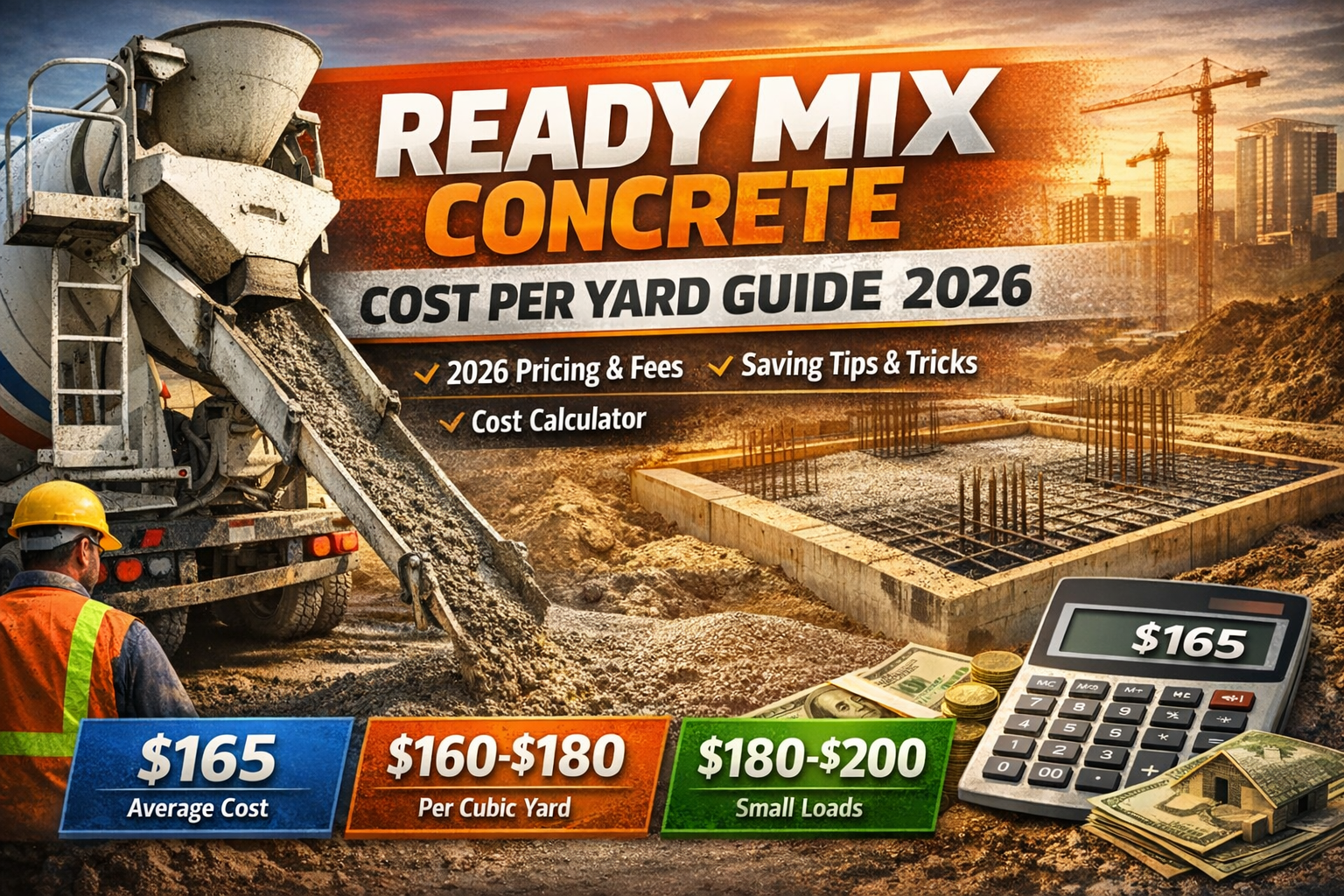
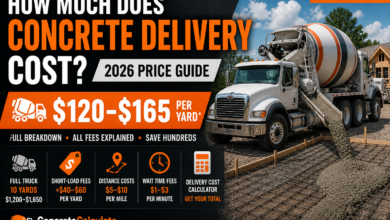
Ready mix concrete costs $160-$180 per cubic yard in 2026, with the national average at $165 per yard for standard strength concrete. Understanding ready mix concrete cost per yard helps you budget accurately for driveways, patios, foundations, and other concrete projects. This guide breaks down current pricing, delivery fees, cost factors, and strategies to save money on your next concrete purchase.
Current Ready Mix Concrete Pricing (2026)
Ready mix concrete pricing varies significantly based on order size, location, and concrete strength. Here’s what you can expect to pay in 2026 across the United States.
Pricing by Order Size
The amount of concrete you order dramatically impacts your cost per yard. Suppliers charge short-load fees for orders under 10 cubic yards because they lose money running partially filled trucks.
| Order Size | Cost Per Yard | Total Cost |
|---|---|---|
| 1-2 cubic yards | $190-$210 | $190-$420 |
| 3-4 cubic yards | $180-$195 | $540-$780 |
| 5-9 cubic yards | $170-$185 | $850-$1,665 |
| 10+ cubic yards (full truck) | $160-$180 | $1,600-$1,800 |
| 15+ cubic yards (multiple trucks) | $155-$175 | $2,325+ |
A standard ready mix truck holds 10 cubic yards. Ordering a full load eliminates short-load fees and gives you the best price per yard. If your project needs 8-9 yards, consider adjusting your pour slightly thicker to reach the 10-yard threshold and save $50-150 in fees.
Regional Price Variations
Concrete costs vary by region due to local material costs, labor rates, and transportation distances. Here are typical 2026 regional averages for standard 3000 PSI concrete:
- Southeast (Georgia, Florida, Alabama): $155-$170 per yard (lowest in nation)
- Midwest (Ohio, Indiana, Illinois): $160-$175 per yard (near national average)
- Southwest (Texas, Arizona, New Mexico): $165-$180 per yard (moderate pricing)
- Northeast (New York, Massachusetts, Pennsylvania): $180-$200 per yard (higher labor costs)
- West Coast (California, Washington, Oregon): $190-$220 per yard (highest in nation)
Urban areas within each region run 10-20% higher than rural areas due to higher operating costs and increased demand. Use our concrete price per yard calculator to get location-specific pricing estimates.
What’s Included in the Price Per Yard
The quoted ready mix concrete cost per yard typically includes specific services, but many expenses are separate. Understanding what you’re paying for prevents budget surprises.
Included in Base Price
- Concrete materials: Portland cement, aggregates (sand and gravel), water, and basic admixtures
- Batching: Precise mixing at the plant according to your specified strength and slump
- Standard delivery: Transportation within 20 miles of the batch plant during business hours
- Truck time: First 5-10 minutes on-site for unloading (varies by supplier)
- Basic testing: Quality control testing at the plant before loading
NOT Included (Additional Costs)
- Labor: Pouring, spreading, screeding, and finishing the concrete
- Pump truck: $200-$500 for pumping concrete to hard-to-reach areas
- Short-load fees: $50-$80 per yard for orders under 10 cubic yards
- Extended delivery: $8-12 per mile beyond 20 miles from the plant
- Weekend/holiday delivery: $50-$150 additional fee
- Standby time: $2-4 per minute after the first 5-10 minutes
- Special additives: Color, fiber reinforcement, accelerators, retarders
- Site preparation: Excavation, forms, gravel base, reinforcement
Ready mix trucks begin charging standby fees after 5-10 minutes on site. At $3 per minute, a 30-minute delay costs an extra $75. Have your site completely ready before the truck arrives including finished forms, compacted base, and helpers standing by. The concrete starts curing immediately and waiting destroys quality.
7 Factors That Affect Ready Mix Concrete Costs
Multiple variables influence how much you pay for ready mix concrete per yard. Understanding these factors helps you make cost-effective decisions.
1. Concrete Strength (PSI Rating)
Compressive strength measured in pounds per square inch (PSI) directly impacts price. Higher PSI concrete contains more cement, the most expensive component.
| Strength Rating | Cost Per Yard | Common Applications |
|---|---|---|
| 2500 PSI | $155-$165 | Sidewalks, patios, light-duty slabs |
| 3000 PSI | $160-$175 | Residential slabs, foundations |
| 3500 PSI | $165-$180 | Driveways, garage floors |
| 4000 PSI | $175-$190 | Heavy-duty applications, commercial |
| 5000 PSI | $190-$210 | Structural elements, extreme loads |
2. Distance from Batch Plant
Concrete begins curing immediately after mixing. Suppliers limit delivery distance to ensure quality. Most include delivery within 20 miles, then charge $8-12 per additional mile.
If you’re 35 miles from the nearest plant, expect to pay an extra $120-180 ($8-12 × 15 miles) per load. Projects requiring multiple trucks quickly add hundreds in delivery fees.
3. Order Timing and Scheduling
When you schedule delivery significantly impacts cost. Weekday deliveries during business hours (Monday-Friday, 7am-4pm) receive standard pricing. Premium timing adds fees:
- Saturday delivery: +$50-$150 per load
- Early morning (before 7am): +$75-$100 per load
- Late afternoon (after 4pm): +$50-$75 per load
- Sunday/holiday delivery: +$150-$250 per load (if available)
4. Special Additives and Admixtures
Additives modify concrete properties for specific needs. Each additive increases your cost per yard:
- Fiber reinforcement: +$8-15 per yard (reduces cracking)
- Color pigments: +$30-80 per yard (integral color throughout)
- Accelerators: +$5-12 per yard (faster setting in cold weather)
- Retarders: +$4-8 per yard (slower setting in hot weather)
- Air entrainment: +$3-6 per yard (freeze-thaw resistance)
- Water reducers: +$5-10 per yard (higher strength, less water)
5. Seasonal Demand Fluctuations
Concrete pricing follows seasonal construction patterns. Peak season (April-October) sees prices 5-15% higher than winter months. In northern climates, winter concrete requires heated materials and cold-weather admixtures, adding $10-20 per yard.
Schedule non-urgent projects for late fall or early spring to capture lower pricing before or after peak season.
6. Local Material and Fuel Costs
Concrete ingredients (cement, aggregate, water) and diesel fuel for delivery trucks fluctuate with market conditions. Cement prices rose 8% in 2025 due to supply chain factors. Suppliers adjust pricing quarterly to reflect current costs.
7. Supplier Competition and Volume
Areas with multiple batch plants benefit from competitive pricing. Single-supplier rural areas often charge 10-15% more. Large commercial projects negotiating multi-load purchases can secure discounts of $5-15 per yard.
🧮 Calculate Your Exact Concrete Costs
Get instant pricing estimates for your project including material costs, delivery fees, and total cubic yards needed with current 2026 rates.
Use Free Cost Calculator →Delivery Fees and Additional Charges
Understanding all delivery-related costs prevents surprise charges on your final invoice. Here’s every fee you might encounter.
Standard Delivery Fees
Most suppliers charge a flat delivery fee of $60-$180 per load, typically including delivery within 20 miles during business hours. This covers truck operation, driver labor, and fuel costs.
💼 Example: Standard Delivery Cost
Project: 12 cubic yards of 3500 PSI concrete
Material cost: 12 yards × $170/yard = $2,040
Delivery fee: $120 (2 trucks needed, $60 each)
Distance: 15 miles (within free zone)
Total: $2,160 ($180 per yard including delivery)
Extended Distance Charges
Deliveries beyond 20 miles add per-mile charges. With concrete curing in transit, suppliers limit maximum delivery distance to 45-60 minutes from the plant.
| Distance from Plant | Additional Cost | Total Delivery Fee |
|---|---|---|
| 0-20 miles | $0 | $60-$120 |
| 21-30 miles | $80-$120 | $140-$240 |
| 31-40 miles | $160-$240 | $220-$360 |
| 41-50 miles | $240-$360 | $300-$480 |
Short Load Fees
Orders under 10 cubic yards incur short-load fees because trucks operate below capacity. This fee ranges from $50-$80 per yard for the “missing” concrete.
💼 Example: Short Load Fee Impact
Order: 6 cubic yards of 3000 PSI concrete
Base material cost: 6 yards × $165 = $990
Short load fee: 4 yards × $60 = $240 (charged for 4 “missing” yards)
Delivery fee: $75
Total: $1,305 ($218 per yard effective cost)
Lesson: The short load fee increased your effective cost by $53 per yard (32%).
Standby Time Charges
Suppliers allow 5-10 minutes of free on-site time for unloading. After that, you pay $2-4 per minute. A concrete truck costs $200+ per hour to operate, so delays get expensive fast.
Common causes of standby charges:
- Unfinished site preparation (forms not ready, base not compacted)
- Insufficient helpers for spreading concrete quickly
- Equipment failure (pump truck breakdown, power outage)
- Unexpected site obstacles or access issues
- Weather delays (sudden rain, extreme heat)
Pump Truck Fees
When the concrete truck can’t reach your pour location, you need a pump truck. Concrete pumps cost $200-$500 depending on pump size and duration.
When you need a concrete pump:
- Pour locations over 100 feet from truck access
- Uphill pours or elevated slabs (second-story decks)
- Narrow access preventing truck placement
- Large pours requiring continuous flow
- Backyard projects without alley access
Order full truck loads (10 yards) whenever possible to eliminate short-load fees. If you need 8 yards, consider slightly thickening your slab or extending your pour to reach 10 yards. The extra $340 in concrete ($170 × 2 yards) costs less than the $400-500 you’d pay in short-load fees and higher per-yard pricing.
Concrete Strength (PSI) and Pricing
Choosing the right PSI rating balances cost with performance. Over-specifying wastes money, while under-specifying leads to premature failure.
PSI Ratings Explained
PSI (pounds per square inch) measures concrete’s compressive strength after 28 days of curing. Higher PSI concrete contains more cement and less aggregate, increasing both strength and cost.
Recommended PSI by Application
| Application | Recommended PSI | Cost Per Yard |
|---|---|---|
| Garden pathways, light patios | 2500 PSI | $155-$165 |
| Interior slabs, patios | 3000 PSI | $160-$175 |
| Driveways, garage floors | 3500 PSI | $165-$180 |
| Heavy driveways, commercial slabs | 4000 PSI | $175-$190 |
| Structural columns, beams | 4500+ PSI | $185-$210 |
| Foundation footings | 3000 PSI | $160-$175 |
| Foundation walls | 3500-4000 PSI | $165-$190 |
Most residential projects use 3000-3500 PSI concrete. Building codes often specify minimum PSI requirements, so check local regulations before ordering. Our concrete cost calculator includes PSI selection guidance.
Cost Difference Between PSI Ratings
Each 500 PSI increase adds approximately $5-10 per yard. For a 10-yard pour, upgrading from 3000 to 4000 PSI costs an extra $100-200 total.
If you live in an area with freezing winters, request air-entrained concrete. This additive creates microscopic air bubbles that allow ice expansion without cracking. Air entrainment adds $3-6 per yard but extends concrete life by 10-15 years in cold climates. It’s required by code in most northern states.
How to Calculate Cubic Yards Needed
Accurate concrete quantity calculation prevents costly shortages or expensive overages. Here’s how to calculate exactly how much ready mix concrete you need.
Basic Calculation Formula
Cubic Yards Formula
Divide by 27 because there are 27 cubic feet in one cubic yard (3 × 3 × 3 = 27)
Step-by-Step Calculation
Example: Calculate concrete for a 20×30 foot patio at 4 inches thick
- Convert depth to feet: 4 inches ÷ 12 = 0.33 feet
- Calculate cubic feet: 20 × 30 × 0.33 = 198 cubic feet
- Convert to cubic yards: 198 ÷ 27 = 7.33 cubic yards
- Add waste factor (10%): 7.33 × 1.10 = 8.07 cubic yards
- Round up for ordering: Order 8.5 cubic yards
💼 Example: Common Project Calculations
10×20 foot sidewalk (4 inches thick):
(10 × 20 × 0.33) ÷ 27 = 2.44 yards → Order 3 yards
24×24 foot garage slab (6 inches thick):
(24 × 24 × 0.5) ÷ 27 = 10.67 yards → Order 12 yards
12×18 foot patio (4 inches thick):
(12 × 18 × 0.33) ÷ 27 = 2.64 yards → Order 3 yards
Quick Reference: Cubic Yards per 100 Square Feet
| Thickness | Cubic Yards per 100 sq ft | Coverage per Cubic Yard |
|---|---|---|
| 3 inches | 0.93 yards | 108 sq ft |
| 4 inches | 1.23 yards | 81 sq ft |
| 5 inches | 1.54 yards | 65 sq ft |
| 6 inches | 1.85 yards | 54 sq ft |
| 8 inches | 2.47 yards | 40 sq ft |
Always Add Waste Factor
Never order exact calculated amounts. Concrete calculations don’t account for ground irregularities, spillage, or over-excavation. Add 5-10% waste factor:
- 5% waste: Simple rectangular pours on level ground
- 7-8% waste: Standard residential projects
- 10% waste: Complex shapes, sloped areas, or first-time pours
Running short requires ordering another truck at short-load pricing ($180-210 per yard) plus delivery ($60-120). A 1-yard shortage can cost $250-330 extra. It’s cheaper to order slightly more.
Manual calculations work for simple rectangles, but complex shapes require more sophisticated math. Use our concrete yardage calculator for instant accurate results including automatic waste factor. It handles irregular shapes, multiple pours, and provides itemized cost estimates.
🧮 Calculate Concrete for Any Project
Get instant cubic yard calculations for slabs, driveways, footings, and more. Includes automatic waste factor and current 2026 cost estimates.
Use Cubic Yard Calculator →Real Project Cost Examples (2026)
Understanding complete project costs helps you budget accurately. These examples include ready mix concrete, delivery, and typical additional expenses.
Small Residential Projects
💼 Example: 10×12 Foot Shed Foundation (4 inches thick)
Concrete needed: 1.5 cubic yards
Material cost: 1.5 yards × $195/yard = $293 (small load pricing)
Short load fee: 8.5 yards × $70 = $595
Delivery fee: $75
Gravel base: $60
Form lumber: $45
Total material cost: $1,068 ($712 per yard effective cost)
Recommendation: Consider bagged concrete for projects under 2 yards – it’s cheaper than ready mix with short-load fees.
💼 Example: 12×20 Foot Patio (4 inches thick)
Concrete needed: 3 cubic yards
Material cost: 3 yards × $185/yard = $555
Short load fee: 7 yards × $65 = $455
Delivery fee: $90
Pump truck: $275 (backyard location)
Site prep materials: $180
Total material cost: $1,555 ($518 per yard effective cost)
With professional labor: Add $600-900 ($200-300 per yard labor)
Total project cost: $2,155-$2,455
Medium Residential Projects
💼 Example: 20×40 Foot Driveway (6 inches thick)
Concrete needed: 15 cubic yards
Material cost: 15 yards × $170/yard = $2,550
Delivery fee: $120 (2 trucks)
Rebar reinforcement: $325
Gravel base (6 inches): $480
Form lumber: $215
Total material cost: $3,690 ($246 per yard)
With professional labor: Add $2,400-3,600 ($8-12 per sq ft labor)
Total project cost: $6,090-$7,290
DIY savings: $2,400-$3,600 by doing it yourself
💼 Example: 24×24 Foot Garage Slab (6 inches thick)
Concrete needed: 12 cubic yards
Material cost: 12 yards × $165/yard = $1,980
Delivery fee: $120 (2 trucks)
Wire mesh reinforcement: $185
Vapor barrier: $95
Gravel base (4 inches): $340
Form lumber: $165
Total material cost: $2,885 ($240 per yard)
With professional labor: Add $1,440-2,160 ($6-9 per sq ft labor)
Total project cost: $4,325-$5,045
Large Projects
💼 Example: 1,200 sq ft Basement Floor (4 inches thick)
Concrete needed: 15 cubic yards
Material cost: 15 yards × $165/yard = $2,475
Delivery fee: $120 (2 trucks)
Pump truck: $350 (basement access)
Vapor barrier: $180
Wire mesh: $245
Total material cost: $3,370 ($225 per yard)
With professional labor: Add $3,000-4,800 ($8-13 per sq ft basement labor)
Total project cost: $6,370-$8,170
Calculate exact costs for your specific project using our concrete slab calculator or driveway calculator with current 2026 pricing.
8 Ways to Reduce Ready Mix Concrete Costs
Strategic planning can save hundreds or thousands on concrete projects without compromising quality. Here are proven cost-reduction strategies.
1. Order Full Truck Loads
The single biggest cost saver is eliminating short-load fees by ordering 10+ cubic yards. If your project needs 8-9 yards, consider extending your pour slightly to reach the 10-yard threshold.
Savings: $400-700 on a typical residential project
2. Schedule Weekday Deliveries
Avoid Saturday and holiday deliveries that add $50-150 per load. Weekend convenience costs more than taking a weekday off work for most people.
Savings: $50-150 per delivery
3. Choose the Nearest Batch Plant
Minimize delivery distance by selecting suppliers within 20 miles. Each mile over 20 costs $8-12 each direction.
Savings: $80-240 on long-distance deliveries
4. Have Your Site Completely Ready
Eliminate standby charges by finishing all prep work before the truck arrives. Complete forms, compacted base, reinforcement installed, and helpers standing by.
Savings: $60-200 in standby fees
5. Avoid Pump Trucks When Possible
Design pour access so trucks can discharge directly. Pump trucks add $200-500 to project costs. Sometimes paying $100 to remove a fence temporarily costs less than pumping.
Savings: $200-500 per project
6. Use Standard PSI Unless Code Requires Higher
Don’t over-specify concrete strength. Most residential slabs work fine with 3000 PSI. Using 4000 PSI when 3000 works costs an extra $10-20 per yard.
Savings: $100-300 on a 10-15 yard pour
7. Get Multiple Supplier Quotes
Prices vary between suppliers by $10-30 per yard for identical concrete. Call 2-3 local ready mix companies for quotes. Mention competing prices to negotiate better rates.
Savings: $150-450 on a 15-yard order
8. Combine Projects or Coordinate with Neighbors
If your neighbor also needs concrete, coordinate to order a single large delivery. Splitting delivery costs and ordering full loads benefits both parties.
Savings: $30-75 per person on shared deliveries
💰 Total Potential Savings
Implementing these strategies on a typical 12-yard residential pour can save $500-1,200:
- Full truck load strategy: $400-700
- Weekday scheduling: $50-150
- Nearest supplier: $0-240
- No standby fees: $0-200
- No pump truck: $0-500
- Appropriate PSI: $100-300
- Competitive quotes: $150-450
That’s 15-25% savings on typical concrete projects through smart planning alone.
Ready Mix vs Bagged Concrete Comparison
Small projects face a choice: order ready mix with short-load fees or mix bagged concrete yourself. Here’s when each option makes financial sense.
Cost Comparison
Break-Even Analysis
Bagged concrete costs 2-3 times more per cubic yard than ready mix, but small ready mix orders include expensive short-load fees. The break-even point is around 1-1.5 cubic yards.
| Project Size | Ready Mix Total Cost | Bagged Concrete Total Cost | Best Choice |
|---|---|---|---|
| 0.5 cubic yards (13 bags) | $800-950 (heavy short-load fees) | $60-80 (bags only) | Bagged |
| 1 cubic yard (27 bags) | $900-1,100 | $120-160 | Bagged |
| 2 cubic yards (54 bags) | $800-950 | $240-320 | Either (similar cost) |
| 3 cubic yards (81 bags) | $900-1,100 | $360-480 | Ready Mix |
| 5+ cubic yards | $1,200-1,500 | $600-800 | Ready Mix |
Decision Guidelines
Use bagged concrete when:
- Project requires less than 1.5 cubic yards
- You’re setting fence posts or small repairs
- Truck access is impossible (narrow gates, steep terrain)
- You can work over multiple days (no time pressure)
- You want to avoid minimum delivery fees
Use ready mix concrete when:
- Project requires more than 2 cubic yards
- You need consistent strength throughout
- Time matters (concrete must be placed quickly)
- You want professional quality results
- Physical mixing labor is a concern
Mixing one cubic yard of bagged concrete requires 27 bags at 80 pounds each. That’s 2,160 pounds of material to move, mix, and pour. Each bag takes 5-7 minutes to mix properly. Budget 8-12 hours of physical labor for 1 cubic yard versus 2-3 hours for ready mix. Factor your time value into the cost comparison.
Calculate the best option for your project size using our yards to bags calculator.
How to Get Accurate Supplier Quotes
Getting detailed quotes from ready mix suppliers prevents surprise charges and helps you find the best value. Here’s exactly what information to provide and questions to ask.
Information to Provide
When calling suppliers, have these details ready:
- Project type: Driveway, patio, foundation, slab, sidewalk
- Concrete quantity: Cubic yards needed (use our calculators if unsure)
- Desired strength: PSI rating (3000 PSI is standard residential)
- Pour thickness: Depth in inches
- Delivery location: Complete address with cross streets
- Site access: Truck access details, any obstacles
- Desired delivery date: Target date and time window
- Special requirements: Color, fiber, air entrainment, other additives
Questions to Ask Suppliers
Get complete pricing information by asking:
- What’s your price per cubic yard for [X] PSI concrete?
- What’s included in that base price?
- What’s your delivery fee and how far is my location from your plant?
- Do you charge short-load fees? At what threshold and how much?
- How much free time do I get before standby charges begin?
- What’s your standby charge per minute?
- Is there a weekend or after-hours delivery fee?
- Do you offer volume discounts for larger orders?
- What’s the cost for [specific additives] if needed?
- What’s your minimum order quantity?
- How far in advance should I schedule delivery?
- What happens if I’m not ready when the truck arrives?
💼 Example: Complete Quote Request
“I’m pouring a 20×30 foot driveway at 6 inches thick. I calculate 11 cubic yards needed. My address is [full address]. Trucks can access directly from the street with no obstacles. I need 3500 PSI concrete with air entrainment. Can you provide pricing including all delivery fees and charges for a weekday morning delivery?”
This request gives the supplier everything needed for an accurate quote.
Comparing Multiple Quotes
Get written quotes from 2-3 suppliers. Create a comparison spreadsheet including:
- Base price per cubic yard
- Delivery fee
- Short-load fees (if applicable)
- Distance charges
- Additive costs
- Total project cost
- Supplier reputation and reviews
The cheapest base price doesn’t always mean lowest total cost. A supplier charging $170/yard with free delivery beats one charging $165/yard with $180 delivery.
Many suppliers will match or beat competitors’ prices if you ask. Once you have multiple quotes, call your preferred supplier and mention lower competing prices. They often reduce their quote $5-10 per yard to earn your business. This simple phone call can save $100-300 on larger orders.
Common Cost Mistakes to Avoid
These expensive mistakes cost homeowners hundreds or thousands on concrete projects. Learn from others’ errors.
1. Underestimating Quantity Needed
Running short mid-pour forces you to order emergency concrete at short-load prices plus rush delivery. A 1-yard shortage can cost $300-400 extra.
Solution: Always add 8-10% waste factor to your calculations. Order an extra half yard if you’re on the borderline.
2. Ignoring Short-Load Fees
Many homeowners don’t realize orders under 10 yards incur massive fees. A 6-yard order with $60/yard short-load fees costs $360 extra.
Solution: Plan projects to use full truck loads when possible. Combine multiple small pours into one delivery.
3. Not Preparing Site Before Delivery
Unfinished forms or unprepared sites cause standby charges at $3/minute. A 40-minute delay costs $120.
Solution: Complete all site prep 24 hours before delivery. Do a final check the morning of delivery.
4. Choosing Wrong PSI Strength
Using 2500 PSI for a driveway leads to premature cracking. Using 5000 PSI for a garden path wastes $20+ per yard.
Solution: Match PSI to application. When in doubt, use 3500 PSI for residential projects – it’s the versatile middle ground.
5. Forgetting Required Additives
Ordering concrete without air entrainment in freeze-thaw climates causes winter cracking and failure within 3-5 years.
Solution: Ask suppliers what additives are recommended for your climate and application.
6. Not Having Enough Helpers
Insufficient crew causes slow placement, standby fees, and poorly finished concrete. You need 1 person per 2-3 cubic yards for efficient placement.
Solution: Line up helpers in advance. For 10+ yards, have at least 4 people on site.
7. Scheduling Delivery Too Far Out
Concrete plants work 1-2 weeks in advance. Last-minute orders face limited availability and potential rush fees.
Solution: Schedule delivery 2-3 weeks ahead, especially during peak season (April-October).
8. Not Confirming Day Before
Failing to confirm delivery causes miscommunications about timing, quantity, or specifications.
Solution: Call the supplier afternoon before delivery to confirm time, quantity, mix design, and any special instructions.
📊 Estimate Your Complete Project Budget
Calculate material costs, delivery fees, and additional expenses for your specific project with our comprehensive cost calculators and 2026 pricing data.
Use Budget Calculator →Frequently Asked Questions
🎯 Key Takeaways: Ready Mix Concrete Cost Per Yard
- Ready mix concrete costs $160-$180 per cubic yard on average in 2026, with national average at $165 per yard
- Full truck loads (10+ yards) eliminate expensive short-load fees that add $50-80 per yard
- Total project costs include delivery fees ($60-180), potential pump truck fees ($200-500), and site preparation materials
- Concrete strength (PSI) impacts price by $5-10 per 500 PSI increase – match strength to application needs
- Regional pricing varies 20-30% between lowest-cost Southeast and highest-cost West Coast markets
- Distance beyond 20 miles adds $8-12 per mile in delivery charges each direction
- Weekend and after-hours deliveries add $50-150 premium charges per load
- Standby time fees ($2-4 per minute) apply after first 5-10 minutes on site – have everything ready
- Bagged concrete only makes financial sense for projects under 1.5 cubic yards
- Getting quotes from 2-3 suppliers can save $150-450 through competitive pricing
- Strategic planning (full loads, weekday delivery, site prep) saves $500-1,200 on typical residential projects
- Always add 8-10% waste factor to calculations – running short costs $250-330 extra per yard in emergency delivery
🔗 Related Concrete Calculators & Tools
Plan your project accurately with our free calculators featuring current 2026 pricing and instant results:
- → Concrete Cost Calculator – Complete project cost estimator with labor and materials
- → Concrete Price Per Yard Calculator – Compare pricing between suppliers and PSI levels
- → Concrete Delivery Cost Calculator – Estimate delivery fees based on distance and load size
- → Concrete Yardage Calculator – Calculate exact cubic yards for any project shape
- → Concrete Cubic Yard Calculator – Convert between square feet, cubic feet, and cubic yards
- → Yards to Bags Calculator – Compare ready mix vs bagged concrete costs
- → Concrete Slab Calculator – Calculate materials for floor slabs and foundations
- → Concrete Driveway Calculator – Driveway-specific calculations with thickness recommendations
- → Cost Per Square Foot Calculator – Convert between per-yard and per-square-foot pricing
- → Project Budget Calculator – Complete budget including all materials and labor