Does Concrete Need Rebar? When It’s Required vs Optional (2026)
Not every concrete pour needs rebar – but some absolutely do. A 4-inch residential driveway carrying passenger vehicles can perform fine with wire mesh or no reinforcement at all. A foundation, retaining wall, or slab over unstable soil without rebar is a structural problem waiting to happen. This guide tells you exactly when concrete needs rebar, what size and spacing to use, and when wire mesh or fiber is a legitimate alternative.
Why Concrete Needs Reinforcement at All
Concrete is one of the strongest building materials in compression – it resists being crushed extremely well. A standard 3000 PSI mix can withstand 3,000 pounds of compressive force on every square inch.
But concrete is weak in tension – the force that stretches or bends it. According to research published in engineering literature, concrete’s tensile strength is only about 10-15% of its compressive strength. A 3000 PSI concrete can only handle around 300-450 PSI of tensile stress before cracking.
When a vehicle drives over a slab, when soil shifts beneath a foundation, or when temperature changes cause concrete to expand and contract, tensile stress is the force at work. That is exactly where concrete fails without reinforcement.
Rebar (reinforcing bar) is steel, which handles tension extremely well. When embedded in concrete, rebar and concrete work together – the concrete resists compression, the steel resists tension. The result is a material far stronger than either one alone.
The American Concrete Institute’s ACI 318, “Building Code Requirements for Structural Concrete,” is the primary US standard governing when and how rebar must be used. All structural concrete – foundations, beams, columns, retaining walls – must meet ACI 318 minimum reinforcement requirements. Non-structural flatwork like residential driveways and patios is not always covered by ACI 318, but most experienced contractors follow its guidance as best practice regardless.
When Does Concrete Actually Need Rebar?
The short answer: rebar is required when tensile forces will exceed what the plain concrete can handle on its own, and when code mandates it for structural safety.
Here are the specific conditions where rebar moves from optional to necessary:
- Slab thickness of 5 inches or more. At this depth, the slab spans greater distances between support points and is more exposed to bending stress. Rebar is the standard recommendation from the Concrete Network and most residential contractors.
- Any structural element. Foundations, footings, retaining walls, beams, columns, and elevated slabs all carry loads that require rebar per ACI 318. There is no code-compliant way to build these without steel reinforcement.
- Unstable or expansive soil. Clay-heavy soils that expand when wet and shrink when dry apply constant movement stress to slabs. Rebar keeps slabs together as the soil shifts beneath them.
- Heavy vehicle loading. Any slab designed to regularly carry RVs, heavy trucks, commercial vehicles, or equipment should use rebar regardless of thickness.
- Freeze-thaw climates with poor drainage. Ground heaving from frost puts significant tensile stress on slabs. Rebar does not prevent cracking but it holds crack faces together and prevents them from widening into structural failures.
- Slabs spanning voids or soft spots. If any part of the slab has less than full subgrade support beneath it, rebar is needed to bridge the gap.
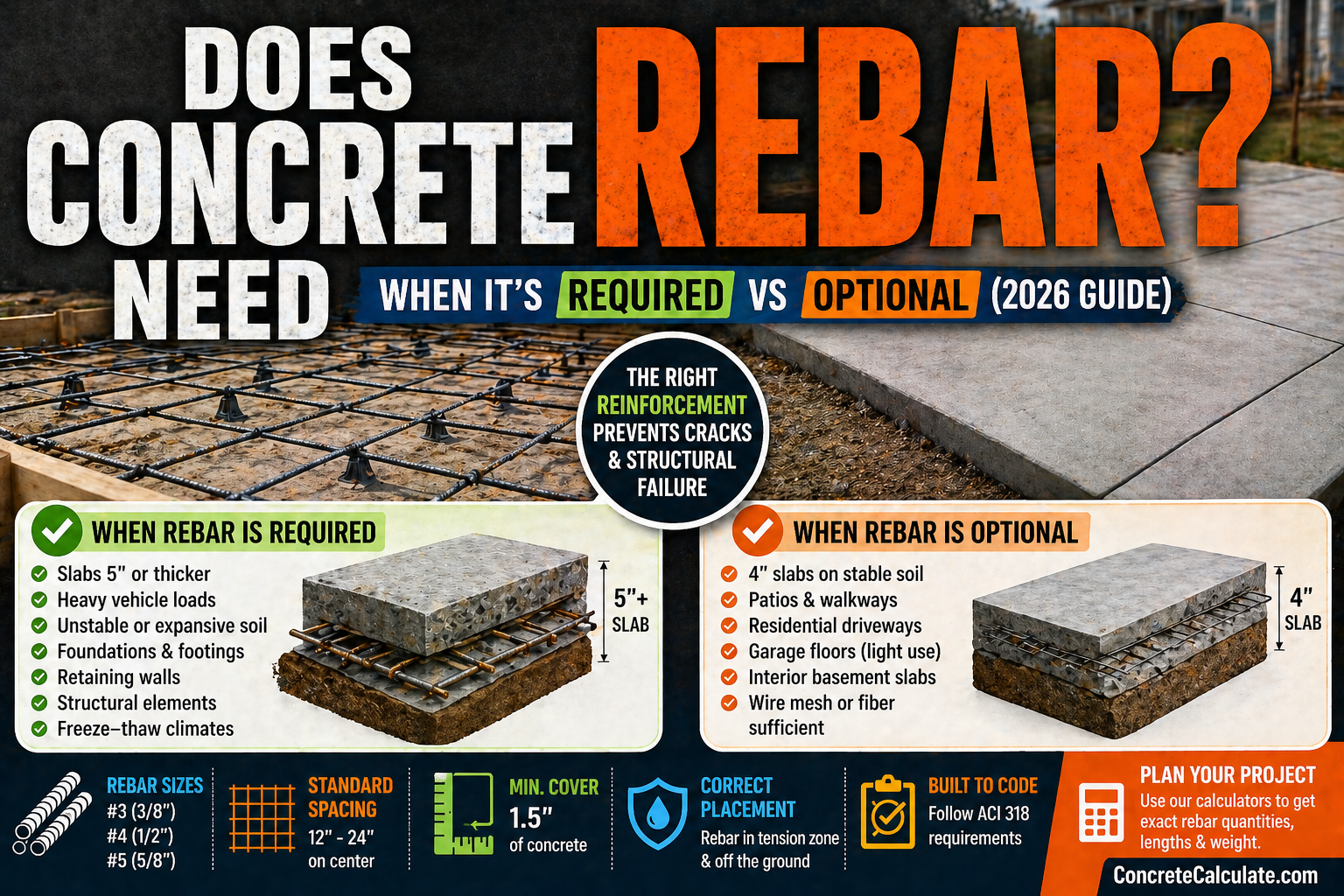
✅ Rebar Required
- ✓ All foundations and footings
- ✓ Retaining walls
- ✓ Elevated slabs (second floor, deck)
- ✓ Slabs 5 inches or thicker
- ✓ Heavy vehicle driveways
- ✓ Unstable or expansive soil
- ✓ Any structural beam or column
- ✓ Pool shells and water features
⚪ Rebar Optional (Wire Mesh Sufficient)
- – 4-inch driveway, stable soil, light vehicles
- – Residential patio at 4 inches
- – Sidewalks and walkways at 4 inches
- – Interior basement floor slabs
- – Garage floors in mild climates
- – Small shed or outbuilding pads
Rebar Requirements by Application
Here is how rebar requirements break down for the most common residential and light commercial concrete applications in the United States.
Concrete Driveways
A standard 4-inch residential driveway carrying passenger vehicles does not require rebar. Wire mesh (6×6 W1.4/W1.4 welded wire fabric) is the standard minimum reinforcement at this thickness. Rebar becomes the correct choice when:
- The slab is 5 inches thick or more
- Heavy vehicles – trucks, RVs, construction equipment – use the driveway regularly
- The subgrade is clay, poorly drained, or has a history of shifting
- You are in a freeze-thaw climate and want to control crack width over time
The Concrete Network, a widely referenced industry source in the US, specifically recommends wire mesh for 4-5 inch driveways and rebar at 12-inch spacing for driveways 5 inches or thicker. Use our concrete driveway calculator to plan your project dimensions and reinforcement needs.
Concrete Patios
Standard 4-inch patios on stable, compacted soil do not require rebar. Wire mesh provides adequate crack control. For patios in freezing climates, over expansive soil, or at 5 inches or thicker, add #3 rebar at 18-24 inches on center.
Stamped or decorative concrete patios benefit from rebar even at 4 inches – controlling crack width preserves the appearance of the pattern. Use our concrete patio calculator to size your pour and reinforcement estimate.
Garage Floors
Most residential garage floors are poured at 4 inches thick. Wire mesh is the standard reinforcement. Step up to rebar if the floor will carry heavy shop equipment, a vehicle lift, or frequent heavy vehicle traffic. Commercial garage floors typically require engineer-specified rebar layouts. Plan your garage pour with our concrete garage floor calculator.
Concrete Foundations and Footings
Rebar is always required for foundations – no exceptions. ACI 318 specifies minimum reinforcement for all footings and foundation walls. A standard residential continuous footing uses two horizontal #4 bars (1/2-inch diameter) running the full length. Foundation walls use vertical and horizontal #4 or #5 bars at spacing specified by the structural engineer.
Skipping rebar in a foundation is a code violation in every US jurisdiction. It is also a structural safety failure. Use our concrete foundation calculator to determine volume and plan your pour.
Retaining Walls
Retaining walls hold back soil and experience significant lateral (horizontal) pressure. Rebar is always required. Typical retaining wall reinforcement uses vertical #4 or #5 bars at 12-16 inches on center, plus horizontal bars for temperature and shrinkage control. The taller the wall and the heavier the soil load, the more reinforcement is needed. Always consult a structural engineer for retaining walls over 4 feet tall.
Sidewalks and Walkways
Standard residential sidewalks at 4 inches thick on a prepared base generally do not require rebar. Wire mesh or fiber reinforcement provides adequate crack control for pedestrian-only use. City and municipal sidewalks often have specific reinforcement requirements – check your local public works standards before pouring any sidewalk that connects to a public right-of-way.
| Application | Thickness | Rebar Required? | Minimum Reinforcement |
|---|---|---|---|
| Driveway (passenger vehicles) | 4 inches | Optional | Wire mesh minimum |
| Driveway (heavy vehicles / RV) | 5-6 inches | Recommended | #3 or #4 at 12-18″ OC |
| Patio (stable soil, 4″) | 4 inches | Optional | Wire mesh minimum |
| Patio (expansive soil or 5″+) | 5+ inches | Recommended | #3 at 18-24″ OC |
| Garage floor (residential) | 4 inches | Optional | Wire mesh minimum |
| Foundation / footing | Any | Always required | #4 minimum per ACI 318 |
| Retaining wall | Any | Always required | Engineer-specified |
| Sidewalk (residential) | 4 inches | Optional | Wire mesh or fiber |
| Elevated slab / second floor | Any | Always required | Engineer-specified |
📐 Calculate Your Rebar Needs
Enter your slab dimensions and get the exact amount of rebar needed for your project – bar count, total length, and weight.
Use Rebar Calculator →Rebar vs Wire Mesh: Which to Use
Both rebar and wire mesh (welded wire fabric) add tensile reinforcement to concrete. They do different things and are suited to different applications. This is one of the most commonly misunderstood decisions in residential concrete work.
What Wire Mesh Does
Wire mesh is a pre-made grid of thin steel wire, typically 6×6 inches spacing with W1.4 or W2.0 wire gauge. It provides crack control – when shrinkage cracks form, the mesh holds the crack faces together and prevents them from widening. It is faster to place than rebar, costs less, and is well-suited for 4-5 inch flatwork with light loading.
Wire mesh does not provide significant structural reinforcement. It will not meaningfully increase the load-bearing capacity of a slab. Its job is holding the slab together if it cracks – not preventing the forces that cause cracking. Use our wire mesh calculator to estimate how much you need for your project.
What Rebar Does
Rebar provides both crack control and genuine structural reinforcement. It resists the tensile forces that would cause a slab to crack or fail under load. When properly placed in the tension zone of a slab, rebar allows the concrete to carry significantly more load than unreinforced concrete.
Rebar is necessary wherever loads, subgrade conditions, or structural requirements exceed what wire mesh can handle. It takes more time to place and tie, but for slabs 5 inches or thicker – or any structural application – there is no substitute.
| Factor | Wire Mesh | Rebar |
|---|---|---|
| Primary function | Crack control | Structural tensile reinforcement + crack control |
| Placement time | Fast – pre-made sheets | Slower – cut, place, and tie individual bars |
| Best for slab thickness | 4-5 inches | 5+ inches, or any structural use |
| Cost (600 sq ft driveway) | $150-$300 material | $400-$700 material (#3 at 18″ OC) |
| Structural code compliance | No – not for structural elements | Yes – per ACI 318 specifications |
| Load-bearing upgrade | Minimal improvement | Significant improvement |
Wire mesh that lies flat on the soil when the concrete is poured provides almost zero benefit. It ends up at the bottom of the slab – in the compression zone – rather than in the tension zone where it is needed. Mesh must be lifted to the center of the slab using chairs or wire supports before and during the pour. Most residential wire mesh ends up at the bottom because workers step on it – which is why many experienced contractors prefer rebar on chairs for any application where reinforcement actually matters.
Rebar Sizes and Spacing for Each Application
Rebar in the US is sold in standard sizes numbered by eighths of an inch in diameter. #3 rebar is 3/8-inch diameter, #4 is 1/2-inch, #5 is 5/8-inch. Here is the right size and spacing for each common residential application.
Driveways and Patios
For residential driveways 5 inches or thicker and patios over expansive soil or in freeze-thaw climates, use #3 rebar (3/8-inch diameter) at 18-24 inches on center in a grid pattern. For heavier-load driveways expecting RV or truck traffic, use #4 rebar (1/2-inch) at 12-18 inches on center.
Place the rebar approximately in the center of the slab depth – for a 5-inch slab, that means rebar at about 2.5 inches from the bottom. Maintain a minimum 1.5 inches of concrete cover below the lowest bar. Use our rebar spacing calculator to determine bar count and rebar cover calculator to verify correct placement depth.
Foundations and Footings
Standard residential continuous footings use two horizontal #4 bars (1/2-inch) running the full length of the footing, positioned 3 inches from the bottom with 2 inches of side cover. Wider or deeper footings may need three or more bars per engineering specification.
Foundation walls use #4 or #5 vertical bars at 12-16 inches on center, plus horizontal bars at 24-36 inches vertically. The exact layout must be specified by a structural engineer and meet local building code requirements. Check load-bearing requirements before finalizing your foundation reinforcement plan.
| Application | Rebar Size | Spacing (on center) | Placement in Slab |
|---|---|---|---|
| 4-5″ driveway, light vehicles | #3 (3/8″) | 18-24 inches | Center of slab |
| 5-6″ driveway, heavy vehicles | #4 (1/2″) | 12-18 inches | Lower third to center |
| Patio, 4-5″, expansive soil | #3 (3/8″) | 18-24 inches | Center of slab |
| Residential footing | #4 (1/2″) | 2 bars horizontal (run full length) | 3″ from bottom |
| Foundation wall (vertical) | #4 or #5 | 12-16 inches | Per engineer spec |
| Retaining wall | #4 or #5 | Engineer-specified | Per engineer spec |
To estimate the total weight of rebar for your project, use our rebar weight per foot calculator.
How to Place Rebar Correctly in a Slab
Rebar placement is where most residential jobs go wrong. The most common mistake is laying rebar directly on the subgrade and expecting it to stay at the correct height during the pour. It does not. Workers step on it, and the pour pushes it down. Rebar on the ground provides no tensile benefit at all.
Use Chairs or Dobies
Plastic bar chairs, wire bar supports, or precast concrete block dobies hold the rebar at the correct elevation during and after the pour. For a 4-5 inch slab, use 2-inch chairs to maintain 2 inches of cover from the bottom. For a 6-inch slab, use 2.5-3 inch chairs. The rebar must stay at that elevation through the entire pour – that is the tension zone where it does its job.
Tie the Grid
Rebar bars crossing each other should be tied with wire ties at every intersection. A tied grid stays in position during the pour. Untied rebar shifts easily when workers walk over it and when concrete flows around it.
Maintain Edge Clearance
Keep at least 2 inches of clearance between the rebar and the edge of the slab forms. Rebar that runs too close to the edge of a slab has insufficient concrete cover, which allows moisture to reach the steel. That leads to rust, which expands and spalls the concrete from the inside out over time.
💼 Example: Rebar Layout for a 20×20 ft Driveway Extension at 5 Inches
Slab size: 20 ft x 20 ft = 400 sq ft
Thickness: 5 inches (RV storage expected)
Rebar selection: #4 (1/2-inch) at 18 inches on center each direction
Grid lines needed: 14 bars x 20 ft each direction = 28 bars total x 20 ft = 560 linear feet
Rebar weight: #4 rebar weighs 0.668 lbs per foot x 560 ft = approximately 374 lbs
Chair height: 2.5-inch plastic chairs to center rebar in the 5-inch slab
Edge clearance: First and last bar no closer than 2 inches from form edge
Use the rebar calculator to verify bar count, total length, and weight for your exact dimensions and spacing.
Fiber Reinforcement: When It Works Instead of Rebar
Synthetic and steel fibers mixed directly into concrete are a legitimate alternative to wire mesh for crack control in non-structural flatwork. They are not a substitute for rebar in structural applications.
How Fiber Reinforcement Works
Fibers – polypropylene, glass, or steel – are added to the concrete mix at the batch plant or job site. They distribute randomly throughout the concrete and resist micro-cracking during the critical early curing period when shrinkage forces are highest. They are effective at reducing plastic shrinkage cracking and can match or exceed wire mesh performance for crack control.
Where Fiber Works Well
- Sidewalks and pedestrian walkways at 4 inches
- Patios at 4 inches on well-prepared, stable soil
- Interior floor slabs with light loading
- Driveways at 4 inches in mild climates with light vehicle use
Where Fiber Is Not Enough
- Any structural element – foundations, walls, beams
- Slabs 5 inches or thicker under significant load
- Driveways expecting heavy vehicles or RVs
- Any application requiring ACI 318 code compliance
Some experienced contractors use both – synthetic fiber for early-age plastic shrinkage crack control, plus rebar for long-term tensile reinforcement. The fiber reduces early micro-cracking during the first 24-48 hours of curing. The rebar handles the ongoing structural loads. For heavy-use driveways, garage floors, and large slabs, this combination is a legitimate upgrade worth the modest added cost of fiber dosage (typically $5-$15 per cubic yard). Learn more about the curing process in our concrete curing and drying time guide.
Common Rebar Mistakes That Cause Problems
Most concrete failures tied to reinforcement are not from using the wrong rebar – they are from installing rebar incorrectly. These are the errors that cost homeowners and contractors the most.
1. Rebar Too Close to the Bottom
Rebar must be in the tension zone – the center to lower-center of the slab. Rebar touching the subgrade is in the compression zone and does nothing for tensile strength. Use chairs. Always. Without them, rebar ends up at the bottom of the pour and provides almost no structural benefit.
2. Insufficient Concrete Cover
The concrete covering the rebar is its only protection from moisture. When cover is less than 1.5 inches on slabs exposed to weather, water eventually reaches the steel. Rust forms, expands, and fractures the concrete from the inside. Check your cover depth with our rebar cover calculator before pouring.
3. Wrong Rebar Size for the Load
Using #3 rebar where #4 or #5 is needed underestimates the tensile demand on the slab. Undersized rebar in a high-load application provides a false sense of security while the slab still fails under stress. When in doubt, go up one size – the cost difference between #3 and #4 is minor compared to the cost of slab replacement.
4. Spacing Too Wide
Rebar placed at 36-inch spacing on a driveway is nearly as ineffective as no rebar at all. Standard spacing for residential slabs is 12-18 inches on center. Going wider than 24 inches for any slab under vehicle load is not recommended. Use the rebar spacing calculator to confirm your layout before cutting bar.
5. Skipping Rebar in Foundations to Save Money
This is the most dangerous mistake. Rebar in a foundation costs $500-$1,500 on a typical residential project. Repairing or replacing a failed foundation costs $10,000-$50,000+. There is no cost-saving justification for skipping rebar in any structural element. Check loads with our slab load calculator and concrete bearing pressure calculator to understand the forces your structure actually faces.
For more on what happens when concrete is improperly reinforced, see our guide on why concrete cracks and how reinforcement decisions affect crack development.
🎯 Key Takeaways: Does Concrete Need Rebar?
- Concrete is strong in compression but only 10-15% as strong in tension – rebar supplies the tensile strength concrete lacks
- A standard 4-inch residential slab (driveway, patio, sidewalk) on a stable base does NOT require rebar – wire mesh is the standard minimum
- Rebar is recommended for all slabs 5 inches or thicker, under heavy vehicles, or over unstable/expansive soil
- Rebar is always required for foundations, footings, retaining walls, beams, columns, and elevated slabs – no exceptions per ACI 318
- Wire mesh provides crack control; rebar provides structural tensile reinforcement – they are not interchangeable for structural applications
- For residential driveways 5+ inches: use #3 rebar at 18-24 inches on center for light loads; #4 at 12-18 inches for heavy vehicles or RVs
- Rebar must be placed in the tension zone – center to lower-center of the slab – using plastic chairs or wire supports
- Minimum concrete cover over rebar is 1.5 inches per ACI 318 to prevent moisture reaching the steel and causing corrosion
- Rebar lying flat on the subgrade provides almost zero tensile benefit – it ends up in the compression zone during the pour
- Synthetic fiber reinforcement is a legitimate alternative to wire mesh for crack control in 4-inch flatwork, but not a substitute for rebar in structural applications
- Skipping rebar to save money on a foundation is never justified – rebar costs $500-$1,500; foundation repair costs $10,000-$50,000+
- Always check local building codes – your jurisdiction may have specific reinforcement requirements beyond national standards
Frequently Asked Questions
🔧 Plan Your Reinforcement with Confidence
Use our rebar and concrete calculators to get exact quantities, spacing, and cost estimates before your next pour.
Calculate Rebar Now →