
How to Measure Concrete Properly Before Calculating Quantity in 2026
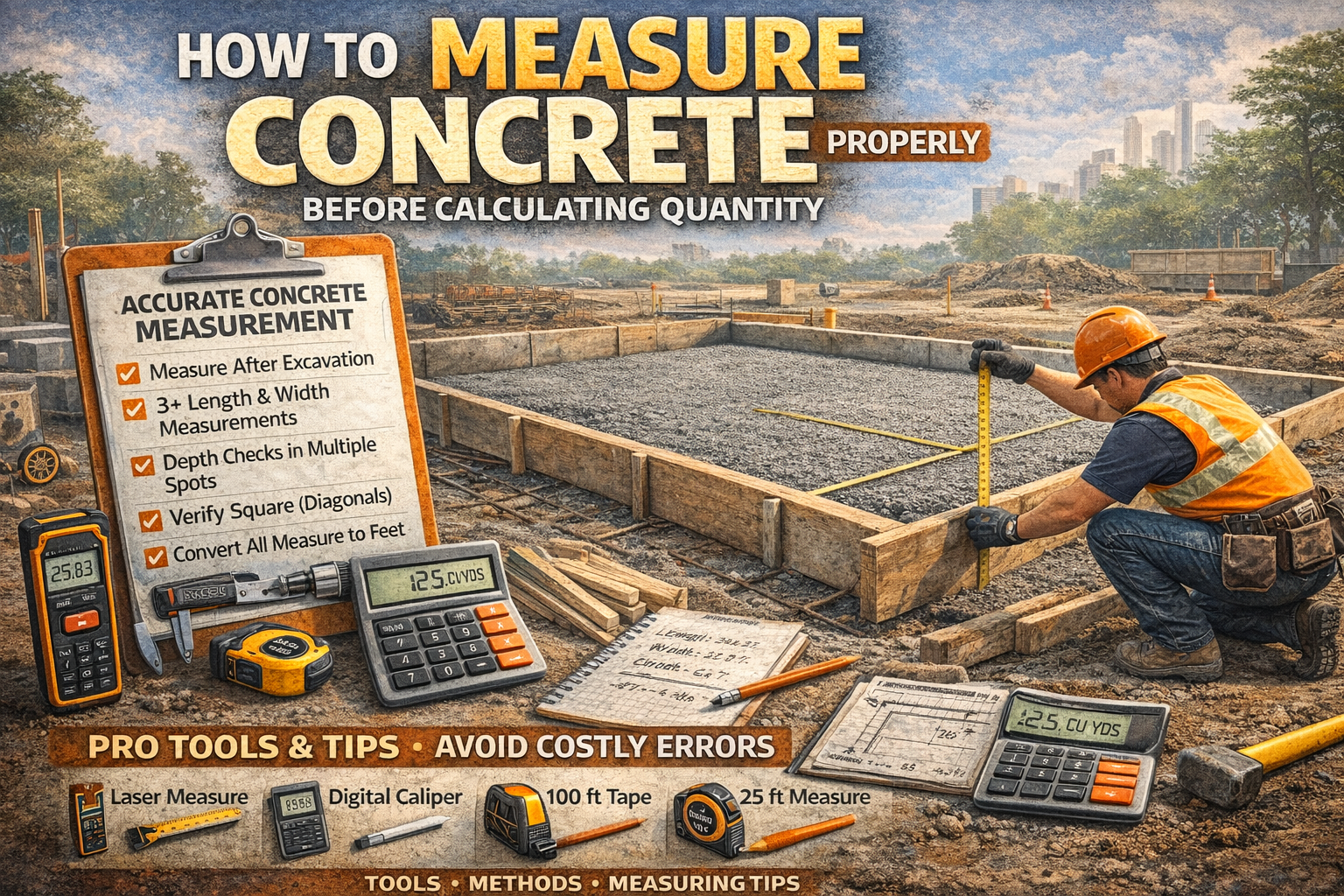
Here’s a sobering fact: A concrete contractor recently lost $50,000 on a commercial foundation because they misread plan dimensions by confusing millimeters with inches. The foundation was poured 2.5 times larger than specified. Accurate measurement is not just good practice, it’s the foundation of profitable construction. Before you even think about calculating concrete quantities or placing an order, you must master the art of precise measurement. One wrong measurement cascades into ordering errors, material waste, structural problems, and catastrophic budget overruns.
Why Measurement Accuracy Matters More Than Calculation
You can have the most sophisticated concrete calculator in the world, but if your measurements are off by even 6 inches, your entire project is compromised. Let me be clear: garbage in, garbage out.
Concrete measurement errors compound through every stage of your project. A measurement that’s 10% off translates to ordering 10% too much (wasted money) or 10% too little (structural failure or expensive emergency delivery). The American Concrete Institute reports that measurement errors account for 40% of all concrete quantity miscalculations.
The Real Cost of Measurement Errors
Consider these actual consequences of improper measurement:
- Material waste: Over-ordering concrete costs $125-$150 per extra cubic yard, plus disposal fees
- Shortage disasters: Running short mid-pour creates cold joints, requiring repairs costing 3-5 times the original work
- Structural failure: Under-thickness slabs crack within months, requiring full replacement ($8-$12 per square foot)
- Failed inspections: Incorrect dimensions violate building codes, forcing costly corrections and project delays
- Budget overruns: Measurement errors on large projects can exceed $10,000-$50,000 in additional costs
A 2025 construction survey found that 67% of concrete cost overruns trace back to inaccurate initial measurements, not calculation errors. Contractors who invest in proper measurement tools and training reduce material waste by 15-25% annually.
Measurement Precision Standards
Professional concrete work requires precision to specific tolerances:
| Measurement Type | Acceptable Tolerance | Why It Matters |
|---|---|---|
| Slab length/width | ±1/4 inch per 10 feet | Affects total volume calculation |
| Thickness/depth | ±1/8 inch for 4-6 inch slabs | Even 1/4 inch error means 5-6% volume difference |
| Footing dimensions | ±1/2 inch for width/depth | Structural load calculations depend on accuracy |
| Wall thickness | ±1/4 inch | Code compliance and structural integrity |
💡 Professional Insight
Maria, a veteran concrete estimator, shared this wisdom: “I’ve seen contractors spend $500 on fancy software but use a bent tape measure from 1995. Your measurements are only as good as your tools. I once caught a 3-foot error in foundation measurements because a laborer measured in worn-out markings. That error would have cost $8,000 in extra concrete.”
Essential Measuring Tools for Concrete Projects
Professional measurement requires professional tools. Skip the dollar store tape measure. Here’s what you actually need for accurate concrete measurements in 2026.
Primary Measuring Tools
| Tool | Best For | Cost (2026) | Key Features |
|---|---|---|---|
| Laser Distance Measurer | Long distances, walls, large slabs | $80-$300 | ±1/16″ accuracy, 300+ ft range, calculates area automatically |
| 50-100 ft Tape Measure | Foundation perimeters, driveways | $30-$80 | Fiberglass or steel, non-stretch, clearly marked |
| 25 ft Locking Tape | Smaller areas, depth checks | $15-$40 | 1/16″ increments, automatic lock, magnetic tip |
| Digital Caliper | Thickness verification, rebar spacing | $25-$60 | 0.01mm precision, depth rod, large display |
| Measuring Wheel | Long sidewalks, curbs, driveways | $40-$120 | Counts feet automatically, works on uneven ground |
| Builder’s Level | Verifying grade, slope, elevations | $200-$800 | Self-leveling, 300 ft range, degree of accuracy |
Supporting Tools You Need
- Stakes and string line: Mark boundaries and establish straight reference lines ($10-$20)
- Carpenter’s square (framing square): Verify 90-degree corners for slabs and footings ($15-$35)
- Notepad or digital device: Record every measurement immediately, never trust memory
- Chalk line: Mark cut lines and boundaries on existing surfaces ($8-$15)
- Spirit level (4 ft): Check ground level before measuring depth ($20-$50)
- Moisture meter: Verify ground conditions that affect excavation depth ($30-$100)
Quality measuring tools pay for themselves on the first project. A $200 laser measurer saves 30-60 minutes per job and eliminates tape measure errors. Over 10 projects, that’s 5-10 hours saved and multiple costly errors prevented. Professional contractors report that investing $500-$800 in proper measuring equipment reduces material waste by $2,000-$5,000 annually.
Why Laser Measurers Are Game-Changers
Laser distance measurers have revolutionized concrete measurement. Here’s why every serious contractor uses them:
- Speed: Measure 100 feet in 2 seconds versus 30-45 seconds with tape
- Accuracy: Consistent ±1/16 inch accuracy even at 300 feet
- Solo operation: One person can measure, no assistant needed holding tape
- Calculations: Built-in area and volume calculators eliminate math errors
- Difficult spaces: Measure across obstacles, water, or unstable ground
- Documentation: Many models save measurements and sync to smartphones
Laser measurers struggle with direct sunlight (use target plate), work poorly on rough or dark surfaces, and can’t measure around corners. Keep a tape measure as backup. For circular concrete projects or curved areas, combine laser measurements with traditional tapes for best results.
Pre-Measurement Preparation and Site Setup
Accurate measurement starts before you pull out a single tool. Site preparation determines whether your measurements reflect reality or fiction.
Step 1: Clear the Area Completely
Remove everything that interferes with accurate measurement:
- Vegetation, grass, weeds (mow or remove entirely)
- Rocks, debris, construction waste
- Old forms, lumber, stakes from previous work
- Standing water, mud puddles (wait for dry conditions)
- Snow or ice in cold climates
Why this matters: A 2-inch layer of grass or debris adds false height to your measurements. Measure through 2 inches of grass across a 400 sq ft area, and you’ve miscalculated by 6.7 cubic feet (0.25 cubic yards). That’s $30-$40 in wasted concrete.
Step 2: Identify and Mark Reference Points
Establish fixed reference points that won’t move during excavation:
- Building corners: Permanent structures make perfect starting points
- Property pins: Survey markers establish legal boundaries
- Permanent stakes: Drive rebar or steel stakes 18-24 inches into ground outside work area
- Existing concrete: Adjacent slabs, driveways, or walkways
🏗️ Example: Setting Up Reference Points
For a driveway concrete project 20 ft × 40 ft:
Step 1: Locate garage door edge (permanent reference)
Step 2: Drive stakes 2 feet outside each corner of planned driveway
Step 3: Run string lines between stakes to mark exact boundaries
Step 4: Measure from garage edge to string line: 20.0 feet
Step 5: Measure parallel string lines: 40.0 feet
Step 6: Verify square by measuring diagonals (should be equal within 1/4 inch)
Step 3: Check Plans and Permits
Before measuring anything, verify what you’re supposed to build:
- Review architectural plans: Confirm dimensions, scale, and units (feet vs inches vs millimeters)
- Check scale accuracy: Never trust printed scale, use known dimensions to calibrate
- Verify permit specs: Ensure your measurements match approved plans exactly
- Confirm setbacks: Property line distances may affect placement
- Identify utilities: Call 811 before measuring near underground lines
Never assume plan scale is accurate. Printing, scanning, or PDF compression can distort dimensions by 2-5%. Always find a dimensioned element on the plans (a 20 ft wall, for example) and verify it measures correctly to scale. Use that known dimension to calibrate before measuring anything else. This single step prevents thousands of dollars in errors.
Step 4: Document Initial Conditions
Take photos and notes of existing conditions:
- Photograph the area from multiple angles
- Note existing grade, slope, and drainage patterns
- Document any obstructions or utilities
- Record soil conditions (rocky, clay, sandy, wet)
- Measure existing elevations if relevant
This documentation protects you if measurements need to be adjusted during excavation and proves original site conditions if disputes arise.
Measuring Slabs, Driveways, and Flat Surfaces
Flat concrete surfaces are the most common measurement task. They’re also the easiest to get wrong by rushing. Here’s the professional approach.
Rectangular Slabs: The Standard Method
For concrete slabs, patios, or garage floors, follow this sequence:
Professional Slab Measurement Protocol
1. Measure Length (Long Dimension)
- Measure along one side from corner to corner
- Take three measurements: near edge, middle, far edge
- If measurements vary more than 1/4 inch, investigate why (ground not level, improper stakes)
- Use the average of three measurements
2. Measure Width (Short Dimension)
- Measure perpendicular to length at three points (near, middle, far)
- Verify 90-degree corners using 3-4-5 triangle method or builder’s square
- Average the three width measurements
3. Measure Depth/Thickness
- Measure from finished grade to bottom of excavation at 5-10 points
- Account for existing surface irregularities
- Use deepest measurement for calculations (never assume perfectly level)
4. Verify Square
- Measure both diagonals corner to corner
- Diagonals should be within 1/4 inch of each other
- If not square, adjust stakes before proceeding
🏗️ Example: Measuring a Patio Slab
Measuring for a 12 ft × 16 ft patio, 4 inches thick:
Length measurements:
Edge 1: 16 ft 0.25 in
Middle: 16 ft 0.5 in
Edge 2: 16 ft 0.25 in
Average: 16 ft 0.33 in = 16.03 feet
Width measurements:
Edge 1: 12 ft 0.5 in
Middle: 12 ft 0.75 in
Edge 2: 12 ft 0.5 in
Average: 12 ft 0.58 in = 12.05 feet
Depth measurements (after excavation):
Corner 1: 4.25 in
Corner 2: 4.0 in
Corner 3: 4.5 in
Corner 4: 4.0 in
Center: 4.75 in
Use deepest: 4.75 in = 0.396 feet
Verify square:
Diagonal 1: 20 ft 0.5 in
Diagonal 2: 20 ft 0.75 in
Difference: 0.25 in ✅ (acceptable)
Record for calculation: 16.03 ft × 12.05 ft × 0.396 ft
Use concrete volume calculator to determine cubic yards needed.
Handling Slopes and Grade Changes
Many slabs sit on sloped ground. Never measure just the top surface:
- Measure actual excavation depth at multiple points, not planned depth
- Use a builder’s level to establish grade differences across the area
- Calculate stepped thickness for sloped driveways or ramps
- Add extra concrete for low spots and grade variations (typically 5-10% more)
For sloped areas, measure depth at the deepest point and use that for all calculations. It’s better to have slightly extra concrete than run short. Many contractors divide sloped areas into sections, measure each separately, then sum totals for more accuracy on walkways or sloped driveways.
Circular and Curved Slabs
For circular concrete slabs or curved features:
- Measure diameter at widest point across the circle
- Verify center point by measuring radius in 4-6 directions (should all be equal)
- For irregular curves, break into smaller sections and measure as rectangles or triangles
- Use string and stake to trace perfect circles, then measure radius from center
🧮 Calculate Your Slab Concrete Instantly
Stop wrestling with formulas. Our free calculators handle rectangular, circular, and complex slab shapes with precise volume calculations.
Calculate Slab Concrete →Measuring Footings and Foundations
Foundation measurements require extreme precision because they’re hidden underground and impossible to fix after pouring. Errors here compromise entire structures.
Continuous Strip Footings
For concrete footings under walls:
Strip Footing Measurement Steps
1. Measure Total Linear Feet
- Trace entire perimeter of foundation or wall
- Measure each straight section separately
- Add all sections together for total linear feet
- Include returns, jogs, and corners in total
2. Measure Width
- Footings are typically 12-24 inches wide (wider than wall above)
- Measure width at multiple points along trench
- Use widest measurement for calculations
- Verify width meets code requirements for soil type
3. Measure Depth
- Measure from bottom of trench to top of footing (usually 8-12 inches thick)
- Check depth at 10-foot intervals minimum
- Verify depth reaches below frost line (code requirement)
- Account for uneven trench bottom
🏗️ Example: Foundation Footing
Measuring footings for a 24 ft × 32 ft foundation:
Linear feet:
Side 1: 24 ft
Side 2: 32 ft
Side 3: 24 ft
Side 4: 32 ft
Total: 112 linear feet
Width measurements:
Section A: 16 inches
Section B: 16.5 inches
Section C: 16.25 inches
Use: 16.5 inches = 1.375 feet (widest)
Depth measurements:
Point 1: 10 inches
Point 2: 11 inches
Point 3: 10.5 inches
Use: 11 inches = 0.917 feet (deepest)
Calculate: 112 ft × 1.375 ft × 0.917 ft = 141.2 cubic feet ÷ 27 = 5.23 cubic yards
Add 10% waste: 5.23 × 1.10 = 5.75 cubic yards
Individual Pier or Column Footings
For pier footings or post hole concrete:
- Count total number of footings needed
- Measure each footing separately (square pads or round holes)
- For square pads: Length × Width × Depth
- For round holes: Diameter → Radius, then π × R² × Depth
- Sum all footings for total concrete needed
Never guess or estimate foundation depth. Building codes require footings below frost line (typically 36-48 inches in northern states, 12-18 inches in southern states). Shallow footings heave during freeze-thaw cycles, cracking foundations and causing catastrophic structural damage. Always verify local code requirements and measure actual excavation depth precisely.
Stepped Footings on Slopes
On sloped lots, footings step down to maintain proper depth:
- Measure each level separately as distinct sections
- Account for vertical riser height between steps
- Verify each step meets minimum thickness and width codes
- Sum all sections for total linear feet, then calculate volume
Measuring Walls and Vertical Structures
Concrete walls require three-dimensional measurement: height, length, and thickness. Miss any dimension by even an inch, and you’ll over or under-order significantly.
Foundation and Retaining Walls
For concrete walls or retaining walls:
Wall Measurement Protocol
1. Measure Height
- Measure from bottom of footing to top of wall
- Take measurements every 10-20 feet along wall length
- Note any height changes, steps, or grade variations
- Use maximum height for calculations if wall slopes
2. Measure Length
- Measure actual wall centerline, not just straight dimensions
- Include corners, returns, and pilasters
- For curved walls, use measuring wheel or multiple straight sections
3. Measure Thickness
- Foundation walls: typically 8-12 inches thick
- Retaining walls: 12-18 inches depending on height and load
- Verify thickness meets structural engineer specifications
- Measure form spacing precisely (inside to inside)
Special Wall Considerations
Some walls require additional measurements:
- Pilasters: Measure as separate columns, add to wall volume
- Window/door openings: Measure opening dimensions, subtract from wall volume
- Buttresses: Calculate as wall extensions, add to total
- Grade beams: Measure depth changes along wall length
🏗️ Example: Basement Wall with Opening
Measuring basement wall 40 ft long, 8 ft high, 10 inches thick, with 6 ft × 4 ft window opening:
Main wall volume:
40 ft × 8 ft × 0.833 ft (10 inches) = 266.6 cubic feet
Window opening (subtract):
6 ft × 4 ft × 0.833 ft = 20 cubic feet
Net concrete needed:
266.6 – 20 = 246.6 cubic feet ÷ 27 = 9.13 cubic yards
Add 10%: 9.13 × 1.10 = 10.04 cubic yards
Columns and Vertical Posts
For concrete columns or sonotube piers:
- Round columns: Measure diameter and height, use cylinder formula (π × R² × H)
- Square columns: Measure width, depth, and height (W × D × H)
- Tapered columns: Measure top and bottom dimensions separately, average them
- Multiple columns: Calculate one column, multiply by total quantity
Handling Complex Shapes and Irregular Areas
Not every concrete project is a perfect rectangle. Here’s how to measure complex geometries accurately.
L-Shapes, T-Shapes, and U-Shapes
Break complex shapes into simple rectangles:
Multi-Section Measurement Method
Step 1: Divide shape into distinct rectangular sections
Step 2: Measure each section separately (length × width)
Step 3: Measure depth/thickness (usually uniform)
Step 4: Calculate volume for each section
Step 5: Sum all sections for total volume
Draw your shape on graph paper (1 square = 1 foot). This visual representation helps identify how to divide the area into measurable sections and prevents double-counting overlapping areas. Use concrete estimators that accept multiple section inputs for complex projects.
Irregular or Freeform Shapes
For truly irregular shapes (curved patios, artistic designs):
- Grid method: Lay out 1 ft × 1 ft grid with string, count squares, estimate partials
- Geometric approximation: Fit shape into combination of circles, triangles, and rectangles
- Digital measurement: Use smartphone apps that trace and calculate area from photos
- Professional survey: For expensive projects, hire surveyor with GPS measurement
Stairs and Steps
For concrete steps:
Stair Measurement Formula
Then add volume of landing platform if applicable
Measure each component:
- Tread depth: Front to back of each step (typically 11-12 inches)
- Riser height: Vertical height of each step (typically 6-8 inches)
- Step width: Side to side dimension (varies by design)
- Number of steps: Count all treads
- Landing: Measure as separate slab (length × width × depth)
Converting Inches to Feet: The Critical Step
This is where most DIYers and even some contractors make fatal errors. You must convert all measurements to decimal feet before calculating, never work in mixed units.
The Conversion Table You Need
| Inches | Decimal Feet | Common Use |
|---|---|---|
| 1 inch | 0.083 ft | Very thin overlays |
| 2 inches | 0.167 ft | Thin resurfacing |
| 3 inches | 0.250 ft | Minimum walkway |
| 4 inches | 0.333 ft | Standard walkway/patio |
| 5 inches | 0.417 ft | Light driveway |
| 6 inches | 0.500 ft | Standard driveway |
| 8 inches | 0.667 ft | Heavy traffic |
| 10 inches | 0.833 ft | Foundation walls |
| 12 inches | 1.000 ft | Thick walls/footings |
The Conversion Formula
Inches to Feet Conversion
Example: 4 inches ÷ 12 = 0.333 feet
WRONG: 20 ft × 10 ft × 4 inches = 800 (meaningless number)
RIGHT: 20 ft × 10 ft × 0.333 ft = 66.6 cubic feet
Mixing feet and inches is the #1 cause of calculation errors. Always convert everything to feet first, then calculate. Use concrete yardage calculators that accept measurements in any unit and convert automatically.
Dealing with Fractions
If you measure 16 feet 6 inches:
- Step 1: Convert inches to decimal: 6 ÷ 12 = 0.5 feet
- Step 2: Add to whole feet: 16 + 0.5 = 16.5 feet
- Step 3: Use 16.5 in your calculations
For 24 feet 3 inches:
- 3 ÷ 12 = 0.25 feet
- 24 + 0.25 = 24.25 feet
Common Measurement Mistakes and How to Avoid Them
Learn from the expensive lessons others have paid for. These are the most common concrete measurement mistakes in the industry.
1. Measuring Before Excavation
The mistake: Taking measurements of the existing ground surface before excavating, assuming depth will be exactly as planned.
Why it’s wrong: Ground is never perfectly level. Once you excavate, you’ll find high spots, low spots, rocks, and variations. Your actual depth will differ from planned depth.
The fix: Always measure after excavation is complete. Measure depth at 10-20 points and use the deepest measurement for calculations. For a shed base or patio, budget 5-10% extra concrete to fill unexpected low spots.
2. Assuming Tape Measures Are Accurate
The mistake: Using old, worn, bent, or cheap tape measures without verification.
Why it’s wrong: Tape measures wear out. The first 6-12 inches are most prone to damage and can stretch, tear, or become illegible. A worn tape measure reading 0.25 inches short per 10 feet creates a 3-inch error on a 120-foot measurement.
The fix: Verify tape measures annually against known distances (use building dimensions or another new tape). Replace any tape with damaged first 12 inches or unclear markings. For projects over $5,000, invest in a laser measurer.
3. Ignoring Temperature Effects
The mistake: Measuring with metal tapes in extreme heat or cold without accounting for expansion/contraction.
Why it’s wrong: A 100-foot steel tape expands about 0.1 inches in 20°F temperature change. On large projects, this compounds into significant errors.
The fix: Use fiberglass tapes for extreme temperature conditions. They expand/contract less than steel. For critical measurements, measure during moderate temperatures (50-70°F) or apply temperature correction factors.
4. Single-Point Depth Measurements
The mistake: Measuring depth at one corner and assuming it’s uniform across the entire area.
Why it’s wrong: Excavations are never perfectly uniform. A 1-inch depth variance across an 800 sq ft slab means 66.6 cubic feet (2.5 cubic yards) difference. That’s $300-$375 in concrete cost.
The fix: Measure depth at minimum 9 points (corners, midpoints, and center). Use the deepest measurement for volume calculations. Document all measurements in case of disputes.
5. Forgetting to Verify Square
The mistake: Measuring length and width but not checking if corners are 90 degrees.
Why it’s wrong: If your shape isn’t square, one side will be longer than measured, requiring more concrete. A 20 ft × 20 ft area that’s 3 inches out of square needs approximately 5% more concrete.
The fix: Always measure diagonal distances. For a perfect rectangle, both diagonals must be equal within 1/4 inch. Use the 3-4-5 triangle method (or 6-8-10, 9-12-15, etc.) to verify 90-degree corners.
6. Misreading Plan Scales
The mistake: Trusting the printed scale on construction plans without verification.
Why it’s wrong: Printing, copying, or saving plans as PDFs can distort scale by 2-5%. A contractor recently miscalculated a foundation by $50,000 because plans showed millimeters but he interpreted as inches.
The fix: Find a dimension marked on the plans (window width, wall length). Measure that element with your scale ruler. If it doesn’t match, recalibrate. Never assume scale accuracy. When using a concrete load calculator, verify your measurements match plan dimensions before ordering.
7. Rounding Too Early
The mistake: Rounding measurements to nearest whole number during initial recording.
Why it’s wrong: Rounding errors compound through multiple calculations. Rounding 16.75 ft to 17 ft on a slab that’s 33.25 ft wide and 0.333 ft deep creates a 1.4% volume error, costing $20-$30 in wasted concrete per miscalculation.
The fix: Record measurements to at least 1/4 inch precision (two decimal places in feet). Only round final cubic yard quantities up to nearest 0.25 or 0.5 yards when ordering.
8. Measuring to Form Outsides Instead of Insides
The mistake: Measuring wall dimensions from outside of forms rather than inside (actual concrete dimensions).
Why it’s wrong: Form thickness (typically 3/4 to 1.5 inches) adds to outside measurements. Measuring a foundation from form outsides can overstate concrete needs by 6-10%.
The fix: Always measure from inside form surfaces where concrete will actually fill. For walls, measure inside-to-inside width. Verify form thickness and account for it in measurements.
Double-Check These Items:
□ All measurements converted to decimal feet
□ Depth measured after excavation (not before)
□ Verified square (diagonals equal)
□ Measured at multiple points, used deepest/largest
□ Plan scale verified against known dimension
□ Measurements recorded precisely (not rounded)
□ Complex shapes divided and summed correctly
□ Added 10% waste factor minimum
□ Cross-referenced with online calculators
□ Second person verified critical measurements
🧮 Verify Your Measurements Now
Input your carefully measured dimensions into our professional calculators. Compare results to catch errors before ordering concrete.
Verify Calculations →🎯 Key Takeaways
- Measurement accuracy matters more than calculation precision: Perfect math means nothing with wrong measurements
- Invest in quality measuring tools: Laser measurers and calibrated tapes pay for themselves immediately
- Always measure after excavation: Ground conditions change once you dig, never measure beforehand
- Take multiple measurements: Measure length/width in 3 places, depth in 10+ places, use maximum values
- Verify square on all rectangular projects: Measure both diagonals, must be equal within 1/4 inch
- Convert all measurements to decimal feet: Never mix inches and feet in calculations
- Document everything: Write down every measurement, take photos, verify with second person
- Use deepest/longest measurements: Better to have extra concrete than run short mid-pour
- Never trust plan scales: Verify against known dimensions before measuring anything else
- Add waste factor after measuring: Minimum 10% for standard projects, 15% for complex shapes
Frequently Asked Questions
Depth (thickness) is the most critical measurement because small errors in depth create large volume errors. A 1/4-inch depth error on a 400 sq ft slab equals 8.3 cubic feet (0.31 cubic yards) or $40-$50 in wasted concrete. Always measure depth at 10+ points and use the deepest measurement. Many contractors lose money by assuming 4-inch depth uniformly when actual excavation varies between 4-5 inches across the pour area.
Always measure after excavation is completely finished. Pre-excavation measurements assume perfectly level ground and uniform depth, which never exists in reality. Excavations reveal rocks, hard spots, soft soil, and grade variations that change actual concrete needs by 5-15%. Measure depth at multiple points after excavation, use the deepest reading, and add 5-10% waste factor for irregularities. Use cubic yard calculators with your post-excavation measurements for accurate ordering.
Minimum 9 points for slabs: 4 corners, 4 midpoints (middle of each side), and center. For slabs over 500 sq ft, measure every 10 feet in a grid pattern. For driveways, sidewalks, or sloped areas, measure every 5 feet along length. Professional estimators measure 15-25 points on residential slabs and use the deepest reading for volume calculations. This practice prevents running short by 0.5-1 cubic yards.
Essential tools: 25 ft locking tape measure ($20-$40) for short measurements, 100 ft fiberglass tape ($40-$80) for long distances, laser distance measurer ($80-$300) for speed and accuracy, builder’s square ($15-$35) to verify 90-degree corners, notepad to record everything, and calculator for conversions. Optional but valuable: measuring wheel ($40-$120) for long linear measurements, builder’s level ($200-$800) for grade checking, digital caliper ($25-$60) for thickness verification. Total investment: $200-$500 saves thousands in ordering errors.
Use the “double-measure, double-check” method: (1) Have two people measure independently and compare results (should match within 1/4 inch), (2) Verify rectangular areas are square by measuring both diagonals (must be equal), (3) Input measurements into multiple concrete volume calculators and compare results, (4) Calculate by hand to verify calculator results, (5) Cross-reference final cubic yards with typical projects (a 12×12 ft garage floor at 4 inches needs approximately 1.8 yards). If anything seems drastically different, re-measure before ordering.
Measure from a consistent reference point (top of form or string line) to the bottom at multiple locations. Record all depths, then use the deepest measurement for calculations. For very uneven bottoms, divide the area into sections, measure each separately, and sum totals. Example: Foundation trench with depths of 10″, 11.5″, 10.75″, and 12″ at four corners—use 12 inches (1.0 foot) for entire trench calculation. This ensures adequate concrete for deepest areas. Add 10% waste factor to account for other irregularities. Professional foundation calculators help handle uneven depths.
If corners aren’t exactly 90 degrees, adjust stakes and forms before pouring. To check squareness, measure both diagonals—they must be within 1/4 inch of each other for a proper rectangle. If you must pour an out-of-square shape, measure all four sides separately (since opposite sides won’t be equal), calculate as trapezoid, or break into triangular sections. Out-of-square slabs use 3-7% more concrete than perfect rectangles of the same approximate dimensions. Always adjust forms to square before pouring rather than calculating complex irregular shapes.
Always round up, never down. Record initial measurements precisely (to nearest 1/4 inch or 0.01 foot), but when ordering concrete, round final cubic yards up to nearest 0.25 or 0.5 yards. Example: calculation shows 7.23 cubic yards needed—order 7.5 yards minimum. It’s far better to have 0.5 yards excess (costs $65-$75) than to run 0.3 yards short (costs $300-$500 for emergency delivery plus cold joint repairs). Most suppliers won’t deliver partial yards anyway. Use ready-mix truck calculators to determine optimal order quantities.
🧮 Calculate Precise Concrete Quantities
You’ve measured properly—now calculate accurately. Our free calculators use industry-standard formulas for perfect concrete estimates every time.
View All Calculators →🔗 Related Concrete Resources
- → Concrete Slab Thickness Calculator – Determine proper thickness for your project type
- → Concrete Cost Calculator – Estimate total project costs with 2026 pricing
- → Concrete Bag Calculator – Calculate bags needed for small projects
- → Yards to Bags Converter – Convert cubic yards to 40, 60, or 80 lb bags
- → Concrete Tube Calculator – Calculate sonotube and cylindrical concrete quantities
- → Concrete Pad Calculator – Equipment pads, AC units, and outdoor structures
- → Stamped Concrete Calculator – Decorative concrete quantity and cost estimates
- → Concrete Countertop Calculator – Kitchen and bathroom concrete counters
- → Concrete Apron Calculator – Garage aprons and driveway transitions
- → Concrete Curb Calculator – Curbs, gutters, and landscape edging


3 Comments