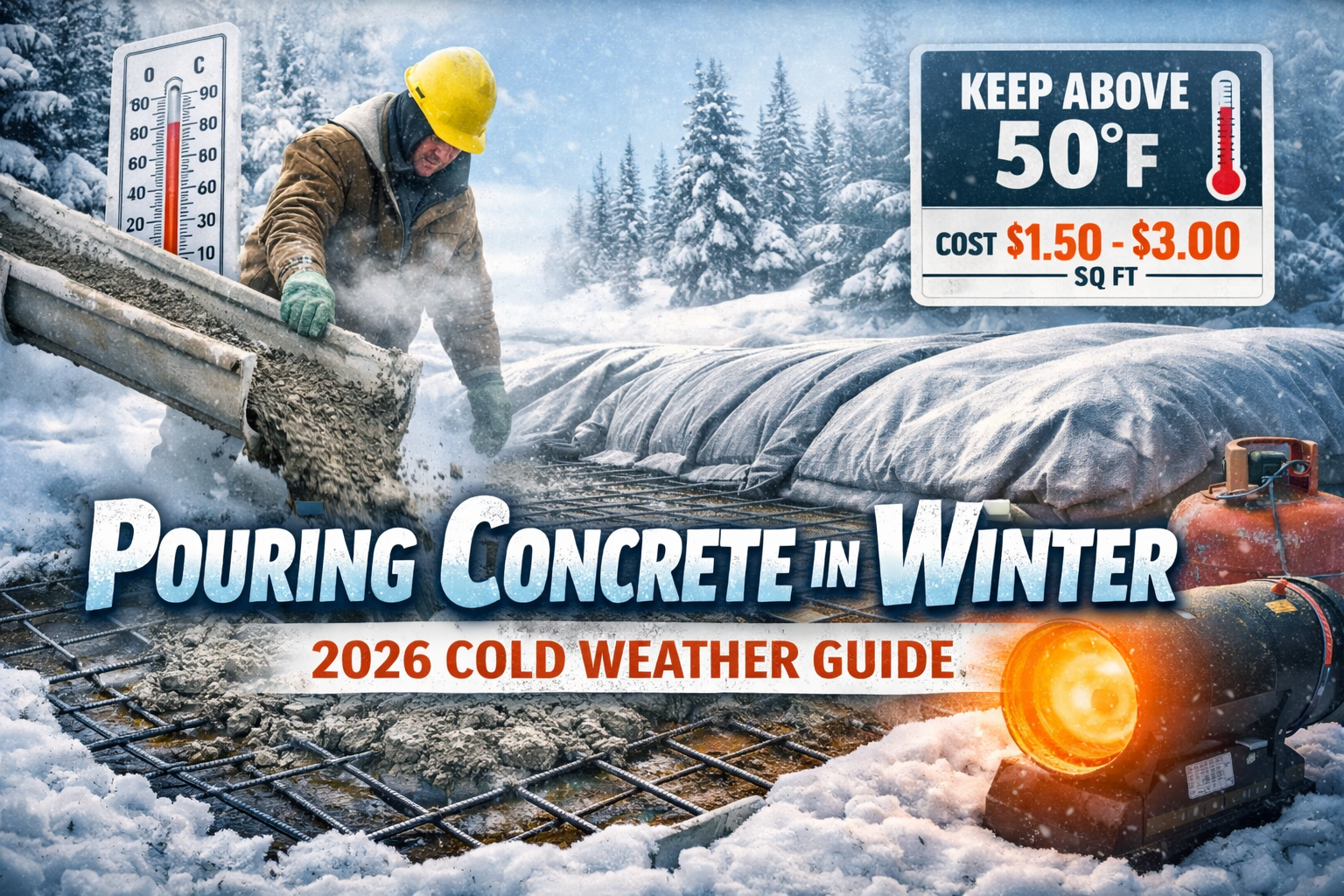
Pouring Concrete in Winter: 2026 Cold Weather Guide
Can you pour concrete in winter? Yes – but it takes preparation, the right materials, and a clear protection plan. Pouring concrete in winter without cold-weather precautions is one of the most expensive mistakes in residential construction. Concrete that freezes before reaching 500 PSI can lose half its design strength – permanently – and you won’t know until it starts cracking and scaling years later. This guide covers everything you need to know: minimum temperatures, mix adjustments, heating methods, protection costs, and exactly how long to keep the slab protected before it’s safe.
Why Cold Weather Concrete Goes Wrong
Concrete strength comes from a chemical reaction called hydration – water reacts with cement particles to form interlocking crystals that harden the mix. This reaction generates heat on its own, which is why large pours stay warm longer than thin slabs. The problem is that cold air, frozen ground, and cold forms all steal that heat faster than hydration can generate it.
When the concrete temperature drops below 50°F, hydration slows dramatically. Below 40°F, it nearly stops. And if the concrete temperature drops below 32°F before it reaches 500 PSI of compressive strength – which typically takes 2-3 days under normal conditions – the water inside freezes. Ice expands by about 9% in volume. That expansion tears apart the forming crystal structure before it has a chance to bind. The concrete looks fine. But it isn’t.
The Hidden Damage Problem
Freeze damage in young concrete is invisible. The slab looks normal after it thaws. It may even pass a visual inspection. But compressive strength testing will reveal a slab that reached 1,400-1,600 PSI instead of its designed 3,000 PSI – and that weakness is permanent. Over the next 5-10 years, it surfaces as early spalling, surface scaling, and progressive cracking that no sealer can fix.
Concrete must reach a minimum of 500 PSI compressive strength before it can safely withstand a single freeze-thaw cycle. Under ideal conditions, this takes approximately 24-48 hours. In cold weather (40-50°F), it can take 3-5 days. This is the window you’re protecting when you cover a winter pour – not the comfort of the crew, but the structural integrity of the slab.
Minimum Temperature Requirements for Pouring Concrete
ACI 306R – the American Concrete Institute’s standard for cold weather concreting – defines cold weather as any period when the air temperature drops below 40°F for more than three consecutive days. These guidelines, available at concrete.org, are the basis for all reputable cold-weather concrete practice in the US.
Temperature Requirements at a Glance
| Air Temperature | Concrete Status | What’s Required | Feasibility |
|---|---|---|---|
| Above 50°F | Normal conditions | Standard curing practices | ✅ No restrictions |
| 40-50°F | Cold weather begins | Insulated blankets overnight, extended curing | ✅ Straightforward |
| 25-40°F | Cold weather concrete | Heated mix water, insulated blankets, ACI 306 | ⚠️ Requires planning |
| 20-25°F | Severe cold weather | Heated enclosure + blankets + accelerators | ⚠️ Specialist work |
| Below 20°F | Extreme cold | Not recommended for residential pours | ❌ Avoid |
| Frozen ground (any air temp) | Frozen subgrade | Must thaw subgrade before pour | ❌ Never pour on frozen ground |
The Mix Temperature Rule
ACI 306 specifies that the fresh concrete temperature at placement must be maintained between 55°F and 75°F in cold weather – regardless of air temperature. This is achievable by heating the mixing water, which is the most efficient way to raise concrete temperature since water holds heat much better than aggregates.
When ordering winter concrete, specify the required mix temperature (55-70°F) in your order. Most ready-mix plants routinely use heated water in winter at no extra charge. Ask your supplier to confirm the concrete temperature at discharge before the truck leaves the plant. For very cold days (below 20°F), some suppliers also heat the aggregates – this costs extra but may be necessary to maintain mix temperature over a long haul distance.
Use the concrete set time calculator to estimate how your specific mix temperature and air temperature combination affects initial and final set times in winter conditions.
Subgrade Prep – Never Pour on Frozen Ground
This is the single rule that cannot be bent for winter concrete: never pour on frozen ground. Frozen subgrade will steal heat from the bottom of your slab faster than any protection on top can compensate. The bottom inch of the slab can freeze within hours of placement, even if the top surface is covered with insulated blankets.
How to Thaw the Subgrade
You need to thaw the subbase to a depth of at least 12-18 inches before the pour. Here are the methods used on residential and light commercial projects:
- Propane torpedo heaters: Set up inside a temporary enclosure over the pour area 24-48 hours before placement. Most effective for areas under 1,000 sq ft. Rental cost: $75-150 per day in 2026.
- Electric heating blankets (hydronic ground thaw): Laid directly on the ground, these circulate hot water or use electric elements to thaw from the surface down. More expensive to rent ($200-400/day for a 500 sq ft area) but more uniform heating.
- Pre-covered ground before freeze: If you know a pour is coming in winter, cover the subgrade with insulated tarps 3-5 days before the pour to prevent freezing in the first place. Much cheaper than thawing frozen ground.
The subgrade can appear thawed at the surface but still be frozen 6 inches down. Push a steel rebar or stake into the ground – it should penetrate easily to at least 12-18 inches with hand pressure. If you hit resistance, keep heating. Pouring over a partially frozen base is almost as bad as pouring over a fully frozen one.
Forms and Reinforcement Temperature
Steel rebar, wire mesh, and metal forms can be extremely cold in winter – well below freezing even when air temperature is at 35°F. Cold reinforcement chills the concrete around it, creating localized freeze risk. Before the pour, heat metal forms and rebar with a propane torch or heat gun until they’re at least 32°F – ideally above 40°F. This takes less time than it sounds for a residential project and makes a measurable difference in slab quality near the edges.
🧮 How Much Concrete Do You Need This Winter?
Get accurate cubic yard estimates and 2026 pricing before you order. Plan your pour day with the right quantities to avoid short loads or costly overages.
Calculate My Slab →Winter Concrete Mix Design and Admixtures
Your standard summer mix isn’t your best option for pouring concrete in winter. Small adjustments to the mix design can dramatically improve cold-weather performance without a significant cost increase.
Lower the Water-Cement Ratio
A lower water-to-cement ratio means less free water in the mix that can freeze. It also produces denser, stronger concrete. For winter pours, target a w/c ratio of 0.40-0.45 instead of the standard 0.50-0.55. This produces concrete that gains strength faster and is more resistant to freeze-thaw damage. Use the water-cement ratio calculator to dial in the right proportions for your winter mix.
Specify Higher Strength Mix
Ordering 4,000 PSI concrete instead of standard 3,000 PSI for a winter pour costs roughly $15-25 more per cubic yard in 2026 but gains strength faster in the critical early days. For a typical 10-yard residential driveway pour, that’s $150-250 extra – worthwhile insurance when temperatures are borderline.
Accelerating Admixtures
Accelerating admixtures speed up the hydration reaction, generating more heat and shortening the time to reach the critical 500 PSI threshold. There are two main types used in winter concrete:
| Admixture Type | Best For | Cost Per Yard (2026) | Notes |
|---|---|---|---|
| Calcium Chloride (CaCl2) | Plain, unreinforced concrete | $8-15 | Most effective accelerator but corrodes steel – never use with rebar |
| Non-chloride accelerator (NCA) | Reinforced concrete with rebar or mesh | $18-30 | Safe with all reinforcement types, slightly less effective than CaCl2 |
| Type III high-early cement | Both reinforced and plain | $20-35 premium over Type I | Achieves 28-day strength in 7 days – excellent for winter pours |
Type III (high early strength) Portland cement is ground much finer than standard Type I/II, which causes it to hydrate faster and generate more heat per pound. A slab using Type III cement in a 40°F environment can reach 500 PSI protection threshold in 24-36 hours instead of 3-5 days. Most ready-mix plants stock Type III – ask when ordering and expect a $20-35/yard premium. For a typical 10-yard driveway, that’s $200-350 extra for dramatically improved cold-weather performance.
💼 Example: Winter Mix Specification for a Chicago Driveway
You’re pouring a 20×40-foot driveway in Chicago in late November. Forecast: highs of 38°F, overnight lows of 25°F for the next 5 days.
Standard summer mix cost: 15 yards x $165/yd = $2,475
Winter mix upgrades:
– Type III cement upgrade: +$25/yd = +$375
– Non-chloride accelerator (rebar slab): +$22/yd = +$330
– Heated mixing water: included by supplier
Upgraded mix total: $3,180 (vs. $2,475 standard)
Protection materials: Insulated blankets rental for 7 days: ~$450
Total project premium over summer pour: approximately $1,155 on materials alone
Calculate your exact concrete volumes with the driveway concrete calculator before ordering.
Protection Methods – Blankets, Enclosures, and Heating
Once the concrete is placed and finished, your only job is to keep it warm enough for hydration to proceed. The protection method you choose depends on how cold it gets overnight and how long temperatures stay below 40°F.
Insulated Curing Blankets (Most Common)
Insulated concrete curing blankets are the standard tool for cold-weather concrete protection. They trap the heat generated by hydration and prevent the slab surface from freezing. They come in R-4 and R-8 ratings – use R-8 for overnight lows below 25°F.
- Cost to buy: $80-150 each for a 6×25-foot blanket (covers 150 sq ft)
- Cost to rent: $0.50-1.00 per square foot per day from concrete supply houses
- How to use: Lay blankets immediately after finishing – within 20 minutes. Overlap edges by 12 inches. Seal edges with extra blankets, sandbags, or tape to prevent wind from lifting them overnight.
- How long to keep on: Until the concrete reaches 500 PSI – typically 3-5 days at 35-45°F, or 5-7 days at 25-35°F
Heated Enclosures (For Temperatures Below 25°F)
When overnight lows drop below 25°F, insulated blankets alone may not hold enough heat to keep the slab above 50°F. A heated enclosure – essentially a temporary tent or frame structure over the pour area with propane or electric heaters – is the solution.
- Enclosure materials: Steel scaffolding frame or 2×4 lumber frame covered with 6-mil polyethylene sheeting. Build before the pour day.
- Heat source: Propane torpedo heaters (80,000-250,000 BTU) or electric construction heaters. One 100,000 BTU propane heater can maintain 50°F inside an enclosure of roughly 1,000 cubic feet in 20°F outdoor temperatures.
- Propane cost: Approximately $3-5 per hour to run a 100,000 BTU heater in 2026. For 7 days of protection, budget $500-840 in fuel alone.
- Ventilation: Propane heaters produce CO2 – ensure the enclosure has ventilation openings and never use open-flame heaters in completely sealed spaces.
🌡️ Know Your Cold-Weather Curing Timeline Before You Pour
Enter your forecast temperatures and see exactly when your winter concrete will hit key strength milestones – from initial set to safe vehicle use.
Use the Curing Temperature Calculator →Cold Weather Curing Timeline – Day by Day
Cold temperatures push every milestone further out. Here’s how the concrete strength gain timeline shifts in winter compared to standard 70°F conditions. All figures are for a standard 3,000 PSI mix with Type I/II cement and no accelerating admixtures.
Strength Development by Temperature
| Milestone | 70°F (Standard) | 50°F | 40°F | 25-35°F (Protected) |
|---|---|---|---|---|
| 500 PSI (freeze-safe) | 1-2 days | 2-3 days | 3-5 days | 5-7 days |
| Light foot traffic | 24-48 hrs | 48-72 hrs | 72-96 hrs | 5-7 days |
| Passenger vehicle use | 7 days | 10 days | 12-14 days | 14-21 days |
| Full 28-day strength achieved | 28 days | 35 days | 40-42 days | 50-60 days |
| Safe to remove protection | N/A | 7 days | 7-10 days | Until above 40°F |
Maturity Method – Estimating Strength in Cold Weather
The maturity method (ASTM C1074) estimates concrete strength based on temperature history – useful for large cold-weather projects where strength testing isn’t practical. Your ready-mix supplier can provide maturity curves for their specific mixes.
When to Remove Protection
Removing insulated blankets too early is the most common cold-weather concrete mistake. The rule: keep blankets on until the concrete has reached at least 500 PSI and temperatures won’t drop below 32°F for the next 24 hours. When you do remove blankets, do it gradually – don’t strip them all at once in 20°F air. Expose the slab slowly over several hours to prevent thermal shock cracking from the rapid temperature change.
For an adjusted timeline based on your actual forecast temperatures, the concrete curing temperature calculator gives day-by-day strength projections. Pair it with the set time calculator to predict when your pour will hit initial and final set in cold conditions.
Real Cost of Pouring Concrete in Winter 2026
Winter concrete is more expensive – that’s just the reality. The question is how much more, and whether the project timeline justifies it. Here’s a realistic cost breakdown for a standard residential driveway pour in cold-weather conditions.
Winter Protection Cost Breakdown
| Item | Temp Range | Cost (2026 Avg.) | Notes |
|---|---|---|---|
| Heated mixing water | All cold weather | Usually included | Standard from most ready-mix plants |
| Non-chloride accelerator | Below 50°F | $18-30/yd | For reinforced slabs |
| Type III cement upgrade | Below 40°F | $20-35/yd | High-early-strength cement |
| Insulated curing blankets (rental) | Below 40°F overnight | $0.50-1.00/sq ft/day | 7-day rental typical for winter |
| Subgrade thawing (propane heater) | Frozen ground | $75-150/day rental + fuel | 24-48 hrs before pour |
| Heated enclosure (build + heat) | Below 25°F | $500-1,200 total | Materials + propane for 7 days |
💼 Example: Total Winter Premium on a 600 sq ft Driveway
Project: 20×30 ft driveway, 6-inch thick, 11 cubic yards, Chicago, January (overnight lows 18-25°F)
Standard summer cost:
Concrete (11 yds x $165): $1,815
Labor and finishing: $1,200
Summer total: ~$3,015
Winter additions:
Type III cement upgrade (11 yds x $28): $308
Non-chloride accelerator (11 yds x $22): $242
Insulated blanket rental (600 sq ft x $0.75 x 7 days): $3,150
Subgrade thaw (heater rental 2 days + fuel): $420
Heated enclosure (framing + plastic + 7 days propane): $1,100
Winter protection total: $5,220 extra
Total winter project cost: approximately $8,235 vs. $3,015 in summer. This is a genuine scenario where waiting for spring saves $5,000+ on a residential driveway.
For most homeowners, this cost analysis makes the decision easy: wait for spring if the project is not urgent. For projects that can’t wait – emergency repairs, structural work, commercial deadlines – winter concrete is feasible, but budget accordingly. Use the concrete cost calculator to build your full project budget including winter premiums.
Common Winter Concrete Mistakes to Avoid
Most winter concrete failures come down to a handful of decisions made before and immediately after the pour. Here’s what goes wrong most often on residential projects.
Mistake 1: Pouring on Partially Frozen Ground
What happens: The frozen subgrade pulls heat from the bottom of the slab immediately. The concrete may look fine on top but the bottom inch can freeze within 2-3 hours, permanently weakening the slab-subgrade interface. Differential freezing also causes the slab to heave and crack as the ground thaws in spring.
The fix: Probe the ground to 18 inches before the pour. If it’s frozen at any depth, heat it. No exceptions.
Mistake 2: Removing Blankets Too Early
What happens: Homeowners and sometimes inexperienced contractors remove protection after 24 hours because “it looks set.” The surface is firm, but the interior may be at 600-700 PSI – far below the 500 PSI freeze-safe threshold at depth. One overnight freeze at day 2 can undo all the work.
The fix: Keep protection on for the full recommended period. A concrete test cylinder cast at pour time and tested at 3-5 days is the only way to know for certain – your contractor can arrange this on large projects.
Mistake 3: Using Calcium Chloride in Reinforced Concrete
What happens: CaCl2 accelerates hydration but also accelerates corrosion of steel rebar and wire mesh. In a few years, the expanding rust causes cracking and spalling from inside the slab. The damage looks like deterioration from age but the cause is the admixture used during the winter pour.
The fix: Always use a non-chloride accelerator in any concrete with steel reinforcement. It costs a bit more but doesn’t compromise the long-term integrity of the slab.
Mistake 4: Applying De-Icing Salt to New Concrete
What happens: Sodium chloride and calcium chloride de-icing salts are extremely damaging to concrete under 90 days old. They cause surface scaling – the top layer flakes off in sheets, leaving a rough, pitted surface that deteriorates rapidly in subsequent freeze-thaw cycles.
The fix: For the first winter after a pour, use sand or kitty litter for traction instead of de-icing salt. After 90 days, a penetrating sealer provides some protection before salt use. For more on surface protection after pouring, see the guide on how to finish concrete.
Mistake 5: Skipping the Curing Compound
What happens: In winter, people focus so much on temperature protection that they forget moisture retention. Even cold concrete needs to retain its mix water for hydration to continue. Without a curing compound or wet burlap under the insulating blankets, the slab can dry out while staying cold – slowing both curing and strength gain simultaneously.
The fix: Apply a curing compound immediately after finishing, before the blankets go down. The concrete curing and drying time guide covers both moisture and temperature curing requirements by season.
Calculators for Your Winter Pour
Careful planning before a winter pour prevents most problems on pour day. These calculators cover materials, timing, mix design, and cost – everything you need before the truck rolls.
Timing and Temperature
- Concrete Set Time Calculator – Predict initial and final set times for your specific winter mix and forecast temperatures
- Curing Temperature Calculator – Get adjusted milestones for foot traffic, vehicle use, and protection removal in cold weather
- Water-Cement Ratio Calculator – Optimize your w/c ratio for maximum cold-weather strength and freeze resistance
Material Quantities
- Driveway Concrete Calculator – Cubic yards and 2026 pricing for your exact driveway dimensions
- Concrete Slab Calculator – For patios, garage floors, and general slabs
- Concrete Yardage Calculator – Quick volume conversion from your measurements
- Slab Thickness Calculator – Confirm your depth is right for your soil conditions and vehicle loads
- Ready-Mix Truck Calculator – How many loads your project requires
Cost Planning
- Concrete Cost Calculator – Full project cost with 2026 USA pricing – add your winter protection estimates on top
- Concrete Mix Calculator – Mix proportions for your specific application and conditions
For the complete pour process once conditions are right, see how to pour a concrete slab and how to pour a concrete driveway. For mixing ratios and batching specifics, concrete mixing instructions covers the proportions needed for a winter-optimized low w/c ratio mix.
🎯 Key Takeaways
- Pouring concrete in winter is possible but requires ACI 306 cold-weather procedures, proper mix adjustments, and active protection.
- Never pour on frozen ground: Thaw the subgrade 12-18 inches deep with propane heaters before the truck arrives – no exceptions.
- 500 PSI is the magic number: Keep the slab above 32°F until it reaches 500 PSI – typically 3-7 days depending on temperatures.
- Request heated mix water: Your ready-mix supplier can heat the water to bring concrete temperature to 55-70°F at placement – usually free.
- Use non-chloride accelerators in reinforced slabs: Never use calcium chloride with rebar or wire mesh – it causes long-term corrosion cracking.
- Cover within 20 minutes of finishing: Lay insulated curing blankets immediately after the surface is finished – don’t wait.
- Budget $1.50-3.00/sq ft extra: A 600 sq ft driveway typically costs $900-$1,800 more in winter than summer due to protection requirements.
- Extend every milestone: At 40°F, the 7-day vehicle rule becomes 12-14 days. The 28-day strength target may take 40-42 days.
- No de-icing salt on new concrete: Avoid all chloride-based de-icers for the first full winter after a pour to prevent surface scaling.
- For most homeowners, waiting for spring is the smart call – the cost premium for winter concrete often exceeds $1,000-5,000 on typical residential projects.
Frequently Asked Questions
Yes, you can pour concrete in winter with proper cold-weather protection following ACI 306 guidelines. The fresh concrete must be maintained between 55-70°F at placement, the subgrade must not be frozen, and the slab must be kept above 50°F until it reaches at least 500 PSI – typically 3-7 days. Without these precautions, concrete that freezes before gaining strength is permanently weakened and cannot be repaired. For most homeowners, waiting until spring is significantly cheaper and lower risk.
The minimum air temperature to pour concrete without active cold-weather protection is 50°F, and it must stay above 40°F for at least 3 days. With heated mix water, insulated blankets, and accelerating admixtures, concrete can be placed in air temperatures down to 20-25°F. Never pour on frozen ground at any air temperature. Below 20°F air temperature, residential concrete pours are generally not recommended even with full protection measures.
If concrete freezes before reaching 500 PSI, water inside the mix expands as it turns to ice, physically tearing apart the calcium silicate hydrate crystals that give concrete its strength. The result is permanently weakened concrete – often 40-50% below its rated design strength. This damage is invisible on the surface and irreversible. The only solution is to remove and replace the affected concrete. This is why cold-weather protection is mandatory, not optional, when pouring in winter.
Keep insulated blankets or heated enclosures on the slab until the concrete has reached at least 500 PSI and temperatures won’t drop below 32°F for the next 24 hours. In temperatures of 35-45°F, this typically takes 3-5 days. In temperatures of 25-35°F, plan on 5-7 days minimum. When removing protection, do it gradually over several hours to prevent thermal shock cracking from the rapid temperature change. Use the curing temperature calculator to get a timeline specific to your forecast.
Only use calcium chloride (CaCl2) in plain, unreinforced concrete with no rebar, wire mesh, or embedded metals. Calcium chloride is the most effective and affordable accelerator for cold-weather concrete, but it promotes corrosion of steel reinforcement – eventually causing internal cracking and surface spalling. For any reinforced slab (which includes most driveways and patios), use a non-chloride accelerator instead. It costs $18-30/yard vs. $8-15/yard for CaCl2, but it won’t destroy your rebar over time.
In 2026, winter concrete protection typically adds $1.50-3.00 per square foot to the total project cost. For a standard 600 sq ft driveway with overnight lows in the 20s°F, expect to pay $900-$1,800 extra for blanket rentals, subgrade thawing, accelerating admixtures, and possibly a heated enclosure. In severe cold (below 20°F), the premium can reach $3,500-5,000+ on a standard residential project – making spring the clear financial choice for most homeowners.
Sunny winter days are actually favorable for concrete pours – solar gain helps warm the slab and buys extra time before overnight temperatures drop. The key is still the overnight forecast: if temps will drop below 32°F that night, you need protection in place before sunset regardless of how warm and sunny it was during the day. On a 40°F sunny day with an overnight low of 20°F, the slab will be warm from solar gain during daylight but face the full freeze risk after dark without insulated blankets.
For most residential projects, waiting for spring is the better choice. The cost premium for winter concrete protection on a typical driveway ranges from $900 to $5,000+ depending on how cold it gets, and the risk of damage from inadequate protection is real. The only reasons to pour in winter are urgent structural repairs, time-sensitive commercial projects, or project timelines where a spring pour would cause unacceptable delays. If you do pour in winter, hire a contractor with documented cold-weather concrete experience – not all concrete crews are equally experienced with ACI 306 procedures.
🧮 Plan Your Concrete Project with Confidence
Whether you’re pouring in winter or waiting for spring, our free calculators give you accurate volumes, costs, and curing timelines. All updated with 2026 USA pricing.
View All Free Calculators →🔗 Related Calculators and Guides
- → Concrete Set Time Calculator – Predict initial and final set in cold weather conditions
- → Curing Temperature Calculator – Adjusted milestones for cold weather strength development
- → Water-Cement Ratio Calculator – Optimize your mix for freeze resistance and winter strength
- → Driveway Concrete Calculator – Cubic yards and 2026 pricing for your driveway dimensions
- → Concrete Slab Calculator – Material quantities for patios, floors, and general slabs
- → Concrete Cost Calculator – Full project cost with 2026 material and delivery pricing
- → Concrete Curing and Drying Time Guide – Seasonal curing methods and timelines for all conditions
- → How to Pour a Concrete Driveway – Complete step-by-step driveway pour guide
- → Concrete Mixing Instructions – Proportions and batching for winter-optimized low w/c ratio mixes
- → Ready-Mix Truck Calculator – Plan your delivery loads and batch quantities before ordering