Rebar Length Chart – Stock, Cut, and Fabricated Bar Lengths
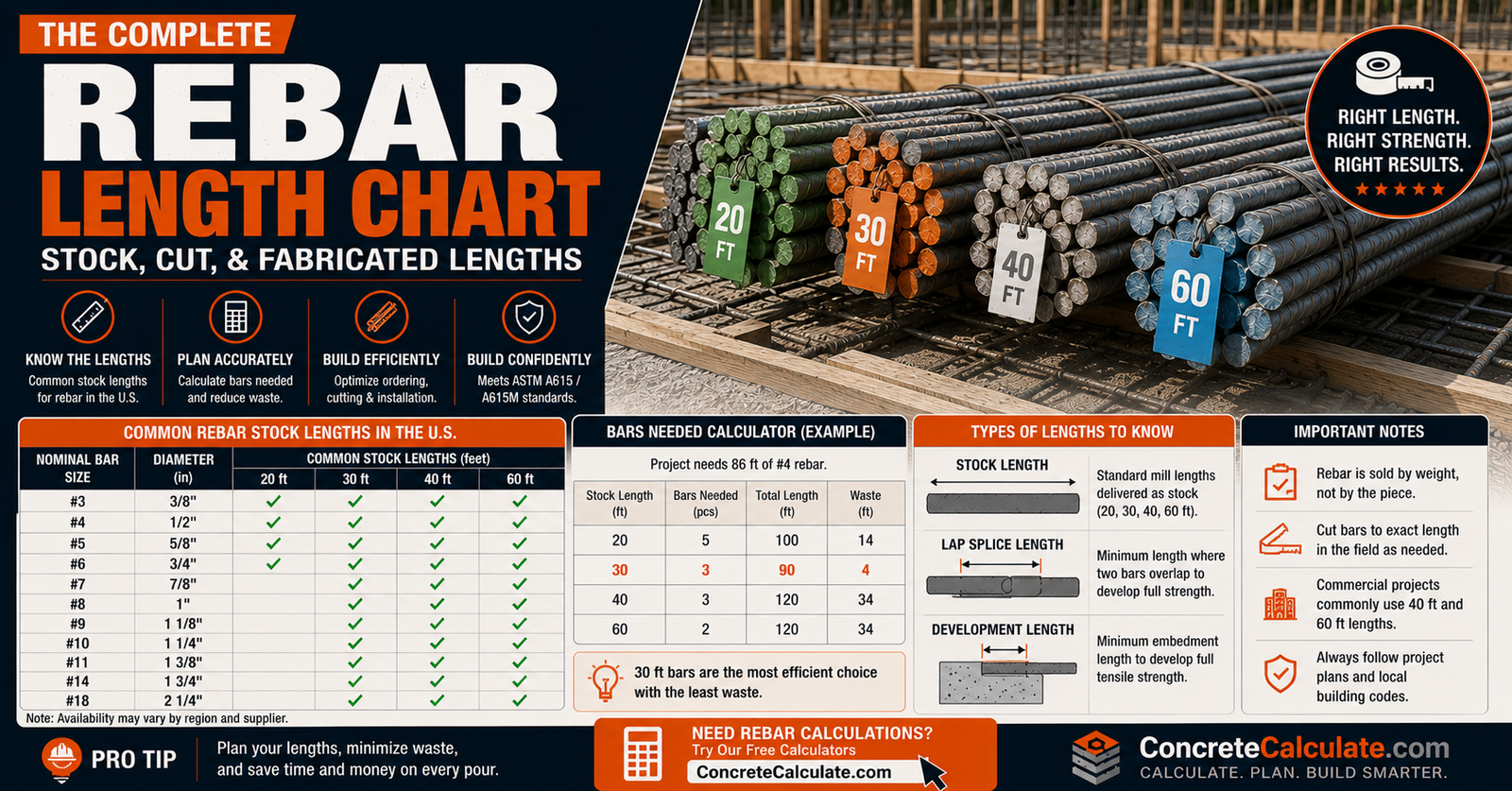
Rebar Length Chart
Stock, Cut, and Fabricated Bar Lengths
What lengths rebar actually comes in, a free bars-needed calculator, and how stock length differs from cut length, lap length, and development length.
 Reviewed by Muhammad Ramzan Babar, PhD Researcher (Plasma Physics) & Calculator Developer — View Profile
⭐ Rebar Length Chart: Quick Reference
Rebar length is not a fixed property of bar size. Availability depends on the supply channel and producer.
Common U.S. Straight Rebar Lengths
| Supply Type | Common Lengths | Typical Use |
|---|---|---|
| Retail / precut | 1, 2, 4, 10, 20 ft | Repairs, DIY, small projects |
| Mill / stock bar | 20, 30, 40, 60 ft | Commercial fabrication |
| Custom cut-to-length | Project-specific | Fabricated reinforcement |
| Coil / spooled | Continuous coil | Automated fabrication |
None of these dimensions are ASTM-mandated standard lengths. Nucor lists most sizes in 20-, 40-, and 60-ft pieces; Gerdau lists 20, 30, 40, and 60 ft with custom lengths available.
✓ Verified against Nucor.com and Gerdau.com, August 2026Length Availability by Bar Size
| Bar Size Group | 20/40/60 ft | Custom Length |
|---|---|---|
| #3 – #6 | Common | Available |
| #7 – #11 | Producer-dependent | Available |
| #14, #18 | Verify with mill | Available |
Verify With Your Actual Supplier
This reflects general market patterns, not a guarantee every mill offers every length for every size. Confirm exact availability and lead time with your supplier.
⭐ Bars-Needed Calculator
Enter the total linear feet of reinforcement your project requires and see how many stock-length bars you would need at each common length, plus the total weight.
🧮 Rebar Stock Length & Weight Calculator
What This Calculator Does and Does Not Do
This tool rounds up to whole stock bars for a simple straight total, using the formula N = ceiling(total feet ÷ stock length). It does not add lap splice length, hooks, bends, or waste allowance. For full project takeoffs with laps and grid layouts, use the Rebar Grid Calculator.
⭐ What Does Rebar Length Mean?
“Rebar length” can mean several different things, and confusing them is one of the most common estimating errors.
Stock Length
The straight bar length as supplied by a mill or distributor, such as 20, 30, 40, or 60 ft.
Cut Length
Straight bar cut down from stock length to a specified project dimension.
Fabricated Length
The length associated with a bar after it has been bent or shaped according to a bar mark on a placing drawing.
Installed Length
The physical reinforcement as actually placed within the concrete member.
Lap or Splice Length
Only the overlap between two adjacent bars, not the overall length of either bar. See Rebar Length and Lap Splices below.
Standard Rebar Lengths in the United States
Answering “how long is a standard piece of rebar” requires a practical hierarchy, not a single number.
- CRSI identifies 60 ft as the standard reinforcing bar length in its economy-of-construction guidance.
- 20, 30, 40, and 60 ft are common mill and commercial supply lengths.
- Individual producer availability varies by mill, region, and bar size.
- Shorter retail lengths are widespread at home centers and hardware retailers.
- Custom fabrication to project-specific lengths is common practice.
CRSI Recommendation
CRSI’s Design Guide for Economical Reinforced Concrete Structures states that the standard length for reinforcing bars is 60 ft, although some fabricators stock shorter lengths, and recommends using the longest available and practical bar lengths to reduce fabrication and placing costs.
✓ Source: CRSI Design Guide, verified August 202620-ft, 30-ft, 40-ft, and 60-ft Rebar Compared
No single length is universally “best.” Each involves different handling and splice tradeoffs.
| Length | Common Source | Splice Implications |
|---|---|---|
| 20 ft | Retail, distribution, mill | More joints on long runs |
| 30 ft | Some mills (e.g. Gerdau) | Fewer joints than 20 ft |
| 40 ft | Common commercial stock | Fewer joints than 20/30 ft |
| 60 ft | Long mill/fabrication stock | Fewest joints where usable |
Nucor and Gerdau demonstrate that commercial length offerings differ by producer: Nucor lists most sizes in 20, 40, and 60 ft, while Gerdau lists typical lengths of 20, 30, 40, and 60 ft with custom lengths available on request.
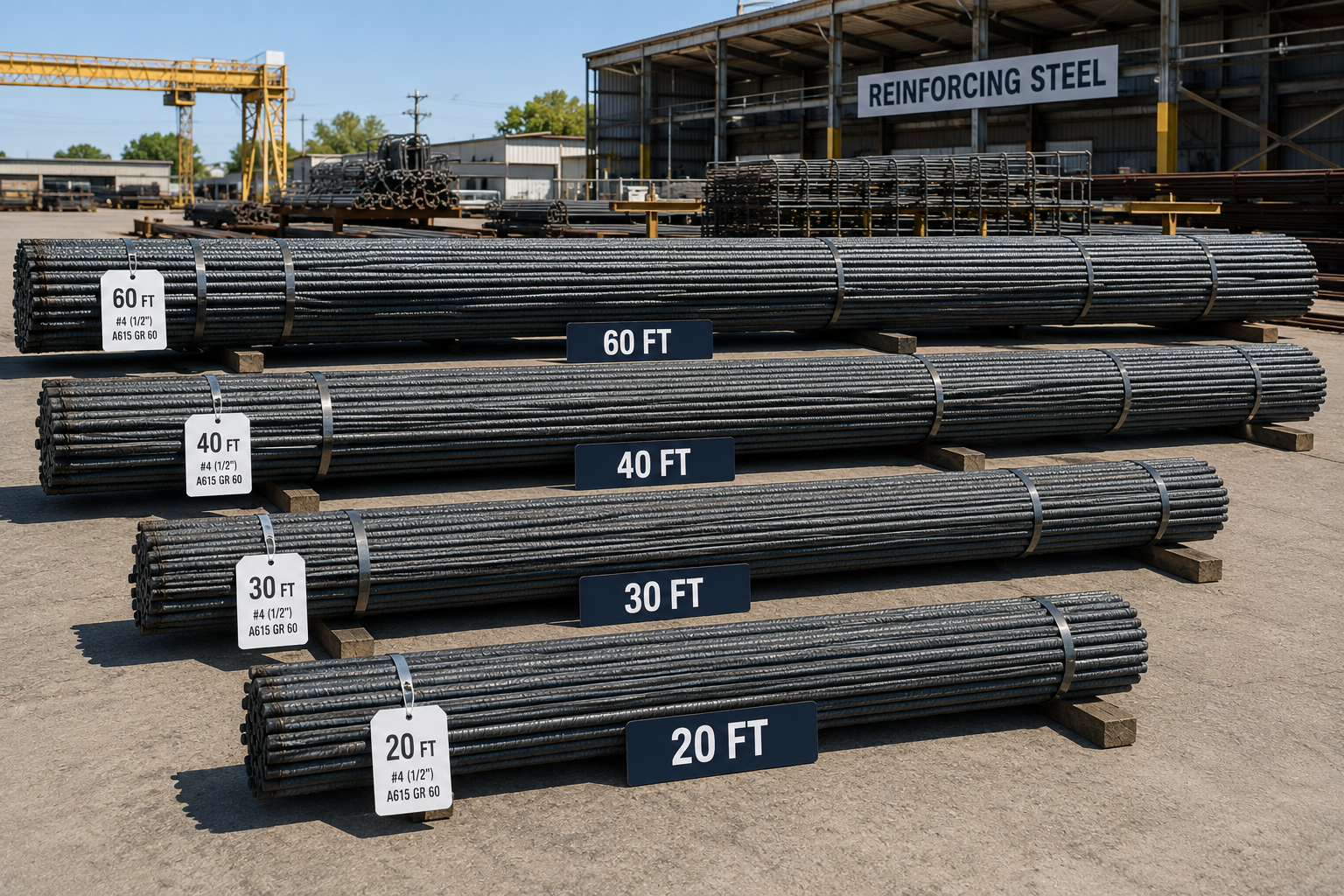
Retail Rebar Lengths vs Commercial Stock Lengths
Homeowner search results look very different from reinforcing-steel industry practice.
Home-Center / DIY Lengths
Retail and home center outlets commonly sell shorter precut pieces, such as 1, 2, 4, 10, and 20 ft lengths, particularly for common #3 and #4 bar used in small repairs and DIY projects.
Fabricator / Mill Lengths
Commercial mills and fabricators typically supply longer stock lengths such as 20, 30, 40, and 60 ft, intended for shop fabrication and job-site placement on larger projects.
Why Availability Differs
Availability depends on the supplier, the specific mill, bar size, grade, coating (such as epoxy or galvanized), region, order quantity, and project fabrication requirements. There is no single national length standard that every channel follows.
Does Rebar Size Determine Its Length?
No. Bar size and bar length are separate, independent dimensions.
A #4 bar might be supplied as a 10, 20, 40, or 60 ft piece depending on the supplier and project. Similarly, a #8 bar is not inherently longer than a #4 bar simply because it has a larger diameter.
Diameter Is a Separate Topic
For nominal and actual bar diameter by size, see the dedicated Rebar Diameter Chart or the master Rebar Size Chart. This page focuses specifically on length, which is independent of diameter.
Rebar Length by Size: #3 through #18
An availability-style reference, not a claim that each diameter has its own unique standard length.
| Rebar Size | Nominal Diameter | Common Length Availability |
|---|---|---|
| #3 | 0.375 in | 20, 40, 60 ft (mill-dependent) |
| #4 | 0.500 in | 20, 40, 60 ft (mill-dependent) |
| #5 | 0.625 in | 20, 40, 60 ft (mill-dependent) |
| #6 | 0.750 in | 20, 40, 60 ft (mill-dependent) |
| #7 | 0.875 in | 20, 40, 60 ft (mill-dependent) |
| #8 | 1.000 in | 20, 40, 60 ft (mill-dependent) |
| #9 | 1.128 in | 20, 40, 60 ft (mill-dependent) |
| #10 | 1.270 in | 20, 40, 60 ft (mill-dependent) |
| #11 | 1.410 in | 20, 40, 60 ft (mill-dependent) |
| #14 | 1.693 in | Verify with mill/fabricator |
| #18 | 2.257 in | Verify with mill/fabricator |
Nucor states that it manufactures most rebar sizes #3 through #18 in lengths of 20, 40, and 60 ft, subject to product and mill availability. If sourcing the ASTM No. 20 [64] bar for a project, verify supplier availability directly rather than assuming the same commercial lengths apply.
Rebar Length in Feet, Inches, and Meters
A practical conversion chart for moving between U.S. shop drawings and metric project documents.
| Feet | Inches | Meters |
|---|---|---|
| 10 ft | 120 in | 3.048 m |
| 20 ft | 240 in | 6.096 m |
| 30 ft | 360 in | 9.144 m |
| 40 ft | 480 in | 12.192 m |
| 60 ft | 720 in | 18.288 m |
Straight Rebar vs Coiled Rebar
ASTM A615 covers reinforcement supplied as both cut lengths and coils.
Straight bar is supplied as individual cut lengths, ready for direct use or further shop fabrication. Coiled rebar is supplied as a continuous coil that is later straightened, cut, and fabricated, typically using automated equipment.
Coiled rebar is useful for automated manufacturing and custom or repetitive fabrication runs. Coil availability applies to specific bar sizes and products rather than the entire size range, so confirm with the supplier whether a given size is offered in coil form.
Stock-Length Rebar vs Cut-to-Length Rebar
A practical procurement decision with real tradeoffs.
Stock length rebar is purchased in the supplier’s standard lengths. Cut-to-length rebar is fabricated to match specific project dimensions.
Tradeoffs to weigh include material waste, labor for cutting and handling, splice count, whether cutting happens in the shop or the field, and how well stock lengths match the project’s actual bar marks.
CRSI Guidance on Stock Bars
CRSI specifically notes that using stock-length bars can be more economical than individually fabricated bars in some irregular wall or slab situations, where field cutting and splicing may cost less than custom fabrication for every unique dimension.
How Rebar Length Is Shown on Structural Drawings
Two distinct drawing types work together to define reinforcement length.
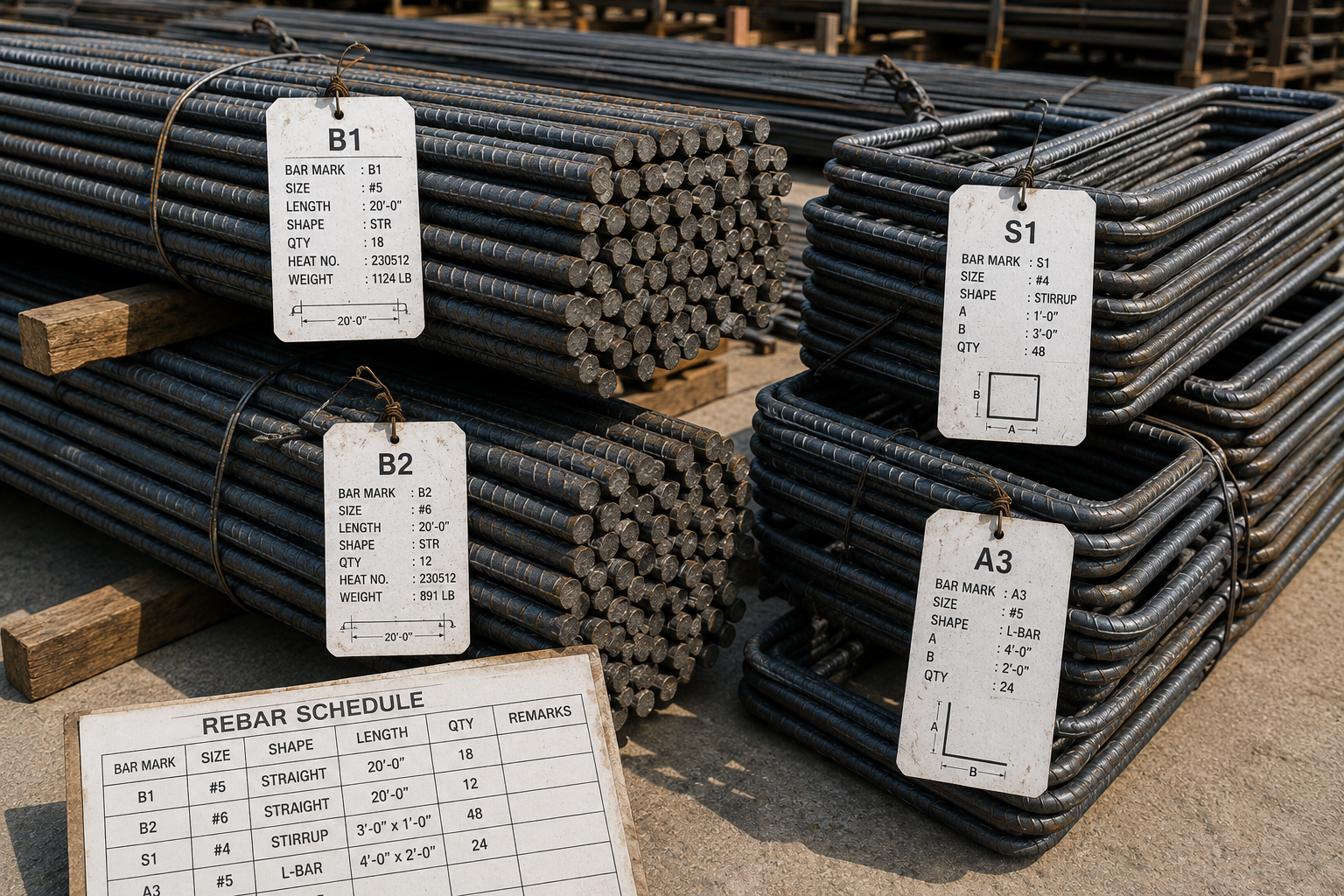
Structural design drawings and reinforcement placing/shop drawings typically show a bar mark, bar size, quantity, shape, dimensions, length, spacing, and location for each piece of reinforcement.
The structural engineer establishes reinforcement requirements on the design drawings, while fabrication and detailing translate those requirements into individual bar marks and precise cutting/bending dimensions on placing drawings used in the shop and field.
Rebar Bar Lists and Bending Schedules
How a project tracks dozens or hundreds of individual bar lengths.
| Bar Mark | Size | Shape | Length |
|---|---|---|---|
| B01 | #5 | Straight | 18′-0″ |
| B02 | #5 | L-bar | 14′-0″ |
This example illustrates the format, not actual project data. The purpose of this section is to show where required individual bar lengths originate on a real project: the bar list or bending schedule, not a generic length chart.
⭐ How Fabricated and Bent Rebar Length Is Measured
Straight bars are simple, but bent bars require standardized measuring points.
CRSI’s current fabrication standard, covering bend diameters, measuring points, and fabrication tolerances for steel reinforcing bars, defines how bent-bar dimensions are established, along with CRSI’s broader technical guidance addressing typical measuring points and fabrication tolerances.
Straight Bar Length
Simple end-to-end length, measured directly.
Bent Bar Dimensions
Measured according to standardized bar-shape measuring points defined in the fabrication standard, which account for the bend geometry rather than a simple straight-line sum of the legs.
Hooks and Bends
Do not simply add the external straight-line leg dimensions together and assume that total equals the fabrication cut length. The actual material length required for a bent bar depends on the bend diameter and the standardized measuring points used by the fabricator.
Rebar Length and Fabrication Tolerances
Fabricated reinforcing steel cannot realistically be treated as having zero dimensional tolerance.
Fabrication tolerances apply to straight bar dimensions, bent bar dimensions, hook dimensions, and the measuring locations used to verify them. CRSI’s current fabrication standard is the principal U.S. reference covering bend diameters, measuring points, and fabrication tolerances for steel reinforcing bars.
Confirm Exact Tolerance Values With the Current Standard
This page does not reproduce specific tolerance numbers, since those values should be confirmed directly from the current CRSI fabrication standard for the project’s applicable edition rather than repeated from a secondary source.
How to Calculate Required Straight Rebar Length
Geometric member length alone is not necessarily the correct bar cutting length.
This simple equality only holds for a basic straight run with no other detailing requirements. Actual reinforcement purchasing can also involve end development or anchorage, cover offsets, laps or splices, hooks, construction joints, and bar termination requirements defined by the design.
Key Point
Do not calculate cut length from concrete member dimensions alone. Always start from the bar schedule or placing drawing, which already accounts for cover, development, and detailing requirements.
Rebar Length and Concrete Cover
A simple geometric distinction, not a universal cutting formula.
Where C1 and C2 are the relevant end clearances or cover dimensions at each face. This gives only the approximate inside geometric dimension for a straight bar extending between two concrete faces.
Actual reinforcement may still require development beyond critical sections, bends, hooks, anchorage, or continuity into adjacent members. This formula should not be promoted as a universal rebar-cutting rule; always follow the project’s reinforcement detailing. See the Concrete Cover Chart for cover requirements by exposure condition.
⭐ Rebar Length and Lap Splices
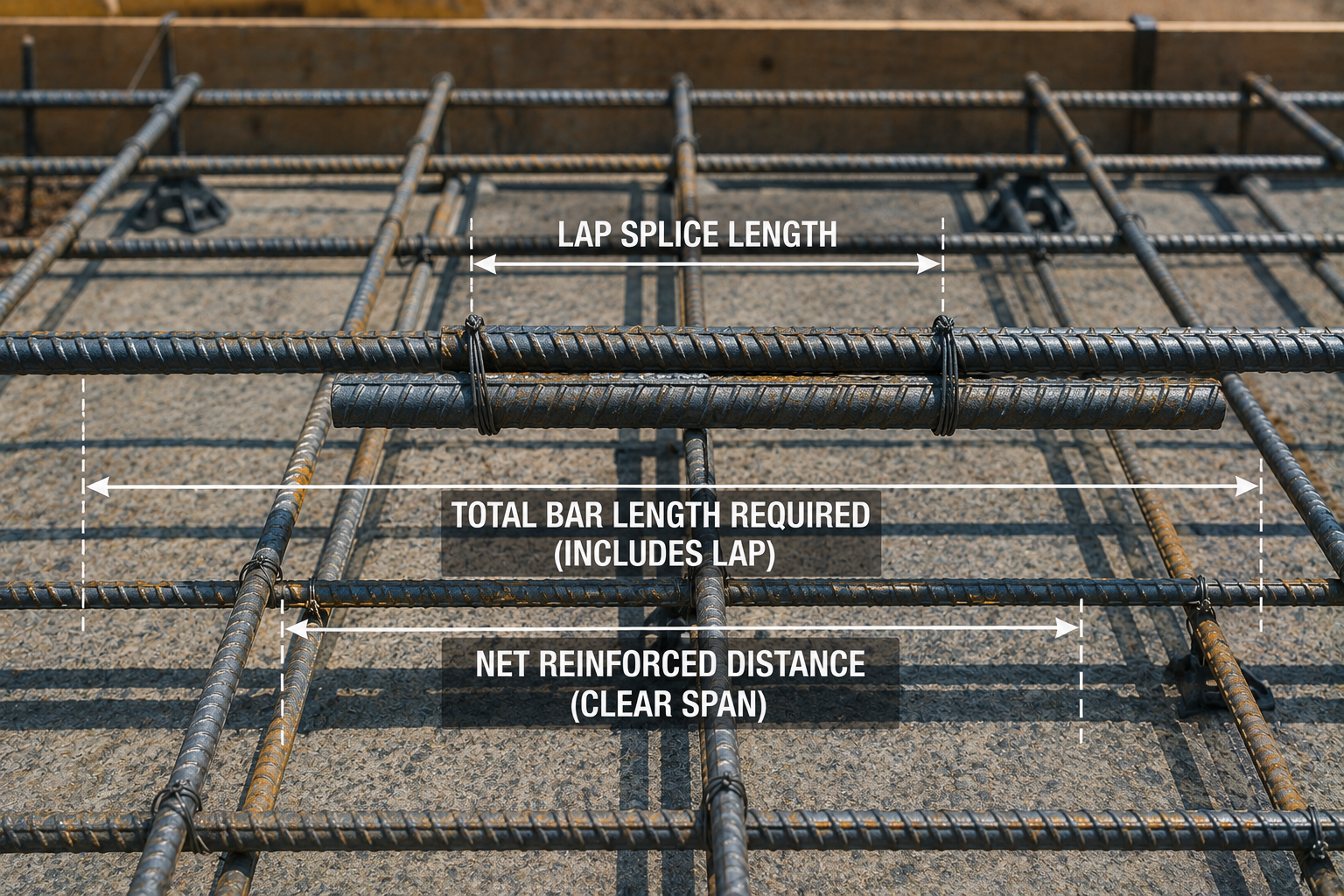
Overlapping bars consume additional material length beyond the net reinforced run.
When a long reinforcement run requires multiple bars joined end to end, the lap region where two bars overlap adds extra material length beyond the distance actually being reinforced.
CRSI notes that lap length varies with concrete strength, concrete type, bar grade, bar size, spacing, cover, and transverse reinforcement, and that lap lengths should be indicated on placing drawings rather than assumed by the installer.
Why You Cannot Use One Universal “40× Bar Diameter” Rule
Simplistic universal lap-length multiples do not account for the variables above and should not be used for design or procurement. For actual lap length values by condition, see the dedicated Rebar Lap Splice Chart.
Rebar Length and Development Length
Bar length and development length answer two different questions.
Bar length is the physical length of a piece of reinforcement. Development length is the required embedment needed to develop the bar’s stress through bond with the surrounding concrete.
ACI CODE-318-25, the current edition of the Building Code for Structural Concrete published by the American Concrete Institute, addresses development and splicing of reinforcement. Development length depends on multiple variables, including bar size, grade, concrete strength, and cover, and should never be treated as synonymous with a stock-bar length.
When Rebar Is Longer Than Available Stock
Practical alternatives exist when a required run exceeds one bar’s stock length.
- Lap splice: overlap two bars by the required lap length.
- Mechanical splice or coupler: connect bar ends without a long overlap.
- Welded splice, where properly permitted and specifically designed.
- Specially ordered or custom lengths, where available from the supplier.
Drilled Shaft Example
FHWA guidance notes that splicing of longitudinal reinforcement in drilled shaft cages is required when the cage length exceeds the length of available reinforcing bars, which are normally supplied in lengths of 60 ft or less. This is a practical, real-world example of the stock length limitation described throughout this page.
Rebar Couplers vs Longer/Lapped Bars
Two different approaches to joining reinforcement, each with its own considerations.
Lap splicing uses overlapping bar length to transfer force between two bars. Mechanical couplers connect bar ends without the same long overlap requirement.
Potential reasons a coupler might be considered include reinforcement congestion, large bar sizes where lap length becomes impractical, limited splice zone dimensions, material length constraints, and construction sequencing needs. This page does not recommend a specific coupler type or claim material savings, since that depends on project-specific engineering analysis and the engineer of record’s approval.
Rebar Length by Construction Application
Project type does not establish one standard rebar length; drawings and bar schedules do.
Slabs and Mats
Long grid runs may require multiple stock lengths joined with laps across the slab or mat.
Footings and Foundations
Straight longitudinal bars, corner bars, dowels, and laps are common length considerations.
Walls
Vertical and horizontal reinforcement lengths depend on wall height, length, and opening locations.
Beams
Longitudinal bars, hooks, anchorage into supports, and stirrup lengths all factor into a beam’s bar list.
Columns
Vertical bars, splices between floor lifts, dowels, and ties determine required lengths.
Structural Drawings Govern
Project type does not establish one standard rebar length. Structural drawings and bar schedules determine required lengths for every application listed above.
⭐ How Many Rebar Lengths Do I Need?
A high-value estimating question with an important caveat about when the simple formula breaks down.
This ceiling-function formula works for a simple line where no overlaps are required, rounding up to the next whole stock bar. Try the Bars-Needed Calculator above for an instant result.
This Simple Formula Is Insufficient When
Laps are required between bars, offcuts can be reused for shorter bar marks, bends or hooks exist, multiple bars run in parallel, or layout spacing controls the total quantity needed rather than a single continuous run.
Number of Bars Along a Run
Determined by required spacing and the total run length, following the project’s reinforcement layout.
Number of Parallel Bars
Determined by member width and required spacing in the perpendicular direction.
Total Linear Feet of Rebar
The sum of every individual bar’s length across the entire project, which feeds directly into both stock-length ordering and total weight calculations. See the Rebar Grid Calculator for a tool that automates this calculation for grid layouts.
Rebar Length and Spacing for Slabs and Grids
Grid reinforcement estimating requires both bar length and number of bars.
For one direction of a rectangular slab, where N1 is the number of bars in that direction.
Total linear feet combines both directions of the grid. Add overlaps, hooks, or other detailing only according to the design, not as a default assumption.
See the Rebar Spacing Chart for spacing requirements and the Rebar Grid Calculator to automate this two-direction calculation.
Total Rebar Length to Weight Conversion
A useful secondary calculation; the dedicated Rebar Weight Chart owns the full intent.
Where W is total weight, L is total bar length, and w is unit weight per foot for the specific bar size. Use the calculator above to get this instantly for your total footage.
Converting Stock Length to Weight
For complete unit-weight tables by bar size, see the dedicated Rebar Weight Chart.
⭐ Rebar Cutting, Waste, and Length Optimization
An excellent practical section for reducing material waste and fabrication cost.
Consider a cut plan that nests shorter bars from long stock, reuses offcuts where practical, favors repetitive lengths across the project, reduces unnecessary cuts, coordinates stock length with the required bar marks, and avoids relocating splices simply to fit available stock.
CRSI Guidance
CRSI specifically recommends using repetitive bar sizes and lengths, and using the longest available bars where practical, to reduce fabrication and placing costs on a project.
Example Cutting Plan
| Stock Bar | Cutting Option | Result |
|---|---|---|
| 60 ft | 3 × 20 ft pieces | 60 ft total, no offcut |
| 60 ft | 2 × 30 ft pieces | 60 ft total, no offcut |
| 60 ft | 1 × 40 ft + 1 × 20 ft | 60 ft total, no offcut |
These are simple arithmetic examples of nesting options for a 60-ft stock bar, not a recommendation to alter reinforcement detailing. Any actual cut plan must still match the bar marks and lengths shown on the approved placing drawings.
Rebar Handling, Delivery, and Long-Bar Logistics
Longer reinforcement reduces splices but increases handling and logistics considerations.
Considerations include site access for long bar delivery, lifting and handling equipment, storage length available on site, fabrication shop constraints, delivery scheduling, crane and rigging needs for assembled cages, and long-bar placement sequencing. FHWA notes the practical relationship between available bar length and the need to splice long drilled-shaft cages, illustrating how stock length limitations translate directly into field logistics decisions. This page does not state a universal trucking or handling maximum, since those limits vary by carrier, route, and local regulation.
⭐ ASTM, ACI, and CRSI References for Rebar Length
Each organization controls a different piece of the rebar length picture.
ASTM A615/A615M
The material specification covering bars supplied in cut lengths and coils, along with size, grade, and material requirements. It does not assign one required length to each bar size.
ACI CODE-318-25
The current edition of the Building Code for Structural Concrete, published by the American Concrete Institute in January 2025, addressing structural requirements affecting development, anchorage, splicing, and reinforcement detailing.
CRSI IPG5.1-2026
CRSI’s current fabrication standard covering bend diameters, measuring points, and fabrication tolerances for steel reinforcing bars.
CRSI Manual/Detailing Practice
CRSI’s Manual of Standard Practice and related design guidance address bar lists, fabrication, placing, stock-length economy, and general industry practice, including the 60 ft standard length reference used throughout this page.
Common Rebar Length Mistakes
The most frequent errors in rebar length estimating, procurement, and detailing.
Saying all rebar is 20 ft long
Length varies widely by supply channel, producer, and bar size.
Saying all rebar is 60 ft long
60 ft is CRSI’s standard reference length, not the only length available.
Treating commercial stock length as an ASTM requirement
ASTM A615 covers cut lengths and coils generally; it does not mandate specific stock lengths.
Assuming bar size determines bar length
Diameter and length are independent dimensions.
Confusing stock length with required structural length
The bar schedule, not the supplier’s stock length, governs the installed length.
Confusing lap length with total bar length
Lap length is only the overlap between bars, not either bar’s full length.
Ignoring development/anchorage
Bar length calculations must account for required embedment beyond critical sections.
Cutting bars based only on concrete member dimensions
Member geometry alone omits cover, development, and detailing requirements.
Ignoring concrete cover/end geometry
End clearances affect the actual inside dimension available for reinforcement.
Measuring bent reinforcement incorrectly
Bent bar length follows standardized measuring points, not a simple sum of leg dimensions.
Ignoring fabrication tolerances
Fabricated bars have real dimensional tolerances that should be confirmed from current standards.
Adding bend legs without correct fabrication measurement
This produces an inaccurate cut length for bent bars.
Moving splice locations merely to fit stock bars
Splice locations should follow the engineer’s design, not convenience.
Assuming retail pieces represent commercial practice
Short retail lengths are a DIY convenience, not the reinforcing-steel industry standard.
Forgetting waste/offcut optimization
Poor cut planning increases material waste and project cost.
Assuming every supplier carries every length
Availability varies by mill, region, bar size, and grade.
Rebar Length Chart Limitations
Important context for interpreting this chart correctly.
Frequently Asked Questions
📥 Download Rebar Length Chart PDF
Use your browser’s print function to instantly save this page as a PDF. This avoids broken file links and gives you an always up-to-date printable version for jobsite binders, estimating folders, and procurement reference kits.