Concrete Curing and Drying Time Guide: Complete 2026 Timeline
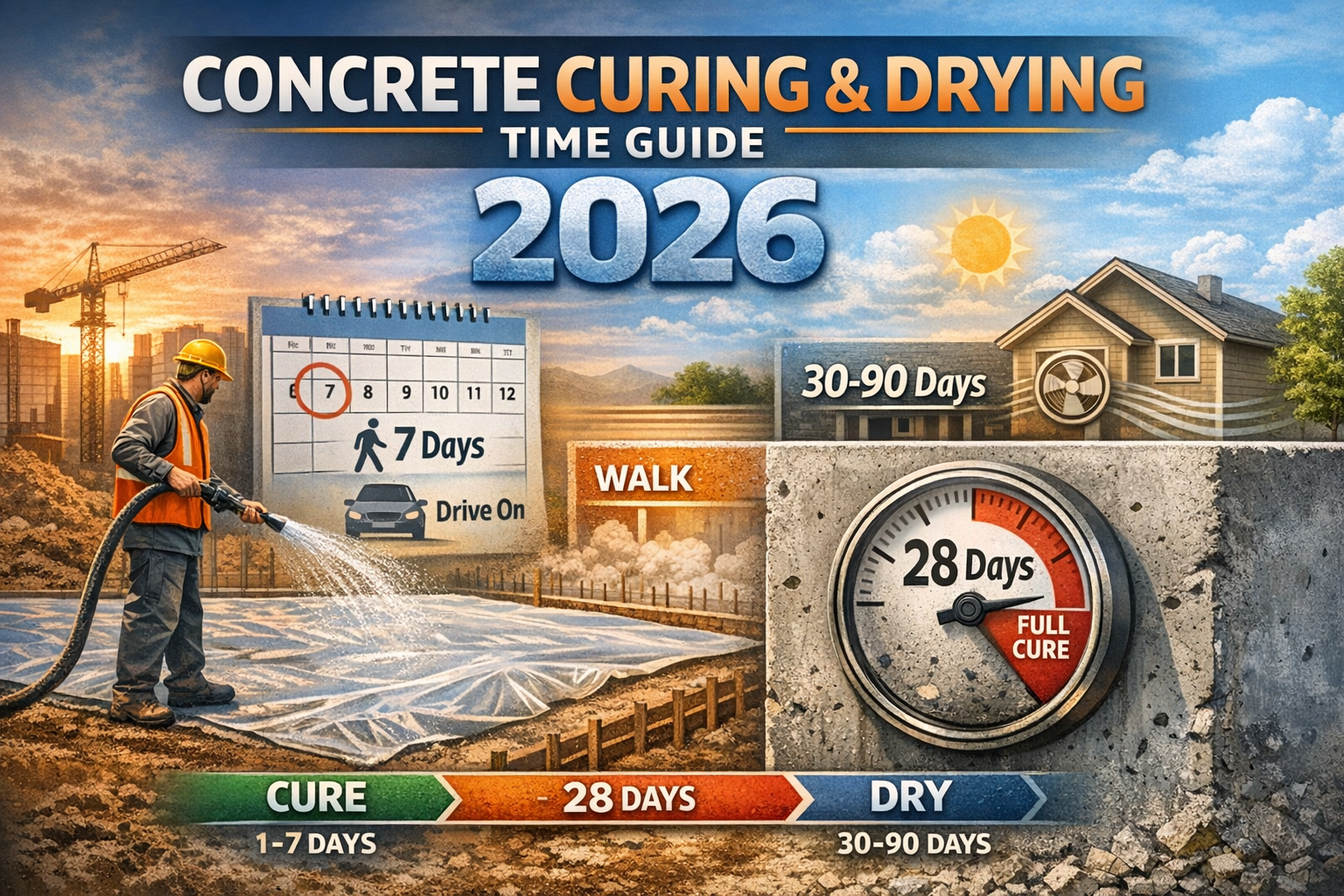
Understanding concrete curing and drying time is critical for project success. Concrete takes 28 days to fully cure and reach maximum strength, but you can walk on it after 24-48 hours and drive on it after 7 days. This guide breaks down the complete concrete curing and drying timeline, explains the difference between curing vs drying, covers strength development stages, and shows you how to achieve optimal results for your 2026 concrete project.
Curing vs Drying: Understanding the Difference
Most people use “curing” and “drying” interchangeably when talking about concrete, but these are completely different processes. Understanding this distinction is essential for proper concrete care and optimal strength development.
What is Concrete Curing?
Curing is a chemical process called hydration. When cement mixes with water, a chemical reaction begins that forms calcium silicate hydrate crystals. These crystals grow and interlock, creating the strong matrix that gives concrete its structural properties.
The hydration process requires three things: water, proper temperature, and time. Remove any of these elements and curing stops, leaving you with weak concrete that never reaches its design strength.
What is Concrete Drying?
Drying is a physical process where excess water evaporates from hardened concrete. After the hydration reaction consumes the water needed for curing, leftover water slowly migrates to the surface and evaporates into the air.
Drying only becomes important when you need to apply floor coverings, coatings, or sealers that require specific moisture levels. Unlike curing, drying benefits from air movement and low humidity.
Concrete doesn’t harden by drying out. It hardens through the chemical hydration process. In fact, concrete submerged in water cures perfectly and reaches full strength. Letting concrete dry too quickly during curing stops the hydration reaction and permanently weakens the concrete.
Complete Concrete Curing Timeline
The concrete curing timeline follows predictable stages. Understanding each phase helps you know what to expect and when you can safely use your concrete surface.
Initial Set (0-24 Hours)
The hydration reaction begins immediately when water contacts cement. Within 30-90 minutes, initial set occurs where concrete loses plasticity and can no longer be worked. Final set happens around 8-12 hours when concrete becomes hard to the touch.
During this critical first day, protect concrete from sun, wind, rain, and temperature extremes. Any disturbance damages the forming crystal structure. Strength gain during the first 24 hours is minimal (less than 10% of final strength).
Early Strength Development (1-7 Days)
The first week sees rapid strength development. Concrete typically reaches 50-70% of its 28-day design strength by day 7. This period is the most critical for proper curing practices.
You can walk on most residential concrete after 24-48 hours. Remove forms after 24-72 hours depending on temperature and concrete strength. Continue aggressive curing throughout this period for maximum strength.
| Day | Approximate Strength | Safe Activities |
|---|---|---|
| Day 1 | 10-15% | None – keep surface protected |
| Day 2 | 25-30% | Light foot traffic, remove forms |
| Day 3 | 40-45% | Normal foot traffic |
| Day 5 | 55-60% | Light equipment, wheelbarrows |
| Day 7 | 65-75% | Passenger vehicles (driveways) |
Continued Curing (7-28 Days)
After the first week, strength development continues but at a slower rate. Concrete reaches 90% design strength by 14 days and 100% by 28 days. Continue moisture curing for at least 7 days, ideally 14-28 days for maximum durability.
Most building codes and engineering calculations assume 28-day strength. Testing for structural applications typically occurs at 28 days to verify concrete meets specifications.
Long-Term Strength Gain (28+ Days)
Hydration continues beyond 28 days at a very slow rate. Concrete reaches 105-110% of design strength by 56-90 days. Some mixes continue gaining strength for years under moist conditions, but the rate becomes negligible.
💼 Example: Residential Driveway Timeline
Day 0: Pour 3500 PSI concrete at 9am, finish by noon, apply curing compound
Day 1: Keep surface moist, no traffic
Day 2: Begin wet curing, can walk on surface carefully
Days 3-7: Continue wet curing, normal foot traffic OK
Day 7: Stop intensive curing, drive passenger cars
Day 10: Drive SUVs and light trucks
Day 14: Drive heavy trucks and RVs
Day 28: Full design strength achieved (3500 PSI)
⏱️ Calculate Your Project Timeline
Get accurate curing time estimates based on temperature, concrete strength, and project type with our specialized calculators.
Use Set Time Calculator →Strength Development Stages
Concrete strength develops in predictable patterns based on the hydration reaction progress. Understanding these stages helps you plan project schedules and know when concrete can handle specific loads.
Dormant Period (0-8 Hours)
The first few hours after mixing show minimal hydration activity. The cement particles are just beginning to dissolve and react with water. Concrete remains workable during this period and gains almost no strength.
The dormant period length varies with temperature and cement type. Hot weather shortens it to 2-3 hours. Cold weather extends it to 12+ hours.
Acceleration Phase (8-20 Hours)
Hydration accelerates dramatically around 8-12 hours after mixing. This is when most heat generation occurs as calcium silicate hydrate crystals rapidly form. Concrete temperature rises 10-30°F above ambient during this phase.
Strength increases exponentially during acceleration. By 20 hours, concrete typically reaches 25-35% of final strength. This is when final set occurs and forms can be removed safely.
Deceleration Phase (20 Hours – 28 Days)
After the initial burst of activity, hydration continues at a steadily decreasing rate. The first 7 days see rapid strength gain (50-70% of final). Days 7-28 add another 25-45% strength more slowly.
This extended period is why proper curing matters. Maintaining moisture during deceleration allows the reaction to continue building strength. Letting concrete dry out stops hydration prematurely.
Strength Development Formula
This approximation works for normal Portland cement concrete at 70°F. Use our PSI strength calculator for accurate predictions.
💼 Example: 3000 PSI Concrete Strength Development
Day 1: 300-450 PSI (10-15% of final)
Day 3: 1200-1350 PSI (40-45% of final)
Day 7: 1950-2250 PSI (65-75% of final)
Day 14: 2550-2700 PSI (85-90% of final)
Day 28: 3000 PSI (100% design strength)
Day 56: 3150-3300 PSI (105-110% of design)
Maturity Method for Strength Prediction
The maturity method accounts for both time and temperature effects on strength development. It’s more accurate than simple age-based estimates, especially in variable weather conditions.
Maturity = Σ (Temperature – Base Temperature) × Time. Most specifications use 32°F (-0°C) as the base temperature below which hydration effectively stops. Our curing temperature calculator applies maturity principles for accurate predictions.
Factors Affecting Curing Time
Multiple variables influence how quickly concrete cures and gains strength. Some you can control, others require adjusting your expectations and methods.
1. Ambient Temperature
Temperature is the single biggest factor affecting curing rate. The hydration reaction is temperature-dependent, proceeding faster in warm conditions and slower in cold.
| Temperature Range | Curing Speed | 7-Day Strength | Considerations |
|---|---|---|---|
| Below 40°F | Very slow | 30-40% | Use heated enclosures, extend cure time |
| 40-50°F | Slow | 45-55% | Extend curing to 10-14 days |
| 50-70°F | Normal | 65-75% | Ideal curing conditions |
| 70-85°F | Fast | 70-80% | Excellent for rapid strength gain |
| Above 85°F | Very fast initial, reduced final | 75-85% | Risk of cracking, reduced long-term strength |
2. Water-Cement Ratio
Lower water-cement ratios produce stronger concrete but require longer curing periods to achieve full strength. Higher ratios cure faster initially but reach lower final strength.
The ideal water-cement ratio for most applications is 0.40-0.50. Below 0.40, concrete becomes difficult to work and may not fully hydrate. Above 0.60, you sacrifice significant strength and durability. Calculate optimal ratios with our water-cement ratio calculator.
3. Concrete Mix Design
Different cement types and additives dramatically affect curing time:
- Type I (normal): Standard 28-day cure for full strength
- Type III (high-early): Reaches 3500 PSI in 3-7 days instead of 28
- Type IV (low heat): Slower curing, used for massive pours
- Fly ash or slag blends: Slower early strength, higher long-term strength
- Accelerating admixtures: Speed initial set by 2-8 hours
- Retarding admixtures: Delay set by 2-6 hours in hot weather
4. Humidity and Wind
Low humidity and wind cause rapid surface evaporation, preventing proper curing. Concrete surfaces dry faster than interior areas, creating moisture gradients that lead to shrinkage cracking.
Relative humidity below 50% requires aggressive moisture retention methods. Wind speeds above 10 mph dramatically increase evaporation rates and cooling effects.
5. Slab Thickness
Thick concrete cures differently than thin sections. Massive pours generate more heat and retain it longer, accelerating internal curing but creating thermal gradients that can crack the concrete.
Thin sections (under 4 inches) lose moisture quickly and cool rapidly, requiring more aggressive surface curing. Use our thickness calculator to optimize pour depth for your application.
Temperatures above 90°F accelerate initial strength gain but reduce final strength by 10-20% due to poor hydrate crystal structure. Use cold water in the mix, pour during cooler morning hours, apply evaporation retarders, and start wet curing immediately. Hot weather concrete is particularly vulnerable to plastic shrinkage cracking in the first 24 hours.
Proper Curing Methods
Choosing the right curing method depends on your project type, weather conditions, and budget. The goal is maintaining moisture and temperature for proper hydration.
Wet Curing Methods
Wet curing is the most effective approach, continuously supplying water to the concrete surface. It produces the highest strength and best durability but requires more labor.
Ponding: Create dikes around the slab and flood with water. Ideal for horizontal surfaces like floors and slabs. Provides excellent temperature control in hot weather. Labor-intensive and requires constant monitoring.
Continuous spraying: Keep surface continuously wet with sprinklers or soaker hoses. Works well for large flat areas. Requires reliable water supply and can waste significant water.
Wet burlap or blankets: Cover concrete with saturated burlap, cotton mats, or specialized curing blankets. Keep materials wet for 7+ days. Excellent for vertical surfaces and complex shapes. Requires rewetting 2-4 times daily.
Membrane Curing Methods
Membrane methods seal moisture inside the concrete, preventing evaporation. They’re less labor-intensive than wet curing but slightly less effective.
Plastic sheeting: Cover concrete with 4-6 mil polyethylene plastic, sealing all edges. Cheap and effective but can cause discoloration. Remove after 7 days. Creates greenhouse effect that can overheat concrete in direct sun.
Curing compounds: Spray liquid membrane-forming compounds that seal the surface. Quick application, no maintenance required. Cost $0.08-0.15 per square foot in 2026. Must apply immediately after finishing while surface is still damp. Plan to remove before applying coatings or sealers.
Waterproof paper: Specialized curing paper that prevents moisture loss. More expensive than plastic but doesn’t trap heat. Good for hot weather curing.
| Curing Method | Effectiveness | Cost | Labor | Best Use |
|---|---|---|---|---|
| Continuous ponding | Excellent | Low | High | Flatwork, hot weather |
| Wet burlap | Excellent | Medium | High | Vertical, complex shapes |
| Plastic sheeting | Very good | Low | Low | Residential slabs, DIY |
| Curing compounds | Good | Medium | Very low | Commercial, large areas |
| Curing blankets | Excellent | High | Medium | Cold weather, rapid set |
Cold Weather Curing
Cold weather (below 50°F) requires special curing methods to maintain concrete temperature and prevent freezing. Frozen concrete suffers permanent strength loss of 30-50%.
Use insulated blankets or heated enclosures to maintain concrete temperature above 50°F for at least 7 days. Type III high-early-strength cement helps in cold conditions. Add 5-10 days to normal curing time for every day concrete temperature stays between 40-50°F.
Apply curing compound immediately after finishing, while concrete is still wet but surface sheen has disappeared. Spray in two perpendicular passes for complete coverage at 200 square feet per gallon. Applying too early traps bleed water, causing surface scaling. Applying too late allows moisture loss that defeats the purpose. Calculate coverage accurately with our curing compound calculator.
🌡️ Optimize Curing for Your Temperature
Calculate exact curing requirements based on ambient temperature, concrete mix, and target strength with our temperature-specific calculator.
Use Temperature Calculator →Temperature and Curing Time
Temperature affects curing time more than any other single factor. Understanding this relationship helps you predict strength development and adjust curing methods appropriately.
Temperature-Strength Relationship
For every 18°F (10°C) increase in temperature, the hydration reaction rate roughly doubles. This means concrete at 70°F cures about twice as fast as concrete at 52°F, and concrete at 88°F cures twice as fast as at 70°F.
However, temperatures above 90°F cause problems. The rapid hydration creates poor crystal structure, reducing final strength by 10-20%. Hot concrete also develops more shrinkage cracks and has lower long-term durability.
Cold Weather Curing Challenges
Below 50°F, curing slows significantly. At 40°F, concrete gains strength at roughly half the normal rate. Below 32°F, hydration essentially stops, and any moisture in the concrete can freeze, causing permanent internal damage.
Cold weather curing requirements:
- Maintain concrete temperature above 50°F for minimum 7 days
- Above 40°F minimum if using Type III high-early cement
- Use insulated blankets or heated enclosures
- Extend curing period proportional to temperature drop
- Never let concrete freeze before reaching 500 PSI (about 24-48 hours)
Hot Weather Curing Solutions
When temperatures exceed 85°F, you face rapid moisture loss, thermal cracking, and reduced final strength. Aggressive curing becomes critical.
Hot weather best practices:
- Pour during cooler morning or evening hours
- Use cold water or ice in the mix to reduce concrete temperature
- Apply evaporation retarders immediately after finishing
- Start wet curing as soon as concrete can support it
- Provide windbreaks and shade if possible
- Consider using retarding admixtures to extend working time
💼 Example: Temperature Impact on 7-Day Strength
Same 3000 PSI concrete mix at different temperatures:
At 40°F: Reaches only 1200 PSI (40%) after 7 days
At 55°F: Reaches 1650 PSI (55%) after 7 days
At 70°F: Reaches 2100 PSI (70%) after 7 days
At 85°F: Reaches 2250 PSI (75%) after 7 days
At 100°F: Reaches 2400 PSI (80%) after 7 days but only 2700 PSI (90%) at 28 days
Maturity-Based Curing
Professional projects often use maturity meters that track time-temperature history to predict strength development. This is especially valuable for fast-track construction or variable weather conditions.
The American Concrete Institute provides maturity guidelines in ACI 306R (Cold Weather) and ACI 305R (Hot Weather). These standards help determine when concrete has cured sufficiently for form removal, post-tensioning, or loading.
The Drying Process Explained
After curing completes, concrete still contains excess water that must evaporate before you can apply floor coverings or coatings. The drying process is separate from curing and follows different rules.
How Concrete Dries
Moisture moves from high-concentration areas (interior of slab) to low-concentration areas (surface) through the pore structure. Surface moisture evaporates into the air, creating a gradient that draws more moisture from below.
Drying rate depends on concrete permeability, ambient humidity, temperature, air movement, and slab thickness. A typical 4-inch residential slab takes 30-90 days to reach equilibrium moisture content in normal conditions.
Factors Affecting Drying Time
Slab thickness: Drying time increases exponentially with thickness. A 4-inch slab might dry in 30 days while an 8-inch slab takes 120 days. Moisture must travel farther from the center to the surface.
Water-cement ratio: Higher water content means more water to evaporate. Concrete with a 0.60 w/c ratio contains much more excess water than 0.45 w/c ratio concrete.
Ambient conditions: Low humidity (below 50%) and good air circulation accelerate drying. High humidity (above 70%) can slow drying to a crawl. Temperature affects drying rate, with warmer conditions drying faster.
Curing method: Concrete cured with membranes or plastic sheeting retains more moisture initially than wet-cured concrete, potentially extending drying time by 1-2 weeks.
Measuring Concrete Moisture
Don’t rely on visual inspection or surface moisture to determine if concrete is dry enough for floor coverings. The surface may feel dry while interior moisture is still high.
Testing methods:
- Calcium chloride test (ASTM F1869): Measures moisture vapor emission rate from surface. Simple but only tests top 1/2 inch.
- Relative humidity test (ASTM F2170): Measures internal RH at 40% of slab depth. More accurate for predicting long-term performance. Most flooring manufacturers require RH below 75-85% depending on product.
- Moisture meters: Handheld devices give quick readings but can be inaccurate. Good for screening, not final verification.
Installing moisture-sensitive flooring (hardwood, vinyl, carpet) over wet concrete causes bubbling, delamination, mold growth, and adhesive failure. Warranty claims related to moisture issues exceed $1 billion annually in the US. Always test concrete moisture before flooring installation, even if the slab is several months old. Heated slabs or those with vapor barriers underneath dry more slowly and require extended wait times.
Accelerating the Drying Process
Unlike curing, you can safely speed up drying once concrete has cured for at least 28 days:
- Increase air circulation: Use fans to move air across the surface
- Reduce humidity: Run dehumidifiers in enclosed spaces
- Increase temperature: Heat accelerates evaporation (don’t heat uncured concrete)
- Remove vapor barriers: If installed on top, remove to allow moisture escape
- Surface grinding: Opening surface pores slightly increases evaporation rate
Professional moisture mitigation systems can dry concrete in 7-14 days instead of 30-90 days, but they cost $2-5 per square foot in 2026. Only consider for fast-track projects where the cost is justified.
When Can You Walk or Drive on Concrete
One of the most common questions is when new concrete can handle various types of traffic. The answer depends on concrete strength, load type, and consequences of premature loading.
Walking on New Concrete
Most residential concrete mixes are safe for foot traffic after 24-48 hours. At this point, surface hardness reaches 300-500 PSI, enough to prevent footprints or surface damage from normal walking.
Wait 48-72 hours in cold weather (below 50°F) or with high-strength mixes that cure more slowly. High-early-strength concrete may be walkable in 12-18 hours in warm conditions.
Light foot traffic (inspection, light cleanup) is okay after 24 hours. Normal foot traffic (moving materials, setting equipment) is safe after 48 hours. Heavy traffic (construction equipment, heavy carts) should wait until 72 hours or more. Always walk carefully and avoid scraping or dragging objects across new concrete surfaces even after the waiting period.
Driving on New Concrete Driveways
Vehicle traffic requires significantly more strength than foot traffic. The concentrated wheel loads can crack or damage weak concrete permanently.
| Vehicle Type | Minimum Wait Time | Required Strength | Notes |
|---|---|---|---|
| Bicycles, motorcycles | 3-4 days | 1200-1500 PSI | Light loads, minimal risk |
| Passenger cars | 7 days | 1800-2000 PSI | Standard recommendation |
| SUVs, minivans | 7-10 days | 2000-2200 PSI | Heavier vehicles need more time |
| Pickup trucks (empty) | 10 days | 2200-2400 PSI | Avoid loaded trucks longer |
| Heavy trucks, RVs | 14-28 days | 2500-3000 PSI | Wait for near-full strength |
| Delivery/moving trucks | 28 days | 3000+ PSI | Full cure required |
These guidelines assume 3000-3500 PSI concrete curing at 60-75°F. Extend wait times by 50-100% in cold weather. Consult our construction schedule calculator for temperature-adjusted timelines.
Installing Equipment or Anchors
Drilling, cutting, or installing anchors in new concrete should wait until at least 7 days after pour. Earlier drilling risks cracking from vibration and stress. The concrete should reach 50% strength minimum before any penetrations.
For structural anchors or heavy equipment, wait the full 28 days. The load ratings of concrete anchors assume full-strength concrete. Installing in weaker concrete creates a safety hazard.
Applying Sealers or Coatings
Most penetrating sealers can be applied after 28 days of curing. Film-forming coatings should wait 60-90 days to allow adequate moisture evaporation. Check manufacturer specifications as requirements vary significantly.
Applying sealers too early traps moisture, causing whitening, bubbling, or delamination. The investment in sealing is wasted if concrete isn’t properly cured and dried first.
💼 Example: Driveway Use Schedule
Project: 20×40 foot residential driveway, 3500 PSI concrete, poured in May, 65-75°F weather
Day 1-2: No traffic, keep wet
Day 3: Walk carefully for inspection
Day 7: Drive family sedan
Day 10: Drive SUV
Day 14: Normal use, all family vehicles
Day 28: Full strength, can park truck
Day 60: Apply penetrating sealer
Common Curing Mistakes to Avoid
These curing errors cause permanent concrete damage, wasted money, and premature failure. Learn from others’ mistakes to protect your investment.
1. Letting Concrete Dry Out Too Fast
The most common and destructive mistake is not protecting concrete from rapid moisture loss. Surface moisture evaporates in minutes on hot, dry, windy days. Once that moisture is gone, hydration stops and cannot restart.
Concrete that dries out reaches only 40-60% of design strength and develops surface cracking, dusting, and poor durability. The damage is permanent and cannot be reversed. See our guide on why concrete cracks for more details.
2. Removing Forms Too Early
Forms provide support and moisture retention. Removing them prematurely allows edges to chip and corners to crack. Wait at least 24 hours for vertical forms and 48-72 hours for horizontal forms supporting the slab.
In cold weather or with fly ash mixes, extend form removal to 3-5 days. The surface might look hard, but internal strength may still be insufficient.
3. Driving on Concrete Too Soon
This mistake causes surface cracks, permanent impressions, and structural damage that worsens over time. Wheel loads concentrate stress in small areas, creating cracks that propagate as the concrete ages.
The “it looks dry” test doesn’t work. Concrete can look and feel completely hard at 50% strength. Impatience costs hundreds or thousands in repairs.
4. Forgetting to Cure at All
Some DIYers think concrete cures on its own and requires no special treatment. Without protection, concrete loses moisture within hours and stops curing at 30-50% strength.
Even a simple plastic sheet provides dramatic improvement over no curing at all. This 5-minute step can double concrete strength.
5. Using Wrong Curing Method for Conditions
Clear plastic sheeting creates a greenhouse effect that can overheat concrete in direct summer sun. This causes thermal cracking and reduced strength. Use white plastic or wet burlap in hot weather instead.
Conversely, wet curing in freezing weather causes surface damage when water freezes. Use insulated blankets for cold weather curing.
6. Inconsistent Curing
Wet curing for 2 days then stopping provides little benefit. The concrete dries out and stops hydrating. Cure consistently for minimum 7 days, ideally 14-28 days for maximum strength.
If using wet burlap, keep it continuously wet. Letting it dry out between waterings does more harm than good.
7. Ignoring Weather Forecasts
Pouring concrete the day before a cold snap or heat wave creates problems. Check extended forecasts before scheduling pours. You need at least 3-7 days of favorable weather for proper curing.
Rain on fresh concrete (first 3-6 hours) damages the surface. Have tarps or shelters ready for unexpected showers.
8. Sealing Too Early
Applying sealers before concrete has adequately dried traps moisture that causes efflorescence, whitening, blistering, and peeling. Wait at least 28 days for curing plus additional time for drying (30-90 days total depending on conditions).
Read product instructions carefully. Some sealers require specific moisture levels before application.
📋 Plan Your Complete Project Timeline
Calculate accurate schedules for pouring, curing, drying, and finishing based on your specific conditions and requirements.
Use Duration Calculator →Testing Concrete Cure and Dryness
Don’t guess when concrete has cured or dried sufficiently. Professional testing ensures your project succeeds and meets specifications.
Strength Testing Methods
Cylinder tests: Standard test method where concrete samples cure alongside your project. Testing labs break cylinders at 7, 14, and 28 days to verify strength development. Cost $75-150 per set of three cylinders in 2026.
Rebound hammer: Non-destructive test that measures surface hardness. Quick and cheap ($200-500 for equipment) but less accurate than cylinder tests. Good for field verification.
Core samples: Drill cores from hardened concrete and test in lab. Used when cylinder tests are unavailable or results are questionable. Cost $200-400 per core plus lab fees.
Moisture Testing Methods
Plastic sheet test: Simple DIY method. Tape plastic sheet to concrete overnight. If moisture appears under plastic, concrete is still releasing moisture. Free but very basic.
Calcium chloride test (ASTM F1869): Measures moisture vapor emission rate. Place dish of calcium chloride on surface for 60-72 hours, weigh to determine moisture emission. Cost $15-30 per test kit. Only measures surface moisture.
Relative humidity test (ASTM F2170): Most accurate method. Drill holes to 40% of slab depth, insert RH probes, measure after 72 hours. Shows internal moisture condition. Cost $30-50 per hole plus $200-500 for RH probe kit.
Flooring manufacturers specify maximum RH levels (usually 75-85%) before installation. Get professional testing for commercial projects or expensive flooring installations.
When to Test
Test concrete strength at 7 days to verify curing is proceeding correctly and at 28 days for final verification. For fast-track projects, test at 3, 7, 14, and 28 days to track strength gain.
Test moisture when you plan to apply floor coverings or coatings, typically 30-90 days after pour. Retest if conditions change or installation is delayed.
Professional testing costs $200-800 for residential projects but prevents thousands in failures. Testing verifies you can safely load the concrete, proceed with finishes, or accept the work from contractors. For commercial projects, testing is required by building codes and engineering specifications. The American Concrete Institute provides standards for all testing methods.
Frequently Asked Questions
🎯 Key Takeaways: Concrete Curing and Drying Time
- Concrete curing takes 28 days to reach full design strength through chemical hydration process
- Curing (chemical) and drying (physical) are different processes with different requirements and timelines
- Concrete reaches 50-70% strength in 7 days, 90% in 14 days, and 100% in 28 days under proper conditions
- Walk on concrete after 24-48 hours, drive passenger cars after 7 days, heavy vehicles after 10-14 days
- Temperature dramatically affects curing rate – ideal range is 50-85°F with 60-75°F optimal
- Proper moisture retention during curing is critical – concrete must stay wet to gain strength
- Drying takes 30-90+ days after curing completes before applying moisture-sensitive floor coverings
- Wet curing methods (ponding, wet burlap) are most effective but require more labor than membrane methods
- Cold weather (below 50°F) requires extended curing time and frost protection to prevent damage
- Hot weather (above 85°F) needs evaporation retarders and aggressive moisture retention to prevent cracking
- Never let concrete dry out during the first 7 days – this causes permanent strength loss of 40-60%
- Professional testing verifies concrete strength and moisture content before loading or applying finishes
🔗 Related Concrete Engineering Calculators
Optimize your concrete project with our specialized calculators for accurate timing and strength predictions:
- → Concrete Set Time Calculator – Predict initial and final set based on temperature and mix design
- → Concrete Curing Temperature Calculator – Optimize curing for current weather conditions
- → Concrete Shrinkage Calculator – Estimate drying shrinkage and cracking risk
- → Concrete PSI Strength Calculator – Calculate strength development timeline
- → Water-Cement Ratio Calculator – Optimize mix design for proper hydration
- → Concrete Mix Ratio Calculator – Design mixes for specific curing requirements
- → Construction Schedule Calculator – Plan complete project timeline including curing
- → Project Duration Calculator – Estimate total time from pour to use
- → Curing Compound Calculator – Calculate membrane curing material quantities