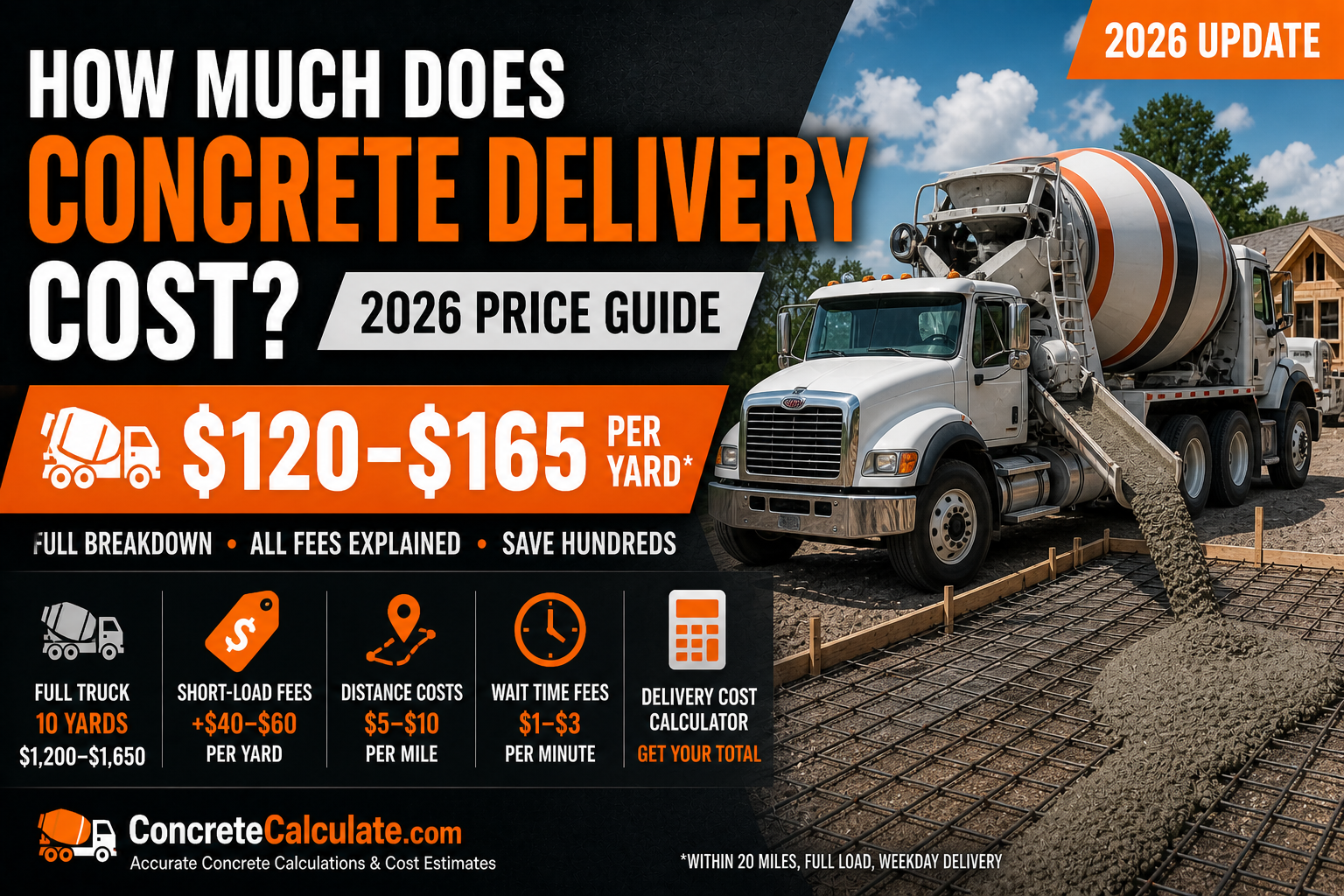
Concrete delivery costs $120 to $165 per cubic yard for a standard ready-mix order in 2026. A full 10-yard truckload runs $1,200 to $1,650 delivered within 20 miles. But the per-yard price is only part of the story. Short-load fees, distance charges, weekend premiums, and standby time can add hundreds to your final bill. This guide breaks down every cost so you know exactly what you’re paying for before the truck shows up.
Concrete Delivery Cost at a Glance
The ready-mix concrete delivery price you see quoted is almost always the base material cost per cubic yard for a full truckload delivered within the plant’s standard radius. Every other fee – distance, short-load, weekend, waiting time – is added on top.
Here is where all the main numbers land in 2026, sourced from supplier data, the National Ready Mixed Concrete Association (NRMCA), and Angi’s contractor cost database:
| Item | 2026 Cost | Notes |
|---|---|---|
| Ready-mix per yard (full load) | $120 – $165/yd | 3,000 PSI, within 20 miles, weekday |
| Full truckload (10 yards) | $1,200 – $1,650 | Best price per yard, no short-load fee |
| Short load (under 10 yards) | +$40 – $60/yd | Added to each yard in a partial load |
| Base delivery fee | $60 – $180/load | Includes 15 to 20 miles from plant |
| Distance over radius | $5 – $10/mile | Per mile beyond the included radius |
| Saturday delivery | +$50 – $125/load | Some plants charge double the weekday fee |
| Fuel surcharge | $20 – $40/load | Increasingly standard in 2026 |
| Standby/waiting time | $1 – $3/minute | After the allowed 5 to 7 min per yard |
| Pump truck rental | $150 – $750 | Required when truck can’t reach the pour |
Use our concrete delivery cost calculator to combine all variables and get a single total estimate before you call suppliers.
Cost by Truck Size: Small Load vs Full Load
The type and size of concrete truck used changes what you pay per yard significantly. There are three main truck types in residential and light commercial work.
Standard Ready-Mix Drum Truck (10 Yards)
This is the truck most homeowners picture – a rotating drum mixer that arrives pre-loaded from the batch plant. It holds 10 cubic yards (sometimes up to 11), which is enough to pour approximately 400 to 600 square feet of concrete at 4 to 6 inches thick.
A full 10-yard load is where you get the best price. No short-load fees. No penalties. The base price of $120 to $165 per yard applies in full. On a 10-yard order, your concrete material cost alone runs $1,200 to $1,650, plus any delivery fees. Use our ready-mix truck calculator to confirm how many yards your project needs before you order.
Mini Ready-Mix Truck (4 to 6 Yards)
Mini trucks are available from some suppliers and designed for residential projects with tight access – narrow driveways, backyard pours, or low-clearance gates that a standard 30-foot drum truck can’t navigate. They hold 4 to 6 cubic yards.
Mini trucks cost more per yard than standard trucks – usually $145 to $190 per yard before short-load fees – because the operational cost of the smaller vehicle is less efficient to run. If you need a mini truck, ask suppliers about it explicitly; not all plants operate them.
Volumetric Mixer (On-Site Mixing)
A volumetric mixer carries dry concrete ingredients and water separately, mixing fresh concrete on-site to order. This eliminates the 90-minute delivery window constraint and lets you control exactly how much is mixed.
Volumetric mixers cost $25 per cubic yard more than a standard ready-mix truck on average, per Angi’s cost data. The premium is worth it for difficult sites, small projects needing precise quantities, or multi-hour pours where timing matters. Some suppliers charge a flat service fee of $60 to $110 per trip instead of a per-yard premium.
💼 Side-by-Side: 5-Yard Pour – Three Truck Options
Standard ready-mix truck at $145/yd + short-load fee ($50/yd x 5 yards short = $250): 5 x $145 + $250 = $975 total
Mini truck at $175/yd (no short-load fee): 5 x $175 = $875 total
Volumetric mixer at $170/yd (no short-load fee, no minimum): 5 x $170 = $850 total
Lesson: For 5-yard orders, the mini or volumetric truck often beats the standard truck once you factor in the short-load fee. Always ask for all three options when your order is under 8 yards.
Short-Load Fees Explained
Short-load fees are the most misunderstood cost on a concrete delivery bill. They are the reason small projects pay dramatically more per yard than large ones – and they can blow up your budget if you don’t plan for them.
What Is a Short-Load Fee?
When you order less than a full truckload, the plant still has to start up equipment, dedicate a mixer, send out a driver, and clean the truck afterward. Those fixed costs don’t shrink just because the load is small. The short-load fee compensates the supplier for running a truck below capacity.
In 2026, short-load fees run $40 to $60 per cubic yard for the “missing” concrete on most standard drum trucks. Some plants charge a flat fee of $150 to $350 per delivery instead. Always ask which structure applies before you order.
When Short-Load Fees Apply
Most suppliers set their full-load threshold at 9 to 10 cubic yards. If you order 7 yards, you are 3 yards short of a full load. At $50 per short yard, that is $150 extra added to your bill – on top of the base cost of the concrete you actually ordered.
Some plants set lower thresholds, particularly for small residential accounts. Thresholds can drop to 5 or 6 yards at some regional suppliers. During slow winter months, some plants waive short-load fees entirely to keep trucks running. Always ask explicitly.
How Short-Load Fees Change Your Effective Price Per Yard
| Order Size | Base Price/yd | Short-Load Fee | Effective Cost/yd | Total Delivered |
|---|---|---|---|---|
| 10 yards (full) | $145 | None | $145/yd | $1,450 |
| 8 yards | $145 | +$50 x 2 short = $100 | $157.50/yd | $1,260 |
| 5 yards | $145 | +$50 x 5 short = $250 | $195/yd | $975 |
| 3 yards | $145 | +$50 x 7 short = $350 | $261/yd | $785 |
| 1 yard | $145 | Flat fee ~$250 | $395/yd | $395 |
A 3-yard order costs nearly twice as much per yard as a 10-yard order at the same plant. If your project needs 8 or 9 yards, strongly consider sizing up to hit the full-load threshold. Adding a small walkway, a curb extension, or extra footings to get to 10 yards costs far less than the short-load penalty on the yards you’re already ordering.
🚚 Calculate Your Exact Delivery Cost
Enter your cubic yards, distance from the plant, and delivery day to get a full cost breakdown including all fees.
Concrete Delivery Cost by Distance
Concrete has a hard time limit. Once it’s mixed at the plant, you have roughly 90 minutes before it starts to set in the truck. That biological clock drives the entire distance pricing structure in the ready-mix industry.
The Standard Delivery Radius
Most ready-mix plants include delivery within 15 to 20 miles in their base price. Within that radius, you pay the quoted per-yard rate plus the standard delivery fee – no distance surcharge. The free radius varies by plant and market. Some urban suppliers with short drive times include only 10 miles. Rural plants with less traffic may include 25 miles.
Always ask the plant: “What is your free delivery radius?” before you compare quotes. Two suppliers quoting the same per-yard price with different radius policies can result in very different total bills for a site near the edge of their service zone.
Beyond the Free Radius: $5 to $10 Per Mile
Once you cross the plant’s radius, most suppliers charge $5 to $10 per additional mile, per Angi’s 2026 pricing data. A site 30 miles from a plant with a 20-mile radius adds $50 to $100 in distance charges. A site 40 miles out adds $100 to $200.
Some suppliers express this differently – a per-yard fee for distance rather than a per-mile charge. Ask for the total delivered price to your specific address to compare apples to apples.
Maximum Delivery Range
Most plants will not deliver beyond 45 to 60 minutes of drive time from the batch plant, because the concrete would begin setting during transport. In practice, that is 30 to 45 miles in normal traffic conditions. If your site is remote, you may have limited supplier options – and those suppliers may charge a premium knowing you have few alternatives.
💼 Distance Cost Example: 10-Yard Pour, Chicago Suburb
Plant A, 12 miles away: $148/yd + $70 delivery = $1,550 total (within free radius)
Plant B, 28 miles away: $140/yd + $70 delivery + $80 distance fee (8 miles over) = $1,550 total
Plant C, 35 miles away: $135/yd + $80 delivery + $150 distance fee (15 miles over) = $1,580 total
Lesson: The cheapest quoted per-yard price is not always the cheapest delivered price. Always ask for the total-to-your-address figure before choosing a supplier.
Every Fee on a Concrete Delivery Bill
Here is a complete list of charges you may see on a concrete delivery invoice in 2026. Most homeowners are surprised by at least one or two of these.
When calling suppliers, ask: “What is the total delivered price to my address for X cubic yards of Y PSI concrete on a weekday?” That one question forces them to include base price, delivery fee, distance charge, fuel surcharge, and any minimum order adjustments in a single number – so you can compare suppliers accurately. Then verify if your expected pour volume crosses the short-load threshold.
How PSI Strength Affects Delivery Cost
PSI is a major cost variable that most homeowners forget to factor in when budgeting for concrete delivery.
Standard 3,000 PSI residential concrete costs $120 to $150 per yard in most US markets in 2026. Upgrading to 4,000 PSI – recommended for driveways, garage floors, and any exterior concrete in freeze-thaw climates – adds $10 to $25 per yard. High-strength 5,000 PSI concrete for commercial applications adds $15 to $30 per yard over the 3,000 PSI baseline.
| PSI Grade | Cost Per Yard (2026) | Common Uses |
|---|---|---|
| 2,500 PSI | $110 – $135 | Sidewalks, light-duty pads |
| 3,000 PSI | $120 – $150 | Patios, slabs, mild-climate driveways |
| 3,500 PSI | $130 – $158 | Better residential standard, foundations |
| 4,000 PSI | $140 – $165 | Driveways, garage floors, cold climates |
| 5,000 PSI | $155 – $175 | Heavy commercial, structural elements |
Air entrainment – mandatory for freeze-thaw resistance in northern states – adds $3 to $6 per yard on top of the base PSI price. Fiber reinforcement adds $5 to $10 per yard. Color pigments add $20 to $80 per yard depending on the shade and intensity. See our concrete price per yard calculator for current pricing by PSI and region.
Ordering 3,000 PSI instead of 4,000 PSI for a driveway in a freeze-thaw climate might save $10 to $25 per yard on delivery. On a 7-yard driveway pour, that’s $70 to $175 in savings. The cost of replacing a driveway that fails in year 3 due to wrong PSI is $4,000 to $12,000. Specify the right strength for your application and save the cost-cutting for elsewhere. See our ready-mix concrete cost guide for full PSI pricing and recommendations.
Bagged Concrete vs Ready-Mix Delivery: Which Is Cheaper?
For very small jobs, bagged concrete from a home improvement store can actually be more cost-effective than a ready-mix delivery – once short-load fees are factored in.
When Bagged Concrete Wins
An 80-pound bag of standard concrete mix costs $5 to $6.50 and yields about 0.6 cubic feet. You need 45 bags to make one cubic yard, putting material cost at $225 to $290 per yard. That’s more expensive than ready-mix on paper.
But add a $250 short-load fee to a 1-yard ready-mix order and your total cost is $145 (concrete) + $250 (fee) = $395 for 1 yard. Compare that to 45 bags at $6 each = $270 in material, plus your own labor to mix them. For projects under 0.75 cubic yards, bagged concrete is almost always the better choice. Use our concrete yards to bags calculator to find the crossover point for your specific project.
When Ready-Mix Delivery Wins
For anything over 1 cubic yard, ready-mix almost always wins on total cost once you factor in the labor and time of mixing bags yourself. A 5-yard pour would require 225 bags – roughly 9 tons of material to mix by hand. At that volume, even with a short-load fee, ready-mix delivered to your site is significantly cheaper in time and labor cost.
The break-even point for most homeowners is around 0.75 to 1.0 cubic yard. Below that: buy bags. Above that: call a ready-mix supplier and accept the short-load fee if applicable. Use the ready-mix bags calculator to compare material costs side by side.
How to Reduce Your Concrete Delivery Cost
There are five reliable ways to cut concrete delivery cost without compromising quality.
1. Hit the Full-Load Threshold
The single biggest money-saver is eliminating the short-load fee. If you need 8 yards, order 10. Use the extra 2 yards for a walkway extension, stepping stones, a small pad, or garden borders. The cost of the extra concrete is almost always less than the short-load penalty on the yards you were already ordering.
If you genuinely cannot use extra concrete, coordinate with a neighbor who also needs a small pour. Combining orders in the same neighborhood on the same day can get both of you to a full load and split the delivery fee.
2. Schedule Weekday Deliveries
Tuesday through Thursday morning deliveries are the cheapest slot at most plants. You avoid the $50 to $125 Saturday premium, you get more scheduling flexibility, and crews are more rested and reliable mid-week. If taking a weekday off from work costs less than the weekend surcharge, it pays to schedule accordingly.
3. Choose a Supplier Within the Free Radius
Distance fees of $5 to $10 per mile add up fast. For a site 30 miles from a plant with a 20-mile free zone, that’s $50 to $100 before you pour a drop. Use our delivery cost calculator to compare total-to-site cost from multiple suppliers, not just the base per-yard price. Sometimes the supplier with the higher per-yard quote is cheaper delivered because their plant is closer to you.
4. Have Your Site Fully Ready Before the Truck Arrives
Ready-mix suppliers charge $1 to $3 per minute for standby time after the allotted unload window. A 10-yard truck gives you 50 to 70 minutes of unloading time. If your crew isn’t ready – forms aren’t set, rebar isn’t placed, or there’s a dispute about the pour location – the meter runs. On a 30-minute delay, you’re looking at $30 to $90 in standby charges, plus a stressed driver who may need to cut the pour short to protect the remaining concrete.
5. Get Three Supplier Quotes With All Fees Included
Ready-mix pricing varies 15 to 30 percent between suppliers in the same market. Call at least three plants and ask for their total delivered price to your address including all fees. Use our concrete project estimator to build a complete budget before reaching out to suppliers, so you know exactly what questions to ask and what a fair bid looks like.
🎯 Key Takeaways: Concrete Delivery Cost 2026
- Ready-mix concrete costs $120 to $165 per cubic yard delivered in 2026 for a full 10-yard load within 20 miles
- A full 10-yard truckload runs $1,200 to $1,650 – the best per-yard price available
- Short-load fees add $40 to $60 per yard for orders under 10 yards, dramatically increasing effective cost per yard on small orders
- Distance fees of $5 to $10 per mile apply beyond the plant’s free delivery radius of 15 to 20 miles
- Saturday delivery adds $50 to $125 per load – schedule weekday pours to avoid this
- Standby time charges of $1 to $3 per minute kick in after the allotted unload window – have your site ready before the truck arrives
- Fuel surcharges of $20 to $40 per load are now standard at most US suppliers in 2026
- Pump trucks cost $150 to $750 extra and are needed when the delivery truck can’t access the pour location
- 4,000 PSI costs $10 to $25 more per yard than 3,000 PSI – always worth the upgrade for driveways and cold climates
- For projects under 0.75 cubic yards, bagged concrete is usually cheaper than ready-mix with a short-load fee
- Always get three total-delivered-price quotes from local suppliers before ordering
Frequently Asked Questions
🧮 Know Your Numbers Before You Order
Use our free calculators to get volume, yardage, and total delivery cost estimates before calling a single supplier.
🚚 Related Calculators
- → Concrete Delivery Cost Calculator – Full cost breakdown including base price, short-load fees, distance, and surcharges
- → Ready-Mix Truck Calculator – How many yards your project needs and which truck size fits best
- → Concrete Yardage Calculator – Cubic yard estimates to plan your order and avoid short-load fees
- → Concrete Volume Calculator – Precise volume for any shape and thickness
- → Concrete Cost Calculator – Material and delivery cost combined in one estimate
- → Concrete Price Per Yard Calculator – Current regional ready-mix pricing by PSI
- → Concrete Cost Per Square Foot Calculator – Per-square-foot pricing including delivery
- → Ready-Mix Bags Calculator – Compare bags vs delivery cost for small projects
- → Yards to Bags Calculator – Find the break-even point between bagged and delivered concrete
- → Gravel Calculator – Base material cost for your project footprint
- → Base Material Calculator – Sub-grade fill estimates before the pour
- → Concrete Project Estimator – Full project cost from volume through delivery to total installed
📚 Related Guides
- → Ready-Mix Concrete Cost Per Yard Guide – Full pricing breakdown by PSI, region, and order size
- → How to Calculate Concrete – Volume, mix ratios, and material quantity formulas
- → Concrete Mixing Instructions – When to mix your own vs order ready-mix