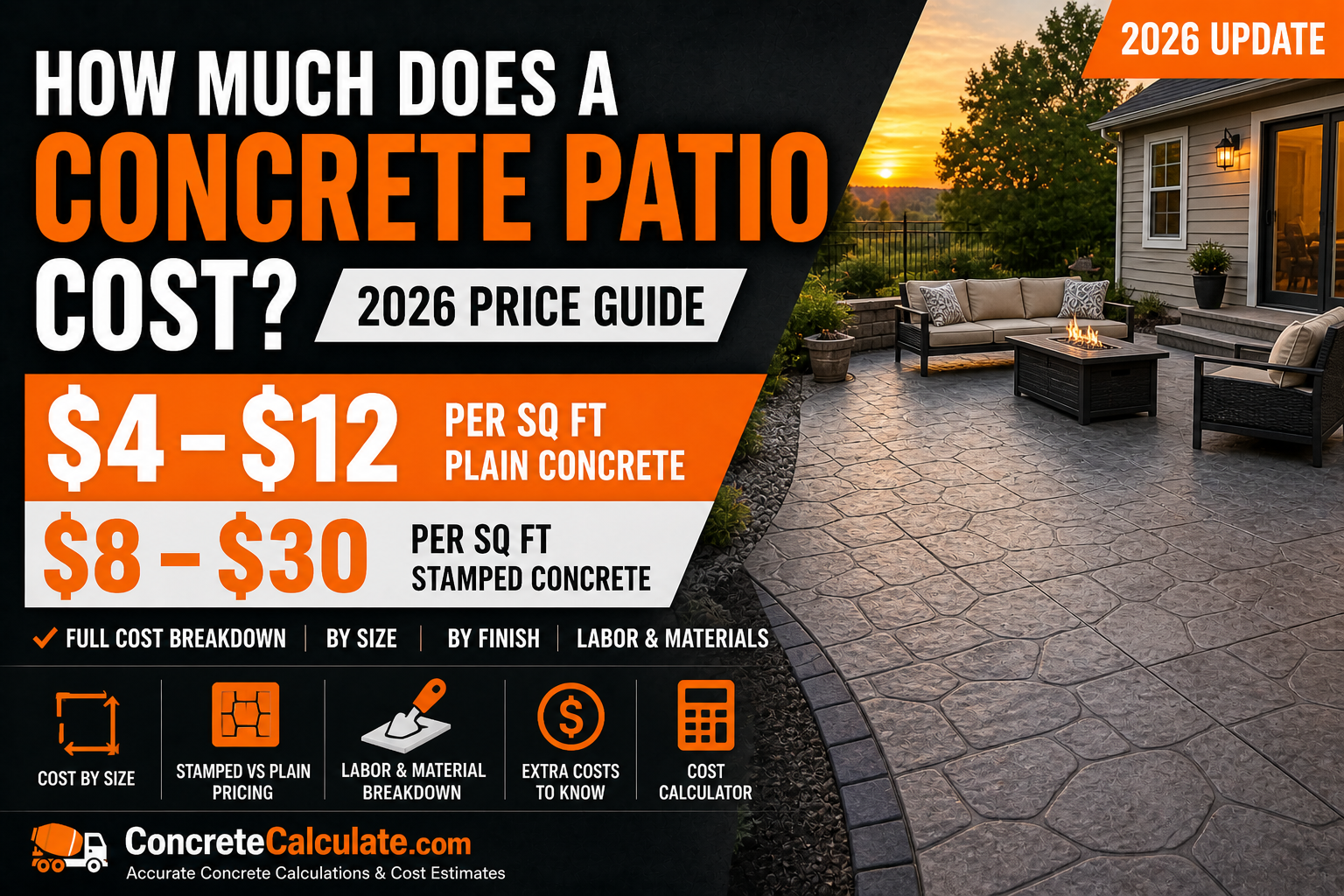
A concrete patio costs $4 to $12 per square foot installed for plain concrete in 2026, or $8 to $30 per square foot for stamped or decorative finishes. The national average project cost runs $2,925, with most homeowners paying between $1,580 and $4,465 total, according to LawnLove and HomeGuide cost data. This guide gives you a complete concrete patio cost breakdown by size, finish type, labor, and materials so you can budget accurately and compare contractor quotes with confidence.
2026 Concrete Patio Cost at a Glance
Concrete is one of the most cost-effective patio materials available. A basic broom-finish patio starts around $4 per square foot in low-cost markets and averages $8 to $10 per square foot nationally for a professional installation in 2026. That puts a small 100 sq ft patio at $400 to $1,200 and a medium 400 sq ft patio at $1,600 to $4,800.
Stamped and decorative concrete pushes prices higher – typically $8 to $25 per square foot, with complex multi-color designs in high-cost markets reaching $30 or more. Regardless of finish, the concrete patio price estimate will also shift based on your site conditions, local labor rates, and whether you need old concrete removed first.
| Patio Type | Cost per Sq Ft | 200 Sq Ft Total | 400 Sq Ft Total |
|---|---|---|---|
| Basic broom finish | $4–$8 | $800–$1,600 | $1,600–$3,200 |
| Standard reinforced | $7–$12 | $1,400–$2,400 | $2,800–$4,800 |
| Exposed aggregate | $8–$14 | $1,600–$2,800 | $3,200–$5,600 |
| Stamped concrete | $12–$25 | $2,400–$5,000 | $4,800–$10,000 |
| Colored or stained | $8–$18 | $1,600–$3,600 | $3,200–$7,200 |
| Custom stamped + color | $18–$30+ | $3,600–$6,000+ | $7,200–$12,000+ |
Costs in the continental US vary significantly. The Midwest and Southeast typically land in the lower half of each range. The Northeast, Pacific Coast, and high-cost metros like Boston, Seattle, and Los Angeles run 20 to 35% above the national average. Hawaii and Alaska can add 25 to 75% on top of all figures listed here.
Cost Per Square Foot Breakdown
The concrete patio cost per square foot reflects two components: materials and labor. Together they determine your total concrete patio installation cost, and understanding each one helps you evaluate bids from multiple contractors.
Materials: $2 to $6 Per Square Foot
Materials cover ready-mix concrete, a compacted gravel base, wire mesh or rebar reinforcement, forming lumber, and any sealer applied after curing. Ready-mix is the largest line item at $125 to $180 per cubic yard delivered nationally in 2026. A standard 200 sq ft patio at 4 inches uses about 2.5 cubic yards of concrete – a material cost of around $315 to $450 for just the ready-mix.
Use the concrete yardage calculator to find your exact cubic yards, or the concrete cost calculator to get a direct material cost estimate for your dimensions and thickness.
Labor: $3 to $5 Per Square Foot
Labor makes up 40 to 50% of total concrete patio installation cost. Nationally, concrete flatwork contractors charge $40 to $55 per hour per worker in 2026. A crew of two to three can pour and finish a 200 to 300 sq ft patio in a single day. Larger or decorative patios requiring stamping, coloring, or complex patterns need more crew hours and skilled finishers, which pushes labor cost toward the higher end of the range.
| Cost Component | Cost per Sq Ft | % of Total |
|---|---|---|
| Ready-mix concrete | $1.50–$4.00 | 25–38% |
| Gravel base (4″ compacted) | $0.50–$1.25 | 7–12% |
| Wire mesh or rebar | $0.25–$1.00 | 4–8% |
| Forms and consumables | $0.25–$0.75 | 3–6% |
| Labor (site prep, pour, finish) | $3.00–$5.00 | 40–50% |
| Decorative finish add-on | $3.00–$12.00 | 20–50% extra |
💰 Calculate Your Patio Cost Now
Enter your patio dimensions and get an instant cost estimate including materials, labor, and finish type.
Cost by Patio Size
Patio size drives total project cost more than any other single factor. Larger patios spread fixed costs like mobilization and setup across more square footage, so the per-square-foot price sometimes drops slightly on larger jobs. Here are real-world installed cost ranges by common patio dimensions.
| Patio Size | Square Feet | Plain Concrete | Stamped Concrete | Typical Use |
|---|---|---|---|---|
| 10×10 | 100 | $400–$1,200 | $800–$2,500 | Small seating area, grill pad |
| 12×12 | 144 | $576–$1,728 | $1,150–$3,600 | Dining table for 4, small patio |
| 10×20 | 200 | $800–$2,400 | $1,600–$5,000 | Rectangular outdoor dining area |
| 16×16 | 256 | $1,025–$3,000 | $2,050–$6,400 | Mid-size backyard entertaining |
| 20×20 | 400 | $1,600–$4,800 | $3,200–$10,000 | Full outdoor living area |
| 20×30 | 600 | $2,400–$7,200 | $4,800–$15,000 | Large entertaining + dining space |
| 30×30 | 900 | $3,600–$10,800 | $7,200–$22,500 | Pool deck, large outdoor room |
💼 Real-World Example: 20×20 Backyard Patio
Dimensions: 20 ft x 20 ft = 400 sq ft
Thickness: 4 inches standard
Concrete volume: 400 x 0.33 / 27 = 4.9 cubic yards
Ready-mix (at $155/yd + delivery): approx. $910
Gravel base + mesh + forms: approx. $450
Labor (400 sq ft at $4/sq ft): approx. $1,600
Broom-finish total estimate: $2,960 to $3,800
With stamped concrete add-on ($8/sq ft): $2,960 + $3,200 = $6,160+
Use the patio cost calculator to run your exact numbers in seconds.
Concrete Patio Labor Cost
Labor is the most variable part of any backyard concrete patio cost. Rates differ by region, crew experience, and project complexity. On a plain broom-finish patio, labor runs $3 to $5 per square foot. On a stamped patio with integral color, border patterns, and multiple stamps, labor can hit $8 to $12 per square foot.
What Labor Covers on a Patio Job
- Site clearing and grading – removing sod, leveling the subgrade, addressing low spots
- Gravel base placement – installing and compacting 4 inches of crushed stone
- Forming – setting perimeter forms to shape the slab edge
- Reinforcement placement – laying wire mesh or rebar before the pour
- Concrete placement and screeding – pouring from the truck or pump and leveling
- Finishing – broom texture, troweling, stamping, edging, and joint cutting
- Curing and cleanup – applying curing compound and removing forms after hardening
Stamped patios add 1 to 3 hours of labor per 100 sq ft because stamping requires working quickly while the concrete is at the right consistency and applying release agent before each stamp impression. Mistakes at that stage are not fixable, so experienced contractors charge accordingly.
Some patio quotes exclude gravel base prep, control joint cutting, or haul-away of excavated material. These are not optional steps. Ask any contractor to give you a written scope covering site prep, base, forms, pour, finish, and cleanup. A quote that skips any of those items will add them back as extras mid-project.
Materials Cost Breakdown
Materials account for 50 to 60% of a standard patio installation. Here is what each component costs in 2026.
Ready-Mix Concrete
Ready-mix runs $125 to $180 per cubic yard delivered nationally in 2026. A 20×20 patio at 4 inches needs 4.9 cubic yards – a material cost of $612 to $882 before delivery charges. Most ready-mix suppliers add $75 to $200 for short loads under 8 cubic yards. Track your exact volume and delivery cost using the concrete price per yard calculator and the concrete delivery cost calculator.
Gravel Subbase
Patios need a 4-inch compacted gravel base to prevent settling and improve drainage. Gravel costs $25 to $65 per cubic yard delivered. A 20×20 patio needs about 5 cubic yards of gravel, adding $125 to $325 in materials. Use the gravel calculator or the base material calculator to size your subbase before ordering.
Reinforcement
Wire mesh (6×6 W1.4xW1.4) costs $0.12 to $0.25 per square foot. A 400 sq ft patio uses $48 to $100 worth of mesh. Rebar is better for larger or load-bearing patios – #4 rebar runs $0.40 to $0.65 per linear foot. Review how to calculate concrete quantities for a full materials breakdown before you order.
Integral Color or Stamps
Integral color powder added to the ready-mix before pouring runs $30 to $75 per cubic yard as a material surcharge – adding $150 to $370 on a 5-yard patio pour. Stamping mats are typically supplied by the contractor. Surface hardeners and color release agents for stamped work add $0.25 to $0.75 per square foot in additional materials.
Stamped vs Plain Concrete Patio Cost
The finish you choose is the second-biggest variable in your patio cost breakdown. Here is a clear side-by-side look at every common option with real 2026 installed prices.
Plain Broom Finish
The most affordable option. A broom is drawn across the surface before the concrete sets to create a slip-resistant texture. No decorative add-ons, minimal extra labor. Total installed cost: $4 to $8 per square foot. Durable, low-maintenance, and appropriate for any climate. The only drawback is plain gray appearance.
Exposed Aggregate
Contractors wash away the surface cement paste after placement to reveal decorative stones or pea gravel. It adds $1 to $3 per square foot over a broom finish. Total installed: $7 to $14 per square foot. It is naturally slip-resistant and hides wear better than plain gray concrete.
Stamped Concrete
Rubber stamp molds pressed into fresh concrete create patterns that mimic stone, brick, flagstone, or wood. Combined with integral color or surface coloring, stamped concrete delivers a premium outdoor look. Total installed cost: $12 to $25 per square foot, with complex custom designs reaching $30 or more. A stamped 20×20 patio averages $4,800 to $10,000.
One important note: stamped concrete patios need resealing every 2 to 5 years to maintain color and surface protection. Resealing costs $0.50 to $2.50 per square foot per application, or $200 to $1,000 for a 400 sq ft patio. Budget for this ongoing cost when comparing finishes. Read our guide on how to finish concrete for a full walkthrough of each finishing method.
Acid Stained or Dyed Concrete
Applying acid stain or dye to cured concrete creates rich, marbled color effects. Acid staining costs $2 to $5 per square foot applied, and dyes cost $1 to $3 per square foot. Combined with a plain base pour, stained patios run $7 to $18 per square foot total installed.
| Finish Type | Added Cost | Total Installed | Resealing Needed |
|---|---|---|---|
| Broom finish | None | $4–$8/sq ft | Every 5–10 years |
| Exposed aggregate | +$1–$3/sq ft | $7–$14/sq ft | Every 5 years |
| Salt finish | +$0.50–$1.50/sq ft | $6–$10/sq ft | Every 5 years |
| Integral color only | +$2–$4/sq ft | $8–$14/sq ft | Every 3–5 years |
| Acid stain | +$2–$5/sq ft | $7–$15/sq ft | Every 3–5 years |
| Stamped concrete | +$5–$15/sq ft | $12–$25/sq ft | Every 2–5 years |
| Stamped + custom color | +$12–$22/sq ft | $18–$30+/sq ft | Every 2–3 years |
🎨 Price Your Finish Type
Compare plain vs stamped costs side by side for your exact patio dimensions using our free calculators.
How Thickness Affects Patio Cost
Most residential patios are poured at 4 inches thick, which is the standard for foot traffic, outdoor furniture, and light use. Going thicker adds concrete volume and material cost without benefit for most patio applications.
Use the concrete thickness calculator to see exactly how changing thickness affects cubic yard requirements and total cost for your specific dimensions.
| Thickness | Best Application | Cost per Sq Ft | Added Cost vs 4″ |
|---|---|---|---|
| 3.5 inches | Walkways only (not patios) | $4–$7 | Save $0.50–$1.00 |
| 4 inches | Standard patio – foot traffic + furniture | $6–$12 | Baseline |
| 5 inches | Heavy planters, outdoor kitchens | $7–$13 | +$0.75–$1.50/sq ft |
| 6 inches | Hot tub or spa pads, heavy loads | $8–$15 | +$1.50–$3.00/sq ft |
Extra Costs to Know About
Several common costs are frequently left out of initial patio quotes. Knowing them before you get bids prevents unexpected invoice additions later.
- Old concrete removal: $1 to $3 per square foot, plus $200 to $500 haul-away. Always ask if demo is included in the base bid.
- Permits: $50 to $300 for most residential patio projects. Requirements vary by city and county – your contractor should pull the permit, but the cost is typically passed to you.
- Grading or drainage work: $500 to $2,500 if your yard has significant slope, standing water issues, or soft spots that need correction before the base can be set.
- Tree root removal: $100 to $800 depending on root size and volume. Roots left under a slab cause cracking and heaving within a few years.
- Sealing: $0.50 to $2.50 per square foot for an initial professional seal coat. Often excluded from base quotes but protects the surface and extends slab life.
- Stairs or steps: Concrete steps leading up to the patio add $150 to $300 per step installed, depending on width and configuration.
- Concrete delivery short-load fee: $75 to $200 if your patio needs fewer than 8 cubic yards. Most 10×10 to 16×16 patios fall below the full-load threshold.
DIY vs Professional Patio Cost
A DIY concrete patio saves 35 to 50% on labor costs but requires equipment rentals, physical effort, and good technique to avoid costly mistakes. For small patios under 150 sq ft, DIY is practical. Above that threshold, the risks of poor finishing, low spots, or premature cracking increase significantly without an experienced crew.
| Factor | DIY | Professional |
|---|---|---|
| Labor cost | $0 (your time) | $3–$5 per sq ft |
| Equipment rental | $150–$600 (screed, trowel, mixer) | Included in quote |
| Materials cost | Same as professional | Same as DIY |
| Stamped finish option | Difficult – timing is critical | Fully available |
| Finish quality risk | High without experience | Low (experienced crew) |
| Best for | Plain slabs under 150 sq ft | Any size, any finish |
| Typical savings | 35–50% on labor | None (but no skill risk) |
Read the full how to calculate concrete guide to size your order correctly, and review how to finish concrete before your pour day. Ordering too little concrete for a patio is one of the most common and frustrating DIY mistakes – the ready-mix truck will not make a second trip for a partial load without a short-load surcharge.
How to Save on Your Concrete Patio
These strategies reduce your concrete patio cost without cutting corners on the finished result.
- Get three or more quotes. Concrete patio pricing varies 20 to 40% between contractors in the same market. Never accept the first number you receive.
- Skip decorative work on a tight budget. A broom-finish patio costs $4 to $8 less per square foot than stamped. You can always resurface or stain an existing slab later at lower cost than a full decorative pour now.
- Do your own site prep. Clearing sod, removing roots, and rough grading saves $200 to $600 on most patio jobs. Contractors price this as labor and it is usually the easiest scope to handle yourself.
- Combine with other concrete work. Getting a driveway, walkway, or steps poured in the same visit reduces per-yard pricing because the truck visit and crew mobilization are shared.
- Book in the off-season. Late fall and winter (in mild climates) bring lower contractor demand and sometimes 10 to 15% rate reductions versus the spring peak.
- Know your volume before calling. Run your dimensions through the concrete volume calculator and the ready-mix bags calculator first. Contractors price more accurately – and tend to pad less – when clients already know their cubic yards.
- Use the right concrete grade. A residential patio in a frost-free area does not need 4000 PSI. Match the mix to the application to avoid paying for unnecessary strength. In northern states where freeze-thaw cycles occur, 4000 PSI is the ACI 318 recommendation for exterior concrete – and worth the $15 to $20 per yard premium.
🎯 Key Takeaways: Concrete Patio Cost 2026
- Plain concrete patios cost $4 to $12 per square foot installed; stamped concrete runs $8 to $30 per square foot
- The national average patio project cost is $2,925, with most homeowners spending $1,580 to $4,465 total
- A 10×10 patio costs $400 to $1,200 plain; a 20×20 costs $1,600 to $4,800 plain or up to $10,000 stamped
- Labor makes up 40 to 50% of total cost – about $3 to $5 per square foot nationally
- Ready-mix concrete costs $125 to $180 per cubic yard delivered nationally in 2026
- Stamped patios require resealing every 2 to 5 years – factor in $200 to $1,000 per application for a 400 sq ft patio
- 4 inches is the standard thickness for residential patios – going thicker only makes sense for heavy load applications
- Old concrete removal, permits, and sealing are commonly excluded from base quotes
- DIY saves 35 to 50% on labor for simple slabs but carries significant risk on larger or decorative pours
- Get at least three contractor quotes – pricing for identical work varies 20 to 40% in the same market
Frequently Asked Questions
🔧 Get Your Patio Numbers Before You Call Anyone
Use our full calculator suite to size your patio, estimate material volume, and build a solid project budget before you talk to a single contractor.
🛠️ Concrete Patio Calculators
- → Concrete Patio Cost Calculator – Full installed cost by patio size and finish type
- → Concrete Patio Calculator – Volume in cubic yards for any patio dimensions
- → Concrete Slab Calculator – General slab volume for any flat project
- → Concrete Cost Calculator – Fast material cost estimate
- → Cost Per Square Foot Calculator – Per-sq-ft pricing breakdown
- → Concrete Price Per Yard Calculator – Ready-mix cost by cubic yard
- → Concrete Delivery Cost Calculator – Short-load fees and delivery charges
- → Concrete Yardage Calculator – Cubic yards for any slab dimensions
- → Concrete Volume Calculator – Precise volume in cubic feet or yards
- → Concrete Thickness Calculator – See how thickness changes volume and cost
- → Ready-Mix Bags Calculator – Bag count for small DIY pours
- → Gravel Calculator – Size your compacted subbase layer
- → Base Material Calculator – Full base volume for your patio footprint
📚 Related Guides
- → How to Calculate Concrete – Volume formulas and sizing your project
- → How to Finish Concrete – Broom, trowel, stamped, and exposed aggregate methods
- → Concrete vs Asphalt Driveways – Material cost and performance comparison
Related Articles

-
How to Finish Concrete Like a Pro (Step by Step Guide) 2026February 19, 2026