Bolt Grade Chart 2026 – SAE, Metric & ASTM Guide
Bolt Grade Chart
SAE, Metric & ASTM Guide
Complete bolt grade reference for engineers and contractors — SAE Grade 2/5/8, metric property classes, ASTM structural bolts, head markings, and selection guidance.
 Reviewed by Muhammad Ramzan Babar, PhD Researcher (Plasma Physics) & Calculator Developer — View Profile
Important: Engineering Reference Only
This page summarizes commonly used bolt grades and general engineering concepts for planning purposes. It is not a substitute for manufacturer specifications, ASTM/SAE/ISO standards, or a licensed engineer’s design final fastener selection must always be verified against the applicable specification and application requirements.
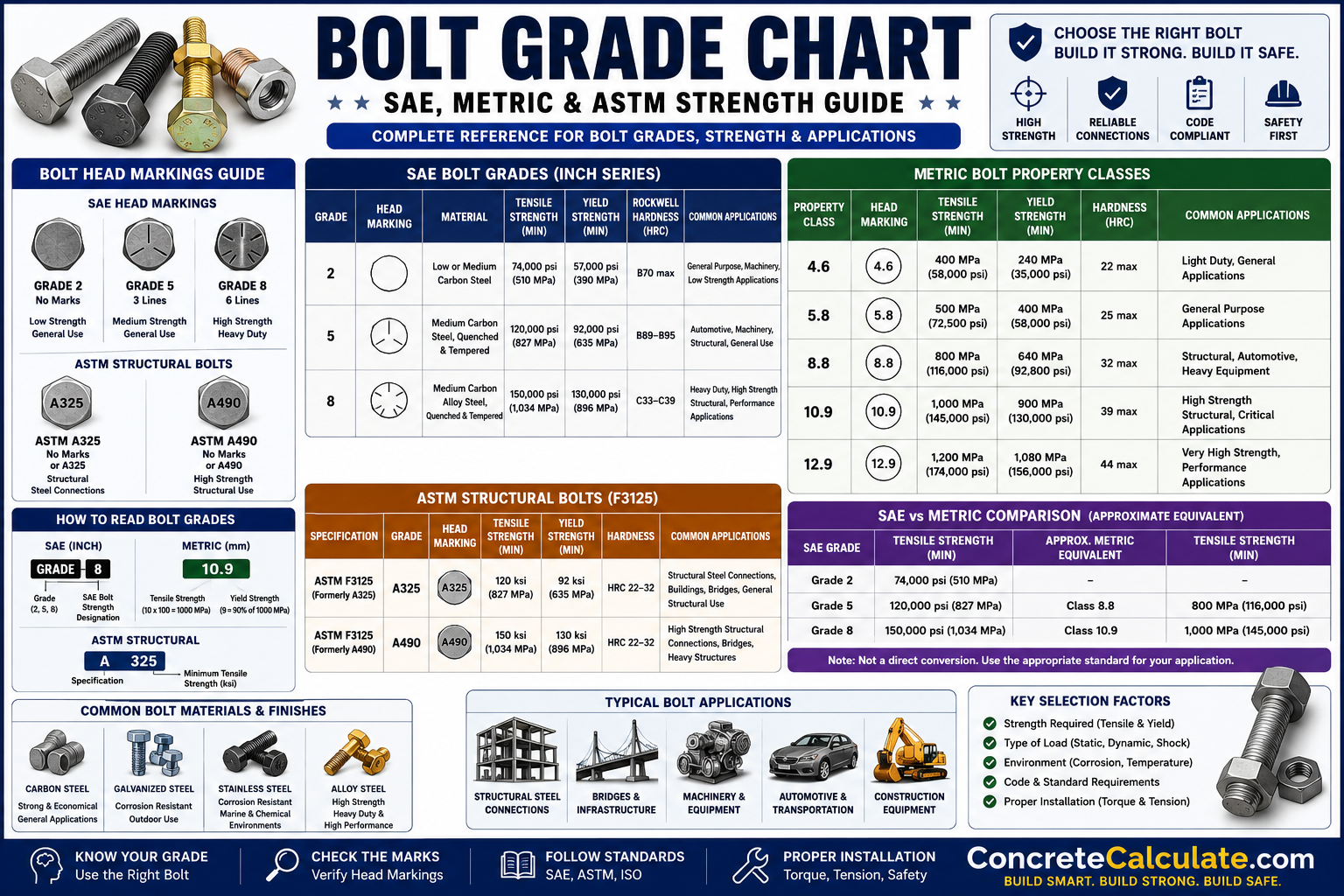
⭐ Master Bolt Grade Chart
Complete overview comparing SAE, metric, and ASTM bolt grades by strength class, head marking, and typical use.
How to Read This Chart
Bolt grade defines material strength, not size — a Grade 8 bolt and a Grade 2 bolt of the same diameter are interchangeable dimensionally but not structurally. Once you’ve identified the right grade, verify installation with our Anchor Bolt Calculator and Base Plate Calculator.
| System | Common Grades/Classes | Head Marking Style | Approx. Tensile Range | Typical Applications |
|---|---|---|---|---|
| SAE (Inch) | Grade 2, 5, 8 | Radial lines (0, 3, 6) | 74,000–150,000 psi | General hardware, automotive, machinery |
| Metric (ISO 898-1) | 4.6, 4.8, 5.8, 8.8, 9.8, 10.9, 12.9 | Stamped class number | 400–1,220 MPa | General hardware, automotive, machinery worldwide |
| ASTM Structural (F3125) | A325, A490 | Stamped “A325” or “A490” | 120,000–150,000 psi | Structural steel connections, bridges |
| Stainless Steel (ISO 3506) | A2-70, A4-80 | Stamped A2/A4 + class | 700–800 MPa | Corrosive, marine, outdoor environments |
⭐ SAE Bolt Grade Chart
One of the highest-volume search topics — SAE J429 inch-series bolt grades used across North America.
| SAE Grade | Head Marking | Tensile Strength | Yield Strength | Typical Applications |
|---|---|---|---|---|
| Grade 2 | No markings | 74,000 psi | 57,000 psi | Light-duty hardware, non-structural fastening |
| Grade 5 | 3 radial lines | 120,000 psi | 92,000 psi | General automotive and industrial hardware |
| Grade 8 | 6 radial lines | 150,000 psi | 130,000 psi | High-strength structural and machinery applications |
Grade 5 values shown apply to bolt diameters ¼” through 1″; strength ratings step down slightly for larger diameters up to 1½” under SAE J429.
⭐ Metric Bolt Grade Chart
ISO 898-1 property classes used throughout most of the world outside North America.
| Property Class | Tensile Strength | Yield Strength | Common Uses |
|---|---|---|---|
| 4.6 | 400 MPa | 240 MPa | Low-strength general hardware |
| 4.8 | 420 MPa | 340 MPa | Light-duty fasteners |
| 5.8 | 520 MPa | 420 MPa | General-purpose hardware, furniture, brackets |
| 8.8 | 800 MPa | 640 MPa | Standard structural and automotive grade |
| 9.8 | 900 MPa | 720 MPa | Higher-strength general hardware |
| 10.9 | 1,040 MPa | 940 MPa | High-strength structural, automotive, machinery |
| 12.9 | 1,220 MPa | 1,100 MPa | Highest common strength, precision machinery |
Decoding the Numbers
In a metric class like 10.9, the first number × 100 gives approximate tensile strength in MPa (10 × 100 = 1,000 MPa), and the second number ÷ 10 gives the yield-to-tensile ratio (9 ÷ 10 = 90%, so yield ≈ 900 MPa).
⭐ ASTM Structural Bolt Grade Chart
Specifications used for certified structural steel connections in buildings and bridges.
| Specification | Min. Tensile Strength | Common Use |
|---|---|---|
| ASTM A307 | 60,000 psi (415 MPa) | Non-structural or lightly loaded connections, anchor bolts |
| ASTM F3125 Grade A325 | 120,000 psi (830 MPa) | Standard high-strength structural steel connections |
| ASTM F3125 Grade A490 | 150,000 psi (1,040 MPa) | Higher-capacity structural connections, constrained geometry |
| ASTM A449 | 120,000–105,000 psi (varies by size) | General high-strength bolts not covered by A325/A490 scope |
| ASTM A354 Grade BD | 150,000 psi (1,040 MPa) | High-strength anchor bolts and studs |
ASTM A325 and A490 have been consolidated under the umbrella specification ASTM F3125, which also includes the metric equivalents A325M and A490M and twist-off styles F1852/F2280.
⭐ SAE vs Metric Bolt Grade Comparison
A very popular search query — understanding the fundamental differences between the two major bolt systems.
| Factor | SAE (Inch) | Metric |
|---|---|---|
| Numbering System | Grade number (2, 5, 8) with no direct strength formula | Class number directly encodes tensile/yield (e.g., 8.8) |
| Strength | Grade 5 ≈ 120,000 psi; Grade 8 ≈ 150,000 psi | Class 8.8 ≈ 800 MPa; Class 10.9 ≈ 1,040 MPa |
| Dimensions | Inch-based diameters and thread pitch (UNC/UNF) | Millimeter-based diameters and thread pitch (coarse/fine) |
| Common Applications | US automotive, machinery, general hardware | Global automotive, machinery, general hardware |
| Regional Usage | Dominant in the United States | Dominant in most of the rest of the world |
Never Mix Systems on the Same Joint
SAE and metric bolts use different thread forms and pitches — an SAE bolt will not properly thread into a metric nut or tapped hole even if diameters appear similar, and forcing the fit can strip threads or create a dangerously weak connection.
⭐ Grade 2 vs Grade 5 vs Grade 8 Bolt Comparison
The most commonly compared SAE grades, side by side across the properties that matter most for selection.
| Property | Grade 2 | Grade 5 | Grade 8 |
|---|---|---|---|
| Tensile Strength | 74,000 psi | 120,000 psi | 150,000 psi |
| Yield Strength | 57,000 psi | 92,000 psi | 130,000 psi |
| Hardness | Lower | Moderate | Highest |
| Ductility | Highest | Moderate | Lowest of the three |
| Corrosion Resistance | Same base material, coating-dependent | Same base material, coating-dependent | Same base material, coating-dependent |
| Cost | Lowest | Moderate | Highest |
| Typical Applications | Light-duty, non-structural | General automotive, industrial hardware | High-strength structural and machinery use |
Corrosion resistance depends primarily on plating or coating (zinc, galvanized) rather than grade itself — a Grade 8 bolt is not inherently more corrosion-resistant than a Grade 5 bolt of the same finish.
Metric Class 8.8 vs 10.9 vs 12.9
The three most common high-strength metric classes compared directly.
| Property | Class 8.8 | Class 10.9 | Class 12.9 |
|---|---|---|---|
| Tensile Strength | 800 MPa | 1,040 MPa | 1,220 MPa |
| Yield Strength | 640 MPa | 940 MPa | 1,100 MPa |
| Hardness | Moderate (22–32 HRC) | High (32–39 HRC) | Highest (39–44 HRC) |
| Typical Uses | General structural and automotive | High-strength automotive and machinery | Precision machinery, aerospace-adjacent |
| Advantages | Widely available, cost-effective, good ductility | Higher load capacity in smaller sizes | Maximum strength in standard fastener range |
| Limitations | Lower capacity than higher classes | More brittle than 8.8, hydrogen embrittlement risk | Least ductile, most sensitive to embrittlement |
⭐ Bolt Grade by Construction Application
Matching typical project categories to commonly used bolt grades.
| Project | Recommended Bolt Grade |
|---|---|
| Residential Construction | SAE Grade 2–5 or metric 4.6–8.8 |
| Structural Steel | ASTM A325 or A490 |
| Concrete Anchoring | ASTM A307 or A354 BD (per anchor design) |
| Timber Framing | SAE Grade 2–5 or metric 4.6–5.8, galvanized |
| Deck Construction | Hot-dip galvanized or stainless SAE Grade 2–5 |
| Bridges | ASTM A325 or A490, weathering-steel compatible |
| Industrial Equipment | SAE Grade 8 or metric 10.9–12.9 |
| Heavy Machinery | SAE Grade 8 or metric 10.9–12.9 |
⭐ Bolt Head Marking Chart
One of the most searched bolt-related topics — visual identification of grade from head markings alone.
SAE Grade 2
No markingsSAE Grade 5
3 radial linesSAE Grade 8
6 radial linesMetric Class 8.8
Stamped “8.8”Metric Class 10.9
Stamped “10.9”Metric Class 12.9
Stamped “12.9”Bolt Grade by Tensile Strength
Comparing ultimate tensile strength, yield strength, and proof load across units.
| Grade/Class | Proof Load | Yield Strength | Tensile Strength |
|---|---|---|---|
| SAE Grade 2 | 55,000 psi | 57,000 psi (393 MPa) | 74,000 psi (510 MPa) |
| SAE Grade 5 | 85,000 psi | 92,000 psi (634 MPa) | 120,000 psi (827 MPa) |
| SAE Grade 8 | 120,000 psi | 130,000 psi (896 MPa) | 150,000 psi (1,034 MPa) |
| Metric 8.8 | 84,000 psi (580 MPa) | 93,000 psi (640 MPa) | 116,000 psi (800 MPa) |
| Metric 10.9 | 120,000 psi (830 MPa) | 136,000 psi (940 MPa) | 151,000 psi (1,040 MPa) |
| Metric 12.9 | 141,000 psi (970 MPa) | 159,000 psi (1,100 MPa) | 177,000 psi (1,220 MPa) |
Bolt Grade by Material
Understanding how base material and coating differ from grade classification.
| Material | Relationship to Grade | Typical Use |
|---|---|---|
| Carbon Steel | Base material for Grade 2, 5, and classes 4.6–5.8 | General-purpose fastening |
| Alloy Steel | Base material for Grade 8 and classes 10.9–12.9 | High-strength structural and machinery use |
| Stainless Steel | Separate grading system (A2/A4), not SAE/metric class | Corrosive and outdoor environments |
| Galvanized Steel | Coating applied over a base grade, does not change strength class | Outdoor and moisture-exposed construction |
| Zinc-Plated Steel | Thinner coating over a base grade, does not change strength class | Indoor or mild-exposure fastening |
Grade describes mechanical strength; material and coating describe composition and corrosion protection — a bolt can be “Grade 8, zinc-plated” or “Grade 5, hot-dip galvanized,” combining both classifications.
Stainless Steel Bolt Grade Chart
Common stainless fastener classes under ISO 3506, used where corrosion resistance is the priority.
| Grade | Corrosion Resistance | Approx. Tensile Strength | Applications |
|---|---|---|---|
| 18-8 | Good general resistance | 70,000–80,000 psi (annealed) | General stainless hardware |
| A2-50 | Good, standard 304-type | ~500 MPa | Lower-strength stainless applications |
| A2-70 | Good, most common stainless spec | 700 MPa | Standard stainless structural/general use |
| A4-70 | Excellent, molybdenum-bearing (316) | 700 MPa | Marine and chemical-exposure use at standard strength |
| A4-80 | Excellent, molybdenum-bearing (316) | 800 MPa | Premium marine and high-corrosion environments |
A2 grades are typically 304-type stainless, while A4 grades are 316-type with added molybdenum for superior resistance to chlorides and marine environments.
Bolt Grade by Corrosion Resistance
Comparing common coating and material options for corrosion protection, independent of strength grade.
| Protection Type | Corrosion Resistance | Typical Use |
|---|---|---|
| Zinc-Plated | Basic, short-term protection | Indoor, low-moisture environments |
| Hot-Dip Galvanized | Strong, long-term protection | Outdoor construction, decks, exposed steel |
| Black Oxide | Minimal corrosion protection, mainly cosmetic/lubricity | Indoor tools and light machinery |
| Stainless Steel | Excellent, inherent to material | Marine, chemical, outdoor high-corrosion use |
| Weathering Steel (A588-type) | Forms stable protective oxide layer | Unpainted exposed structural applications |
Structural Bolt Grade Guide
Where certified structural bolts are required instead of standard commercial-grade hardware.
| Type | Key Characteristic | When Required |
|---|---|---|
| A325 | 120 ksi minimum tensile, heavy hex head | Standard structural steel connections |
| A490 | 150 ksi minimum tensile, heavy hex head | Higher-capacity connections, constrained joint geometry |
| Heavy Hex Bolts | Larger head/wrenching surface than standard hex | Structural connections requiring higher torque capability |
| High-Strength Structural Bolts (General) | Certified to ASTM F3125, traceable material | Any connection governed by AISC structural steel specifications |
Structural connections in steel buildings and bridges must use certified, traceable structural bolts rather than commercial-grade hardware — see our Steel I-Beam Chart for related connection guidance.
Bolt Grade by Torque Recommendation
Why torque values are not simply a function of grade alone.
What Actually Determines Torque
Correct installation torque depends on bolt size (diameter and thread pitch), grade (which sets the target clamping force), lubrication condition (dry vs lubricated threads change friction dramatically), and thread condition (rust, damage, or reuse of structural bolts all affect torque-to-clamp relationships). Because these factors combine differently for every application, we intentionally do not reproduce manufacturer torque tables here — always consult the fastener manufacturer’s specification sheet or an engineer for exact torque values. A dedicated Bolt Torque Chart is planned as a companion reference on this site.
Bolt Grade by Load Type
Different loading conditions favor different bolt characteristics beyond raw tensile strength.
| Load Type | Key Consideration |
|---|---|
| Static Loads | Standard grade selection based on tensile/yield capacity is usually sufficient |
| Dynamic Loads | Fatigue resistance and preload consistency matter more than peak strength |
| Shear Loads | Shear capacity is roughly 60% of tensile capacity; bolt diameter often matters more than grade |
| Tension Loads | Higher grade directly increases capacity; proper preload is critical |
| Fatigue Loading | Moderate-grade, ductile bolts often outperform very high-grade brittle bolts |
| Vibration | Locking features and proper preload matter more than grade alone |
⭐ Bolt Grade Equivalent Chart
Approximate cross-reference between systems — for general understanding only, not for direct substitution.
| SAE Grade | Approx. Metric Equivalent | Approx. ASTM Equivalent |
|---|---|---|
| Grade 2 | Class 4.6 (approx.) | A307 (approx.) |
| Grade 5 | Class 8.8 (approx.) | A325 (approx.) |
| Grade 8 | Class 10.9 (approx.) | A490 (approx.) |
| No direct SAE match | Class 12.9 | — |
Approximate, Not Interchangeable
These equivalents compare strength levels only. They do not mean a metric Class 8.8 bolt can physically replace an SAE Grade 5 bolt in the same connection — thread form, dimensions, and certification requirements differ and must be matched independently.
⭐ Bolt Grade Selection Guide
Quick decision reference matching project type to recommended bolt grade with reasoning.
| Project | Recommended Bolt Grade | Why |
|---|---|---|
| Deck | Hot-dip galvanized SAE Grade 2–5 | Adequate strength with weather resistance for outdoor use |
| Fence | Zinc-plated or galvanized Grade 2 | Light structural demand, cost-effective |
| Steel Beam Connection | ASTM A325 or A490 | Code-required certified structural bolt for steel framing |
| Machinery | SAE Grade 8 or metric 10.9 | High strength needed for dynamic mechanical loads |
| Automotive | SAE Grade 8 or metric 10.9–12.9 | High strength-to-weight for critical automotive fasteners |
| Bridge | ASTM A325 or A490 | Required certified structural bolt for infrastructure |
| Concrete Anchor Plate | ASTM A307 or A354 BD (per design) | Matched to anchor bolt design requirements |
For anchor-specific projects, size embedment and edge distance with our Anchor Bolt Embedment Calculator.
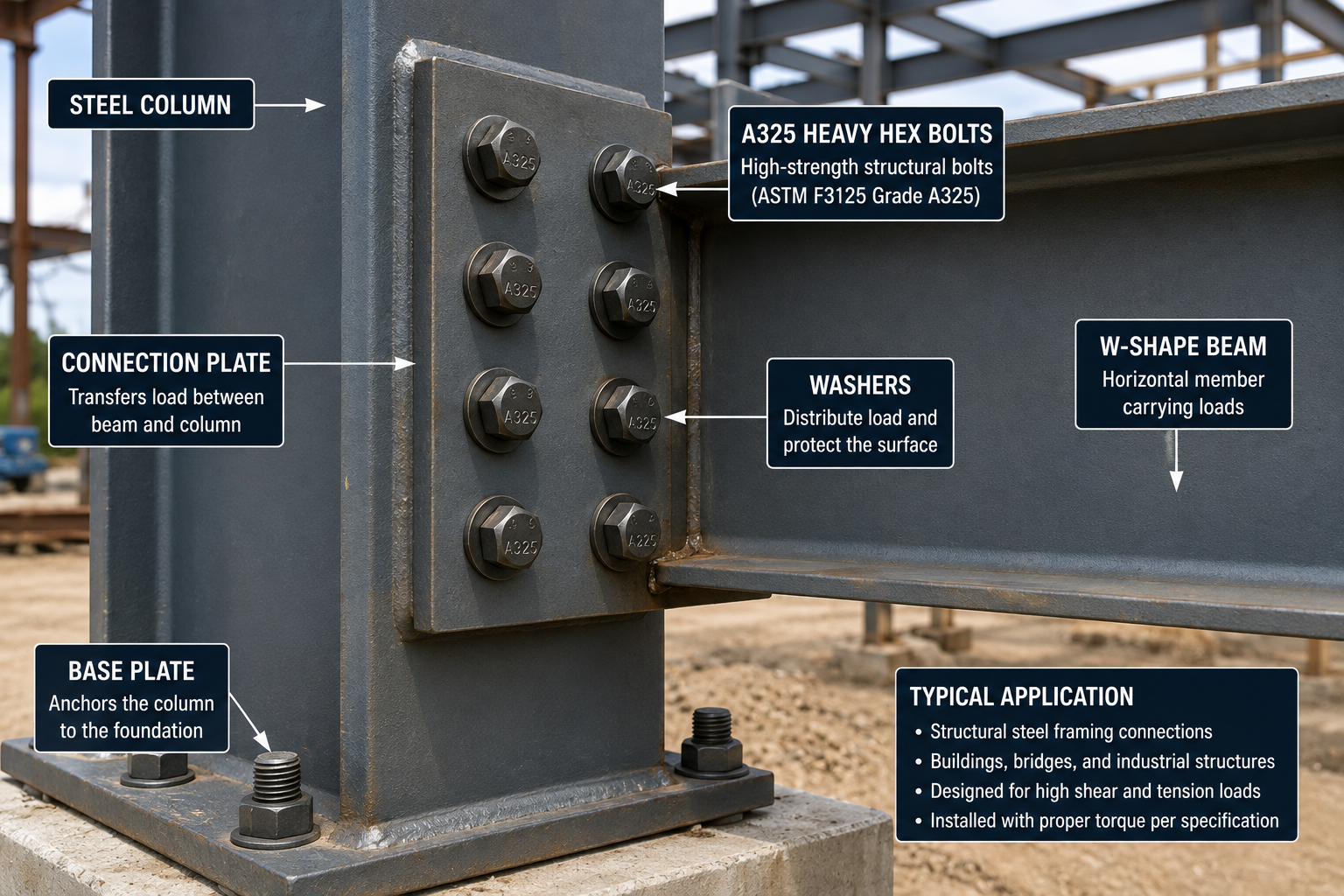
⭐ Visual Bolt Grade Guide
Original engineering diagrams explaining bolt anatomy, thread types, and structural assembly.
Common Bolt Selection Mistakes
Avoiding these errors prevents connection failures, mismatched hardware, and costly rework.
Confusing Bolt Grade with Bolt Size
Grade describes material strength, not diameter or length — a “bigger” bolt is not automatically a higher grade.
Mixing SAE and Metric Hardware
Forcing an SAE bolt into a metric nut (or vice versa) can strip threads and create a dangerously weak connection.
Ignoring Corrosion Environment
Selecting the right strength grade without considering coating or material for the exposure condition leads to premature failure from rust.
Reusing Structural Bolts Where Prohibited
Many structural bolt specifications prohibit reuse after full tensioning, since prior stretching can compromise clamping force.
Using Incorrect Torque Values
Applying a generic torque value without accounting for size, grade, lubrication, and thread condition can under- or over-tighten the joint.
Choosing Higher Strength When Ductility Matters More
In fatigue or shock-loaded applications, a lower-grade, more ductile bolt can outperform a higher-grade, more brittle one.
Failing to Match Nuts and Washers to Bolt Grade
Using an undersized-grade nut or washer with a high-strength bolt can become the weak link in the connection.
Contractor Worked Examples
Real-world bolt grade selection scenarios for common project types. Pair these with our Anchor Bolt Calculator and Base Plate Calculator.
Deck Ledger Connection
Steel Beam Connection
Frequently Asked Questions
📄 Download Bolt Grade Chart PDF
Get a printable engineering reference including SAE bolt grades, metric property classes, ASTM structural bolt specifications, head marking identification, strength comparison tables, material comparison, selection guide, and field-ready quick reference sheet.