How to Pour a Concrete Driveway: Complete DIY Guide for 2026

Ready to save $3,000-$6,000 on your driveway? Pouring your own concrete driveway is one of the most challenging but rewarding DIY projects you can tackle. A standard 20×40 foot driveway costs $8-15 per square foot professionally installed ($6,400-$12,000), but you can do it yourself for $3-5 per square foot in materials ($2,400-$4,000). This guide walks you through every step of how to pour a concrete driveway, from excavation to final curing, with 2026 pricing, professional techniques, and mistakes to avoid.
Planning Your Concrete Driveway Project
Before you break ground on pouring a concrete driveway, proper planning makes the difference between a 30-year driveway and one that cracks within 5 years. This section covers everything you need to consider before starting.
Understanding Driveway Thickness Requirements
Thickness is the most critical decision for your concrete driveway. Too thin and it cracks under vehicle weight. Too thick and you waste money on unnecessary concrete.
Standard thickness guidelines for 2026:
- 4 inches: Passenger cars only, light traffic, no heavy vehicles (minimum acceptable)
- 5 inches: Standard family vehicles including SUVs and minivans (most common residential choice)
- 6 inches: Heavy trucks, RVs, work vehicles, frequent traffic (recommended for durability)
- 8 inches: Commercial vehicles, delivery trucks, equipment (overkill for most homes)
Most homeowners pour 5-6 inch driveways in 2026. The extra inch costs about $150-300 more for a standard driveway but adds years of life. Our concrete thickness calculator helps determine the right depth based on your vehicle types and soil conditions.
Use 3000 PSI concrete minimum for residential driveways. Upgrade to 3500 PSI for heavy vehicles or 4000 PSI for commercial use. Higher PSI costs $10-20 more per cubic yard but prevents cracking under load. All concrete should include air entrainment (5-8%) in freeze-thaw climates.
Slope and Drainage Planning
Water is concrete’s enemy. Your driveway needs proper slope to drain water away from your garage and home foundation.
Minimum slope requirements:
- 2% grade (1/4 inch per foot): Absolute minimum for drainage
- 3-4% grade (3/8 to 1/2 inch per foot): Ideal for most driveways
- Maximum 15% grade: Steeper slopes need special techniques or alternative materials
Slope away from buildings and toward street or drainage areas. A 20-foot driveway with 3% slope drops 7.2 inches from garage to street. Use string lines and a level during excavation to maintain consistent grade.
Building Codes and Permits
Most jurisdictions require permits for new driveways or major replacements. Check with your local building department before starting.
Common permit requirements:
- Site plan showing driveway location and dimensions
- Minimum thickness and PSI specifications (typically 4 inches and 3000 PSI)
- Proper drainage away from property lines
- Curb cut permit if connecting to public street
- Setback requirements from property boundaries
Permit costs range from $50-300 depending on location. Skipping permits can result in fines and forced removal of unpermitted work. Budget 2-4 weeks for permit approval before starting work.
Call 811 (free utility locating service) at least 3 business days before digging. Underground gas, electric, water, and cable lines can cause serious injury or death if struck. This service is free and legally required in most states. Mark all utility locations with flags before excavation begins.
Cost Breakdown: DIY vs Professional Installation (2026)
Understanding the true cost of pouring a concrete driveway helps you decide between DIY and professional installation. Here’s the complete 2026 breakdown for a standard 20×40 foot (800 sq ft) driveway.
DIY Material Costs
| Material/Item | Quantity | 2026 Cost |
|---|---|---|
| Concrete (3500 PSI, 6″ thick) | 14.8 cubic yards | $2,442 ($165/yard) |
| Concrete delivery | 1 trip | $75 |
| Gravel base (4″ compacted) | 10 tons | $350 ($35/ton delivered) |
| Rebar #4 (18″ grid) | 420 linear feet | $210 ($0.50/ft) |
| Form lumber (2×6) | 140 linear feet | $168 ($1.20/ft) |
| Form stakes and hardware | 40 stakes | $80 |
| Wire ties, chairs, misc | Various | $65 |
| Plastic sheeting (curing) | 900 sq ft | $45 |
| Total Material Cost | $3,435 |
Tool Rental Costs (if not owned)
| Tool | Rental Period | 2026 Cost |
|---|---|---|
| Mini excavator (optional) | 1 day | $250-350 |
| Plate compactor | 1 day | $75 |
| Bull float | 1 day | $35 |
| Concrete finishing tools (if needed) | Purchase | $150-250 |
| Tool Rental Total | $510-710 |
Total DIY Cost: $3,945-$4,145 (approximately $4.90-$5.20 per square foot)
Professional Installation Cost
Professional concrete contractors charge $8-15 per square foot for complete driveway installation in 2026, depending on your region and project complexity.
For the same 800 sq ft driveway:
- Budget contractors: $6,400 ($8/sq ft) – basic installation, standard finish
- Mid-range contractors: $8,800 ($11/sq ft) – quality installation, proper reinforcement
- Premium contractors: $12,000 ($15/sq ft) – decorative finishes, stamped or colored concrete
💰 DIY Savings Breakdown
By pouring your own concrete driveway, you save $2,255-$7,855 in labor costs on a standard 800 sq ft driveway. That’s a 36-66% savings compared to professional installation.
However, consider these hidden costs:
- Physical labor: 24-32 hours of hard work over 3 days
- Helper costs: You need 3-4 people on pour day (pizza and beer budget)
- Learning curve: First-time mistakes can be expensive
- Tool purchases: If you buy instead of rent, add $500-1,000
Use our concrete driveway cost calculator to get exact pricing for your specific dimensions and location.
🧮 Calculate Your Exact Driveway Costs
Get instant material quantities and cost estimates for your specific driveway dimensions. Includes concrete, gravel, rebar, and complete cost breakdown with 2026 pricing.
Use Free Driveway Calculator →Tools and Materials You’ll Need
Proper tools make pouring a concrete driveway significantly easier. Here’s your complete checklist organized by project phase.
Excavation and Site Prep Tools
- Excavation: Shovels, mattock, wheelbarrow (or rent mini excavator for $250-350/day)
- Compaction: Plate compactor (rent for $75/day) – essential for gravel base
- Layout: 100 ft tape measure, string line, line level, marking paint
- Leveling: 4 ft level, laser level (optional but helpful for $50 rental)
- Cutting: Circular saw for form boards, rebar cutter or angle grinder
Forming and Reinforcement Tools
- Form building: Hammer, 16d nails, wood screws, power drill
- Leveling forms: Transit level or laser level, grade stakes
- Rebar work: Rebar ties, wire tying tool, rebar chairs (2-3″ height)
- Measuring: Tape measure, speed square, chalk line
Concrete Pouring and Finishing Tools
- Spreading: Square-point shovels (3-4), concrete rakes, come-along
- Screeding: 2×4 or 2×6 screed board (4 ft longer than driveway width)
- Floating: Bull float (48″ magnesium, rent for $35/day)
- Finishing: Hand trowels (3-4), edger tool, grooving tool for control joints
- Brushing: Stiff-bristle broom for non-slip texture
- Safety: Rubber boots, gloves, knee pads, safety glasses
Essential Materials List
For a 20×40 ft driveway at 6 inches thick:
| Material | Quantity Needed | Notes |
|---|---|---|
| Ready-mix concrete (3500 PSI) | 14.8 cubic yards | Add 10% waste factor |
| Gravel base (3/4″ crushed stone) | 10 tons (4″ depth) | Must be compacted |
| Rebar #4 (1/2″ diameter) | 420 linear feet | 18″ grid spacing |
| Form boards (2×6 lumber) | 140 linear feet | Straight, dry boards |
| Form stakes (2×4) | 40 stakes | Every 3-4 feet |
| Rebar chairs | 80 pieces | Every 4-5 feet of rebar |
| Plastic sheeting (6 mil) | 900 sq ft | For curing protection |
Calculate exact quantities for your driveway dimensions using our concrete calculator and gravel calculator.
Rent specialized tools like plate compactors and bull floats. They cost $500-1,200 to buy but only $75-110 per day to rent. Purchase hand tools like trowels, edgers, and floats ($150-250 total) since you’ll use them for repairs and future projects. Quality finishing tools make a visible difference in your final surface.
Step 1: Design and Layout Your Driveway
Proper layout prevents expensive mistakes. Take time to mark boundaries, establish grade, and plan drainage before any digging begins.
Measuring and Marking
Start by marking your driveway boundaries with stakes and string line. Standard single-car driveways measure 10-12 feet wide. Two-car driveways need 18-24 feet.
Layout process:
- Drive stakes at all four corners of the planned driveway
- Stretch string line between stakes at ground level
- Measure diagonals to ensure square corners (diagonals should be equal)
- Mark edges with marking paint or chalk for excavation reference
- Add 6 inches beyond planned edges for working room and forms
Establishing Grade and Slope
Use a line level or laser level to establish proper slope. Your driveway should slope 3-4% (about 3/8 to 1/2 inch per foot) away from your garage.
Slope Calculation Formula
Example: 40 ft driveway × 3% slope = 14.4 inches total drop
Mark your desired elevations on stakes at both ends of the driveway. Run string lines at the height of your finished concrete surface (accounting for gravel base and concrete thickness).
Planning Control Joints
Control joints prevent random cracking by directing cracks to planned locations. Plan joint spacing before pouring.
Control joint spacing rules:
- Maximum spacing: 2-3 times the slab thickness in feet (12-18 ft for 6″ concrete)
- Create approximately square panels when possible
- Joints should be 1/4 the slab thickness deep (1.5″ deep for 6″ slab)
- Cut or tool joints within 12 hours of pouring
For a 20×40 ft driveway, plan joints every 10-13 feet to create panels roughly 10×13 ft or 13×20 ft. Mark joint locations on your forms before pouring.
Step 2: Excavation and Base Preparation
A stable base is critical for preventing driveway settling and cracking. This step requires significant physical work but determines your driveway’s longevity.
Excavation Depth Calculation
Calculate total excavation depth by adding concrete thickness plus gravel base:
- Concrete thickness: 5-6 inches (typical)
- Gravel base: 4-6 inches compacted (6 inches recommended)
- Total excavation: 10-12 inches below finished grade
For a 6-inch concrete driveway with 6-inch gravel base, excavate 12 inches below where you want the finished surface.
Excavation Process
Manual excavation: Budget 12-16 hours of digging for a standard 800 sq ft driveway with 2-3 people. Rent a mini excavator ($250-350/day) to complete the same work in 3-4 hours.
Excavation steps:
- Remove any existing asphalt, concrete, or pavement
- Dig to consistent depth across entire area
- Check depth frequently with tape measure from string lines
- Slope bottom to match planned drainage (3-4% grade)
- Remove all organic material, roots, and soft spots
- Fill any low spots or holes with compactable material
If you encounter soft, wet, or organic soil during excavation, remove it and replace with compacted gravel. Soft subgrade causes settling and cracking within 2-3 years. In severe cases, consider adding geotextile fabric before gravel to prevent mixing with poor soil.
Gravel Base Installation
The gravel base provides drainage and a stable foundation. Use 3/4-inch crushed stone (also called Class II base rock or CA6).
Base installation process:
- Spread 3 inches of gravel evenly across excavated area
- Compact thoroughly with plate compactor (3-4 passes)
- Add second 3-inch layer of gravel
- Compact again until surface feels solid underfoot
- Check final depth and grade with string lines
- Final surface should be 6 inches below finished concrete surface
Proper compaction is critical. The plate compactor should leave no visible footprints when you walk on the finished base. Calculate your gravel needs with our gravel calculator.
For 4 inches compacted depth: approximately 1 ton of gravel per 100 square feet
For 6 inches compacted depth: approximately 1.5 tons per 100 square feet
Standard 800 sq ft driveway needs 10-12 tons delivered ($350-420 in 2026)
Step 3: Build Forms and Install Reinforcement
Forms contain the concrete and create clean edges. Reinforcement prevents cracking and holds the slab together.
Building Strong Forms
Use straight 2×6 lumber for 6-inch driveways or 2×4s for 4-inch slabs. Avoid warped or twisted boards.
Form installation steps:
- Set form boards on edge along driveway perimeter
- Top of forms should match your finished concrete height
- Drive 2×4 stakes every 3-4 feet on outside of forms
- Secure forms to stakes with 2-3 screws or nails per stake
- Use level to ensure forms follow planned slope
- Brace any joints between boards to prevent movement
- Coat inside of forms with release agent or oil for easy removal
Forms must be strong enough to hold concrete weight without bowing. Test by pushing hard against forms – they shouldn’t move at all.
Installing Rebar Reinforcement
Rebar dramatically increases driveway strength and prevents cracks from spreading. Use #4 rebar (1/2-inch diameter) in an 18-inch grid pattern.
Rebar installation process:
- Cut rebar to length (stop 3 inches from forms on all sides)
- Lay first set of rebar parallel to driveway length, 18 inches apart
- Lay second set perpendicular, also 18 inches apart
- Wire-tie intersections with rebar ties
- Place rebar chairs under grid every 4-5 feet
- Ensure rebar sits in middle third of slab depth (2 inches up for 6-inch slab)
- Rebar should not touch gravel base or extend above concrete surface
Calculate exact rebar quantities with our rebar calculator. For an 800 sq ft driveway, expect to use 400-450 linear feet of rebar.
Rebar provides superior reinforcement compared to wire mesh. It costs about the same ($200-250 for standard driveway) but delivers much better crack control. Wire mesh tends to sink to the bottom during pour, reducing effectiveness. Rebar stays positioned properly on chairs and provides consistent reinforcement throughout the slab thickness.
Final Pre-Pour Inspection
Before ordering concrete, verify everything is ready:
- ✓ Forms are level, straight, and properly sloped
- ✓ Forms are well-braced and won’t move under concrete weight
- ✓ Gravel base is compacted solid with no soft spots
- ✓ Rebar is properly positioned on chairs in middle third of slab
- ✓ Rebar grid is tied together at intersections
- ✓ All tools and helpers are scheduled for pour day
- ✓ Weather forecast shows no rain for 24 hours
🧮 Calculate Concrete Needed for Your Driveway
Before ordering, get exact cubic yards needed for your dimensions. Our calculator includes waste factor and converts to bags if needed. Never run short or order too much.
Calculate Concrete Volume →Step 4: Calculate and Order Concrete
Accurate concrete calculation prevents the disaster of running short mid-pour or wasting money on excess. This section shows exactly how to order the right amount.
Calculating Cubic Yards
Concrete is sold by the cubic yard. Use this formula for rectangular driveways:
Concrete Volume Formula
Depth in feet = Inches ÷ 12
💼 Example: 20×40 ft Driveway at 6 inches thick
Step 1: Convert depth to feet
6 inches ÷ 12 = 0.5 feet
Step 2: Calculate volume
20 ft × 40 ft × 0.5 ft = 400 cubic feet
Step 3: Convert to cubic yards
400 ÷ 27 = 14.8 cubic yards
Step 4: Add 10% waste factor
14.8 × 1.10 = 16.3 cubic yards
Order: 16.5 cubic yards (round up to nearest half-yard)
Always add 10% waste factor for spillage, uneven subgrade, and measurement errors. Running short mid-pour creates weak cold joints that crack easily. Use our driveway calculator for instant accurate calculations.
Ordering Ready-Mix Concrete
Call concrete suppliers 3-5 days before your pour date. Here’s what to specify:
Order specifications:
- Quantity: 16.5 cubic yards (your calculated amount)
- PSI strength: 3500 PSI (standard driveway)
- Slump: 4-5 inches (easier to work, still strong)
- Air entrainment: 5-8% (required in freeze-thaw climates)
- Aggregate size: 3/4 inch maximum
- Special additives: None for standard driveway
Confirm delivery time (early morning is best), truck access to pour location, and any short-load fees. Most suppliers charge $30-50 per yard for orders under 4-5 yards.
Ready-Mix vs Bagged Concrete Decision
For driveways, ready-mix is almost always the better choice. Here’s why:
| Factor | Ready-Mix Truck | Bagged Concrete |
|---|---|---|
| Cost (16 yards) | $2,640-2,880 | $7,200 (720 bags × $10) |
| Labor time | 20 minutes unload | 60+ hours mixing |
| Quality consistency | Perfect throughout | Varies by batch |
| Working time | 90-120 minutes | Indefinite (mix as needed) |
| Best for | Projects over 1 yard | Projects under 0.5 yard |
Use bagged concrete only for small repairs or projects under 0.5 cubic yards. Calculate bags needed with our bag calculator if doing a very small section.
Ready-mix trucks are massive (80,000 lbs loaded). Verify truck access to your pour site. Check overhead clearance (13-14 ft), street width (12 ft minimum), and weight limits on driveways or streets. Have alternate wheelbarrow route planned if truck can’t reach forms. Drivers typically give you 10-15 minutes to unload before charging wait time fees ($2-3 per minute).
Step 5: Pour and Spread the Concrete
Pour day is intense. You’ll work fast with 3-4 helpers for 4-6 hours. Concrete waits for no one – once it arrives, the clock is ticking.
Pre-Pour Final Checklist
Complete these tasks the day before your pour:
- ✓ Weather check: No rain forecast for 48 hours, temperature 50-85°F
- ✓ Wet down gravel base lightly (not muddy, just damp)
- ✓ Position wheelbarrows if truck can’t reach all areas
- ✓ Layout all tools within easy reach
- ✓ Confirm 3-4 helpers are arriving 30 minutes before truck
- ✓ Have water source available for cleanup and tool rinsing
- ✓ Clear truck access path of vehicles, toys, obstacles
Pouring Process
When the ready-mix truck arrives, work quickly and systematically:
Pouring technique:
- Start at farthest point from truck access
- Pour concrete into forms in 4-6 foot sections
- Spread immediately with shovels and rakes
- Fill to slightly above form height (concrete settles)
- Work concrete around rebar and into corners
- Eliminate air pockets by tapping forms and rebar
- Move to next section and repeat
Have two people spreading while others rake and level. Keep concrete moving – don’t let it sit in piles. The entire pour should take 15-30 minutes depending on driveway size.
Never let concrete sit for more than 30 minutes before adding more. Cold joints (where fresh concrete meets partially-set concrete) create weak spots that crack easily. If you must stop pouring, create a proper construction joint with keyway or dowels. For driveways, plan to pour the entire slab in one continuous session.
Working Time Limits
Concrete working time depends on temperature:
- 70-75°F: 90-120 minutes working time
- 85-90°F: 60-75 minutes working time
- 95°F+: 45-60 minutes working time (avoid if possible)
- Below 50°F: Extended time but slow strength gain
Plan your finishing steps accordingly. In hot weather, work extra fast and consider ordering concrete with retarder additive.
Step 6: Screed and Level the Surface
Screeding levels concrete to form height and removes excess material. This step determines your final surface flatness.
Screed Board Setup
Use a straight 2×4 or 2×6 board at least 2 feet longer than your driveway width. For a 20-foot wide driveway, use a 22-foot screed board.
Screeding technique:
- Position screed board across forms at one end
- Two people hold board ends, resting on forms
- Pull board toward you in sawing motion
- Keep board level and moving forward 6-12 inches per pass
- Fill any low spots immediately with fresh concrete
- Screed low areas again until level with forms
- Continue across entire driveway length
The screed board rides on top of forms like rails, cutting off excess concrete and filling low spots. This creates a flat surface ready for finishing.
Common Screeding Problems
Problem: Low spots that won’t fill
Solution: Add fresh concrete from wheelbarrow, tamp down with shovel, screed again
Problem: Forms bowing under screed pressure
Solution: Add more stakes and bracing. Forms must be rigid.
Problem: Concrete too stiff to screed smoothly
Solution: Order higher slump next time (5 inches vs 4 inches). For now, work harder.
Problem: Rebar showing through surface
Solution: Rebar is too high. Push down with shovel or add more concrete on top.
Step 7: Float, Edge, and Finish the Surface
Finishing creates your driveway’s final appearance and texture. Proper timing is critical – too early and you’ll bring up water, too late and concrete won’t respond.
Bull Floating
Wait 5-15 minutes after screeding for bleed water to evaporate. When surface loses wet sheen but concrete still moves under pressure, it’s ready to float.
Bull float technique:
- Attach extension handle to bull float (rent 48-inch magnesium float)
- Place flat on concrete surface at far end
- Push float away from you with slight downward pressure
- Pull back with float slightly raised (don’t dig in)
- Overlap passes by half the float width
- Cover entire surface systematically
Bull floating smooths the surface, embeds aggregate, and prepares for final finishing. Don’t over-float or you’ll bring up too much cream.
Edging
Edging creates rounded corners that resist chipping and look professional. Start edging when concrete is firm enough to hold its shape.
Edging process:
- Run edger tool along forms with light pressure
- Keep front of edger slightly raised
- Make smooth, continuous passes
- Create 1/4 to 1/2 inch radius on edges
- Go around entire perimeter
Control Joints (Grooving)
Cut control joints before final finishing. These planned cracks prevent random cracking.
Control joint guidelines:
- Space joints every 10-15 feet for 6-inch concrete
- Cut 1/4 of slab depth (1.5 inches for 6-inch slab)
- Use straight board as guide for straight joints
- Smooth cut edges with edger tool
For a 20×40 ft driveway, cut joints at 10-foot intervals creating four 10×20 ft panels. Use our control joint calculator to determine optimal spacing.
Final Surface Texture
Driveways need non-slip texture for safety. Apply texture when concrete is firm but still responds to tool pressure.
Texture options:
- Broom finish (most common): Drag stiff-bristle broom perpendicular to driveway length. Creates parallel lines. Best traction in wet conditions.
- Light broom: Use soft-bristle broom for finer texture. Good for warmer climates.
- Trowel finish: Smooth steel trowel finish (not recommended – too slippery when wet)
Standard broom finish is best for driveways. Brush from side to side in smooth, even strokes without stopping mid-pass.
0-15 minutes: Pour, spread, screed
15-45 minutes: Wait for bleed water to disappear
45-75 minutes: Bull float, edge, cut joints
75-120 minutes: Apply final texture, finish edges
120+ minutes: Begin curing process
Step 8: Cure and Protect Your Driveway
Curing is the most neglected step in concrete driveways. Proper curing increases strength by 50% and prevents surface cracking. Don’t skip this critical phase.
Understanding Concrete Curing
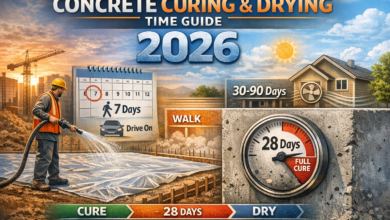
Concrete doesn’t “dry” – it cures through a chemical reaction with water. Keeping concrete moist for 7 days allows this reaction to continue, building maximum strength.
Strength gain timeline:
- 1 day: 20-30% of final strength (hard enough to walk on)
- 3 days: 40-50% strength
- 7 days: 70% strength (can drive passenger cars)
- 28 days: 100% design strength
Curing Methods
Choose one curing method and follow consistently:
Option 1: Plastic Sheeting (Best for DIY)
- Wait 4-6 hours after finishing for concrete to set
- Cover entire driveway with 6-mil plastic sheeting
- Overlap sheets by 12 inches
- Weight down edges with boards or bricks
- Leave in place for full 7 days
- Check daily – reseal any gaps or tears
Option 2: Water Curing
- Wait 4-6 hours for initial set
- Spray concrete with fine mist 3-4 times daily
- Keep surface damp but not puddled
- More effective than plastic but requires daily attention
- Continue for full 7 days
Option 3: Curing Compound
- Apply liquid membrane-forming curing compound with sprayer
- Apply immediately after finishing when sheen disappears
- Creates moisture barrier on surface
- No daily maintenance required
- Cost: $30-50 for standard driveway coverage
Calculate curing compound needs with our curing compound calculator.
Concrete poured in temperatures above 85°F needs extra protection. Hot weather causes rapid moisture loss and weak surface concrete. In hot conditions: (1) Pour early morning, (2) Use plastic sheeting AND water spray, (3) Keep concrete continuously moist, (4) Consider sunshade over driveway for first 3 days. Neglecting hot weather curing results in surface dusting and early deterioration.
When Can You Use Your Driveway?
Follow these timelines for best results:
| Activity | Wait Time | Notes |
|---|---|---|
| Walking on surface | 24-48 hours | Wear soft shoes |
| Remove forms | 24-48 hours | Gentle – edges still fragile |
| Light foot traffic | 3-5 days | Keep curing through this period |
| Passenger car driving | 7 days minimum | 10 days is better |
| Heavy trucks, RVs | 14 days | Wait longer if possible |
| Full vehicle load | 28 days | 100% strength reached |
The most common mistake is driving on concrete too early. Wait the full 7 days for passenger vehicles or risk permanent surface damage and cracking.
📊 Complete Driveway Cost Breakdown
See exactly what your project will cost with our detailed cost calculator. Includes materials, labor (if hiring), tools, permits, and delivery fees with 2026 pricing.
Calculate Full Project Cost →Common Mistakes and How to Avoid Them
After analyzing hundreds of DIY concrete driveways, these mistakes appear repeatedly. Learn from others’ expensive errors.
1. Inadequate Base Preparation
The mistake: Skipping gravel base, using too little gravel, or not compacting thoroughly. Pouring directly on dirt or poorly compacted soil.
The result: Driveway settles unevenly within 1-2 years. Cracks appear along settlement lines. Entire sections may sink 1-3 inches.
The fix: Always use minimum 4 inches of compacted gravel base (6 inches is better). Compact in 3-inch layers with plate compactor. Base should feel solid with no footprints when you walk on it. Budget $350-500 for proper base materials and compaction.
2. Insufficient Concrete Thickness
The mistake: Pouring 4 inches to save money when 6 inches is needed for vehicle weight. Not accounting for heavy trucks or RVs.
The result: Cracks within 6-18 months, especially where cars park regularly. Surface breaking up under wheel loads.
The fix: Use 5-6 inches minimum for residential driveways. The extra concrete costs $150-300 but adds 10-15 years of life. Use our thickness calculator based on your vehicle types and soil conditions.
3. No Reinforcement or Improper Placement
The mistake: Skipping rebar completely to save $200-250. Placing rebar on ground instead of chairs. Using wire mesh that sinks during pour.
The result: Cracks develop and spread rapidly. No structure holds cracked sections together. Cracks widen to 1/4 inch or more.
The fix: Always use #4 rebar in 18-inch grid on chairs. Rebar must sit in middle third of slab (2 inches up for 6-inch concrete). This $200-250 investment prevents thousands in repair costs.
4. Poor Drainage Design
The mistake: Flat driveway with no slope. Sloping toward house or garage. Not considering where water will drain.
The result: Standing water after rain. Water flows toward foundation. Ice buildup in winter. Accelerated surface deterioration.
The fix: Plan 3-4% slope away from buildings before excavating. Use string lines and level to verify grade. Water should flow to street, swale, or drainage area – never toward structures.
5. Running Short on Concrete
The mistake: Calculating exact amount needed with no waste factor. Not accounting for uneven base depth.
The result: Running out mid-pour creates cold joint. Weak spot where new and old concrete meet. Cold joints crack within first year.
The fix: Always order 10% more than calculated. For 15 cubic yards calculated, order 16.5 yards. Extra costs $150-200 vs $1,500+ to repair cold joint failure.
6. Neglecting Curing Process
The mistake: Removing plastic sheeting after 2 days. Not keeping concrete moist. Driving on driveway after 3-4 days.
The result: Surface dusting and weakness. Reduced final strength by 30-50%. Early cracking and surface deterioration.
The fix: Keep concrete covered and moist for full 7 days. Wait minimum 7 days before driving passenger cars (10-14 days for heavy vehicles). Proper curing costs nothing but adds years of life.
7. Poor Weather Timing
The mistake: Pouring in rain, extreme heat (95°F+), or cold (below 50°F). Ignoring weather forecast.
The result: Rain washes cream off surface. Heat causes rapid drying and cracking. Cold prevents proper strength development.
The fix: Check 5-day forecast before ordering concrete. Ideal conditions: 60-80°F, no rain for 48 hours, moderate humidity. In hot weather, pour early morning. In cold weather, use cold-weather concrete mix and insulated blankets.
8. Attempting Solo or With Insufficient Help
The mistake: Trying to pour driveway alone or with just one helper. Underestimating physical demands and time pressure.
The result: Cannot finish before concrete sets. Poor surface finish. Incomplete compaction around rebar. Exhaustion leading to mistakes.
The fix: Recruit minimum 3-4 people for pour day (5-6 for driveways over 600 sq ft). Assign specific roles: pouring, spreading, screeding, floating. Work systematically as team. Concrete waits for no one.
Project Timeline and Weather Considerations
Understanding the complete timeline helps you plan time off work, coordinate helpers, and choose the best season for pouring a concrete driveway.
Complete Project Timeline
Week 1: Planning and Permits
- Days 1-2: Measure area, finalize design, calculate materials
- Days 3-4: Apply for permits (if required)
- Days 5-7: Order materials, schedule concrete delivery, recruit helpers
Week 2-3: Site Preparation
- Day 1: Mark layout, call 811 for utility locate
- Days 2-3: Excavation (12-16 hours labor or 4 hours with mini excavator)
- Day 4: Grade and compact subgrade
- Day 5: Spread and compact first gravel layer
- Day 6: Add second gravel layer and final compaction
Week 4: Forms, Reinforcement, and Pour
- Day 1: Build and set forms (4-6 hours)
- Day 2: Install rebar reinforcement (3-4 hours)
- Day 3: Final inspection, wet down base
- Day 4: Pour day (4-8 hours intensive work with 3-4 helpers)
- Days 5-11: Curing period (daily monitoring)
Week 5: Completion
- Day 7-10: Remove forms carefully
- Day 11+: Continue curing through day 7 minimum
- Day 14: Light vehicle traffic allowed
- Day 28: Full strength reached, normal use
Total project time: 4-5 weeks from start to driving on driveway
Best Seasons for Pouring Concrete Driveways
Spring (April-May): Excellent
- Moderate temperatures (60-75°F ideal)
- Predictable weather patterns
- Soil moisture stabilized after winter
- Risk: Spring rains require weather watching
Summer (June-August): Good with Caution
- Long working days with extended daylight
- Fast curing (can drive sooner)
- Risk: Heat above 85°F causes rapid drying – pour early morning only
- Risk: Afternoon thunderstorms in many regions
Fall (September-October): Excellent
- Best season for concrete work in most regions
- Moderate temperatures, low humidity
- Stable weather patterns
- Concrete cures at optimal rate
Winter (November-March): Avoid or Use Special Measures
- Temperatures below 50°F slow curing dramatically
- Freezing temps during first 7 days can destroy concrete
- Requires heated enclosures, insulated blankets, special mix
- Only pour if temperature stays above 50°F day and night for 7 days
Weather Day-Of Requirements
Only pour concrete if ALL these conditions are met:
- ✓ Temperature 50-85°F (60-80°F ideal)
- ✓ No rain forecast for 48 hours
- ✓ Wind under 15 mph (high wind dries surface too fast)
- ✓ No freeze forecast for 7 days
- ✓ Humidity 40-70% (extreme dryness causes rapid evaporation)
If weather looks questionable 24 hours before pour, reschedule. Most concrete suppliers let you change delivery with 24 hours notice.
Schedule your concrete pour for a Thursday or Friday. This gives you the weekend to monitor curing without missing work. If anything goes wrong during the pour, you have Saturday to address issues before concrete fully hardens. Avoid Monday pours – you’ll be exhausted all week.
🎯 Key Takeaways for Pouring a Concrete Driveway
- Thickness matters: Use 5-6 inches for residential driveways, 6-8 inches for heavy vehicles
- Base is critical: 4-6 inches of compacted gravel prevents settling and cracking
- Reinforce always: #4 rebar in 18-inch grid on chairs increases strength 300%
- Proper slope: 3-4% grade away from buildings ensures good drainage
- Order 10% extra concrete: Running short mid-pour creates permanent weak spots
- Use 3500 PSI minimum: Higher strength concrete resists cracking under vehicle loads
- Recruit 3-4 helpers: You cannot pour a driveway alone – it’s physically impossible
- Cure for 7 days: Keep concrete moist and covered – this step determines final strength
- Wait 7 days before driving: Early traffic causes permanent damage to surface
- Best seasons: Spring and fall provide ideal temperatures for concrete work
- DIY saves $3,000-6,000: Material costs $3-5/sq ft vs $8-15/sq ft professionally installed
- Total time commitment: 4-5 weeks from start to finish, 24-32 hours of physical labor
Frequently Asked Questions
A residential concrete driveway should be 4-6 inches thick for standard passenger vehicles. Use 6 inches for heavy vehicles like trucks or RVs. Commercial driveways handling heavy equipment need 6-8 inches. The thicker the concrete, the more weight it can support without cracking. Most homeowners pour 5-6 inch driveways in 2026 for optimal durability. The extra inch costs about $150-300 more but adds 10-15 years of service life. Always check local building codes for minimum thickness requirements.
In 2026, professional concrete driveway installation costs $8-15 per square foot ($6,400-$12,000 for a standard 20×40 ft driveway). DIY installation costs $3-5 per square foot ($2,400-$4,000 for materials only), saving $3,000-$6,000 in labor costs. Material breakdown: concrete averages $165 per cubic yard, gravel base $35 per ton, rebar $0.50 per foot. Tool rentals add $500-700. Prices vary by region, with urban areas typically 20-30% higher than rural. Use our driveway cost calculator for exact estimates in your location.
Yes, you can pour a concrete driveway yourself if you have 3-4 helpers, proper tools, and physical stamina. The project takes 2-3 days for a standard driveway. You’ll need excavation equipment, a concrete source (ready-mix truck or mixer), finishing tools, and knowledge of concrete working time (90-120 minutes). DIY is practical for driveways under 800 square feet. Consider hiring professionals for larger driveways or if you lack experience with concrete. The physical demands are intense – you’ll be working fast for 4-6 hours on pour day with no breaks.
Pouring a concrete driveway takes 2-3 days total for the actual construction: Day 1 for excavation and base preparation (6-8 hours with equipment), Day 2 for forms and reinforcement (4-6 hours), Day 3 for pouring and finishing (4-8 hours intensive work). However, the complete project timeline is 4-5 weeks including planning, permits, material delivery, and curing. Concrete reaches walking strength in 24-48 hours but needs 7 days before driving on it and 28 days to reach full 100% strength. Weather and complexity affect timing – add time for large driveways or difficult site conditions.
Rebar is highly recommended for concrete driveways to prevent cracking and increase longevity. Use #4 rebar (half-inch diameter) in a grid pattern spaced 18-24 inches apart, positioned in the middle third of the slab depth using rebar chairs. This costs $200-250 for a standard driveway but increases structural strength by 300% and prevents cracks from spreading. Wire mesh is an alternative for lighter applications, but rebar provides superior strength for vehicle loads. Some building codes require rebar for driveways – check local requirements. Skipping reinforcement to save money leads to expensive repairs within 3-5 years.
Use 3000 PSI concrete minimum for residential driveways with passenger vehicles. Upgrade to 3500-4000 PSI for driveways handling heavy trucks, RVs, or frequent traffic. Higher PSI concrete costs $10-20 more per cubic yard but provides better durability and crack resistance. The extra cost is $150-300 for a standard driveway – a worthwhile investment for longevity. All driveway concrete should include air entrainment (5-8% air content) in freeze-thaw climates to prevent surface scaling. Request 4-5 inch slump for easier finishing while maintaining strength. Never use less than 3000 PSI for driveways.
Calculate concrete for a driveway using this formula: (Length × Width × Depth in feet) ÷ 27 = Cubic Yards. Convert depth in inches to feet by dividing by 12. For a 20 ft × 40 ft driveway at 6 inches thick: (20 × 40 × 0.5) ÷ 27 = 14.8 cubic yards. Always add 10% waste factor for spillage and uneven base, so order 16.3 cubic yards (round to 16.5). Running short mid-pour creates weak cold joints that crack easily. Use our concrete driveway calculator for instant accurate results including waste factor and cost estimates with 2026 pricing.
Wait minimum 7 days before driving on a new concrete driveway with passenger vehicles. Heavy vehicles like trucks and RVs need 10-14 days wait time. Concrete reaches 70% strength at 7 days and full 100% design strength at 28 days. Walking on the surface is safe after 24-48 hours with soft-soled shoes. Driving too early causes surface damage, micro-cracking, and permanent weakening of the concrete that leads to early deterioration. Be patient – the extra few days of waiting adds years to your driveway life. In hot weather, concrete reaches usable strength slightly faster, but still wait the full 7 days minimum.
🏗️ Ready to Pour Your Concrete Driveway?
Calculate exact materials, costs, and timeline for your specific project. Our free calculator gives you everything needed to order materials and plan your DIY driveway with confidence.
Start Planning Your Driveway →🔗 Essential Concrete Driveway Calculators
- → Concrete Driveway Calculator – Calculate exact cubic yards for any driveway size
- → Concrete Thickness Calculator – Determine proper depth for your vehicle types
- → Gravel Base Calculator – Calculate tons of gravel needed for base layer
- → Rebar Calculator – Determine rebar quantities and grid spacing
- → Driveway Cost Calculator – Complete cost breakdown DIY vs professional
- → Concrete Volume Calculator – Convert dimensions to cubic yards
- → Ready-Mix Truck Calculator – Determine delivery requirements
- → Control Joint Calculator – Plan crack control joint spacing
- → How to Calculate Concrete – Master concrete volume calculations
- → All Concrete Calculators – Browse 45+ free concrete tools