Cost of Concrete Slab Per Square Foot: 2026 USA Price Guide
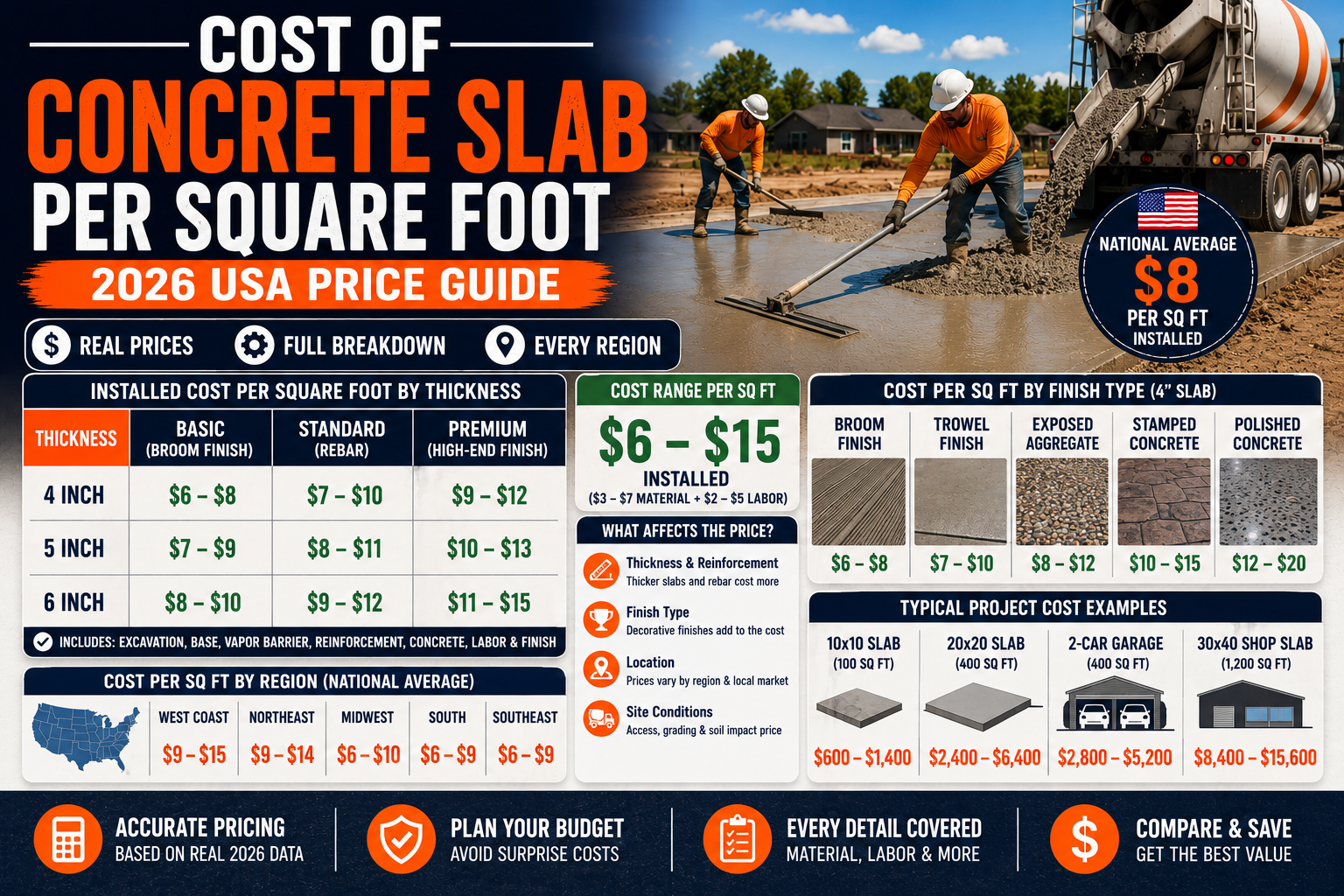
A concrete slab costs $6 to $12 per square foot installed in the USA in 2026, with a national average of around $8 per square foot for a standard 4-inch residential slab. Materials alone run $3 to $7 per square foot. Labour adds $2 to $5 per square foot. Decorative finishes, thicker pours, and high-cost markets push the total toward $12 to $15 per square foot. This guide covers every factor that moves that number – by size, thickness, finish type, reinforcement, project category, and region – so you can build a precise budget for your specific slab before you talk to a single contractor.
Quick Reference: Cost Per Square Foot by Project Type
Before diving into every variable that affects the per-square-foot price, here is a quick reference table showing what fully installed concrete costs per square foot for the most common residential and light commercial projects in 2026. These figures reflect the national average market – not the highest-cost or lowest-cost regions.
| Project Type | Typical Thickness | Cost Per Sq Ft | Notes |
|---|---|---|---|
| Outdoor patio (plain broom) | 4 in | $6 to $10 | Most common residential project |
| Patio (exposed aggregate) | 4 in | $8 to $13 | Adds wash-off finish step |
| Patio (stamped concrete) | 4 in | $10 to $25 | Wide range based on pattern complexity |
| Walkway / sidewalk | 4 in | $6 to $10 | Long narrow pours often cost more per sq ft |
| Shed pad / utility slab | 4 in | $6 to $10 | Small sizes attract minimum job fees |
| Driveway (plain) | 5 to 6 in | $7 to $12 | Needs thicker pour for vehicle loads |
| Driveway (decorative) | 5 to 6 in | $10 to $20 | Coloured, stamped, or exposed aggregate |
| Garage floor (single car) | 4 to 5 in | $6 to $10 | Standard residential garage |
| Garage floor (two to three car) | 5 to 6 in | $7 to $13 | Higher spec for vehicle traffic |
| Shop / workshop floor | 6 in | $8 to $14 | Full rebar grid, trowel finish |
| Pool deck | 4 in | $8 to $14 | Slip texture required, often decorative |
| House foundation slab | 6 in | $8 to $14 | Includes thickened edge footings |
| Barndominium / pole barn slab | 6 in + footings | $9 to $15 | Thickened perimeter, utility stubs |
| Commercial floor (light) | 6 in | $9 to $15 | Flatness tolerances, saw cuts, sealer |
| Polished interior slab | 6 in | $15 to $30+ | Grind, hone, seal multi-stage process |
Enter your slab dimensions, thickness, finish type, and zip code into the concrete cost estimator for a precise 2026 price specific to your market. The tool applies regional labour rates, current material pricing, and your chosen spec to produce a real project budget – not a national average that may not reflect your location.
Material vs. Labor Cost Per Square Foot
Every installed concrete slab price has two main components: materials and labour. Understanding the split helps you evaluate contractor quotes, spot overpriced bids, and decide whether any portion of the work makes sense to handle yourself.
| Cost Component | Per Sq Ft (Low) | Per Sq Ft (High) | What It Covers |
|---|---|---|---|
| Concrete material (4 in, 4000 PSI) | $1.20 | $2.00 | Ready-mix delivery, 4000 PSI standard mix |
| Concrete material (6 in, 4000 PSI) | $1.80 | $3.00 | Ready-mix delivery, 6 in thickness |
| Gravel base (4 in compacted) | $0.50 | $1.50 | Crushed stone delivery and compaction |
| Wire mesh reinforcement | $0.35 | $0.80 | 6×6 welded wire, standard residential |
| Rebar (#4 at 18 in OC) | $0.80 | $1.50 | Structural reinforcement, garage/shop spec |
| Vapor barrier (10 mil poly) | $0.15 | $0.35 | Moisture protection under enclosed slabs |
| Forms and stakes | $0.40 | $1.20 | Lumber, metal forms, layout stakes |
| Pour and finish labor | $2.00 | $5.00 | Screeding, floating, troweling, brooming |
| Excavation and grading labor | $0.40 | $1.67 | Site prep prior to pour day |
| Control joints | $0.10 | $0.40 | Saw-cut at 10 to 15 ft spacing |
| Curing and sealing | $0.15 | $0.60 | Curing compound, optional penetrating sealer |
| Contractor overhead and profit | $0.80 | $2.00 | Typically 20 to 35% markup on labour |
Labour is 50 to 60% of the total installed price on most residential slabs. That ratio means a 20% reduction in labour rates – moving from a California market to a Texas market, for example – reduces the total installed price by 10 to 12% on its own. It also explains why DIY concrete work saves meaningful money on the labour side but does not change material costs, which are set by the ready-mix plant regardless of who places the concrete.
Cost Per Square Foot by Slab Size
Per-square-foot costs are not flat across all slab sizes. Small slabs cost more per square foot because contractor mobilisation costs – truck, crew, equipment, and travel time – are spread over fewer square feet. Large slabs have a lower effective per-square-foot rate because those fixed costs are diluted. Here are 2026 installed prices for common slab sizes at a standard 4-inch broom finish specification in national average markets.
| Slab Size | Square Feet | Per Sq Ft | Total Cost Range | Notes |
|---|---|---|---|---|
| 6×6 | 36 sq ft | $14 to $22 | $500 to $800 | Minimum job charge applies; rarely cost-effective |
| 8×8 | 64 sq ft | $11 to $18 | $700 to $1,150 | Still in minimum charge territory at most contractors |
| 10×10 | 100 sq ft | $9 to $14 | $900 to $1,400 | Common shed pad size |
| 10×20 | 200 sq ft | $8 to $12 | $1,600 to $2,400 | Single-car parking pad |
| 12×12 | 144 sq ft | $8 to $13 | $1,150 to $1,870 | Small patio |
| 12×20 | 240 sq ft | $7 to $12 | $1,680 to $2,880 | Single-car garage slab |
| 16×16 | 256 sq ft | $7 to $11 | $1,790 to $2,816 | Mid-size patio |
| 20×20 | 400 sq ft | $7 to $11 | $2,800 to $4,400 | Two-car garage or large patio |
| 24×24 | 576 sq ft | $7 to $10 | $4,032 to $5,760 | Standard two-car garage |
| 20×30 | 600 sq ft | $7 to $10 | $4,200 to $6,000 | Large patio or RV pad |
| 24×30 | 720 sq ft | $6.50 to $10 | $4,680 to $7,200 | Two-car garage with shop area |
| 30×30 | 900 sq ft | $6.50 to $10 | $5,850 to $9,000 | Large garage or small shop |
| 30×40 | 1,200 sq ft | $6 to $9.50 | $7,200 to $11,400 | Two to three bay shop |
| 30×50 | 1,500 sq ft | $6 to $9.33 | $9,000 to $14,000 | Large garage or barndominium slab |
| 40×60 | 2,400 sq ft | $5.75 to $9 | $13,800 to $21,600 | Commercial shop or warehouse pad |
| 50×100 | 5,000 sq ft | $5.50 to $8.50 | $27,500 to $42,500 | Small commercial building |
Most concrete contractors set a minimum job charge of $500 to $1,000 regardless of slab size. On a 6×6 or 8×8 slab, this minimum charge makes the effective per-square-foot cost far higher than the standard $6 to $12 range. If your project is under 150 square feet, compare the all-in quote from a contractor against the cost of mixing bags yourself – the material cost for a 100 sq ft slab at 4 inches is only $150 to $220 in bags, and the labour is manageable for a single person over a weekend.
Cost Per Square Foot by Thickness
Thickness is the most direct variable in the concrete material cost calculation. Each inch of thickness adds concrete volume – and therefore cost – in a perfectly linear way. Here is what each thickness level costs per square foot in 2026 in materials only, and in total installed cost.
| Thickness | Concrete Volume Per 100 Sq Ft | Material Cost Per Sq Ft | Total Installed Per Sq Ft | Best Application |
|---|---|---|---|---|
| 3 inches | 0.93 cu yds | $1.20 to $1.75 | $4 to $7 | Walkways, thin-set patios, overlays only |
| 4 inches | 1.23 cu yds | $1.60 to $2.25 | $6 to $10 | Patios, shed pads, walkways, mild-use slabs |
| 5 inches | 1.54 cu yds | $2.00 to $2.80 | $7 to $11 | Driveways, single-car garages, RV pads |
| 6 inches | 1.85 cu yds | $2.40 to $3.35 | $8 to $13 | Garages, shops, foundations, most building slabs |
| 7 inches | 2.16 cu yds | $2.80 to $3.90 | $9 to $14 | Heavy-load commercial, loaded pallet racking |
| 8 inches | 2.47 cu yds | $3.20 to $4.45 | $10 to $16 | Vehicle lifts, heavy equipment, structural |
| 10 inches | 3.09 cu yds | $4.00 to $5.55 | $12 to $18 | Industrial, high-load structural pads |
| 12 inches | 3.70 cu yds | $4.80 to $6.65 | $14 to $21 | Heavy industrial, engineered structural slabs |
Increasing from 4 inches to 6 inches adds roughly $0.80 to $1.10 per square foot in concrete material cost. On a 400 sq ft garage floor, that is $320 to $440 extra in material – a small premium for significantly better durability and load capacity. Always confirm the right thickness for your application with the slab thickness calculator before finalising your specification.
Cost Per Square Foot by Project Type
Different project types demand different specifications beyond just thickness – reinforcement, subbase depth, vapor barriers, flatness tolerances, and finishing techniques all vary. Here are the real installed per-square-foot costs for each major project category in 2026.
Patio Slab Cost Per Square Foot
A concrete patio costs $6 to $10 per square foot for a plain broom finish and $10 to $25 per square foot for stamped or decorative finishes. The typical residential patio ranges from 200 to 500 square feet – large enough to avoid minimum job charges but small enough that decorative upgrades are affordable. Use the concrete patio cost calculator for a full budget by size and finish type.
Driveway Slab Cost Per Square Foot
A concrete driveway costs $7 to $12 per square foot for a plain finish at 5 to 6 inches thick. Driveways carry regular vehicle loads and need thicker concrete and better reinforcement than patios. A typical two-car driveway of 400 to 600 square feet runs $3,000 to $7,200 installed. Decorative driveway work with exposed aggregate or integral colour adds 20 to 40% to the base price. Use the concrete driveway cost calculator for a full estimate.
Garage Floor Cost Per Square Foot
A garage floor costs $7 to $13 per square foot for a standard 6-inch pour with rebar and a trowel finish. Single-car garages (200 to 250 sq ft) run $1,400 to $3,250. Standard two-car garages (400 to 500 sq ft) run $2,800 to $6,500. Three-car garages and large shop floors (600 to 1,200 sq ft) run $4,200 to $15,600. Use the garage floor cost calculator for a complete breakdown.
Foundation Slab Cost Per Square Foot
A house foundation slab costs $8 to $14 per square foot fully installed in 2026. This includes the thickened perimeter footings, deeper excavation, full rebar grid, vapor barrier, utility stub-outs, and a steel-trowel finish. On a 1,200 sq ft house slab, the total installed cost runs $9,600 to $16,800. Foundation slabs in California and the Northeast run $14 to $22 per square foot. Use the foundation slab cost calculator for a site-specific estimate.
| Project Type | Sq Ft Range | Per Sq Ft Installed | Key Spec Difference |
|---|---|---|---|
| Shed / utility pad | 50 to 200 sq ft | $6 to $11 | 4 in, mesh only, no vapor barrier needed |
| Patio – plain finish | 100 to 600 sq ft | $6 to $10 | 4 in, mesh or rebar, broom finish |
| Patio – decorative | 100 to 600 sq ft | $10 to $25 | 4 in, same base but stamped/coloured surface |
| Walkway / sidewalk | 20 to 200 sq ft | $6 to $11 | 4 in, broom texture, narrow forms cost more |
| Driveway | 200 to 800 sq ft | $7 to $12 | 5 to 6 in, rebar, control joints every 10 ft |
| Garage floor | 200 to 800 sq ft | $7 to $13 | 5 to 6 in, rebar, vapor barrier, trowel finish |
| Shop / workshop | 400 to 2,400 sq ft | $8 to $14 | 6 in, full rebar grid, flatness tolerance spec |
| Pool deck | 200 to 800 sq ft | $8 to $14 | 4 in, slip texture required, often decorative |
| House foundation | 800 to 3,000 sq ft | $8 to $14 | 6 in + thickened edge, full rebar, stubs |
| Barndominium slab | 800 to 3,000 sq ft | $9 to $15 | 6 in + footings, anchor bolts, utility rough-in |
Cost Per Square Foot by Finish Type
Finish type is the most powerful tool for moving the per-square-foot cost either up or down once you have fixed your thickness and reinforcement spec. Here is what each finish adds to the base broom-finish price in 2026.
| Finish Type | Total Installed Per Sq Ft | Added Cost Over Broom | Best Application |
|---|---|---|---|
| Broom finish (baseline) | $6 to $10 | $0 | Driveways, walkways, utility areas |
| Trowel finish (smooth) | $7 to $11 | +$0.50 to $1.50 | Garage floors, interior slabs |
| Exposed aggregate | $8 to $14 | +$2 to $4 | Patios, pool decks, outdoor entertainment |
| Salt finish | $7 to $11 | +$1 to $2 | Pool decks, walkways – subtle texture |
| Coloured / integral colour | $8 to $13 | +$2 to $4 | Decorative patios, driveways |
| Stamped – basic (1 pattern) | $10 to $14 | +$4 to $6 | Entry patios, simple pool decks |
| Stamped – mid-range (2 colours) | $13 to $18 | +$7 to $10 | Premium patios, driveway accents |
| Stamped – premium (custom) | $18 to $25 | +$12 to $18 | High-end outdoor living spaces |
| Hardener / densifier | $7 to $11 | +$0.50 to $1 | Shop floors – reduces surface dusting |
| Epoxy coating (applied after cure) | $9 to $14 | +$2 to $5 | Garage floors, workshop showrooms |
| Honed concrete | $12 to $20 | +$6 to $12 | Interior slabs, barndominium living areas |
| Polished concrete (full grind) | $15 to $30+ | +$10 to $22+ | Commercial showrooms, high-end residential |
If you want the most visual impact per dollar, exposed aggregate delivers a significant decorative upgrade for $2 to $4 per square foot over a plain broom finish. It is durable, low-maintenance, and looks far more premium than a basic broom finish. Integral colour adds $2 to $4 per square foot and works well combined with a standard broom or trowel finish. Stamped concrete is the premium option but requires sealing every 2 to 3 years to maintain its appearance – factor in that ongoing maintenance cost when comparing it against exposed aggregate.
Cost Per Square Foot by US Region
Regional labour rates are the biggest driver of per-square-foot price variation across the USA. Here are 2026 installed costs for a standard 4-inch plain slab and a 6-inch garage floor by region.
| Region | 4 in Plain Slab/Sq Ft | 6 in Garage Floor/Sq Ft | Labour Rate Reference |
|---|---|---|---|
| South (TX, OK, AR) | $4.50 to $7.50 | $7 to $10 | $25 to $38/hr |
| Southeast (GA, AL, MS, TN, SC) | $5 to $8 | $7.50 to $11 | $26 to $40/hr |
| Florida | $5.50 to $8.50 | $8 to $12 | $28 to $42/hr |
| Midwest (OH, IN, IL, MI, WI) | $6 to $9 | $8.50 to $12 | $30 to $45/hr |
| Great Plains (MN, IA, MO, KS, NE) | $5.50 to $8.50 | $8 to $11.50 | $28 to $42/hr |
| Mountain (CO, UT, MT, ID, WY) | $6 to $9.50 | $8.50 to $12.50 | $30 to $47/hr |
| Southwest (AZ, NM, NV) | $6 to $9.50 | $8.50 to $12.50 | $30 to $47/hr |
| Southeast Atlantic (NC, VA, MD) | $6.50 to $10 | $9 to $13 | $32 to $50/hr |
| Mid-Atlantic (PA, NJ, DE) | $7.50 to $11 | $10 to $14 | $38 to $58/hr |
| Northeast (NY, MA, CT, RI) | $9 to $14 | $11 to $16 | $45 to $72/hr |
| California (all markets) | $9 to $15 | $11.50 to $17 | $52 to $80/hr |
| Pacific Northwest (WA, OR) | $8 to $13 | $10 to $15 | $42 to $66/hr |
Reinforcement Cost Per Square Foot
Reinforcement is one of the most impactful line items for long-term slab performance and one of the most negotiated in contractor quotes. Here is what each type adds per square foot in 2026.
| Reinforcement Type | Added Cost Per Sq Ft | Notes | Right For |
|---|---|---|---|
| No reinforcement | $0 | Never recommended – always use at minimum mesh | Nothing – unreinforced slabs crack |
| 6×6 W1.4 Wire Mesh | $0.35 to $0.80 | Most common for basic patios and utility pads | Outdoor pads, light-use slabs, no vehicles |
| Polypropylene fiber | $0.15 to $0.40 | Mixed into concrete batch – supplement only | Added to mesh or rebar – not standalone |
| #4 Rebar at 18 in OC | $0.80 to $1.50 | Standard for garage floors and enclosed building slabs | Garages, workshops, enclosed pads |
| #4 Rebar at 12 in OC | $1.20 to $2.00 | Higher density for heavier loads | Heavy equipment, vehicle lifts |
| #5 Rebar at 12 in OC | $1.67 to $2.80 | Structural applications only | Foundation slabs, very heavy commercial |
| Post-tension cables | $2.00 to $4.00 | Requires engineering, special finishing | Expansive soils, engineered structures |
Full Project Cost Examples
Here are complete line-item project examples showing what a concrete slab costs per square foot in total across three real-world specifications and size categories in 2026.
📋 Example 1: 16×20 Patio, Plain Broom Finish – Midwest
Size: 16×20 = 320 sq ft | Thickness: 4 inches
Concrete (4.7 yds x $140): $658 | Gravel base: $280 | Wire mesh: $180 | Forms: $200 | Excavation: $300 | Pour + finish labor: $960 | Control joints: $100 | Sealer: $150
📋 Example 2: 20×22 Garage Floor, Trowel Finish – Southeast
Size: 20×22 = 440 sq ft | Thickness: 6 inches
Concrete (9.8 yds x $145): $1,421 | Gravel base: $460 | Rebar (#4 at 18 in): $528 | Vapor barrier: $130 | Forms: $300 | Excavation + grading: $420 | Pour + trowel labor: $1,760 | Control joints: $180 | Curing + seal: $220 | Permit: $150
📋 Example 3: 25×35 Stamped Patio, 2-Color Pattern – Pacific Northwest
Size: 25×35 = 875 sq ft | Thickness: 4 inches
Concrete (12.9 yds x $160): $2,064 | Gravel base: $700 | Mesh: $490 | Forms: $525 | Excavation: $700 | Pour labor: $3,500 | Stamping (2 colours): $3,500 | Release agent + colour hardener: $800 | Saw cuts + caulk: $350 | Premium seal (2 coats): $700 | Permit: $200
Get Your Exact Per-Square-Foot Cost Estimate
Enter your dimensions, thickness, finish, and location for a 2026 price specific to your project.
Use the Concrete Cost EstimatorWhat Drives Cost Per Square Foot Up or Down
Knowing the average per-square-foot price is a starting point. Knowing what moves that price in either direction is what lets you build a true budget.
Factors That Push Cost Per Square Foot Higher
- Thicker pour – every additional inch of thickness adds $0.40 to $0.85/sq ft in concrete material cost.
- Rebar instead of mesh – adds $0.45 to $0.70/sq ft over wire mesh; double-bar grids for heavy loads add more.
- Decorative finish – stamped work adds $4 to $18/sq ft; polished concrete adds $9 to $22/sq ft.
- Difficult site access – if a pump truck is needed, adds $0.40 to $1.00/sq ft on large slabs.
- Sloped or difficult terrain – extra excavation, retaining, and grading adds $0.60 to $4.00/sq ft depending on severity.
- Small slab size – fixed mobilisation costs spread over fewer square feet inflate the effective rate on small jobs.
- California, Northeast, or Pacific Northwest market – labour rates in these markets are 40 to 80% higher than the southern USA.
- Weekend or after-hours pours – adds $0.05 to $0.15/sq ft on large slabs; flat $50 to $150/load from the plant.
- High-strength concrete (5000+ PSI) – adds $0.10 to $0.25/sq ft in material cost over standard 4000 PSI.
Factors That Pull Cost Per Square Foot Lower
- Large pour area – fixed costs (mobilisation, pump, forming labour) spread across more square feet.
- Flat, easily accessible site – straightforward excavation and direct truck chute access reduce labour time.
- Low-cost US market – Texas, rural Midwest, and the South have the lowest concrete labour rates in the country.
- Owner-completed site prep – clearing, excavation, and gravel spreading done by the owner before the pour crew arrives can save $0.40 to $1.50/sq ft.
- Standard broom or trowel finish – base finishes require no specialty equipment or extra curing steps.
- Multiple slabs scheduled together – combining two adjacent pours in one contractor visit spreads mobilisation across both.
DIY vs. Contractor Cost Per Square Foot
DIY concrete is viable for small, simple slabs. For larger or more complex projects, the financial savings are smaller than most people expect. Here is the honest comparison for 2026.
| Approach | Cost Per Sq Ft | Best Slab Size | Skills Required | Risk |
|---|---|---|---|---|
| Full contractor (turnkey) | $6 to $14 | Any size | None from owner | Low – contractor is responsible |
| Owner does site prep, contractor pours | $5 to $11 | Any size over 200 sq ft | Basic grading, gravel work | Low to moderate |
| Owner sets forms, contractor pours | $4.50 to $10 | 200 to 600 sq ft | Layout, leveling, forming | Moderate – form accuracy matters |
| Full DIY (owner pours) | $3 to $6 | Under 200 sq ft | Screeding, floating, finishing | High on first attempt |
The most practical cost-reduction strategy for most homeowners is to handle site preparation – clearing vegetation, rough grading, and gravel delivery and spreading – themselves, then hire a professional crew for the pour day. This approach saves $0.80 to $2.50 per square foot while keeping the highest-risk part of the project in experienced hands. On a 400 sq ft garage floor, that is $320 to $1,000 in genuine savings with minimal quality risk.
How to Use a Per-Square-Foot Price to Build Your Budget
A per-square-foot price is only useful if you know what it does and does not include. Here is a reliable process for building an accurate budget from any per-square-foot quote.
- Measure your exact area. Use the concrete calculator to confirm your square footage for any shape – including L-shaped slabs, circular areas, and irregular borders.
- Multiply by the per-square-foot rate. Use the range for your project type, thickness, and region from the tables above. Multiply by both the low and high ends to get your budget range.
- Check what the per-square-foot price includes. Always ask or confirm: does the rate include excavation and grading? Gravel base? Reinforcement? Delivery? Finishing? Sealing? Permits? Some contractors quote a “pour and finish only” rate and itemise everything else separately.
- Add site prep if not included. Budget $0.40 to $2.50/sq ft for excavation, grading, and gravel base if the contractor’s rate does not cover it.
- Add pump costs if access is restricted. Add $0.40 to $1.00/sq ft if the site requires a pump rather than direct chute discharge.
- Add permit and inspection fees. Budget $0 to $0.60/sq ft depending on your municipality’s requirements for the project type.
- Compare three quotes. Use the concrete cost estimator as your independent reference. Quotes more than 25% below the estimator output deserve scrutiny – confirm what is missing from the scope before accepting.
Concrete Cost Calculators By Project
- Concrete Cost Estimator – full project budget by size and spec
- Concrete Cost Per Square Foot Calculator – instant per-sqft estimate
- Concrete Patio Cost Calculator – patio full budget
- Concrete Driveway Cost Calculator – driveway full budget
- Garage Floor Cost Calculator – garage slab full budget
- Foundation Slab Cost Calculator – foundation and barndominium slab
- Stamped Concrete Cost Calculator – decorative finish pricing
- Concrete Labor Cost Calculator – labour-only budget check
- Concrete Pour Cost Calculator – pour-day cost breakdown
- Concrete Slab Calculator – cubic yards for any dimensions
- Slab Thickness Calculator – right thickness for your application
- Ready-Mix Truck Calculator – truckloads and short-load check
Key Takeaways
- A concrete slab costs $6 to $12 per square foot installed in 2026, with the national average at $8/sq ft for a standard 4-inch residential slab with broom finish.
- Materials alone run $3 to $7 per square foot. Labour adds $2 to $5 per square foot. Labour is 50 to 60% of the total installed price on most residential slabs.
- Thickness directly drives material cost: going from 4 to 6 inches adds $0.80 to $1.10/sq ft in concrete material – worth doing for any garage, shop, or enclosed building slab.
- Stamped concrete costs $10 to $25/sq ft installed. Polished or honed concrete costs $15 to $30+/sq ft. Exposed aggregate at $8 to $14/sq ft is the best value decorative option.
- Small slabs under 150 sq ft attract minimum job charges that inflate the effective per-square-foot rate well above the published range.
- California and the Northeast pay 40 to 80% more per square foot than Texas, the Southeast, and the Midwest – almost entirely because of labour rate differences.
- The best cost-reduction strategy is to handle site preparation yourself and hire a professional crew for pour day – saving $0.80 to $2.50/sq ft with minimal quality risk.
Frequently Asked Questions
Sources & References
Pricing data in this guide is cross-referenced from government labour statistics, industry cost databases, and concrete industry associations. All figures reflect June 2026 USA market conditions.
- U.S. Bureau of Labor Statistics — Cement Masons & Concrete Finishers Wages by State
- U.S. BLS Producer Price Index — Ready-Mix Concrete (PCU32732327320)
- American Concrete Institute (ACI) — ACI 318 & ACI 302.1R Slab Standards
- National Ready Mixed Concrete Association (NRMCA)
- Homewyse — Cost to Install Cement Slab (2026)
- Angi — Concrete Slab Cost Guide (2026)
- Concrete Network — Concrete Prices 2026
- RSMeans — Construction Cost Data (2026 Edition)