3000 PSI Concrete Guide 2026: Uses, Mix Design, and Costs
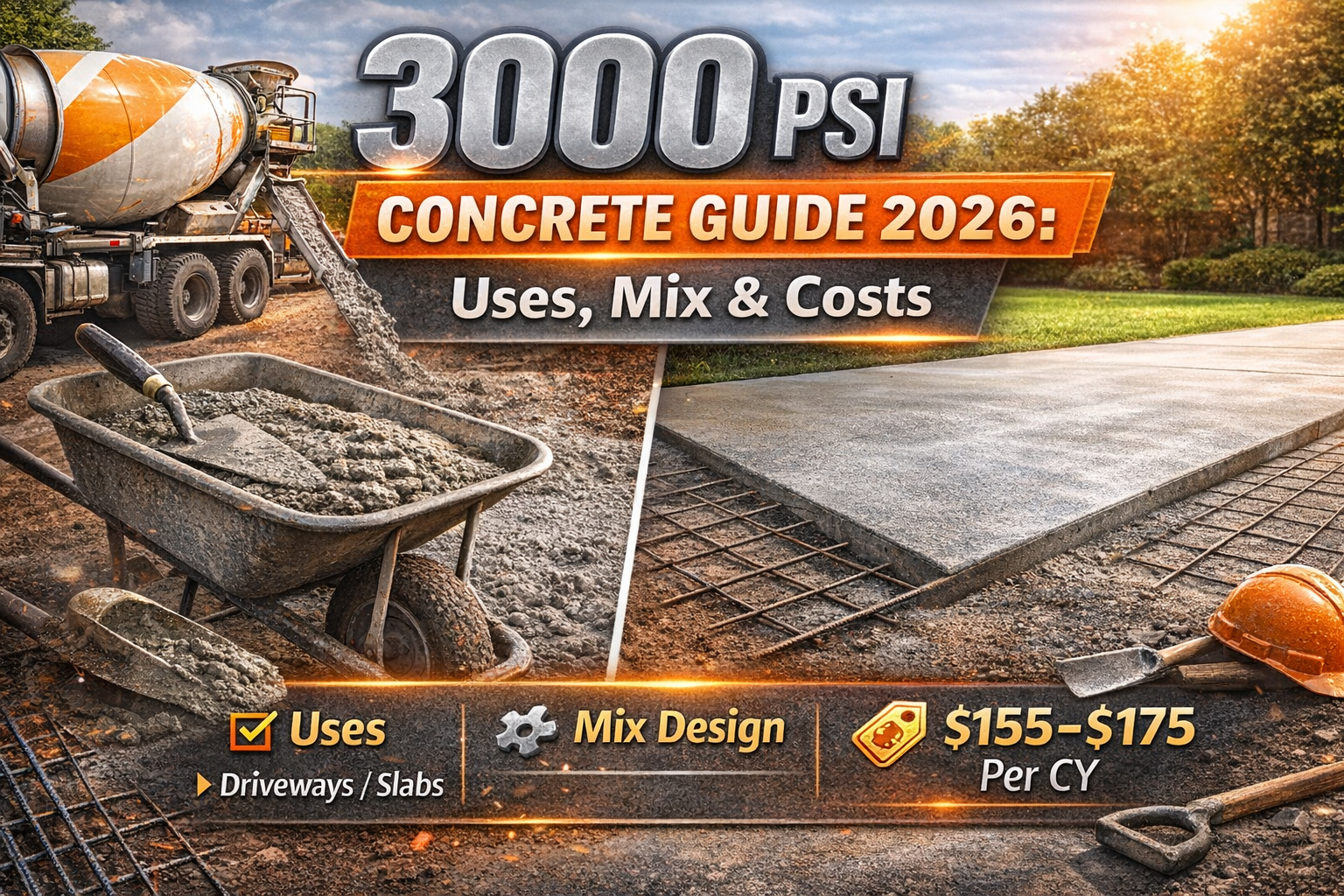
If you’ve ever ordered concrete and weren’t sure what PSI to specify, you’ve probably defaulted to 3000 PSI – and most of the time, that’s the right call. This 3000 PSI concrete guide covers everything you need to know: what it’s right for, where it falls short, how the mix is designed, what it costs in 2026, and when paying a little more for 4000 PSI is worth it. Whether you’re pouring a patio, a driveway, or a foundation, this guide gives you the facts to make the right decision.
What Is 3000 PSI Concrete?
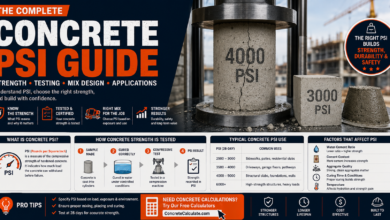
3000 PSI concrete is the most widely used ready-mix strength grade in the United States for residential construction. The PSI number – pounds per square inch – tells you the compressive strength the hardened concrete achieves at 28 days of age. At 3000 PSI, it can withstand 3,000 pounds of crushing force per square inch before it fails.
This grade is the industry default for a reason. It balances workability, cost, strength, and durability in a way that works for the widest range of everyday residential applications. Walk into any ready-mix plant in America and ask for concrete – they’ll probably quote you 3000 PSI first.
How 3000 PSI Fits Into the Concrete Strength Scale
Concrete PSI grades range from around 2000 PSI for very light-duty applications all the way up to 10,000+ PSI for high-rise structural columns. Residential work typically runs 2500-4500 PSI. 3000 PSI sits squarely in the middle of that residential range – strong enough for most applications, yet still easy to work with and price-competitive.
In metric units used internationally, 3000 PSI equals 20.7 MPa. If you’re working with plans from a foreign architect or international building standards, that’s the equivalent value. See our full concrete PSI guide for complete strength grade comparisons.
ACI 318 sets 2500 PSI as the structural minimum, but most local building codes and standard residential specs call for 3000 PSI minimum. It provides adequate strength for typical residential loads, a reasonable margin above the minimum, and better freeze-thaw performance than 2500 PSI – all at a price that makes sense for homeowners and contractors.
Best Applications for 3000 PSI Concrete
3000 PSI concrete covers a broad range of residential applications. Here’s where it genuinely works well and delivers long-term value.
Sidewalks and Walkways
Residential sidewalks are a perfect application for 3000 PSI. They carry foot traffic only, are typically 4 inches thick, and in mild climates don’t face severe freeze-thaw stress. The standard ACI 318 sidewalk specification calls for 3000 PSI minimum in moderate exposure conditions.
For sidewalks in northern states exposed to deicing salts or repeated freeze-thaw cycling, step up to 4000 PSI with air entrainment. Use our sidewalk calculator to estimate exactly how much concrete your walkway project needs.
Patios and Exterior Flatwork (Mild Climates)
In states like Florida, Georgia, Texas, Southern California, Arizona, and similar warm-weather markets, 3000 PSI is the right grade for residential patios. It handles normal outdoor use, patio furniture, grills, and foot traffic without issue when the climate doesn’t include hard freeze-thaw cycles.
If you’re in a mild-climate state and your patio won’t see vehicle traffic or heavy concentrated loads, 3000 PSI at 4 inches thick delivers 20+ years of solid performance. Estimate your patio material needs with our concrete patio calculator.
Interior Slabs and Basement Floors
Interior concrete floors – basement slabs, laundry room floors, utility areas, and similar protected applications – are ideal for 3000 PSI. They’re shielded from weather, not exposed to deicing chemicals, and carry typical household loads that 3000 PSI handles comfortably.
For finished living spaces in basements, stepping up to 3500 PSI improves surface hardness and reduces crack risk under floor coverings. But for purely functional utility slabs, 3000 PSI does the job.
Residential Foundations and Footings
3000 PSI is the widely accepted minimum for residential foundations across most of the country. It meets ACI 318 requirements for typical residential loads and provides adequate moisture resistance for most soil conditions.
Many contractors and engineers use 3500-4000 PSI for foundations as a matter of practice, especially in wet climates or expansive soil areas. But for a standard single-family home on stable soil in a mild climate, 3000 PSI foundations perform reliably for the life of the structure. Our foundation calculator helps you estimate volume and cost accurately.
Driveways in Mild Climates
3000 PSI is appropriate for residential driveways in warm-climate states that don’t experience regular freezing. It handles passenger vehicle loads well, provides adequate surface hardness to resist tire scuffing, and lasts 20+ years with proper installation in mild conditions.
In northern states where temperatures drop below freezing and deicing salts are used, 3000 PSI isn’t sufficient for driveways. ACI 318 requires 4000 PSI for freeze-thaw exposed concrete. Use our driveway calculator to plan your project accurately.
💼 Example: 3000 PSI Application Decision by Location
Project: 20×20 ft backyard patio, 4 inches thick
Miami, FL (no freeze-thaw): 3000 PSI – perfect choice. Typical cost: 3.7 CY x $150/CY = $555 in concrete material.
Atlanta, GA (light frost, rare freezing): 3000 PSI acceptable with air entrainment. Typical cost: 3.7 CY x $160/CY = $592 in material.
Chicago, IL (heavy freeze-thaw, deicing salts): Upgrade to 4000 PSI with 5-6% air entrainment. Typical cost: 3.7 CY x $185/CY = $685 in material. The $93 premium is not negotiable for 30-year durability.
Lesson: Climate drives PSI selection more than application type for exterior flatwork.
💪 Verify Your 3000 PSI Strength Development
Get exact predictions for when your 3000 PSI concrete reaches design strength based on your temperature and mix conditions.
Use PSI Strength Calculator →3000 PSI Concrete Mix Design
Understanding what makes 3000 PSI concrete hit its target strength helps you verify what you’re ordering, catch problems before they occur, and design your own mix if needed.
Standard Proportions Per Cubic Yard
A properly designed 3000 PSI mix achieves its strength through a specific combination of cement content, water content, and aggregate proportions. The water-cement ratio is the most critical variable – higher water means lower strength, every time.
Standard 3000 PSI Mix Design (Per Cubic Yard)
Water: 305-338 lbs (36-40 gallons)
Fine aggregate (sand): 1,700 lbs
Coarse aggregate (3/4″ stone): 1,850 lbs
Water-cement ratio: 0.55-0.60
Air content: 1-2% (non-air-entrained)
Air content w/ air entrainment: 5-7% (freeze-thaw)
Use our mix ratio calculator to adjust proportions for your aggregate sizes and project requirements.
The Water-Cement Ratio Explained
The 0.55-0.60 water-cement ratio for 3000 PSI is the primary lever controlling strength. Adding water to a 3000 PSI mix on site – even a single 5-gallon bucket per truckload – pushes w/c above 0.60 and can drop final strength to 2600-2700 PSI. Never add water on site without authorization.
If you need more workability, order a mix with a water-reducing admixture (plasticizer) from the plant. This improves flow without increasing w/c ratio or compromising your 3000 PSI target. Use our water-cement ratio calculator to see exactly how water adjustments affect strength.
Cement Types for 3000 PSI
Standard Type I/II Portland cement is used for most 3000 PSI residential mixes. It produces predictable strength gain over 28 days and is available everywhere. Type III (high-early-strength) cement can achieve 3000 PSI equivalent strength in 7-10 days, useful for fast-track projects.
Many ready-mix plants blend fly ash or slag into their 3000 PSI mixes – up to 20-25% by cement weight. This reduces cost slightly and improves long-term strength and workability. However, fly ash blends gain early strength more slowly, so wait a full 28 days before loading structural elements poured with blended mixes.
Aggregate Selection
The coarse aggregate size affects workability and surface quality. Most residential 3000 PSI mixes use 3/4-inch maximum aggregate. For thin slabs under 3.5 inches, request 3/8-inch or 1/2-inch maximum aggregate so it doesn’t bridge across the slab thickness. Pea gravel mixes work well for decorative applications and hand-placed work.
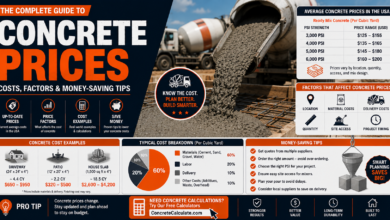
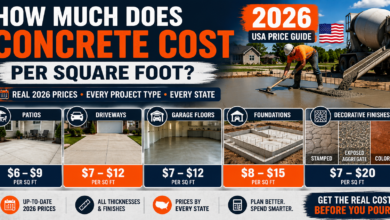
3000 PSI Concrete Cost in 2026
Concrete pricing varies across the US based on fuel costs, aggregate availability, labor markets, and regional demand. Here’s what to expect for 3000 PSI concrete in 2026.
Ready-Mix Pricing by Region
| Region | 3000 PSI per CY (Delivered) | 4000 PSI per CY | Upgrade Premium |
|---|---|---|---|
| Northeast (NY, MA, CT, NJ) | $165-185 | $185-205 | $18-25/CY |
| Southeast (FL, GA, SC, NC) | $145-165 | $165-185 | $15-22/CY |
| Midwest (IL, OH, MI, IN) | $155-175 | $175-195 | $15-22/CY |
| South / Texas | $140-160 | $160-180 | $15-22/CY |
| Mountain West (CO, UT, AZ) | $155-175 | $175-195 | $15-22/CY |
| Pacific Coast (CA, WA, OR) | $165-195 | $185-215 | $18-25/CY |
Real Project Cost Examples
Raw material cost is only part of the total project picture. Here’s what typical projects cost in 2026 using 3000 PSI concrete at average national pricing:
| Project | Size | Thickness | Cubic Yards | Concrete Material Cost |
|---|---|---|---|---|
| Small patio | 12×16 ft (192 sq ft) | 4 inches | 2.4 CY | $375-420 |
| Standard patio | 20×24 ft (480 sq ft) | 4 inches | 5.9 CY | $915-1,032 |
| Two-car driveway | 20×20 ft (400 sq ft) | 5 inches | 6.2 CY | $961-1,085 |
| Residential sidewalk | 4×40 ft (160 sq ft) | 4 inches | 2.0 CY | $310-350 |
| Basement floor | 24×40 ft (960 sq ft) | 4 inches | 11.9 CY | $1,845-2,082 |
Note: These are concrete material costs only. Add labor ($2-4/sq ft for basic flatwork), forms, rebar or wire mesh, finishing, and sealing for total installed cost. Use our cost per square foot calculator for complete project budgets. Also add 10% to cubic yard calculations to account for waste and over-excavation.
Bagged Concrete as an Alternative
For projects under half a cubic yard, bagged concrete is practical. Quikrete 5000 (80-lb bags at $7-9 each in 2026) produces 5000 PSI strength but is often used as a higher-quality 3000 PSI substitute for small jobs. One bag covers about 0.60 cubic feet, so you need 28 bags to make one cubic yard.
For a 50-square-foot shed pad at 4 inches thick (0.62 CY), that’s 18 bags costing $126-162 – slightly more than a minimum ready-mix load but no delivery wait and no short-load fee.
📐 Calculate Exactly How Much Concrete You Need
Get precise cubic yard calculations for any slab, including your 10% waste factor, so you order just the right amount of 3000 PSI concrete.
Use Slab Calculator →3000 PSI Concrete Strength Development Timeline
Ordering 3000 PSI concrete doesn’t mean you have 3000 PSI to work with the next day. Strength builds gradually through the hydration process. Here’s exactly what to expect at each stage.
Strength by Age at 70°F
| Age | % of 28-Day PSI | Approx. Strength | Practical Implication |
|---|---|---|---|
| 12-24 hours | 10-15% | 300-450 PSI | Hard surface – foot traffic only with soft soles |
| 3 days | 40-45% | 1,200-1,350 PSI | Normal foot traffic, no vehicles |
| 7 days | 65-75% | 1,950-2,250 PSI | Form removal (non-structural), light vehicles |
| 14 days | 85-90% | 2,550-2,700 PSI | Residential vehicle traffic acceptable |
| 28 days | 100% | 3,000 PSI | Full design strength – all uses acceptable |
| 90 days | 108-112% | 3,240-3,360 PSI | Continued minor strength gain |
Temperature Effects on Strength Gain
Temperature dramatically affects how quickly 3000 PSI concrete reaches usable strength. The hydration reaction slows significantly in cold weather and accelerates in heat.
- Above 85°F: 3000 PSI may be walkable in 18-20 hours, but rapid early strength gain can reduce long-term strength by 5-10% due to poor crystal formation. Keep moist and shaded.
- 65-75°F (ideal): Standard 24-hour walkable, 28-day full strength timeline.
- 50-60°F: Add 4-8 hours to early strength milestones. 28-day strength usually still achievable with adequate curing.
- 40-50°F: Strength gain slows 30-40%. 7-day strength may be only 45-55% of design. Extend form removal to 10 days minimum.
- Below 40°F: Concrete may freeze before gaining adequate strength. Use heated enclosures, insulating blankets, and hot mix water. Never allow fresh concrete to freeze before reaching 500 PSI.
See our full curing guide for cold and hot weather best practices. For timing foot and vehicle access, check our walk-on concrete guide.
Why Proper Curing Is Non-Negotiable
3000 PSI concrete that dries out before completing hydration may only reach 1,500-1,800 PSI in practice. The hydration reaction needs moisture to continue. Concrete that looks hard and dry at 3 days hasn’t finished gaining strength – it just appears done.
Cover all fresh concrete with plastic sheeting or wet burlap immediately after finishing. Keep it covered and moist for a minimum of 7 days, and 14 days for structural elements. Alternatively, apply a curing compound per manufacturer instructions after final finishing. This single step is the most cost-effective way to ensure your investment in 3000 PSI concrete actually delivers 3000 PSI performance.
3000 PSI Concrete Compared to Other Grades
Understanding how 3000 PSI relates to other common grades helps you make confident specification decisions for any part of a project.
3000 PSI vs 2500 PSI
3000 PSI is 20% stronger than 2500 PSI, with a lower water-cement ratio (0.55-0.60 vs 0.65-0.70). The denser structure of 3000 PSI handles freeze-thaw better and provides noticeably better surface hardness and abrasion resistance. Cost difference: $15-20 per cubic yard.
For virtually any residential application that sees weather exposure or foot traffic, 3000 PSI is the clear choice over 2500 PSI. The durability benefit far outweighs the cost difference. Read our full guide on 2500 PSI concrete uses to understand where the lower grade is appropriate.
3000 PSI vs 4000 PSI
4000 PSI is 33% stronger than 3000 PSI and uses a water-cement ratio of 0.44-0.50, significantly denser than 3000 PSI. The real-world performance difference shows up in freeze-thaw durability, salt resistance, and long-term surface wear.
In cold climates, 4000 PSI driveways and exterior slabs last 30+ years while 3000 PSI may show surface scaling in 5-8 years. The cost premium averages $15-20 per cubic yard. On a typical 400 sq ft driveway, that’s $30-50 total extra material cost for a 10-15 year longer service life.
| Property | 2500 PSI | 3000 PSI | 4000 PSI |
|---|---|---|---|
| Compressive strength (28 days) | 2,500 PSI | 3,000 PSI | 4,000 PSI |
| Water-cement ratio | 0.65-0.70 | 0.55-0.60 | 0.44-0.50 |
| Typical 2026 cost/CY | $130-145 | $155-175 | $175-195 |
| Freeze-thaw resistance | Poor | Fair-Good | Excellent |
| Driveway (cold climate) | No | No (ACI 318) | Yes |
| Driveway (mild climate) | No | Yes | Yes |
| Residential foundation | Minimum only | Yes | Preferred |
| Structural beams/columns | No | Marginal | Yes (minimum) |
| Expected exterior lifespan | 5-10 years | 15-25 years | 30+ years |
Placement, Finishing, and Curing Tips
Getting 3000 PSI performance from your concrete pour depends as much on proper placement and curing as on the mix design itself. Here’s what experienced contractors do that most DIYers skip.
Ordering and Delivery Tips
When you call your ready-mix supplier, specify clearly: 3000 PSI, 4-inch slump (or 5-inch if pumping), 3/4-inch maximum aggregate, and air entrainment percentage if needed for your climate. Get a delivery ticket for every load and check that the w/c ratio and design strength match your specification.
Order 10% more than your calculated cubic yards. Pour volume calculations assume perfect forms and no waste. In reality, minor form deflection, ground variations, and spillage consume 5-15% more than calculated. Running out mid-pour is a serious problem. Our slab calculator includes an automatic 10% waste margin – use it.
Placing and Consolidating
Discharge concrete into the lowest point of the pour and push it toward forms – never rake or drag it long distances, which segregates aggregate from paste. For any pour over 4 inches thick or any structural element, use an internal vibrator at 18-24 inch intervals. Hold the vibrator in each position for 5-15 seconds and withdraw slowly to prevent air pockets.
Avoid over-vibrating. More than 15 seconds in one spot causes aggregate to sink and bleed water to rise, weakening the surface layer. Proper consolidation is one of the most impactful things you can do for final concrete quality.
Finishing the Surface
Start screeding immediately after consolidation while concrete is still plastic. Float and trowel after bleed water evaporates but while the surface is still workable. Finishing over standing bleed water traps it in the surface layer, creating a weak zone prone to scaling and delamination.
For exterior slabs, broom finish perpendicular to the direction of travel for slip resistance. For interior slabs, a hard-steel-troweled finish provides better surface hardness but requires skill and timing. Review our complete slab pouring guide for step-by-step finishing instructions.
Curing Methods and Timeline
Begin curing within 30 minutes of final finishing. Three effective methods:
- Plastic sheeting: Lay 4-6 mil polyethylene sheeting over the entire surface, overlapping edges by 12 inches and weighing down to prevent wind lifting. Most cost-effective for flat slabs.
- Wet burlap: Lay burlap directly on the surface and keep it wet by re-wetting every 4-8 hours. More labor-intensive but very effective in hot, dry conditions.
- Curing compound: Spray-apply immediately after final finishing. One gallon covers 150-200 square feet. Don’t use if you plan to apply additional concrete or topping – it breaks the bond.
Maintain curing for minimum 7 days for most residential applications. 14 days for structural elements, cold weather pours, or any application where full design strength is critical before loading.
Take timestamped photos of your pour at placement, 24 hours, 7 days, and 28 days. Note the temperature during the first 72 hours. If a strength problem or surface defect appears later, this documentation helps determine whether the issue is a mix problem, a curing problem, or premature loading. It also protects you during warranty discussions with ready-mix suppliers or contractors.
When to Upgrade From 3000 PSI Concrete
3000 PSI is the right default for many projects, but there are clear situations where paying for a higher grade is the correct call. Knowing these thresholds saves you from expensive repairs later.
Climate-Based Upgrades
The most important trigger for upgrading beyond 3000 PSI is climate. ACI 318 Section 19.3.3 specifies that concrete exposed to freezing and thawing in a moist condition or to deicing chemicals must have a minimum of 4000 PSI. This means any outdoor concrete in states north of roughly the 35th parallel (which runs through North Carolina, Tennessee, Oklahoma, New Mexico) should be 4000 PSI as a baseline.
Don’t try to make 3000 PSI work in Chicago, Minneapolis, Boston, or Denver for outdoor applications. The ACI requirement exists because engineers have documented that 3000 PSI concrete in freeze-thaw exposure fails prematurely, consistently. Use our engineering calculators to evaluate specific exposure conditions.
Load-Based Upgrades
When loads exceed typical residential patterns, upgrade beyond 3000 PSI:
- Driveways seeing RVs, loaded trailers, or frequent commercial vehicles: 4000-4500 PSI
- Structural beams and columns in any building: 4000-5000 PSI per ACI 318
- Post-tensioned slabs: 4000-5000 PSI minimum (pre-stress requires higher bond strength)
- Commercial garage floors or industrial slabs: 4000-5000 PSI
- Parking structures and bridge decks: 5000+ PSI
Use our load-bearing calculator and slab load calculator to analyze whether 3000 PSI handles your specific loads safely.
Chemical Exposure Upgrades
Concrete exposed to sulfates in soil (common in western US soils), seawater, or aggressive industrial chemicals needs specialized mixes. Sulfate-resistant concrete typically uses Type V cement or fly ash and requires 4500 PSI minimum for moderate sulfate exposure. Always consult a geotechnical or structural engineer for sites with known soil chemistry issues.
Common 3000 PSI Concrete Mistakes to Avoid
These errors show up regularly on residential projects. Each one compromises the 3000 PSI performance you paid for.
1. Using 3000 PSI for Cold-Climate Exterior Work
This is the most costly and common mistake in northern US residential construction. A homeowner in Ohio, Illinois, or New York sees 3000 PSI listed as “standard residential” and uses it for a driveway. Three winters later, the surface is scaling and spalling. The fix costs $8,000-15,000. ACI 318 is clear: 4000 PSI for freeze-thaw exposure. Period.
2. Adding Water to the Ready-Mix Truck on Site
Every gallon of water added per cubic yard at the site drops PSI by 200-300. A driver who adds 5 gallons to a 10-yard load to improve slump just turned your 3000 PSI order into something closer to 2700-2800 PSI. Always specify slump in your order (4-5 inches for typical flatwork), not “make it easier to work.” If you need higher slump, order a plasticizer admixture from the plant.
3. Stopping Curing Too Early
Removing plastic sheeting or curing compound at day 3 because the concrete “looks done” stops strength gain at 40-45% of design strength. Your 3000 PSI investment produces 1,200-1,350 PSI concrete that fails early under load and is susceptible to surface damage. Keep concrete cured and moist for 7 days minimum, 14 for structural applications.
4. Not Specifying Air Entrainment for Cold Climates
Even if you correctly upgrade to 4000 PSI for a cold-climate driveway, skipping air entrainment eliminates most of the freeze-thaw benefit. Air-entrained concrete requires 5-7% air for outdoor freeze-thaw applications. This must be specified when ordering – it doesn’t come standard. Always ask your supplier to confirm air content on the delivery ticket.
5. Over-Finishing the Surface
Finishing concrete while bleed water is still on the surface traps water in the top layer, creating a weak, porous crust prone to scaling and delamination. Wait for bleed water to evaporate completely before floating and troweling. This is especially critical for 3000 PSI concrete, which has slightly more bleed water than 4000 PSI due to its higher w/c ratio.
6. Ignoring the 10% Waste Factor
Calculating cubic yards based on perfect dimensions and ordering exactly that amount leaves you short. Sub-base irregularities, form deflection, and normal waste consistently consume more than calculated. Running short mid-pour creates a cold joint – a structural weakness at the point where fresh and older concrete meet. Always add 10% to your calculated volume. Use our concrete calculation guide to get your numbers right.
🏗️ The Bottom Line on 3000 PSI Concrete
The 3000 PSI concrete guide bottom line: this is the right grade for most residential applications in mild climates, including sidewalks, patios, driveways in frost-free areas, interior slabs, and residential foundations. In cold climates, step up to 4000 PSI for any outdoor application. The cost difference is small. The durability difference is large. Most projects in the northern US should default to 4000 PSI for anything that sees weather.
🎯 Key Takeaways: 3000 PSI Concrete Guide
- 3000 PSI concrete is the standard residential grade in the US, appropriate for most mild-climate residential applications
- It achieves 3,000 pounds per square inch compressive strength at 28 days – equivalent to 20.7 MPa
- Standard mix uses 564 lbs of cement per CY (6.2 bags), water-cement ratio of 0.55-0.60, and 3/4-inch aggregate
- Typical 2026 cost is $155-175 per cubic yard delivered, varying by region and supplier
- Strength gains are: 10-15% at 24 hours, 65-75% at 7 days, 100% at 28 days – curing conditions critically affect these numbers
- For any exterior concrete in freeze-thaw climates, ACI 318 requires upgrading to 4000 PSI – 3000 PSI is not code-compliant in those conditions
- Never add water to ready-mix on site – even 5 gallons per cubic yard can drop PSI by 200-300 across the entire pour
- Cure for minimum 7 days using plastic sheeting, wet burlap, or curing compound to guarantee reaching design strength
- Always order 10% more than your calculated cubic yards to account for waste, form deflection, and ground variation
- 3000 PSI is 20% stronger than 2500 PSI and 25% less strong than 4000 PSI – a real-world performance difference for durability-critical applications
- The upgrade from 3000 to 4000 PSI costs $15-20 per cubic yard – on a 10-yard pour, that’s $150-200 for significantly better freeze-thaw durability
- Air entrainment (5-7% air) is required alongside adequate PSI for any outdoor concrete in freezing climates
Frequently Asked Questions
🧮 Plan Your 3000 PSI Concrete Project Right
Calculate exact quantities, verify strength requirements, and estimate total costs for your 2026 project with our full calculator suite.
Explore All Calculators →