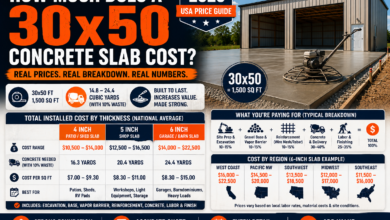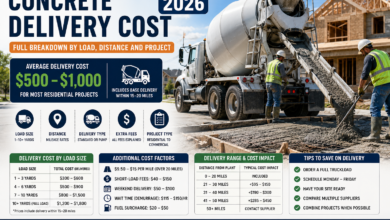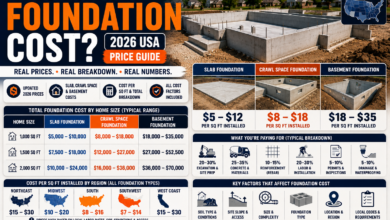
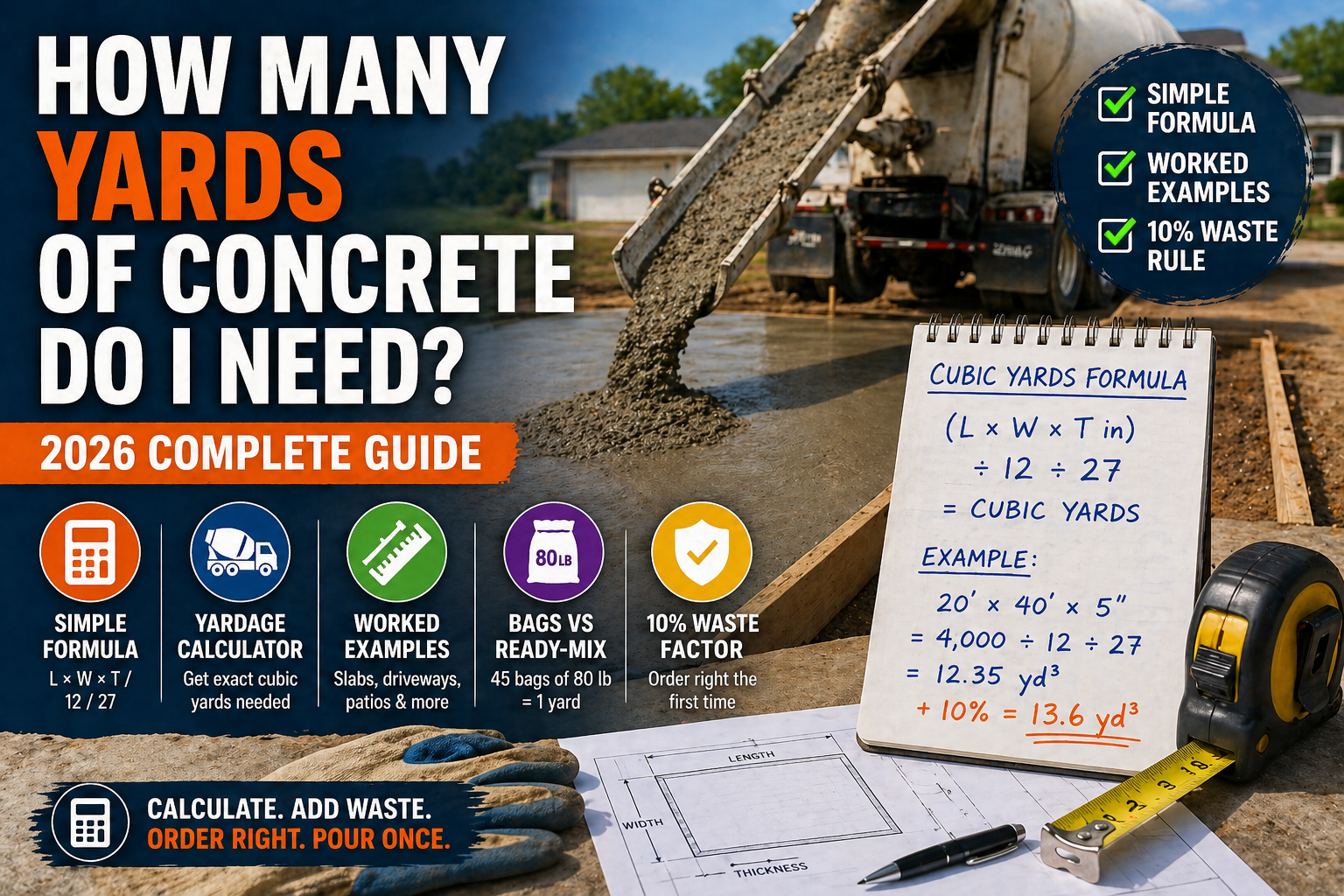
Ordering too little concrete means a second delivery charge and a cold joint in your slab. Ordering too much means paying for concrete that gets dumped on the ground. The formula to get it right is simple: Length x Width x Thickness (inches) / 12 / 27. This guide walks through that calculation for every common project type, explains when to use bags vs. ready-mix, and shows you exactly how to add a proper waste factor so you order right the first time.
The Cubic Yards Formula Explained
Concrete in the United States is sold by the cubic yard. One cubic yard equals 27 cubic feet – that’s a 3 ft x 3 ft x 3 ft cube of concrete. All your measurements need to convert to yards before placing an order. The easiest path is to work in feet and inches first, then convert at the end.
Here is the formula used by contractors and ready-mix plants across the country:
📐 The Concrete Cubic Yards Formula
Or written another way:
Cubic Yards = (Length ft x Width ft x Thickness ft) / 27
Step 1: Measure length and width in feet.
Step 2: Note your thickness in inches (most slabs are 4 or 5 inches).
Step 3: Multiply length x width x thickness in inches.
Step 4: Divide by 12 to convert thickness inches to feet.
Step 5: Divide by 27 to convert cubic feet to cubic yards.
Step 6: Multiply by 1.10 to add the 10% waste factor.
The division by 12 converts your thickness from inches to feet. The division by 27 converts cubic feet to cubic yards. Those two steps are the ones most people forget – which is why orders come up short. Always run through both conversions before calling the plant.
For a faster route, use our concrete cubic yard calculator – enter your dimensions and it handles every step automatically.
Ready-mix trucks in the US carry 8 to 11 cubic yards per load. Billing by the yard keeps numbers practical. One cubic yard of concrete weighs approximately 4,050 pounds. Knowing you need 9 yards is far more useful than saying you need 243 cubic feet – even though they’re the same volume. Our concrete volume calculator handles all unit conversions for you.
Worked Examples by Project Type
We recently published a detailed step-by-step Medium article explaining slab concrete calculations, real examples, bag conversions, contractor tips, and 2026 pricing updates.
The formula is the same for every project. What changes is the dimensions and the thickness. Here are step-by-step calculations for the most common residential concrete projects.
Concrete Slab
A 20 ft x 20 ft slab at 4 inches thick:
- 20 x 20 x 4 = 1,600
- 1,600 / 12 = 133.3 cubic feet
- 133.3 / 27 = 4.94 cubic yards
- With 10% overage: order 5.4 cubic yards
Use our concrete slab calculator to get this result instantly for any slab size and depth.
Concrete Driveway
A standard two-car driveway at 20 ft x 40 ft, 5 inches thick:
- 20 x 40 x 5 = 4,000
- 4,000 / 12 = 333.3 cubic feet
- 333.3 / 27 = 12.35 cubic yards
- With 10% overage: order 13.6 cubic yards
For a complete driveway material estimate including PSI recommendations, use the concrete driveway calculator.
Concrete Patio
A 16 ft x 20 ft patio at 4 inches thick:
- 16 x 20 x 4 = 1,280
- 1,280 / 12 = 106.7 cubic feet
- 106.7 / 27 = 3.95 cubic yards
- With 10% overage: order 4.35 cubic yards – round up to 4.5
The concrete patio calculator also estimates finish and sealer quantities for decorative work.
Concrete Foundation or Footing
Foundation calculations use the same formula but often deal with long, narrow strips. For a perimeter footing that is 60 linear feet, 18 inches wide, and 12 inches deep:
- Convert all to feet: 60 ft long, 1.5 ft wide, 1 ft deep
- 60 x 1.5 x 1 = 90 cubic feet
- 90 / 27 = 3.33 cubic yards
- With 10% overage: order 3.67 cubic yards
For foundation projects with multiple footing sections, the concrete foundation calculator handles each section separately and totals them automatically.
💼 Example: Backyard Project in Austin, TX
Project: 12×24 ft concrete patio + 10×10 ft pad for an outdoor kitchen
Thickness: 4 inches throughout
Patio volume: 12 x 24 x 4 / 12 / 27 = 3.56 cubic yards
Kitchen pad volume: 10 x 10 x 4 / 12 / 27 = 1.23 cubic yards
Total before overage: 4.79 cubic yards
With 10% overage: 5.27 cubic yards – order 5.5 cubic yards
Concrete spec: 3500 PSI (mild Texas climate, no freeze-thaw)
Estimated ready-mix cost: $935-$1,018 at $170-$185 per yard
Quick Reference Table: Common Project Sizes
Use this table to quickly estimate cubic yards needed for the most common residential project sizes. All figures include a 10% overage factor and assume 4-inch thickness unless noted.
| Project | Dimensions | Thickness | Net Cu Yd | Order (with 10%) |
|---|---|---|---|---|
| Small shed pad | 10×10 ft | 4 in | 1.23 yd | 1.35 yd |
| 12×12 patio | 12×12 ft | 4 in | 1.78 yd | 1.96 yd |
| One-car garage slab | 12×20 ft | 4 in | 2.96 yd | 3.26 yd |
| Standard patio | 16×20 ft | 4 in | 3.95 yd | 4.35 yd |
| Two-car garage slab | 20×22 ft | 4 in | 5.43 yd | 5.97 yd |
| Single driveway | 10×40 ft | 5 in | 6.17 yd | 6.79 yd |
| Two-car driveway | 20×40 ft | 5 in | 12.35 yd | 13.59 yd |
| House foundation slab | 40×50 ft | 6 in | 37.04 yd | 40.74 yd |
🧮 Get Your Exact Cubic Yards in Seconds
Enter your project dimensions and our calculator returns cubic yards, bags, and cost estimates with the waste factor already built in.
Use Yardage Calculator →The 10% Waste Factor Rule
Your calculated volume is the theoretical amount of concrete needed to fill a perfectly uniform space. Real projects are never perfectly uniform. The subgrade has minor high and low spots. Forms flex slightly under pressure. Some concrete spills or stays in the chute. Measurement errors happen too.
The standard industry practice is to add 10% to every concrete order. For a calculated need of 5 cubic yards, order 5.5 yards. For 10 yards, order 11.
When should you go higher than 10%?
- Uneven or rocky subgrade: Go to 12-15% overage. Low spots in the base consume more concrete than your measurements account for.
- Complex shapes with many cutouts: Use 12% – more cuts and forms mean more potential for error.
- Long-distance pumping: Pump hoses retain concrete. Add an extra 0.25-0.5 yards for pump waste beyond your 10%.
- Very small orders under 2 yards: Consider adding 15% since proportional waste is higher on small pours.
If you run out of concrete before completing a section, you’ll have to stop the pour and create a cold joint – a visible, structurally weaker seam where fresh concrete meets partially set concrete. A cold joint in a driveway or slab is nearly impossible to repair invisibly. Always order slightly more than you think you need. Leftover concrete can go toward a small pad, stepping stones, or post holes.
Bags vs. Ready-Mix: Which One to Order
The decision between bagged concrete and ready-mix delivery comes down to project volume, available labor, and cost. The general rule: use bags for projects under 1 cubic yard, and order ready-mix for anything larger.
When to Use Bags
Bags make sense for:
- Post holes for fence posts or mailboxes
- Small repair patches and step replacements
- Stepping stones and garden borders
- Any project under 0.5 to 1.0 cubic yards total
Mixing bags by hand or with a small electric mixer is slow and exhausting. At 1 cubic yard, you need to mix 45 bags of 80 lb concrete – a full day of hard labor for one person. Ready-mix delivers that same yard in about 5 minutes of truck chute time.
When to Order Ready-Mix
Ready-mix is the right call when:
- Your project needs more than 1 cubic yard
- You need consistent quality throughout a large pour
- You’re working with a slab that needs to be poured and finished in one session
- You need a specific PSI or air-entrained mix for a cold-climate driveway
Most ready-mix plants charge a short load fee for orders under 5 to 7 cubic yards – typically $50-150 extra. Factor that into your cost comparison when deciding between bags and a small truck order. For projects in the 1-3 yard range, the fee can sometimes shift the math back toward bags. See our ready-mix concrete cost guide for current 2026 pricing.
Under 1 yard: bags are practical. 1-3 yards: compare bag cost vs. ready-mix plus short load fee. Over 3 yards: ready-mix is almost always cheaper and faster. Use our yards to bags calculator to see the exact bag count and cost comparison for your project size.
How Many Bags per Cubic Yard
If bags are the right choice for your project, here’s exactly how many you need per cubic yard based on bag weight. These figures account for the fact that dry mix volume shrinks slightly when water is added and the concrete consolidates.
| Bag Size | Volume per Bag | Bags per Cu Yd | Bags per Cu Ft | Approx Cost per Yd (2026) |
|---|---|---|---|---|
| 80 lb bag | 0.022 cu yd / 0.60 cu ft | 45 bags | 1.67 bags | $215-$270 |
| 60 lb bag | 0.017 cu yd / 0.45 cu ft | 60 bags | 2.22 bags | $225-$285 |
| 50 lb bag | 0.013 cu yd / 0.375 cu ft | 74 bags | 2.67 bags | $245-$310 |
| 40 lb bag | 0.011 cu yd / 0.30 cu ft | 90 bags | 3.33 bags | $270-$340 |
The 80 lb bag is the most cost-effective option – it yields the most concrete per dollar. The tradeoff is weight. If you have back concerns or limited help, 60 lb bags are more manageable without a significant cost penalty. Use our concrete bag calculator to get the exact bag count and total cost for your project volume.
Calculating Irregular Shapes
Most concrete projects aren’t perfect rectangles. L-shaped patios, curved driveways, and multi-section pads all require a slightly different approach – but the math stays simple.
L-Shaped or Multi-Section Projects
Break the shape into two or more rectangles. Calculate each section separately using the formula, then add the results together.
Example – an L-shaped patio with a 12×16 ft section and a 10×8 ft extension, both at 4 inches thick:
- Section A: 12 x 16 x 4 / 12 / 27 = 2.37 cu yd
- Section B: 10 x 8 x 4 / 12 / 27 = 0.99 cu yd
- Total: 3.36 cu yd + 10% = 3.7 cu yd to order
Circular Slabs and Pads
For round pads, use the circle area formula: Area = 3.14 x radius x radius. Then apply the standard thickness conversion.
Example – a 12 ft diameter circular pad at 4 inches thick:
- Radius = 6 ft
- Area = 3.14 x 6 x 6 = 113 sq ft
- 113 x 4 / 12 / 27 = 1.40 cu yd
- With 10% overage: order 1.54 cu yd
For any shape, our concrete volume calculator handles rectangles, circles, and cylinders with no manual math needed.
Measure twice in each direction and use the average. For sloped or uneven areas, measure at the deepest planned point for thickness. Include any cutouts like landscaping beds inside a patio and subtract them from total area before calculating. Read our full guide on how to measure concrete properly for step-by-step field measurement techniques.
What a Yard of Concrete Costs in 2026
Understanding volume is only half the equation – cost is the other. Ready-mix prices vary by region, PSI, and market conditions. These are typical ranges for delivered concrete in 2026 across the United States:
- 2500 PSI: $130-$145 per cubic yard
- 3000 PSI: $155-$175 per cubic yard
- 3500 PSI: $165-$185 per cubic yard
- 4000 PSI: $175-$195 per cubic yard
- 5000 PSI: $200-$250+ per cubic yard
Short load fees for orders under 5-7 cubic yards typically run $50-150. Pump truck rental for hard-to-reach areas adds $400-800 per day. Saturday or after-hours delivery often adds $50-100 per load.
For a full breakdown of what affects ready-mix pricing and how to get the best quotes in your area, see our ready-mix concrete cost per yard guide.
Tips for Ordering Ready-Mix Concrete
Getting the yardage right is step one. Getting the order placed correctly is step two. These are the details that matter when you call the plant.
What Information to Have Ready
- Total cubic yards needed – with your 10% overage already added
- Required PSI – 4000 PSI for most northern driveways and exterior slabs; 3000-3500 PSI for mild climates
- Air entrainment needed? – yes for any exterior slab in a freeze-thaw climate
- Slump preference – 4-5 inch slump is standard for most flatwork; ask the plant if you’re unsure
- Delivery date and time window – have your forms, base, and crew ready before the truck arrives
- Site access details – truck clearance, distance from street to pour location
Minimum Order Sizes and Short Load Fees
Most ready-mix plants have a minimum order of 1 cubic yard. Some require a minimum of 3-4 yards before waiving the short load fee. Call your local plant to confirm their minimum and fee policy before finalizing your order. If you’re slightly under their minimum, it’s often worth rounding up rather than paying the surcharge.
When to Get Multiple Quotes
For any order over 5 cubic yards, get at least two quotes from different plants. Prices vary by $10-25 per yard between plants in the same city. On a 10-yard order, that difference is $100-250. On a 40-yard foundation pour, it can be $400-1,000. Use our ready-mix and bags calculator to build a detailed materials list before calling for quotes.
📦 Calculate Your Full Concrete Order
Get cubic yards, bag counts, cost estimates, and ready-mix specs for any project – all in one place.
Use the Main Concrete Calculator →🎯 Key Takeaways: How Many Yards of Concrete You Need
- The formula is: Length (ft) x Width (ft) x Thickness (in) / 12 / 27 = cubic yards
- Always add 10% to your calculated volume before placing any concrete order
- One cubic yard equals 27 cubic feet and weighs approximately 4,050 pounds
- Use bags for projects under 1 cubic yard; order ready-mix for anything larger
- One cubic yard requires approximately 45 bags of 80 lb, 60 bags of 60 lb, or 90 bags of 40 lb concrete
- A standard 4-inch, 20×20 ft slab needs about 5.4 cubic yards with overage
- A standard two-car driveway at 20×40 ft, 5 inches thick needs about 13.6 cubic yards with overage
- Ready-mix costs $155-$195 per cubic yard in 2026 depending on PSI and location
- Short load fees add $50-150 for orders under 5-7 cubic yards at most plants
- For irregular shapes, break the area into rectangles or circles, calculate each, and add the totals
- Running out mid-pour creates a cold joint – always better to order slightly more than come up short
- Get at least two ready-mix quotes for any order over 5 cubic yards
Frequently Asked Questions
🔧 Ready to Calculate Your Project?
Use our free calculators to get exact cubic yards, bag counts, and cost estimates for any concrete project – slabs, driveways, patios, and foundations.
Explore All Calculators →🔧 Concrete Volume Calculators
- → Main Concrete Calculator – Full project calculator with volume, bags, and cost
- → Concrete Yardage Calculator – Calculate cubic yards from any dimensions
- → Cubic Yard Calculator – Fast cubic yard converter for rectangular slabs
- → Concrete Volume Calculator – Handles rectangles, circles, and multi-section projects
- → Yards to Bags Calculator – Convert cubic yards to 40, 60, or 80 lb bag counts
- → Concrete Bag Calculator – Total bags needed with cost comparison
- → Ready-Mix vs. Bags Calculator – Side-by-side cost comparison for your volume
📐 Project-Specific Calculators
- → Concrete Slab Calculator – Volume and cost for any slab dimensions and depth
- → Concrete Driveway Calculator – Driveway material estimate with PSI recommendations
- → Concrete Patio Calculator – Patio volume with finish and sealer estimates
- → Concrete Foundation Calculator – Volume for multi-section footings and foundations
📚 Related Guides
- → How to Calculate Concrete – Complete formula and step-by-step calculation guide
- → How to Measure Concrete Properly – Field measurement techniques before pouring
- → Concrete Formula Calculation Guide – All formulas used in concrete volume and cost math
- → Ready-Mix Concrete Cost Per Yard Guide – 2026 pricing by PSI, region, and order size