
When Can You Drive on Concrete? (2026 Complete Guide)
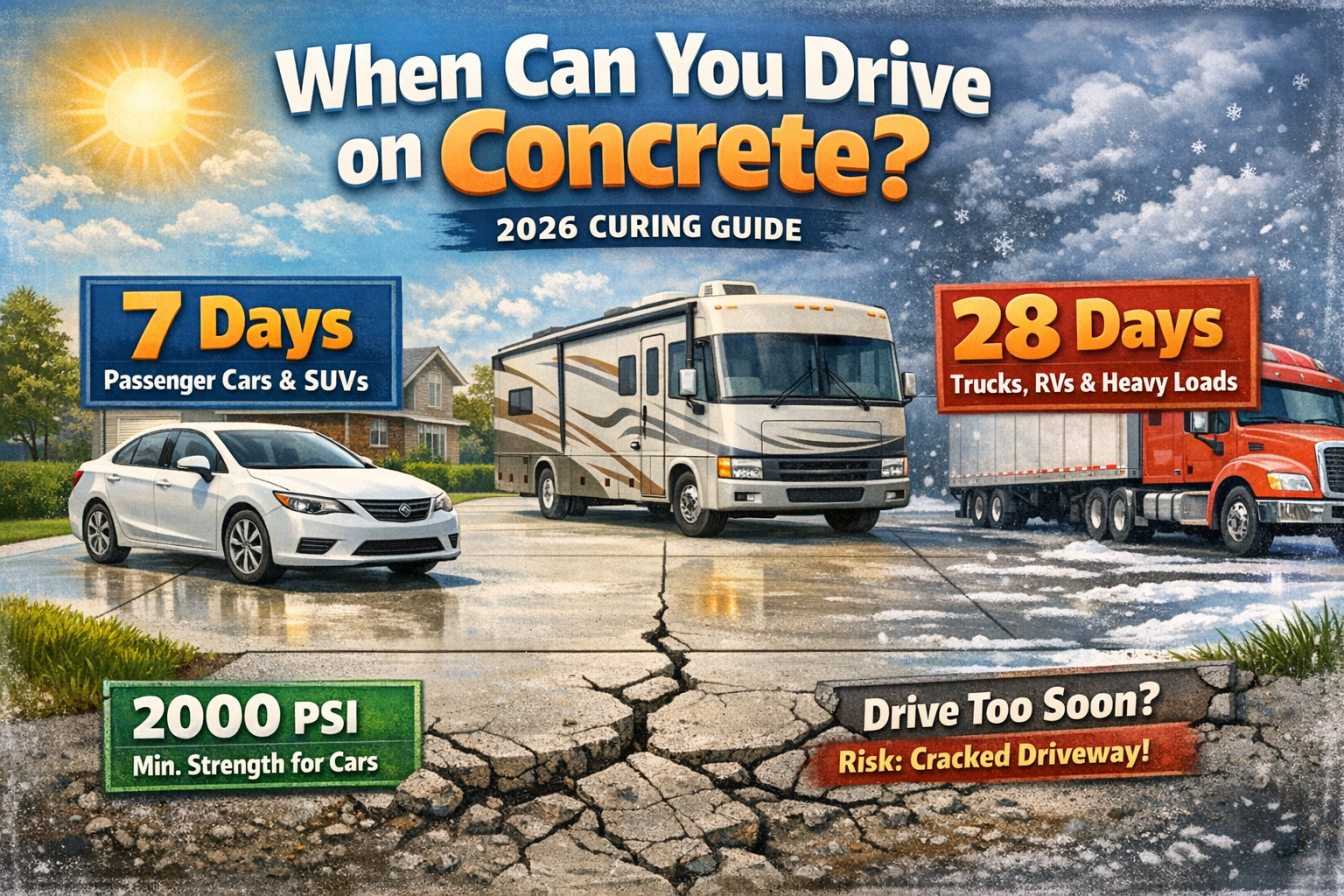
The bottom line: You can drive on new concrete after 7 days for passenger cars and light vehicles. For heavy trucks, RVs, and loaded trailers, wait the full 28 days. Drive on it too soon and you’re looking at permanent cracks that can’t be patched – just a full demolish and repour. This guide covers when you can drive on concrete for every vehicle type, how weather changes the timeline, and how to avoid the most expensive mistake homeowners make after a fresh driveway pour.
Why Timing Matters More Than You Think
You just had a new concrete driveway poured and it looks perfect. The surface is smooth, the edges are clean, and you want to park your car on it. The temptation to use it early is real – but this is exactly where homeowners cost themselves thousands of dollars.
Driving on concrete before it’s ready doesn’t just leave tire marks. It causes structural cracking that starts small, widens every winter as water freezes inside the crack, and eventually requires a full slab replacement. There’s no effective patch for early-load cracking – once the damage is done, it’s done.
What “Not Ready” Actually Means
Concrete isn’t a material that’s either ready or not ready at a single point in time. It gains strength gradually over 28 days – and beyond. The question isn’t whether it’s “set” (it sets within hours) but whether it has developed enough compressive strength to support the load you’re planning to put on it.
A standard 3000 PSI concrete mix means it will reach 3,000 pounds per square inch of compressive strength at 28 days. At 7 days, it’s typically only at 1,950-2,100 PSI – about 65-70% of its design value. That’s enough for a car. It is not enough for a loaded pickup truck, RV, or delivery vehicle. Getting this wrong means a cracked driveway you’ll be looking at for years.
How Concrete Builds Strength Over Time
Concrete strength development isn’t a straight line. It curves sharply upward in the first week, then flattens out as it approaches its 28-day design value. Understanding this curve is what separates homeowners who protect their investment from those who crack their new driveways.
The Hydration Reaction
When water mixes with cement, a chemical reaction called hydration begins. Cement particles react with water to form calcium silicate hydrate (C-S-H) crystals that interlock and create the rigid structure we recognize as concrete. This is why concrete doesn’t just “dry” – it actually transforms chemically, and that transformation takes time.
The critical point: hydration requires water. If you let fresh concrete dry out too fast – through hot sun, dry wind, or lack of moisture – the reaction stops prematurely and the concrete never reaches its rated design strength. This is why proper curing is as important as proper mixing. For everything you need to know about the curing process, see the concrete curing and drying time guide.
Why the 28-Day Rule Exists
The 28-day strength rating is an industry standard established by ASTM C39 testing protocols. Engineers design slabs to meet this benchmark – which means all the load calculations for your driveway assume concrete at full 28-day strength. When you load it early, you’re putting design loads on a slab that isn’t at its design strength yet.
💡 A Simple Way to Think About It
Imagine concrete strength like a battery charging. At 7 days it’s at 65-70% charge – good enough to run light devices (passenger cars) but not heavy equipment (trucks, RVs). At 28 days it’s fully charged and rated for everything on the spec sheet. Running heavy loads on a 70% battery doesn’t just drain it – it damages it permanently.
Use the concrete PSI strength calculator to estimate your slab’s compressive strength at any point in the curing process based on your mix design and temperature.
When Can You Drive on Concrete – Cars and SUVs
For standard passenger cars, crossovers, and light SUVs – anything under approximately 6,000 lbs gross vehicle weight – the industry standard waiting period before driving on new concrete is 7 days.
What “7 Days” Assumes
The 7-day guideline is based on standard conditions. Before you mark day 7 on the calendar and pull in, confirm these conditions were met:
- Temperature stayed above 50°F throughout the first 7 days
- No freezing occurred during the curing period
- The surface was kept moist or a curing compound was applied after finishing
- Standard 3000-4000 PSI mix was used (not a rapid-set or specialty product)
- No heavy rain in the first 24 hours after the pour
If any of these conditions weren’t met – especially if it got cold – add more time. A week at 45°F is not the same as a week at 70°F. In cold conditions, 10 days is a safer target before passenger vehicle use.
Before driving on day 7, do a quick scratch test. Try to scratch the surface with a nail or key. If you can’t leave a mark, the surface hardness is good. If the surface scratches easily or produces powder, give it a couple more days. This isn’t a precise strength test, but it’s a practical gut check before committing a vehicle.
💼 Example: Residential Driveway Pour Schedule
You poured a new 20×40-foot concrete driveway on Monday, February 10, 2026. Here’s your exact use timeline:
Day 1 (Feb 10): Pour day – keep everyone off, apply curing compound
Day 2-3 (Feb 11-12): No foot traffic – surface still gaining early strength
Day 3 (Feb 13): Light foot traffic okay if temps stayed above 60°F
Day 7 (Feb 17): Passenger cars and light SUVs may use the driveway
Day 14 (Feb 24): Light trucks and loaded vehicles under 10,000 lbs
Day 28 (March 10): Full loads – heavy trucks, RVs, all equipment
Plan your driveway materials with the concrete driveway calculator – includes 2026 material costs and cubic yard estimates.
Heavy Trucks, RVs, and Equipment Load Timelines
Heavy vehicles are where the “wait 28 days” rule becomes non-negotiable. A passenger car weighs 3,000-4,500 lbs. A loaded half-ton pickup can weigh 8,000+ lbs. A Class A motorhome can tip the scales at 30,000+ lbs. These loads concentrate massive force through the tire contact patches – and they will crack concrete that hasn’t reached full design strength.
Vehicle Weight Guide for Concrete Load Planning
| Vehicle Type | Typical Weight (lbs) | Min. Days Before Use | Min. Slab Thickness |
|---|---|---|---|
| Compact/Sedan car | 2,800-3,800 | 7 days | 4 inches |
| SUV / Crossover | 3,500-5,500 | 7 days | 4-5 inches |
| Light pickup truck (empty) | 4,500-6,000 | 7 days | 5-6 inches |
| Loaded 1/2-ton pickup | 6,000-8,500 | 14 days | 6 inches |
| Loaded 3/4 or 1-ton pickup | 8,500-14,000 | 28 days | 6-8 inches |
| Class B/C Motorhome | 8,000-16,000 | 28 days | 6-8 inches |
| Class A Motorhome | 18,000-30,000+ | 28+ days | 8 inches minimum |
| Delivery/Box truck | 10,000-26,000 | 28 days | 6-8 inches |
| Construction equipment | Varies widely | 28 days | Engineer to specify |
One of the most common causes of early driveway cracking is allowing a delivery vehicle to pull onto new concrete before 28 days. Amazon, UPS, FedEx, and fuel trucks often weigh 10,000-26,000 lbs when loaded. A single pass from a delivery truck on day 10 can crack a fresh slab. Post a visible sign at the driveway entrance and notify expected delivery services about your new driveway during the curing period.
Before deciding on slab thickness for your driveway, use the slab thickness calculator to match your depth to your heaviest expected vehicle. Then verify the finished slab can handle it with the concrete load calculator.
🚛 Will Your Slab Handle the Load?
Check whether your driveway thickness and PSI rating can safely support your heaviest vehicle once fully cured – before you drive on it.
Use the Load Calculator →Concrete Strength Gain Chart by Day
Here’s the day-by-day concrete strength gain chart for a standard 3000 PSI mix (Type I/II Portland cement) cured at 70°F with proper moisture retention. These figures align with typical ASTM C39 testing values used by engineers and ready-mix suppliers across the US.
| Curing Age | % of 28-Day Strength | Approx. PSI (3000 PSI Mix) | Safe Activity |
|---|---|---|---|
| 12 hours | ~8% | ~240 PSI | No contact at all |
| 1 day | ~16% | ~480 PSI | No contact at all |
| 2 days | ~30% | ~900 PSI | Very careful foot traffic |
| 3 days | ~40% | ~1,200 PSI | Normal foot traffic |
| 7 days | ~65-70% | ~1,950-2,100 PSI | Passenger cars/light SUVs |
| 14 days | ~85% | ~2,550 PSI | Light trucks, loaded pickups |
| 21 days | ~92% | ~2,760 PSI | Most vehicles except heavy loads |
| 28 days | 100% | 3,000 PSI | All vehicles, full design loads |
| 90 days | ~115-120% | ~3,450-3,600 PSI | Maximum long-term strength |
For higher-strength mixes (4000-5000 PSI), the curve looks similar but reaches higher absolute values at each stage. Use the concrete PSI strength calculator to see the strength profile for your specific mix. For the complete formula breakdown behind these numbers, see the concrete formula calculation reference page.
Minimum Strength Threshold Formula
Engineers use bearing pressure calculations – the load calculator does this automatically for your slab and vehicle type
How Weather Affects Concrete Driveway Curing Timeline
Weather is the variable that throws off the most homeowners. The 7-day rule assumes 60-80°F temperatures and proper moisture. Drop below 50°F or climb above 90°F and all bets are off without adjustments.
Cold Weather – The Biggest Risk
Below 50°F, the hydration reaction slows dramatically. Below 40°F, it nearly stops. Concrete that freezes before reaching 500 PSI of compressive strength is permanently damaged – the ice expansion disrupts the forming crystal structure in a way that can’t be fixed.
| Average Temperature (First 7 Days) | Adjusted Days Before Car Traffic | Adjusted Days for Heavy Vehicles |
|---|---|---|
| Above 70°F | 6-7 days | 25-28 days |
| 60-70°F | 7 days | 28 days |
| 50-60°F | 8-10 days | 30-35 days |
| 40-50°F | 10-14 days | 35-42 days |
| Below 40°F | 14+ days (with heating) | 42+ days (with heating) |
| Below 32°F (freezing) | Not safe without cold weather protection per ACI 306 | Consult engineer |
Hot Weather – Faster Isn’t Always Better
In temperatures above 85-90°F, concrete sets faster on the surface. You might think this means you can drive sooner – but hot weather curing without proper moisture retention often results in lower final strength than cold-weather curing with protection. The surface dries before the interior has fully hydrated.
- In temperatures above 90°F, apply a curing compound immediately after finishing to lock in moisture
- Cover the slab with wet burlap and plastic sheeting if possible for the first 3-5 days
- Avoid pouring in direct afternoon sun above 90°F – early morning pours are best
- The hot-weather vehicle timeline (7 days for cars) holds as long as moisture was retained
Get an adjusted, weather-specific curing timeline using the concrete curing temperature calculator before finalizing your drive-on date. And check set timing before your pour with the concrete set time calculator.
🌡️ Get Your Weather-Adjusted Curing Timeline
Enter your location’s forecast temperatures and concrete mix to get a precise day-by-day strength and readiness timeline for your specific project.
Calculate My Curing Timeline →Driveway Thickness and Vehicle Load Capacity
Thickness and PSI strength work together to determine how much load a slab can handle. A thin 4-inch slab of 5000 PSI concrete can still fail under a heavy point load. Getting the thickness right is just as important as waiting the right number of days.
Standard Driveway Thickness by Use
For residential driveways in most US jurisdictions, code minimum is 4 inches – but the practical recommendation for any driveway that will see regular car traffic is 5-6 inches. The extra inch or two of concrete costs roughly $180-250 more on a typical two-car driveway in 2026, but it dramatically extends the life of the slab and allows heavier vehicles without risk.
To estimate exactly how much material you need for your driveway at various thicknesses, use the driveway concrete calculator. For garage floor pours, the garage floor calculator covers that specific use case. And for the full pour process, the guide on how to pour a concrete driveway walks through every step from subgrade prep to finishing.
How to Protect New Concrete in the First 28 Days
Knowing when you can drive on concrete is only half the equation. The other half is actively protecting the slab during the curing window so it actually reaches its rated strength on schedule.
First 24 Hours – The Most Critical Window
The surface is most vulnerable in the first 24 hours. Protect it from:
- Rain within 4-6 hours of finishing: Heavy rain can wash out the surface cement paste and cause pitting. Light rain after 6 hours is usually harmless.
- Direct sun and dry wind: Can cause plastic shrinkage cracking before the concrete even sets fully. Apply curing compound within 20-30 minutes of final finishing.
- Any foot traffic: Even light footsteps can leave impressions before 24 hours. Barricade the area.
- Freezing temperatures: Cover with insulated blankets if temps may drop below 40°F overnight.
Days 1-7 – Maintain Moisture
The single most impactful thing you can do after a pour is keep the surface moist. ACI 308 standards recommend a minimum of 7 days of moist curing for Type I/II cement at temperatures above 50°F. Your options:
- Curing compound: Sprayed on immediately after finishing – forms a membrane that traps moisture inside the slab. Cost: $18-30 per gallon, covers ~200 sq ft. Most convenient option.
- Wet burlap + plastic sheeting: Lay wet burlap on the surface, cover with plastic to hold moisture in. Re-wet the burlap daily. Labor-intensive but highly effective.
- Ponding: Building small earth dams around the perimeter and flooding the surface with water. Very effective for flat slabs in hot weather.
Concrete cured with moisture for 28 days is approximately 50% stronger than concrete that was allowed to air-dry from day 1. That’s not a rounding error – it’s the difference between a driveway that lasts 30 years and one that starts cracking and scaling in 8-10 years. The $30-60 you spend on a curing compound is one of the highest-ROI investments in any concrete project.
Days 7-28 – Manage Traffic and Loads
- Allow only passenger vehicle traffic from day 7, parked away from slab edges
- Keep heavy trucks, delivery vehicles, and equipment completely off the slab
- Avoid sharp turns on the surface – they generate lateral stress that can crack young concrete
- Don’t apply sealer until after the full 28-day mark – sealing too early traps moisture and can cause delamination
- Keep the surface clean – de-icing salts in winter are extremely damaging to concrete under 90 days old
For more detail on the finishing steps right after your pour, the how to finish concrete guide covers surface treatment, edging, and curing compound application. For the mixing ratios that affect your final strength, see concrete mixing instructions.
Calculators for Planning Your Pour
Getting the timing right starts before the truck arrives. Knowing your cubic yards, slab thickness, mix design, and local weather conditions all feed into the drive-on timeline. These calculators cover every variable.
Material Planning
- Driveway Concrete Calculator – Cubic yards and 2026 pricing for your exact driveway size
- Concrete Slab Calculator – For patios, garage floors, and general slabs
- Concrete Yardage Calculator – Quick volume conversion from your measurements
- Ready-Mix Truck Calculator – How many loads your job requires
- Concrete Weight Calculator – Total slab weight for structural planning
Strength and Timing
- Concrete Set Time Calculator – When will your pour hit initial and final set?
- Curing Temperature Calculator – Weather-adjusted timeline for when you can drive on concrete
- PSI Strength Calculator – Day-by-day strength estimate for your mix design
- Slab Thickness Calculator – Right depth for your vehicle load requirements
- Concrete Load Calculator – Verify slab can handle your heaviest vehicle
Cost Planning
If you’re still in the planning phase and weighing your options, these tools and comparisons help with the big-picture decision:
- Concrete Driveway Cost Calculator – Full 2026 pricing with labor and material breakdown
- Concrete vs. Asphalt Driveways – Side-by-side cost and durability comparison
- Gravel vs. Concrete Driveway – When gravel makes sense and when it doesn’t
🎯 Key Takeaways
- 7 days for passenger cars: When you can drive on concrete depends on vehicle type – standard cars and light SUVs are safe at 7 days under normal conditions.
- 14 days for loaded pickups: Trucks carrying heavy loads should wait at least 14 days – they’re well above the “light vehicle” threshold.
- 28 days for everything heavy: RVs, box trucks, construction equipment, and loaded trailers must wait the full 28-day curing period.
- 3 days is always too early: At 3 days, concrete is only at 40% design strength – driving on it is a leading cause of permanent driveway cracking.
- Cold weather extends every timeline: Below 50°F, add days to every milestone. Below 40°F, concrete barely cures without protection.
- Keep it moist for 7 days: Concrete that dries out too fast is permanently weaker – apply curing compound or wet burlap immediately after finishing.
- 6 inches is the real driveway standard: Code minimums of 4 inches aren’t enough for regular vehicle traffic – 5-6 inches is the practical standard.
- Post a sign for delivery trucks: A loaded delivery truck at day 10 is one of the most common causes of fresh driveway cracking – keep them off until 28 days.
- Don’t seal before 28 days: Sealing new concrete too early traps moisture and causes surface delamination.
- Use the calculators: The curing temperature and PSI strength calculators remove the guesswork from your specific conditions.
Frequently Asked Questions
For passenger cars and light SUVs (under 6,000 lbs), you can drive on new concrete after 7 days under normal temperature conditions (60-80°F) using standard 3000-4000 PSI concrete. At 7 days, concrete typically reaches 65-70% of its 28-day design strength – enough for passenger vehicle loads but not for heavy trucks or RVs. In cold weather, extend this timeline to 10-14 days.
No. At 3 days, a standard 3000 PSI concrete mix has only reached approximately 40% of its design strength – roughly 1,200 PSI. That’s not enough to safely handle vehicle loads. Driving on it at 3 days is one of the most common causes of permanent driveway cracking. The cracks start small, widen with freeze-thaw cycles, and eventually require full slab replacement. There’s no shortcut that makes 3 days acceptable for vehicle loads.
In cold weather, the concrete driveway curing timeline extends significantly. If average temperatures stayed between 50-60°F, plan on 8-10 days before passenger cars. Between 40-50°F, wait 10-14 days. Below 40°F, concrete needs additional protection (insulated blankets, heated enclosure) and even with proper care, you’re looking at 14+ days before vehicle use. Use the curing temperature calculator to get a precise timeline for your forecast conditions.
RVs should wait the full 28 days before parking on new concrete. Class A motorhomes can weigh 18,000-30,000+ lbs and Class B/C units run 8,000-16,000 lbs – these loads are far beyond the 7-day threshold for passenger vehicles. Additionally, make sure your slab is at least 6-8 inches thick and designed for RV loads – a standard 4-inch residential driveway slab will eventually fail under regular RV parking even after 28 days.
The minimum recommended compressive strength before allowing passenger vehicle traffic is approximately 2,000 PSI. For a standard 3000 PSI mix, this is typically achieved at 7 days under normal conditions. For heavier vehicles – anything over 6,000 lbs gross vehicle weight – wait for the full 28-day design strength (3,000 PSI for standard mixes). The concrete load calculator can check if your specific slab thickness and PSI handles your vehicle’s load at any strength level.
Driving on concrete before it’s strong enough causes permanent structural cracking – typically diagonal cracks near corners, or transverse cracks across the slab width where the bending stress is highest. These cracks allow water to enter the slab, which then freezes and expands every winter, widening the crack further. Over 5-10 years, what started as a hairline crack becomes a structural failure. These damage patterns can’t be repaired with crack fillers or resurfacing – the entire damaged section needs to be demolished and repoured.
Thickness doesn’t significantly change the timing for when vehicle traffic is first safe – the 7-day rule for passenger cars applies whether your slab is 4 or 6 inches thick. However, thickness directly affects how much load the slab can carry once cured. A 4-inch slab designed for 3,000 PSI cannot handle heavy truck loads even at 28 days – thickness and strength work together. Use the slab thickness calculator to make sure your driveway is designed correctly for its heaviest intended vehicle.
The most reliable method is simply tracking days since the pour and checking the temperature record. If 7 days have passed, temps stayed above 50°F, and moisture was maintained, you’re in the safe zone for passenger vehicles. For a quick surface check, try the scratch test – if a nail or key doesn’t leave a mark, surface hardness is adequate. For peace of mind on expensive pours, some contractors use a rebound hammer (Schmidt hammer) to get a non-destructive compressive strength estimate before approving vehicle access.
🧮 Plan Your Concrete Project With Confidence
From cubic yards to curing timelines – our free calculators give you the numbers you need before and after your pour. All updated with 2026 USA pricing.
View All Free Calculators →🔗 Related Calculators and Guides
- → Curing Temperature Calculator – Get your weather-adjusted drive-on timeline
- → Concrete PSI Strength Calculator – Day-by-day strength estimates for your mix
- → Concrete Set Time Calculator – Predict initial and final set based on temperature
- → Concrete Load Calculator – Verify your slab handles your heaviest vehicle
- → Driveway Concrete Calculator – Cubic yards and 2026 cost for any driveway size
- → Slab Thickness Calculator – Match your depth to your vehicle load requirements
- → Driveway Cost Calculator – Full 2026 pricing breakdown with labor and materials
- → Concrete Curing and Drying Time Guide – Complete guide to moisture retention and curing methods
- → How to Pour a Concrete Driveway – End-to-end guide from subgrade prep to finishing
- → Ready-Mix Truck Calculator – Plan delivery loads and batch quantities before ordering