4000 PSI Concrete Guide 2026: Uses, Mix Design, and Costs
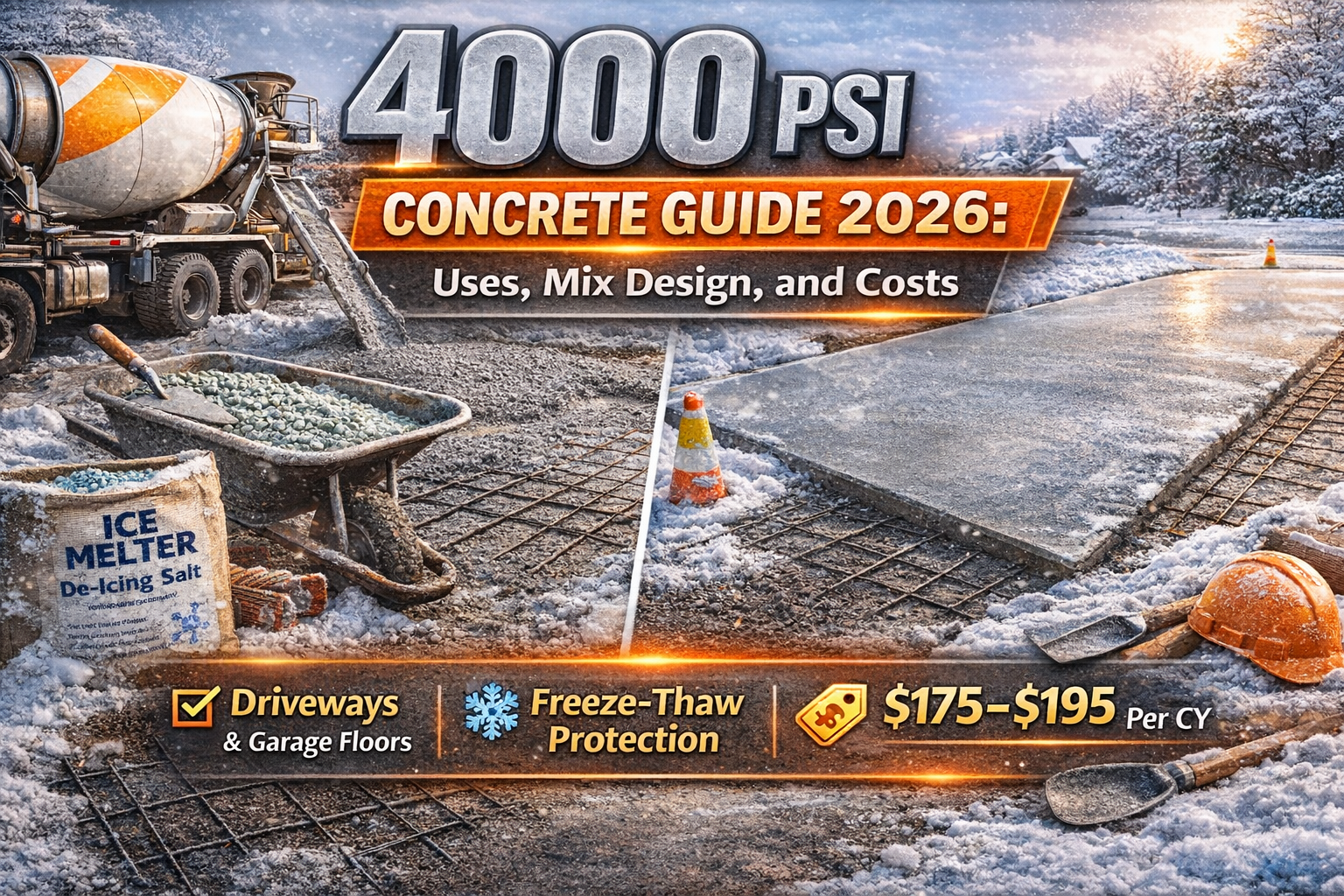
If you’re pouring a driveway, garage floor, or any exterior slab in a state that sees freezing winters, the 4000 PSI concrete guide answer is short: this is what you need, full stop. ACI 318 requires 4000 PSI minimum for concrete exposed to freeze-thaw cycles and deicing salts – and that covers most of the United States. This guide explains exactly where 4000 PSI is required, how the mix is designed, what it costs in 2026, and why using a lower grade in the wrong application is one of the most expensive mistakes you can make in residential construction.
What Is 4000 PSI Concrete?
4000 PSI concrete is a high-strength residential and light commercial grade that withstands 4,000 pounds of compressive force per square inch at 28 days of curing. It sits at the upper end of the standard residential strength range and is the minimum grade required by ACI 318 for any concrete exposed to freezing temperatures, deicing chemicals, or heavy structural loads.
In metric terms, 4000 PSI equals 27.6 MPa. If you’re working from structural drawings that use metric units, that’s the equivalent strength class. For the vast majority of US residential and light commercial projects in cold climates, 4000 PSI is not an upgrade – it’s the baseline requirement.
What Makes 4000 PSI Different From 3000 PSI
The key difference isn’t just the raw strength number. 4000 PSI concrete uses a water-cement ratio of 0.44-0.50, compared to 0.55-0.60 for 3000 PSI. That tighter ratio means less free water in the mix, fewer pores in the hardened concrete, and a structure that’s fundamentally denser and less permeable.
This reduced permeability is what matters for real-world performance. Less permeable concrete absorbs less water, which means less water available to freeze and expand inside the slab during cold weather. It also resists deicing salt penetration better, reducing corrosion of any embedded rebar. The 33% strength increase is significant, but the permeability reduction is what gives 4000 PSI its 30+ year exterior lifespan in cold climates.
Where 4000 PSI Fits in the Strength Scale
Concrete PSI grades for residential and light commercial work typically span 2500-5000 PSI. 4000 PSI is at the high end of what most residential ready-mix plants produce as a standard catalog item. Above 4000 PSI, you move into specialty structural territory that requires more sophisticated mix design with admixtures, silica fume, or fly ash. See our full concrete PSI guide for the complete strength grade spectrum.
The American Concrete Institute’s ACI 318 Building Code Requirements for Structural Concrete specifies 4000 PSI (27.6 MPa) as the minimum compressive strength for concrete exposed to freezing and thawing in a moist condition or to deicing chemicals. This is not a recommendation – it’s a minimum code requirement that applies to the vast majority of outdoor concrete applications across the northern and mountain United States. Contractors and homeowners who use 3000 PSI in these conditions are building out of code compliance.
When ACI 318 Requires 4000 PSI Concrete
The most important question for any concrete project isn’t “which PSI is cheapest” – it’s “what does the code require for my application and climate?” Here’s a clear breakdown of when 4000 PSI is required, not just recommended.
Freeze-Thaw Exposure (Exposure Class F1 and F2)
ACI 318 classifies concrete by exposure conditions. Class F1 applies to concrete exposed to freezing and thawing in a moist condition – this covers outdoor flatwork, patios, sidewalks, and driveways in any state that experiences temperatures below 32°F. Class F2 applies to concrete in frequent contact with water and freezing, such as pool decks and bridge decks.
For F1 exposure, ACI 318 requires 4000 PSI minimum with 4.5-7.5% air entrainment. For F2 exposure, the minimum rises to 4500 PSI. If you live anywhere north of roughly the 35th parallel – which takes in all of the Northeast, Midwest, Mountain West, and Pacific Northwest – virtually every outdoor concrete application falls into F1 or F2 exposure class.
Deicing Chemical Exposure (Exposure Class W2 and S)
Garage floors and driveways in northern states face a double threat: freeze-thaw cycling plus deicing salt penetration. Chloride ions from road salts penetrate porous concrete and accelerate rebar corrosion. The lower w/c ratio of 4000 PSI concrete significantly slows chloride penetration compared to 3000 PSI, which is why ACI 318 requires 4000 PSI for these applications.
Even in states where freezing is rare, if your driveway or garage floor is regularly exposed to road salts tracked in by vehicles, the 4000 PSI grade provides meaningfully better durability than 3000 PSI for this chemical exposure reason alone.
Structural Applications
For reinforced concrete beams, columns, and post-tensioned slabs, most structural engineers specify 4000-5000 PSI as a practical minimum. The higher strength improves the bond between concrete and rebar, increases shear capacity, and provides a safety margin above the code minimum. Our load-bearing calculator helps verify whether 4000 PSI meets the structural demands of your specific project.
Homeowners in states like Virginia, North Carolina, Tennessee, Missouri, and Kansas sometimes assume their climate is mild enough to skip the 4000 PSI upgrade for driveways. These states regularly see temperatures below 20°F in winter with significant freeze-thaw cycling. If your area has more than 10-15 freeze-thaw cycles per year, use 4000 PSI with air entrainment for any exterior flatwork. The repair bill for premature failure isn’t worth the $15-20 per cubic yard savings.
Best Applications for 4000 PSI Concrete
4000 PSI concrete is the right grade for a wide range of residential and commercial applications. Here’s where it delivers clear value over lower grades.
Driveways in Cold Climates
This is the most common and most important 4000 PSI application for residential projects. A driveway in Chicago, Denver, Boston, Minneapolis, or any northern city needs 4000 PSI with 5-7% air entrainment to survive the combination of vehicle loads, freeze-thaw stress, and deicing salt exposure. Done right with 4000 PSI, a residential driveway in a cold climate lasts 30-40 years with minimal maintenance.
Done wrong with 3000 PSI, the surface begins scaling at 3-5 years, develops pop-outs and cracks by year 8, and needs full replacement by year 12-15. The repair cost is $8,000-20,000 for a standard two-car driveway in 2026. The material cost difference between 3000 and 4000 PSI on that same driveway is $120-180. The math is clear. Use our driveway calculator to plan your project accurately.
Garage Floors
Garage floors face vehicle loads, oil spills, road salt tracked in by tires, and in attached garages, temperature swings as the door opens and closes in winter. 4000 PSI provides the surface hardness to resist tire scuffing, the density to resist oil penetration, and the durability to handle chemical and freeze-thaw stress simultaneously.
For residential garages in cold climates, 4000 PSI at 4-5 inches thick with wire mesh or rebar is the standard spec. For commercial garages or facilities where heavier vehicles operate, 4500-5000 PSI may be appropriate.
Exterior Patios and Flatwork in Cold Climates
Any poured concrete patio, pool deck, or exterior slab in a state that experiences regular freezing needs 4000 PSI. Patios are fully exposed to the sky, receive no roof protection from rain or snow, and sit directly on grade where ground moisture is always present. That combination of moisture and freeze-thaw is exactly the exposure condition ACI 318 defines as requiring 4000 PSI minimum.
Residential and Commercial Foundations
While 3000 PSI is technically acceptable for foundations in mild climates, 4000 PSI is strongly preferred and often required in cold, wet, or chemically aggressive soil environments. A residential foundation is arguably the most critical concrete in the building – it’s permanent, it can’t be easily repaired, and the consequences of failure are severe. The cost premium on a typical residential foundation pour (15-20 cubic yards) is $300-400 for 4000 vs 3000 PSI. That’s one of the best value-for-money upgrades in construction. Our foundation calculator handles the volume and cost math.
Structural Beams and Reinforced Elements
Reinforced concrete beams, lintels, columns, and any element with steel reinforcement benefit significantly from 4000 PSI. The higher compressive strength improves load capacity, the lower w/c ratio reduces the permeability that leads to rebar corrosion, and the denser paste provides better mechanical bond with steel bars. Use our beam calculator and load-bearing calculator for structural element analysis.
💼 Example: True Cost of Choosing 3000 vs 4000 PSI for a Driveway
Project: 20×22 ft (440 sq ft) two-car driveway in Columbus, Ohio (freeze-thaw climate)
Concrete volume: 440 sq ft x 5 inches thick / 12 = 183 cu ft = 6.8 cubic yards, plus 10% waste = 7.5 CY total
3000 PSI option: 7.5 CY x $165/CY average = $1,238 in material (wrong grade for this climate)
4000 PSI option: 7.5 CY x $183/CY average = $1,373 in material (correct ACI 318 grade)
Upfront difference: $135
Cost to replace failed 3000 PSI driveway at year 10: $9,000-14,000
Verdict: Use 4000 PSI. The $135 material difference is irrelevant against the replacement cost risk. Use our cost calculator to compare grades for your specific project dimensions.
🔢 Check 4000 PSI Strength for Your Project Loads
Enter your slab thickness and expected loads to verify 4000 PSI handles your specific project requirements safely.
Use Slab Load Calculator →4000 PSI Mix Design, Water-Cement Ratio, and Air Entrainment
Getting 4000 PSI performance from your concrete requires more than just ordering the right grade. The mix design, air entrainment specification, and on-site handling all affect whether you actually achieve 4000 PSI in the finished slab.
Standard Mix Proportions Per Cubic Yard
4000 PSI concrete uses more cement and less water than 3000 PSI – the fundamental recipe for higher strength. Here’s the standard design:
Standard 4000 PSI Mix Design (Per Cubic Yard)
Water: 282-329 lbs (34-39 gallons)
Fine aggregate (sand): 1,550-1,600 lbs
Coarse aggregate (3/4″ stone): 1,800-1,850 lbs
Water-cement ratio: 0.44-0.50
Air content (standard): 1-2%
Air content (freeze-thaw, ACI 318): 5-7%
Use our mix ratio calculator to adjust proportions for your aggregate type and project conditions.
The Critical Role of Air Entrainment
For any outdoor 4000 PSI application in a freeze-thaw climate, air entrainment is not optional – it’s part of the required specification. Air entrainment creates millions of microscopic air bubbles distributed throughout the paste. When water in the concrete freezes, these bubbles provide space for the ice to expand without building destructive internal pressure.
The ACI 318-required air content for 3/4-inch maximum aggregate in a severe freeze-thaw exposure zone is 6% (+/- 1.5%). You must specify this when ordering. Ask your supplier to confirm the target air content on the delivery ticket and check that it’s within the specified range. A batch with only 3% air in a cold climate gives you significantly less protection than 6% air – the relationship between air content and freeze-thaw resistance is not linear.
Admixtures for 4000 PSI Mixes
Most ready-mix plants use water-reducing admixtures (plasticizers or superplasticizers) in 4000 PSI mixes to achieve the low w/c ratio while maintaining workable slump. This allows the mix to flow and consolidate properly without adding water that would drop strength. If your pour requires high slump for pumping or complex forms, specify a mid-range or high-range water reducer rather than adding water on site.
Some 4000 PSI mixes incorporate fly ash or slag cement as partial cement replacements (up to 20-25%). These pozzolanic materials can improve long-term strength and reduce permeability further, but they slow early strength gain. If you need to load the slab within 10-14 days, confirm with your supplier whether blended cement is being used. See our w/c ratio calculator to understand how admixtures shift the strength-workability balance.
4000 PSI Concrete Cost in 2026
4000 PSI concrete costs more than 3000 PSI, but the premium is smaller than most people expect. Here’s the complete 2026 pricing picture.
Ready-Mix Pricing by Region (2026 Averages)
| Region | 3000 PSI per CY | 4000 PSI per CY | Upgrade Premium |
|---|---|---|---|
| Northeast (NY, MA, CT, NJ) | $165-185 | $185-210 | $18-28/CY |
| Southeast (FL, GA, SC, NC) | $145-165 | $165-185 | $15-22/CY |
| Midwest (IL, OH, MI, IN, WI) | $155-175 | $175-195 | $15-22/CY |
| South / Texas | $140-160 | $160-180 | $15-22/CY |
| Mountain West (CO, UT, ID, WY) | $155-175 | $175-200 | $18-28/CY |
| Pacific Coast (CA, WA, OR) | $165-195 | $185-215 | $18-25/CY |
Real Project Cost Examples in 2026
Here’s what 4000 PSI concrete material costs for common residential projects at average 2026 national pricing of $183/CY delivered:
| Project | Size | Thickness | CY (with 10% waste) | Material Cost |
|---|---|---|---|---|
| Two-car driveway | 20×22 ft (440 sq ft) | 5 inches | 7.5 CY | $1,373 |
| Standard patio | 16×20 ft (320 sq ft) | 4 inches | 4.3 CY | $787 |
| Two-car garage floor | 20×22 ft (440 sq ft) | 5 inches | 7.5 CY | $1,373 |
| Residential foundation | 40×60 ft perimeter | 8 inch wall, 36 LF | 18 CY | $3,294 |
| Sidewalk (public) | 4×60 ft (240 sq ft) | 4 inches | 3.3 CY | $604 |
These are concrete material costs only. Total installed costs add labor ($2.50-5.00/sq ft for flatwork), forms, rebar or wire mesh reinforcement, pump truck if needed ($800-1,500), and finishing. Use our cost per square foot calculator for complete project estimates. For your exact cubic yard calculation, our slab calculator includes the 10% waste factor automatically.
Air Entrainment Cost Addition
Specifying 5-7% air entrainment for freeze-thaw applications adds approximately $5-10 per cubic yard to the 4000 PSI base price at most ready-mix plants. On a 7-yard driveway pour, that’s $35-70 additional cost – truly negligible given the performance benefit. Always confirm air entrainment pricing separately when you call for a quote.
📐 Calculate Your 4000 PSI Concrete Quantities
Get exact cubic yards with waste factor built in for any slab, driveway, foundation, or structural element in 2026.
Use Slab Calculator →4000 PSI vs 3000 PSI vs 5000 PSI Concrete
Understanding how 4000 PSI relates to neighboring grades clarifies exactly what you’re gaining – or giving up – at each strength level.
4000 PSI vs 3000 PSI: The Key Differences
4000 PSI is 33% stronger than 3000 PSI in raw compressive strength. But the practical performance difference is much larger than 33% for cold-climate outdoor applications, because of the permeability difference driven by the lower w/c ratio.
3000 PSI concrete with a w/c ratio of 0.55-0.60 has noticeably more pore space than 4000 PSI at 0.44-0.50. Each freeze-thaw cycle pushes water into these pores, freezes it, and the expansion damages the paste structure incrementally. After 50 cycles, 3000 PSI shows measurable surface deterioration. After 200 cycles in a harsh climate like Minneapolis, it’s visibly failing. 4000 PSI with proper air entrainment can survive 500+ freeze-thaw cycles without significant deterioration. Use our PSI strength calculator to compare strength development timelines for both grades side by side.
4000 PSI vs 5000 PSI: When the Extra Strength Is Worth It
5000 PSI concrete costs $200-225 per cubic yard in 2026, or about $20-30 more per yard than 4000 PSI. For most residential applications, the performance difference over 4000 PSI is marginal. The strength increase (25%) helps in commercial floors, parking structures, post-tensioned slabs, and heavily loaded structural elements, but isn’t needed for standard driveways, patios, or residential foundations.
The main practical reason to go to 5000 PSI is structural engineering specification, not field preference. If your structural engineer calls for 5000 PSI on a project, don’t substitute 4000 PSI. If there’s no engineer specification, 4000 PSI handles virtually every residential application correctly.
| Specification | 3000 PSI | 4000 PSI | 5000 PSI |
|---|---|---|---|
| Compressive strength (28 days) | 3,000 PSI | 4,000 PSI | 5,000 PSI |
| Water-cement ratio | 0.55-0.60 | 0.44-0.50 | 0.35-0.44 |
| Typical 2026 cost/CY | $155-175 | $175-195 | $200-225 |
| ACI 318 freeze-thaw compliance | No (F1/F2 exposure) | Yes (F1 exposure) | Yes (all exposure) |
| Driveway (cold climate) | Not code compliant | Yes – required | Yes – over-spec |
| Residential foundation | Acceptable (mild) | Preferred | Over-spec (most) |
| Structural beams/columns | Marginal | Yes (minimum) | Yes (preferred) |
| Expected exterior lifespan | 15-20 years (mild) | 30+ years | 40+ years |
| Modulus of elasticity | ~3.12 million PSI | ~3.60 million PSI | ~4.03 million PSI |
4000 PSI Strength Development Timeline
4000 PSI concrete gains strength more slowly in its early days than 3000 PSI because its lower water-cement ratio means less free water for the hydration reaction in the early stages. Understanding this timeline prevents the common mistake of loading slabs too soon.
Strength by Age at Standard Curing Conditions (70°F)
| Age | % of 28-Day Strength | Approx. PSI | Practical Milestone |
|---|---|---|---|
| 12-24 hours | 10-15% | 400-600 PSI | Surface hardened – no foot traffic yet |
| 3 days | 38-45% | 1,520-1,800 PSI | Foot traffic acceptable |
| 7 days | 60-70% | 2,400-2,800 PSI | Form removal (non-structural slabs) |
| 14 days | 80-88% | 3,200-3,520 PSI | Residential vehicle traffic |
| 28 days | 100% | 4,000 PSI | Full design strength – all uses |
| 90 days | 110-115% | 4,400-4,600 PSI | Continued strength gain |
Cold Weather Strength Gain
Cold weather hits 4000 PSI concrete harder in early strength development because the hydration reaction is more temperature-sensitive at lower w/c ratios. At 40°F, expect only 35-45% of design strength at 7 days. At 32°F, hydration essentially stops. Fresh concrete must reach 500 PSI before it can safely freeze without damage – this typically takes 24-36 hours at 50°F or 48-72 hours at 40°F.
For cold weather pours below 50°F, use hot mix water from the plant, insulating blankets on the fresh concrete, and heated enclosures if temperatures will fall below 32°F within the first 72 hours. Your concrete supplier can adjust the mix with accelerating admixtures and hot water to improve early strength gain in cold conditions. See our detailed curing guide for complete cold weather procedures.
Why Curing Is More Important for 4000 PSI
4000 PSI concrete has less free water (lower w/c ratio) than lower grades. If that limited water evaporates before completing hydration, strength gain stops permanently. A 4000 PSI mix that loses moisture at day 3 may only reach 2,800-3,200 PSI – dropping below even the 3000 PSI you were trying to exceed.
This makes proper curing more critical for 4000 PSI than for lower grades. Apply curing compound within 30 minutes of final finishing, or lay plastic sheeting and seal edges. Keep the slab covered for 7 days minimum, 14 days for structural applications or any pour in marginal weather. Check our walk-on timing guide for specific access milestones.
Placement, Finishing, and Curing for 4000 PSI
High-strength concrete requires more careful handling than lower grades. The lower w/c ratio means less workable mix, shorter working time in hot weather, and less tolerance for the mistakes that 3000 PSI absorbs more easily.
Ordering and Delivery Protocol
When calling your ready-mix supplier, specify: 4000 PSI compressive strength, 5-7% air entrainment (for cold climate exterior work), 4-inch slump (5-inch if pumping), 3/4-inch maximum aggregate, and delivery time that gives you a 90-minute maximum between batching and placement. Check the delivery ticket at the truck for PSI design, w/c ratio, air content, cement content, and batch time. Reject any load where batch time exceeds 90 minutes in normal weather or 60 minutes in hot weather above 85°F.
For large pours, have your contractor request a concrete testing service to take slump and air content measurements at the truck and cast test cylinders. Test cylinders cured alongside the pour and broken at 7 and 28 days give you documentation that your slab actually achieved design strength – valuable for any structural application or permit-required pour.
Consolidation and Finishing
4000 PSI mixes with lower slump require thorough internal vibration to consolidate properly. Use a 1-1/2 inch to 2 inch vibrator head at 18-inch intervals, holding in place for 5-15 seconds per location. Insufficient consolidation leaves voids that can drop in-situ strength significantly below the design value.
Wait for all bleed water to evaporate before beginning floating and troweling operations. 4000 PSI concrete with air entrainment has less bleed water than 3000 PSI without air, so the timing can be shorter. But finishing over even a thin film of bleed water creates a weak, porous surface layer that will scale prematurely in cold weather – exactly the failure mode you’re trying to prevent by using 4000 PSI in the first place. Read our full concrete slab pouring guide for step-by-step finishing procedures.
Air content can vary significantly between batches. A load ordered at 6% air might arrive at 4% or 8% due to variations in admixture dosing, mixing time, or aggregate moisture. Buy or rent an air meter ($80-120 at tool rental shops) and test each load before discharge. Concrete arriving below 4% air content for a freeze-thaw application should be rejected. This 5-minute check protects a $1,000-2,000 concrete investment from premature failure.
Common 4000 PSI Concrete Mistakes to Avoid
4000 PSI concrete delivers outstanding performance when handled correctly. These are the mistakes that waste the upgrade and produce early failure.
1. Ordering 4000 PSI Without Specifying Air Entrainment
This is the most common and most damaging error for cold-climate pours. Ordering 4000 PSI gives you the compressive strength requirement. Not specifying air entrainment leaves out the freeze-thaw protection mechanism. The ready-mix plant will happily deliver 4000 PSI non-air-entrained concrete – and you’ll be re-pouring the driveway in 7 years when the surface begins scaling. Always specify both 4000 PSI AND 5-7% air entrainment for any outdoor cold-climate application in the same phone call.
2. Adding Water to the Truck on Site
At 0.44-0.50 w/c, 4000 PSI concrete has very little water to spare. Adding even 3-4 gallons per cubic yard pushes the w/c to 0.54-0.58, dropping your mix closer to 3500 PSI territory. That might seem close enough, but it crosses the ACI 318 threshold for freeze-thaw compliance. If your mix arrives too stiff, reject it and order a new batch with the correct slump – don’t add water on site.
3. Driving on It Too Soon
4000 PSI concrete at 7 days has achieved 60-70% of design strength, or roughly 2,400-2,800 PSI. That’s adequate for foot traffic and one-time emergency vehicle access, but not for daily vehicle loads. Wait 14 days minimum before regular passenger vehicle traffic. Wait 28 days before any commercial vehicle, loaded trailer, or heavy equipment operates on a newly poured 4000 PSI slab. Early loading causes surface cracking and internal micro-damage that permanently compromises long-term durability.
4. Pouring Over Frozen Ground
Concrete placed over frozen ground loses heat to the subgrade rapidly, slowing strength gain in the bottom of the slab where it begins. The interface between the slab bottom and frozen ground also becomes a weak zone as the ground thaws and settles. Thaw the subgrade to at least 12 inches depth before pouring. In very cold conditions, use insulated forms and heated blankets to maintain the concrete above 50°F for the first 72 hours.
5. Skipping the 10% Waste Factor
Calculating 4000 PSI concrete exactly to your slab dimensions without adding 10% for waste is a setup for running short mid-pour. A cold joint – where fresh concrete meets concrete that has already begun setting – is a structural weakness that’s essentially impossible to repair properly. It’s one of the most common causes of premature cracking in residential slabs. Use our concrete calculation guide and always add 10% to your final cubic yard number before ordering.
🏗️ The Bottom Line on 4000 PSI Concrete
The 4000 PSI concrete guide comes down to this: if you’re pouring anything outside in the northern, mountain, or Pacific Northwest United States, 4000 PSI with air entrainment is what ACI 318 requires and what 30-year durability demands. The cost premium over 3000 PSI averages $15-20 per cubic yard. On most residential jobs, that’s $120-350 total. That number shouldn’t factor into the decision when you’re protecting a $1,000-15,000 concrete investment that you want to last a generation.
🎯 Key Takeaways: 4000 PSI Concrete Guide
- 4000 PSI concrete is the minimum required by ACI 318 for any outdoor concrete exposed to freeze-thaw cycles or deicing chemicals in the US
- It achieves 4,000 PSI compressive strength at 28 days, equivalent to 27.6 MPa in metric units
- The lower water-cement ratio (0.44-0.50) creates a denser, less permeable structure than 3000 PSI (0.55-0.60)
- For cold-climate exterior applications, always specify 4000 PSI AND 5-7% air entrainment together – one without the other is not sufficient
- Typical 2026 cost is $175-195 per cubic yard delivered, or $15-20 more per yard than 3000 PSI
- On a standard 7-yard driveway pour, the upgrade from 3000 to 4000 PSI costs $105-140 total in material – less than one hour of a concrete contractor’s labor rate
- Strength gains: 10-15% at 24 hours, 60-70% at 7 days, 100% at 28 days at standard curing temperature
- Never add water to the ready-mix truck on site – even small additions push the w/c ratio above the 4000 PSI threshold
- Cure for 7-14 days with plastic sheeting or curing compound – 4000 PSI is more sensitive to early drying than lower grades due to its limited free water
- 4000 PSI exterior slabs in cold climates last 30+ years; 3000 PSI in the same conditions shows failure in 5-8 years
- Always add 10% to cubic yard calculations before ordering to prevent cold joints from running short mid-pour
- Use the PSI strength calculator to verify strength development timelines for your specific mix and climate conditions
Frequently Asked Questions
🧮 Plan Your 4000 PSI Concrete Project With Confidence
Calculate exact quantities, verify structural loads, and estimate total 2026 costs for your driveway, foundation, or exterior slab using our full engineering and concrete calculator suite.
Explore Engineering Calculators →